
AI Sales for Bridal Brands: How Calista Couture Connects Brand Storytelling With Retail Growth

AI sales for bridal brands is becoming increasingly relevant as fashion businesses manage more markets, more retail partners, more content, and more customer touchpoints at the same time.
For a bridal brand, growth is rarely driven by a single audience.
The bride matters.
But so does the boutique owner.
The stylist.
The buyer.
The regional retailer.
The stockist.
The wholesale partner.
Each sees the same collection from a different perspective.
A bride may care about silhouette, emotion, fit, and how the gown makes her feel.
A boutique owner may care about territory protection, delivery reliability, marketing support, collection differentiation, and whether the dresses will perform commercially in their local market.
For Calista Couture, connecting those two worlds is an important part of international growth.
Calista positions itself as a designer-led bridal brand serving boutiques seeking distinctive gowns, refined craftsmanship, and commercially relevant collections. The company regularly meets independent bridal shops, regional chains, and e-commerce buyers through major bridal markets and works with retailers around assortment planning, fabric evaluation, silhouettes, merchandising, and local market needs.
That creates an interesting challenge:
How do you turn a strong fashion brand into a repeatable retailer growth process without losing the personal relationships that make bridal special?
This is where YTT AI can support the commercial side of the journey.
Bridal Growth Is Both B2C and B2B
Bridal fashion is unusual because brand marketing and channel sales are closely connected.
A bride might discover Calista Couture through social media.
She saves a dress.
Visits the website.
Searches for a nearby boutique.
Then makes an appointment with an authorized retailer.
At the same time, a bridal boutique may discover Calista through a trade show, an industry introduction, digital content, or wholesale research.
The boutique evaluates the collection from an entirely different perspective.
They want to know:
Does the collection fit our customer profile?
Is our territory available?
Which silhouettes should we carry?
What marketing assets are provided?
How reliable are delivery timelines?
What customization options exist?
How much support will our stylists receive?
How will this brand help differentiate our store?
From the customer's point of view, these are connected experiences.
Inside the business, however, they may involve separate teams, conversations, files, events, and follow-up tasks.
That is where context begins to matter.
A Retailer Is More Than a Lead
Not every bridal boutique is the right partner.
Location matters.
Existing designer portfolio matters.
Customer profile matters.
Price positioning matters.
Local competition matters.
Territory availability matters.
The strength of the boutique's physical and digital presence may also matter.
Calista's retailer application process itself reflects this. Prospective partners share information about their boutique, location, current brand portfolio, and market before territory compatibility and assortment fit are evaluated.
That means boutique development is not simply a numbers game.
The goal is not:
“Find as many bridal stores as possible.”
The better question is:
“Which retail partners fit the brand, the territory, and the commercial opportunity?”
This is exactly where structured buyer research can support a fashion sales team.
Understanding a Boutique Before the Conversation
A strong wholesale salesperson usually researches a retailer before reaching out.
They may look at:
Boutique location
Current designer brands
Price range
Social media presence
Store positioning
Number of locations
Local bridal market
Existing Calista territory coverage
Website quality
Customer reviews
Potential collection fit
Traditionally, this information is gathered manually.
A salesperson switches between Google, Instagram, LinkedIn, boutique websites, CRM records, trade show notes, and old conversations.
YTT Sales Master is designed to support buyer research, inquiry qualification, customer-history retrieval, and follow-up guidance within one sales workflow. It can work with websites, emails, customer records, historical conversations, and existing sales data while keeping important commercial decisions under human control.
For a growing bridal brand, the benefit is not simply speed.
It is entering the conversation with more relevant context.
Why AI Sales for Bridal Brands Is About More Than Automation
When people hear AI sales for bridal brands, they may imagine automated outreach.
More emails.
More messages.
More follow-up.
But that is only one small part of the opportunity.
Luxury and bridal fashion rely heavily on relationships.
A boutique owner does not want to feel like one row in a spreadsheet.
They want to know whether the designer understands their market.
Whether the collection fits their brides.
Whether the brand will support their business.
Whether the relationship will still be there after the first order.
AI is most useful when it helps sales teams prepare for those conversations rather than replacing them.
The goal is not to automate the relationship.
The goal is to reduce the amount of time required to reconstruct the information behind the relationship.
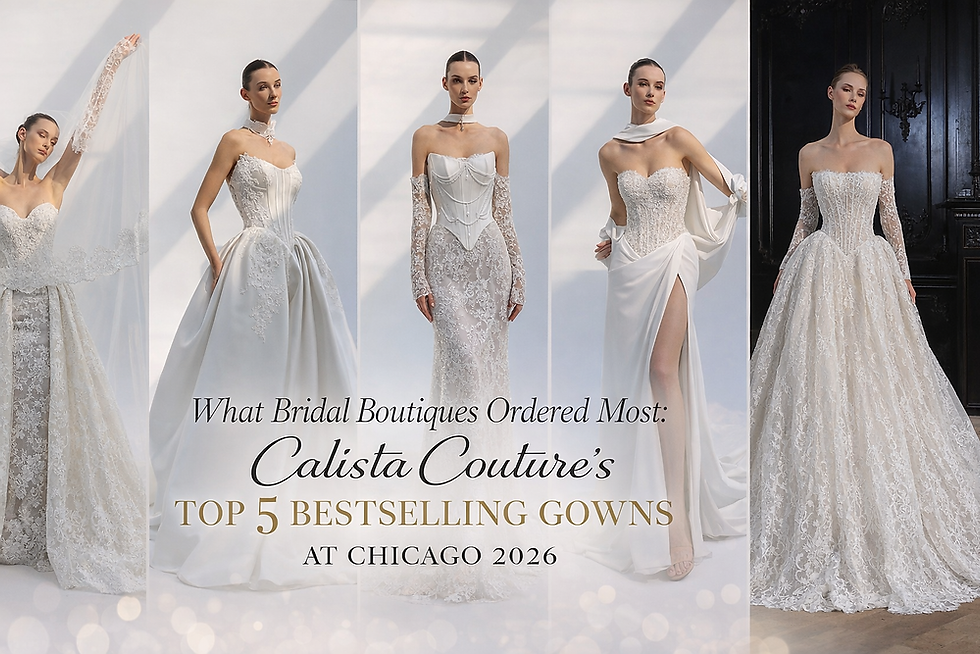
From Beautiful Content to Commercial Intent
Calista Couture naturally operates in a content-rich category.
Editorial photography.
Campaign videos.
Runway presentations.
Collection launches.
Trunk shows.
Social media.
Fabric details.
Designer stories.
Boutique events.
All of these assets build desire around the brand.
But content can also reveal commercial intent.
A consumer looking at a specific wedding dress is different from a boutique owner reading about a global stockist program.
A retailer researching territory exclusivity may be closer to a wholesale conversation.
A boutique viewing trade show information may already be considering a buying appointment.
Calista currently publishes content specifically for wholesale and retailer audiences, including global stockist programs, retailer partnerships, territory protection, marketing support, onboarding, and collection planning.
This creates an opportunity to connect:
Content → Visitor Intent → Retailer Research → Sales Context → Follow-Up
rather than treating content and sales as completely separate activities.
Building a Stronger Retailer Partnership Model
Calista's retailer proposition goes beyond supplying dresses.
Its public stockist program highlights territory protection, high-resolution campaign photography, digital lookbooks, social media materials, onboarding resources, stylist training, fabric information, account support, and assistance with custom inquiries.
This means every retailer relationship produces more information over time.
Which collections are they interested in?
Which dresses perform well?
What type of bride do they serve?
Did they attend a market appointment?
Which sample gowns were discussed?
Did they ask about territory?
Were marketing assets provided?
Was a follow-up promised?
Is the boutique waiting for a new collection?
When those details remain fragmented across email threads and individual memory, retailer development becomes harder to scale.
Keeping Retailer Context Connected
YTT Sales Master is designed around the idea that sales context should move with the opportunity.
Its workflow can capture customer signals, identify buyer needs, retrieve relevant business knowledge, and prepare potential next actions for human review.
For Calista, that principle can be applied to retailer relationships.
For example:
Capture the signal
A boutique submits an inquiry, books a trade show appointment, downloads information, or begins a retailer conversation.
Understand the partner
The sales team researches its location, positioning, existing brands, territory, and potential collection fit.
Connect relevant knowledge
The salesperson can access appropriate collection information, customization guidance, marketing assets, retail support policies, and historical conversations.
Prepare the next step
The system can help organize follow-up actions, conversation summaries, and sales context for the team.
The important point is that the relationship stays human.
AI supports the preparation.
The team owns the decision.
Sales Memory Matters in Fashion Too
Fashion may move quickly, but wholesale relationships often do not.
A boutique may first meet the brand at a bridal market.
Then request a catalog.
Then review the collection internally.
Then wait for a new season.
Then reconnect months later.
The same retailer might interact with several people during that period.
If the context is not preserved, the next conversation begins with:
“Can you remind me what we discussed?”
That sounds minor.
Across dozens or hundreds of retail relationships, it becomes a real operational problem.
Sales memory helps preserve:
Previous interests
Territory discussions
Product preferences
Collection feedback
Event conversations
Follow-up promises
Marketing support provided
Commercial stage
YTT Sales Master is built specifically around reducing context loss in long-cycle and cross-border B2B sales workflows.
For a bridal brand expanding through retailer partnerships, that continuity can become part of the customer experience.
From Global Brand Awareness to Local Boutique Growth
Calista's growth model depends on something especially interesting:
global brand visibility must eventually produce local retail value.
A bride can discover Calista anywhere online.
But if she wants to try a gown, the experience often needs to move into a local boutique.
Calista's current store locator lists 36 partner boutiques, including 27 in the United States, along with international stockists in markets such as Germany and Mexico.
This creates a two-way growth system.
Global marketing can generate interest for retailers.
Strong retailers make the brand more accessible to brides.
Retail activity creates more market knowledge.
That knowledge can then inform future marketing and partnership development.
When those signals are connected, sales and marketing begin to reinforce each other.
Better Retail Growth Starts With Better Context
Consider two boutique inquiries.
Both say:
“We are interested in carrying your collection.”
At first glance, they look identical.
But the first may be an established premium bridal boutique in an open territory with strong local demand and a complementary designer portfolio.
The second may be located close to an existing stockist and compete directly with a current partner.
The message is the same.
The commercial meaning is completely different.
That is why AI-supported sales should not focus only on producing faster replies.
The higher-value opportunity is helping the team understand what the inquiry actually represents.
Product Knowledge Becomes Retail Sales Knowledge
Calista carries multiple silhouettes, collections, fabrics, design details, customization possibilities, sizing information, and retailer-support resources.
A salesperson or account manager may need to answer questions about:
Collection positioning
Fabric
Silhouette
Sizing
Delivery
Customization
Sample gowns
Marketing assets
Territory
Trunk shows
Stylist support
The information may already exist.
The challenge is accessing it consistently.
YTT Sales Master includes product knowledge retrieval so approved information from product pages, catalogs, historical knowledge, and business documents can be surfaced when sales teams need it.
For fashion brands, this can help maintain consistency across conversations without making the customer experience feel automated.
AI Should Protect the Brand Experience
For Calista Couture, brand experience matters.
Tone matters.
Visual identity matters.
Exclusivity matters.
The way a boutique is approached matters.
So the right AI model should not simply maximize outbound volume.
It should help protect consistency.
That means:
Better preparation before outreach
More relevant personalization
Easier access to approved brand knowledge
Stronger follow-up continuity
Clearer retailer context
Human approval for important decisions
YTT Sales Master keeps commitments, pricing, discounts, and sensitive decisions under human control rather than allowing the AI to make those decisions independently.
That is especially important in relationship-led premium industries.
A More Connected Model for Bridal Growth
Calista Couture shows why modern bridal growth cannot be separated neatly into “marketing” and “sales.”
The customer journey crosses both.
A collection launch creates awareness.
A bridal market creates conversations.
Content attracts retailers.
Retail partnerships create distribution.
Boutiques create local customer experiences.
Sales teams maintain relationships.
Marketing supports the stockist.
And every interaction generates more context.
The opportunity for AI is to help connect those pieces.
Not to turn bridal fashion into an automated sales machine.
But to help a growing team remember more, understand more, and prepare better.
That is the kind of role YTT AI is designed to play.
From Brand Attention to Better Retail Opportunities
For Calista Couture, international growth is ultimately built on two things:
a distinctive brand and strong retail relationships.
Technology should strengthen both.
YTT AI helps connect customer research, business knowledge, sales history, and follow-up so teams can spend less time rebuilding context and more time developing the right opportunities.
For bridal and fashion companies exploring AI sales for bridal brands, this is a more useful place to start than simply asking how many messages AI can send.
The better question is:
Can our team understand every potential partner well enough to know what should happen next?
Ready to Build a More Connected Retail Growth Process?
YTT Sales Master helps global B2B teams research buyers, organize customer context, retrieve business knowledge, and prepare the next best sales action across complex and long-cycle workflows.


Comments