

Prospect Company Growth: How B2B Sales Teams Spot and Prioritize Expanding Accounts

Prospect company growth refers to measurable expansion signals at a target business—such as rising headcount, new funding, facility openings, or product launches—that B2B sales teams use to prioritize accounts, time outreach, and tailor value propositions. For sales development and field sales teams, growth is one of the strongest buying signals because expanding companies often need new tools, services, and partners to scale operations. The goal is not to chase every growing company, but to focus limited selling time on accounts where growth directly creates demand for what you sell.
What Prospect Company Growth Means for B2B Sales Teams
In B2B sales, growth is not a single metric. It is a pattern of changes across operations, hiring, financing, and market presence that together indicate a company is expanding. When a business grows, its budgets, team structure, technology stack, and supply chain usually shift. Those shifts create openings for sales teams that can show up with a relevant solution at the right moment.
For sales development reps, understanding prospect company growth improves reply rates and meeting conversion because outreach can be tied to a real business change instead of a generic pitch. For field sales representatives and territory managers, growth signals help focus travel and visit plans on accounts with the highest near-term revenue potential. This is why B2B sales account prioritization by growth has become a core part of modern sales prospecting.

Growth signals for sales prospecting fall into six main categories, from hiring trends to operational investment.
Key Growth Signals for Sales Prospecting
Growth signals are observable changes that suggest a company is expanding. Not every signal matters equally, and their importance depends on your product, industry, and buyer profile. The most reliable signals fall into six categories.
Hiring and Headcount Expansion
Rising headcount, especially in specific departments, is one of the clearest prospect company expansion indicators. A company hiring dozens of new sales reps may need CRM tools, training programs, or lead generation services. A business building out a customer success team may need support software, onboarding platforms, or analytics tools. Look at both total headcount trend and the roles being hired, because department-specific growth often maps directly to buying needs.
Funding and Financial Milestones
New funding rounds, revenue announcements, or profitability milestones give companies budget to invest. While funding alone does not guarantee a purchase, it often precedes hiring, new product development, and market expansion. Early-stage companies may scale quickly after a raise, while mature companies may use new capital for acquisitions or geographic expansion.
New Locations and Facilities
Office openings, warehouse expansion, new retail locations, or entry into new regions are strong growth signals for field sales teams. A company moving into your territory or adding sites near existing customers is often actively seeking local suppliers, vendors, and service providers. Facility growth can also indicate larger operational budgets for equipment, software, logistics, and facilities management.
Product Launches and Market Expansion
New product lines, entry into new industry verticals, or expansion into international markets usually require new capabilities. A software company launching an enterprise version may need security tools, compliance support, or channel partners. A consumer brand entering a new category may need packaging, manufacturing, or marketing services. Product-led growth often translates into procurement activity if you can connect your offering to the launch plan.
Leadership and Organizational Changes
New executive hires, restructuring, or the creation of new departments can signal upcoming buying decisions. A newly hired CFO may review financial systems. A first VP of sales may build out a tech stack from scratch. Leadership changes often create windows where incumbents are re-evaluated and new vendors are considered.
Digital and Operational Investment
Signs of digital transformation, process redesign, or supply chain investment are indirect but valuable growth signals. Companies posting more about automation, data infrastructure, or operational scaling are usually in a buying mindset. These signals are especially useful for SaaS, consulting, and technology vendors.
A Step-by-Step Framework to Evaluate Growth Signals
Knowing individual signals is useful, but you need a repeatable framework to compare accounts fairly. Below is a practical four-step process for evaluating prospect company growth before you add an account to your priority list.
1. Define Which Growth Signals Matter for Your Offer
Start by mapping your product to the growth scenarios that create demand. If you sell warehouse management software, facility expansion and headcount growth in operations are high-value signals. If you sell sales enablement tools, hiring in sales and recent funding are more relevant. Not all growth is good growth for your business. Be precise about which indicators correlate with closed-won deals.
2. Score Each Account on a Simple Growth Scale
Use a basic scoring system so you can rank prospects consistently. For example, assign one point for each strong signal you confirm and half a point for weaker or indirect signals. You do not need a complex model at first; consistency is more important than precision. The goal is to separate fast-growing accounts from stable or declining ones.
3. Verify Signals With Multiple Sources
Growth signals can be outdated or misleading. Always cross-check what you find with multiple sources such as company career pages, press releases, official job boards, and public filings where available. Treat rankings and third-party estimates as research inputs, not facts. Confirm current demand with the buyer before you build an entire outreach strategy around one signal.
4. Match Growth to Buying Timing
A growing company is not automatically ready to buy. You need to estimate where the company is in its expansion cycle. Recent funding or a new executive hire often means early-stage planning. A wave of hiring in a specific department may mean immediate budget. New locations already under construction may mean purchasing decisions have already been made. Adjust your outreach angle and urgency accordingly.
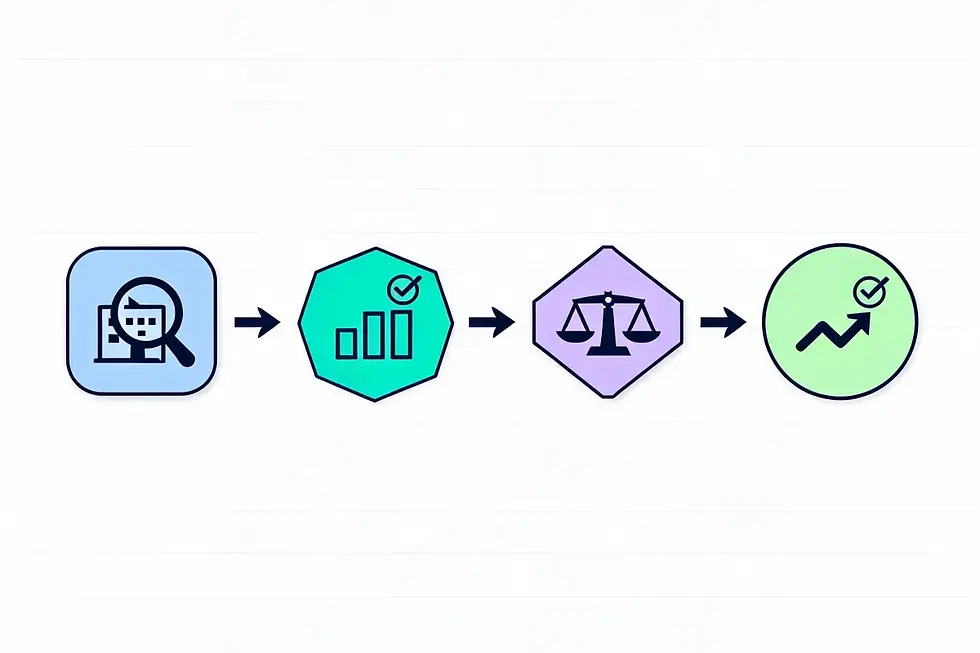
A repeatable four-step framework helps teams evaluate prospect company growth consistently across accounts.
How to Apply Growth Insights to Your Sales Outreach
Growth-based prioritization only pays off if your outreach reflects what you learned. Generic pitches waste the research effort. Here is how to translate prospect company growth into more relevant sales conversations.
First, open with the specific growth signal you observed. Instead of a generic introduction, reference a new office, a hiring trend, or a recent product launch. This shows you have done basic research and positions your message as relevant to a current business priority.
Second, tie your value proposition to the challenges that come with that growth. Fast hiring creates onboarding and training needs. New locations create logistics and compliance challenges. Product launches create go-to-market and support demands. Do not talk about your features; talk about the problem the prospect is likely facing because they are expanding.
Third, adjust your ask to the stage of growth. For early-stage expansion, suggest a short exploratory conversation. For later-stage growth where a need is already clear, propose a focused review of how your solution supports their specific initiative.
For field sales teams operating in a defined area, growth signals can shape territory planning. You can cluster visits around newly opened offices, expanding facilities, and companies hiring in your target roles. This makes each trip more efficient and increases the chance of reaching decision-makers during active expansion phases.
Common Mistakes to Avoid When Judging Growth
Growth signals are helpful, but they can also lead sales teams astray if interpreted poorly. Watch for these common mistakes.
One mistake is treating a single signal as proof of strong growth. One job posting or one press release does not mean a company is expanding at scale. Look for a pattern across multiple signals and sources before you move an account into high-priority status.
Another mistake is confusing growth with budget readiness. A startup that just raised money may be growing fast, but it may also be focused on product development rather than the category you sell into. Make sure the type of growth aligns with your buyer role and solution area.
A third mistake is relying too heavily on estimated data. Third-party growth scores and employee counts are useful inputs, but they are often delayed or inaccurate. Use them to prioritize research, not to replace direct verification with the prospect.
Finally, avoid over-generalizing across industries. Growth in SaaS looks different from growth in manufacturing, retail, or professional services. Build your signal list based on the industries you actually sell to.
How Sales Intelligence Tools Support Growth-Based Prioritization
Manual growth research works for a small number of accounts, but it becomes slow and inconsistent at scale. Sales intelligence tools help teams identify growing prospect companies faster by surfacing company profiles, growth indicators, and recommended accounts in one place. This is especially valuable for teams managing large prospect pools or covering wide territories.
For sales development teams, the main benefit is faster account selection. Instead of visiting dozens of websites to check hiring, funding, and news, you can review scored company profiles and recommendation reasons, then move qualified accounts into outreach queues. This reduces research time and lets reps focus on messaging and conversations.
For field sales teams, growth signals become even more powerful when combined with territory discovery. A tool that lets you discover prospective customers in a chosen area, filter by growth indicators, and view results on a map helps you plan routes and visit schedules around accounts with the strongest expansion momentum.
It is important to set clear boundaries when using intelligence tools. Use rankings and scores as research inputs, not final decisions. Always confirm current demand with the buyer, and keep human approval in place before moving accounts into high-priority campaigns. The tool speeds up discovery; your team still validates fit and timing.

B2B sales account prioritization by growth helps field sales teams focus travel time on expanding accounts in their territory.
Growth-based account prioritization is one of the highest-leverage improvements a B2B sales team can make. By focusing on companies showing clear prospect company growth, you spend less time on accounts that are not buying and more time on prospects with active expansion plans and budget. Start small: define your top three growth signals, score your next 20 prospects, and compare the meeting rate against your current approach. To scale the process across your team and territory, explore YTTAI Sales Master for your B2B sales workflow Explore YTTAI Sales Master.
FAQ
What is prospect company growth in B2B sales?
Prospect company growth refers to measurable expansion signals at a target business—such as rising headcount, new funding, facility openings, or product launches—that sales teams use to prioritize accounts, time outreach, and tailor value propositions.
How do you identify growing prospect companies?
You identify growing prospect companies by looking for patterns across hiring, funding, new locations, product launches, leadership changes, and operational investment. Always cross-check signals across multiple sources and confirm current demand with the buyer.
Why is B2B sales account prioritization by growth effective?
B2B sales account prioritization by growth is effective because expanding companies often have new budgets, changing needs, and active projects. Focusing on growing accounts improves reply rates, meeting conversion, and overall sales efficiency.
What are the most reliable prospect company expansion indicators?
The most reliable prospect company expansion indicators include sustained hiring growth, new funding or revenue milestones, new facilities or locations, product launches into new markets, and clear patterns of operational or digital investment.
Comments