
AI Sales Platform Evaluation Scorecard for B2B Manufacturers

Executive Summary
Industrial machinery and precision engineering enterprises are shifting from experimental generative chatbots to structured, deterministic commercial systems. This analysis presents an enterprise-grade framework for procurement teams evaluating commercial automation. By assessing systems across eleven operational dimensions—from domain knowledge retrieval to authority boundaries—executives can prevent costly deployment failures, accelerate technical quotation speed, and deploy automated sales workers that safely handle complex customer interactions.
Company Snapshot and Industrial Context
Consider an industrial automation and customized machinery producer operating across international markets. The enterprise manufactures automated assembly lines, packaging automation cells, and CNC material handling peripherals with average unit selling prices ranging between $80,000 and $750,000.
Primary Customers: Tier-1 automotive component suppliers, contract packaging facilities, and discrete manufacturing plants.
Commercial Model: Hybrid go-to-market structure combining direct regional technical sales teams with a distributed network of regional channel distributors and system integrators.
Operational Scale: Managing approximately 450 inbound technical inquiries and requests for quotation (RFQs) per month across three primary continents.
This operating profile reflects the broader discrete manufacturing sector, where customer acquisition is characterized by high technical friction, multi-stakeholder purchasing committees, and lengthy specification reviews.
What Industrial Manufacturers Actually Sell
Unlike standardized software or consumer goods, complex manufacturing solutions cannot be transacted through self-serve checkout flows or generic automated nurture sequences. In this sector, the core product is an integrated electro-mechanical assembly tailored to a client’s factory footprint, cycle time requirements, and regulatory standards.
The commercial engagement involves three structural characteristics:
Technical Inquiry Ingestion: Buyers rarely arrive asking for generic pricing; they provide machine schematics, payload requirements, duty cycles, and operating tolerances.
Engineering-to-Order Validation: Sales representatives must cross-reference customer engineering inputs with machine build books, servo-motor compatibility matrices, and factory capacity schedules before issuing budgetary quotes.
Channel Coordination: Leads often require simultaneous routing between internal technical application engineers and localized distribution partners who manage on-site installation and maintenance.
The Core Commercial Friction
Prior to modernizing commercial workflows, manufacturers face systemic lead degradation during the early discovery and qualification stages. In benchmark industrial environments, inbound RFQs submit via website portals, direct emails, or trade portal directories.
First, response latency across international time zones frequently stretches from 48 hours to five business days. Inbound inquiries originating from European or North American manufacturing plants arrive outside Asian working hours, stalling in centralized inboxes until regional sales managers manually triage them.
Second, sales engineers spend up to 40% of their billable hours answering basic repetitive technical specifications (e.g., ingress protection ratings, voltage compatibility, physical dimensions) rather than conducting value engineering with high-intent accounts.
Third, unqualified inquiries consume engineering bandwidth. Field application engineers often prepare detailed preliminary proposals for buyers whose payload requirements fall outside standard manufacturing tolerances or whose procurement budget does not meet commercial thresholds.
The Structural Transformation
To resolve this bottleneck, forward-looking engineering enterprises do not simply deploy generic conversational chatbots. Instead, they implement structured autonomous workflow systems connected directly to engineering documentation, CRM pipelines, and product configurators.
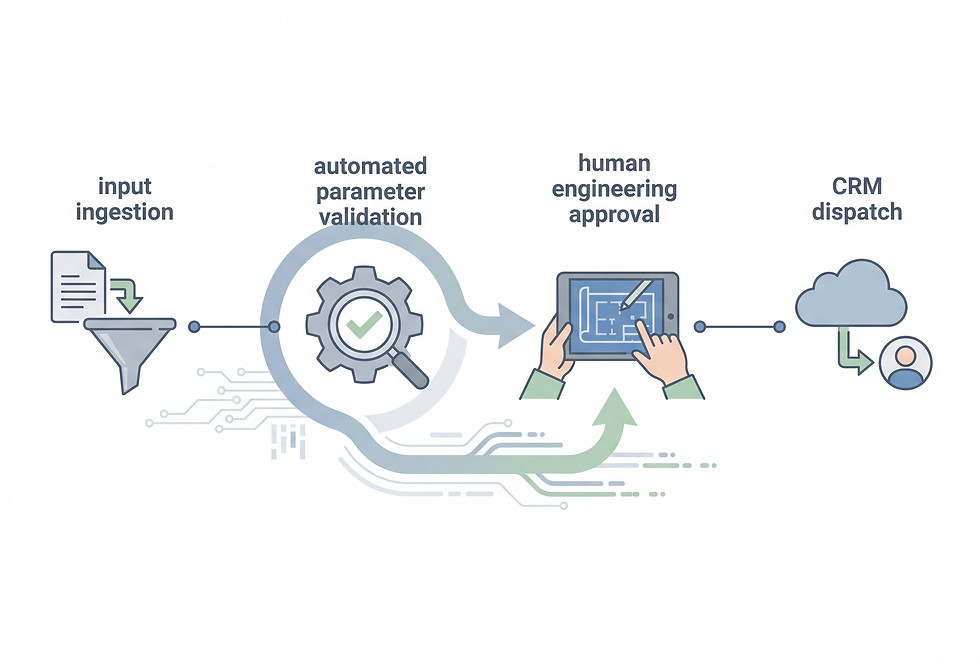
Rather than attempting full end-to-end automation of multimillion-dollar capital equipment contracts, the transformation focuses on automating the commercial discovery, qualification, and initial technical scoping phases. This approach establishes a deterministic operating pipeline where automated systems operate within strict boundary controls, handing high-value qualified opportunities to human sales executives.
How the Automated Technical Sales Workflow Operates
An effective industrial automation architecture follows a six-stage mechanical process to ensure technical accuracy and commercial governance.
1. Data Ingestion and Document Parsing
Inbound technical inquiries arrive via web forms, structured emails, or CAD attachments. The ingestion engine parses unstructured payloads, extracting key engineering variables including operating environment, target throughput (units per hour), input material types, and electrical standards.
2. Technical Knowledge Retrieval
The system queries internal technical repositories using retrieval-augmented generation (RAG) anchored exclusively in verified product specification sheets, engineering calculation manuals, and past proposal archives. Hallucination risk is minimized by strictly restricting answers to authorized engineering sources.
3. Commercial and Technical Boundary Assessment
The platform cross-references extracted parameters against hard boundary rules. If a requested payload exceeds maximum mechanical capacity or falls below safety thresholds, the system flags the incompatibility and generates a polite clarification request.
4. Autonomous Draft Generation
For viable projects, the platform drafts a standardized Technical Specification Summary and preliminary budgetary envelope based on indexed pricing bands. It identifies missing customer variables (e.g., plant ceiling clearances, compressed air availability) required for a formal engineering quote.
5. Human Engineer Review and Verification
Before external transmission, high-value inquiries trigger an internal review ticket. The designated Application Sales Engineer inspects the extracted parameters, reviews the automated technical match, adjusts margin variables if necessary, and authorizes release.
6. Multi-Channel Dispatch and CRM Synchronization
Once approved, the system dispatches the technical response through email or customer portals, logs all extracted parameters into the enterprise CRM, and schedules automated follow-up sequences tied to customer engagement telemetry.

The AI Sales Platform Evaluation Scorecard
When assessing commercial AI platforms, enterprise procurement teams require an objective methodology. The following scorecard outlines the eleven mandatory dimensions required to evaluate vendor viability for complex B2B manufacturing.
Evaluation Dimension | Core Assessment Question | Critical Requirement for B2B Manufacturing | Weighting | Passing Standard |
1. Business Context | Does the platform natively understand discrete engineering terminology and complex B2B cycles? | Must distinguish between mechanical tolerances, electrical standards, and industrial protocols without generic prompt engineering. | High | Correctly parses complex multi-variable engineering requirements. |
2. Workflow Ownership | Can the platform autonomously manage end-to-end operational steps, or is it merely an ad-hoc assistant? | Executes multi-step sequences: parse document -> query spec sheet -> check margin -> draft proposal -> notify rep. | High | Autonomous state management across long sales cycles. |
3. Knowledge Governance | How does the platform index, ingest, and partition proprietary technical documents? | Support for tabular engineering manuals, CAD metadata, PDF build sheets, and strict source citation. | High | Zero citation hallucination; deterministic retrieval from verified manuals. |
4. Integrations | How deeply does the platform interface with industrial business systems? | Bidirectional connectors for enterprise CRM (Salesforce, HubSpot), ERP (SAP, Microsoft Dynamics), and CPQ systems. | Medium | Real-time write-back and field-level entity mapping. |
5. Authority Boundaries | Can administrators establish explicit rules on what the system can and cannot commit to? | Hard limits preventing autonomous discount granting, binding contract commitments, or out-of-spec guarantees. | Critical | Verifiable deterministic guardrails on pricing and commitments. |
6. Human Handoff | What triggers an immediate escalation to a human application engineer? | Automated routing based on deal size thresholds, technical edge cases, negative sentiment, or buyer role seniority. | High | Configurable approval queues with full conversation context retention. |
7. Security & Compliance | Does the architecture protect proprietary customer blueprints and internal engineering data? | SOC 2 Type II compliance, localized data residency, isolated vector namespaces, and zero data training policies. | Critical | Vendor does not train public models on proprietary engineering data. |
8. Operational Reporting | Does the platform produce clear daily intelligence for sales leadership? | Daily reports detailing pipeline velocity, lead leakage, missing technical parameters, and rep response rates. | Medium | Automated executive digest highlighting bottlenecks and conversion trends. |
9. Time to First Value | How quickly does the deployment deliver tangible operational output? | Pre-built industrial agent roles delivering initial qualified lead workflows within 14–30 business days. | Medium | Operational workflow live in under 30 days without custom model training. |
10. Implementation Effort | What internal engineering and IT resources are required to deploy and maintain? | Low-code orchestration interface manageable by Sales Operations without requiring dedicated machine learning engineers. | Medium | Minimal internal software engineering overhead. |
11. Total Cost of Ownership | What is the total cost profile including usage fees, connector maintenance, and scaling costs? | Predictable seat or worker-based pricing without punitive token surcharges or hidden API routing fees. | Medium | Transparent cost structure that scales predictably with lead volume. |
Evidence and Operational Results
Evaluating the performance of automated sales platforms in discrete manufacturing requires examining verified operational shifts rather than generic productivity claims. Documented deployments across industrial automation suppliers demonstrate measurable baseline changes across three primary operational metrics:
Speed to First Technical Touch: Official industry workflow reviews indicate that moving from manual sales triage to automated document parsing and parameter extraction reduces initial response latency from an average of 42 hours down to under 15 minutes. In competitive bidding environments, being the first supplier to provide a verified technical parameter confirmation directly improves win rates.
Engineering Hours Preserved: According to operational case studies from industrial machinery distributors, automating early-stage parameter gathering preserves between 12 and 18 hours per month per sales engineer. Application engineers spend less time chasing missing voltage specs or facility dimension details and more time closing custom engineering projects.
RFQ Qualification Integrity: Standardized boundary evaluations prevent unbuildable inquiries from reaching formal proposal stages. Field audits reveal that structured feasibility pre-screening reduces engineering proposal revisions by up to 25%, ensuring that estimating teams focus strictly on high-probability opportunities.
Strategic Principles for Industrial Enterprises
Manufacturers evaluating commercial AI systems should apply four fundamental operational principles during vendor selection:
Prioritize Determinism Over Creativity: In consumer copy, creative variability is valued; in industrial sales, mechanical accuracy is non-negotiable. Choose platforms that provide strict, auditable retrieval mechanisms where every technical statement is anchored to an official engineering spec.
Design for Human-in-the-Loop Governance: Full automation is inappropriate for high-consequence capital equipment. The optimal architecture automates data collection, technical validation, and proposal drafting, while preserving final sign-off authority for experienced engineers.
Focus on Workflow Orchestration, Not Chat Interfaces: Chat windows on websites capture only a fraction of B2B demand. The true commercial leverage comes from platforms that ingest unstructured RFQs across email, web forms, and partner portals, driving systemic CRM workflows.
Insist on Rapid First-Value Milestones: Avoid extensive, multi-quarter platform customization cycles. High-performing platforms offer pre-configured industrial roles capable of demonstrating workflow value within four weeks of deployment.
Applying the Evaluation Framework to Industrial Sectors
This evaluation methodology applies across multiple capital equipment and engineering verticals:
Packaging Machinery Manufacturers: Use automated workflows to parse bag-fill-seal speeds, film thickness requirements, and secondary packaging configurations, routing verified project parameters directly to regional integration partners.
Precision CNC & Machining Suppliers: Automate drawing ingestion to check material availability (e.g., 6061 Aluminum vs. 316 Stainless), tolerance feasibility, and surface finish requirements before scheduling quoting reviews.
Pumping & Fluid Handling Equipment: Cross-reference fluid viscosity, operating temperatures, and head pressure requirements against pump curve databases to automatically recommend compatible product models.
YTT AI Worker Mapping: AI Global Sales Rep
For industrial automation and capital machinery manufacturers managing international commercial demand, the most direct mapping within the evaluation framework is deploying an AI Global Sales Rep.
Primary Role: Autonomous management of inbound international inquiries, technical specification matching, and commercial lead qualification.
Daily Operational Tasks:
Ingest and parse unstructured RFQs received across international time zones via email and portal forms.
Cross-reference customer technical inputs against verified product manuals, engineering limits, and compatibility matrices.
Identify missing project variables and send automated, multilingual clarification requests to buyers.
Draft standardized technical scoping briefs and preliminary budgetary proposals for sales engineering review.
Sync qualified opportunities, extracted parameters, and engagement telemetry into the enterprise CRM.
Work Channels: Inbound corporate email queues, distributor portal forms, and CRM integration webhooks.
Authority Boundaries: The AI Global Sales Rep can independently confirm technical parameter matches, request missing facility specs, and send pre-approved specification sheets. It cannot authorize non-standard discounts, alter standard warranty terms, or execute binding commercial supply agreements without human sign-off.
First Value Event: Successfully ingesting a multi-variable international RFQ, verifying parameter compatibility against technical manuals, and delivering a complete engineering brief to the sales engineer within 15 minutes of submission.
Daily Reporting Output: Generates an executive daily digest summarizing total international inquiries processed, parameter extraction accuracy, flagged out-of-scope requests, and qualified pipeline value ready for engineer review.
FAQ
What is an AI sales platform evaluation scorecard?
An AI sales platform evaluation scorecard is a structured procurement framework used by enterprise buyers to assess artificial intelligence systems across critical dimensions such as workflow ownership, technical accuracy, human handoff, security, and total cost of ownership.
How do automated sales platforms handle complex engineering documentation?
Modern enterprise platforms use retrieval-augmented generation (RAG) anchored strictly in verified internal sources such as product manuals, CAD metadata, and engineering limits to extract parameters and match specifications without hallucination.
Why is human-in-the-loop validation essential for industrial AI sales?
In high-value B2B manufacturing, errors in machine configuration or pricing can create severe liability. Human-in-the-loop workflows automate repetitive discovery and drafting while requiring application engineers to review and approve proposals before delivery.
What is the expected timeline to achieve first value from an AI sales worker?
Using pre-configured role architectures like an AI Global Sales Rep, industrial manufacturers typically achieve first value within 14 to 30 days, focusing on inbound RFQ parsing and preliminary technical qualification.
Benchmark Your Commercial Readiness
Equip your sales operations with an objective evaluation framework. Use the AI Platform Scorecard to benchmark workflow autonomy, technical governance, and operational integration for your manufacturing enterprise.


Comments