
AI Sales Platform for Manufacturers: A Buyer’s Guide for Complex B2B Sales

Executive Summary
Industrial equipment makers and contract manufacturers operate in high-friction commercial environments where technical specifications, custom engineering reviews, and protracted quotation cycles stall revenue. Deploying an ai sales platform for manufacturers transitions fragmented lead qualification into an orchestrated, auditable operational engine. By combining deep technical product knowledge parsing with deterministic human-in-the-loop validation, industrial leaders eliminate quotation bottlenecks, accelerate pipeline velocity, and protect gross margins across international distribution networks.
Industry Snapshot: The Complex B2B Manufacturing Landscape
Industrial manufacturing encompasses engineered-to-order (ETO), configured-to-order (CTO), and precision component production across sectors such as robotics, industrial automation, fluid handling, and advanced packaging machinery. Unlike standard business-to-business (B2B) software or commoditized consumer goods, industrial transactions involve high average order values (AOVs ranging from $50,000 to over $2,000,000), multi-stakeholder purchasing committees, and stringent regulatory compliances.
The commercial ecosystem typically involves equipment manufacturers (OEMs), Tier-1 component suppliers, specialized system integrators, regional value-added distributors, and procurement teams representing industrial end-users. Sales models rely heavily on technical capability demonstration, custom specification analysis, and lengthy bidding procedures.
Analyzing commercial systems in this sector is critical because traditional customer relationship management (CRM) tools fail to capture domain-specific physics, engineering tolerances, and multi-tier channel relationships. When commercial operations break down in manufacturing, the failure rarely stems from top-of-funnel traffic generation; it stems from the operational inability to process, qualify, and quote complex technical inquiries efficiently.
What Industrial Manufacturers Actually Sell and How Buying Occurs
Manufacturing organizations do not sell standalone SKUs through standard transactional funnels. Instead, they deliver complex engineering solutions that integrate hardware, firmware, maintenance contracts, and operational guarantees. A standard commercial transaction involves multiple distinct evaluation phases:
Technical Discovery and Fit Assessment: The buying committee (plant managers, reliability engineers, procurement leads) submits operational parameters such as cycle times, load capacities, material compatibility, and facility layout constraints.
Engineering Review and Specification Matching: Application engineers review incoming request for quotation (RFQ) documentation, CAD schematics, and factory compliance mandates against existing production capabilities.
Commercial Feasibility and Margin Calculation: Operations teams assess supply chain lead times, bill of materials (BOM) costs, and custom tooling expenses.
Formal Proposal and Multi-Channel Clarification: Sales leadership generates formal technical bids, negotiating performance warranties, service-level agreements (SLAs), and staged payment terms.
Because technical evaluation precedes commercial negotiation, the velocity of the technical qualification directly determines win rates. Inquiries left unanswered for days while routing through internal engineering queues routinely result in lost opportunities to agile competitors.
The Structural Commercial Friction in Industrial Sales
Industrial commercial operations face four structural points of failure that drain sales engineering capacity and compromise conversion rates:
1. The High-Volume, Unqualified RFQ Inundation
Manufacturing sales teams receive high volumes of inbound inquiries via digital portals, email, trade portals, and distributor networks. However, over 60% of these inquiries lack essential technical parameters—such as target operating voltage, duty cycle, material grade, or realistic production timelines. Highly paid application engineers spend hundreds of hours manually chasing missing specifications rather than solving high-margin customer problems.
2. Information Asymmetry Across Global Channel Distribution
Manufacturers relying on independent distributor networks and regional sales agents suffer from massive visibility gaps. Regional partners frequently lack deep familiarity with newly released machinery variants, custom configuration options, or updated pricing tiers. Consequently, inquiries receive inconsistent responses, and corporate headquarters loses visibility into real-time market demand.
3. Protracted Technical Triage and Hand-off Delays
When an RFQ enters a standard CRM, it remains static until a sales representative reviews the raw text, identifies the relevant product line, and forwards it to the appropriate regional application engineer. If the engineer discovers incomplete documentation, the request bounces back to the prospect. This ping-pong exchange creates weeks of latency before the prospect receives a preliminary technical response.
4. Inconsistent Account Nurturing Across Multi-Month Cycles
Industrial procurement cycles often extend from six months to two years. Human sales teams naturally prioritize opportunities approaching immediate closing stages, neglecting mid-funnel prospects who are conducting preliminary budgetary research. When these long-cycle prospects finally secure capital expenditure (CapEx) budget approvals, they re-engage with competitors who maintained consistent technical touchpoints.
The Modern Solution: Architecture of an AI Sales Platform for Manufacturers
To resolve technical triage latency and maintain rigorous sales discipline, industrial enterprises are implementing specialized commercial AI platforms designed for technical workflows. Rather than treating artificial intelligence as a generic conversational chatbot, an enterprise-grade ai sales platform for manufacturers serves as an operational translation layer between unstructured customer inquiries and internal engineering databases.
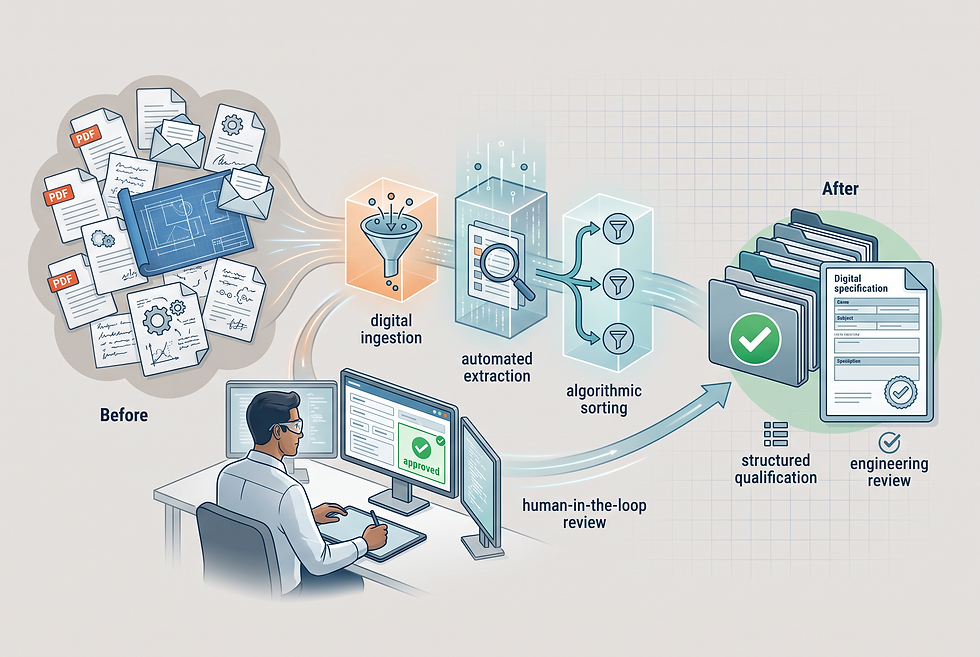
This architecture incorporates several distinct functional modules:
Multimodal Document Parsing: Ingestion engines capable of extracting structured parameters from unstructured RFQ text, scanned specification sheets, and tabular BOM lists.
Domain Retrieval-Augmented Generation (RAG): Knowledge repositories housing technical manuals, legacy application engineering case histories, standard operating procedures, and product configuration limits.
Deterministic Governance and Boundary Guardrails: Explicit logic trees that prevent the platform from hallucinating delivery commitments, pricing discounts, or unsupported engineering tolerances.
Human-in-the-Loop Review Interfaces: Operational review queues allowing field sales engineers to verify, adjust, or reject AI-drafted technical proposals with a single click.
How the End-to-End Workflow Operates
The implementation of an automated industrial sales workflow follows a six-stage operational sequence that unifies ingestion, validation, and human decision-making.
Step 1: Ingestion and Parameter Normalization
Inbound communications arrive across multiple commercial channels (e.g., website technical request forms, inbound email inboxes, global distributor portals). The system ingests the raw communication, extracts key entity parameters (e.g., operating temperature, media viscosity, required throughput units, delivery geography), and matches them against standard manufacturing catalog ontologies.
Step 2: Technical Feasibility Scoring and Knowledge Retrieval
The platform queries the organization's verified engineering knowledge base to cross-reference customer requirements against existing standard configurations and custom production constraints. If the application falls outside safe operating envelopes, the system flags the incompatibility immediately.
Step 3: Automated Specification Clarification
If the initial inquiry lacks mandatory operating parameters required for engineering review, the platform automatically drafts a precise, technical clarification inquiry addressed to the prospect or distributor. Once the buyer replies with the necessary parameters, the system updates the master opportunity record without manual sales intervention.
Step 4: Margin Protection and Routing Evaluation
The platform evaluates the complete technical scope against historical production data and regional sales routing matrices. High-value, perfectly specified opportunities are tagged for prioritized routing, complete with a structured executive summary detailing project feasibility, estimated resource requirements, and risk factors.
Step 5: Human Application Engineer Review and Approval
The assigned commercial sales engineer receives a pre-compiled dossier containing the customer context, extracted technical parameters, recommended catalog solutions, and draft response messaging. The engineer reviews the technical recommendations, modifies pricing or delivery parameters if necessary, and authorizes dispatch.
Step 6: System Synchronization and Long-Horizon Execution
Upon human approval, the platform dispatches the technical response, logs structured line-item data into the enterprise CRM/ERP, and schedules staged, value-added follow-up cadences aligned with the buyer’s specified procurement milestones.
Operational Comparison: Legacy vs. AI-Enabled Manufacturing Sales
The following structured breakdown highlights the operational shifts between legacy manufacturing sales processes and modern automated execution:
Operational Dimension | Legacy Manufacturing Sales Model | Modern AI-Enabled Sales Architecture |
Inbound RFQ Intake | Unstructured text dumped into general sales inbox; manually sorted by junior reps. | Automated parsing of PDFs, technical specifications, and operating parameters into structured fields. |
Technical Verification | Application engineers spend 4–8 business days reviewing missing data and basic catalog matches. | Instant knowledge retrieval cross-references specifications against CAD limits and catalog rules in seconds. |
Information Gathering | Sales reps send generic emails requesting clarification; high drop-off during back-and-forth. | Precise, automated clarification prompts request specific missing engineering variables instantly. |
Approval Mechanics | Informal email chains; pricing and technical promises lack centralized audit logs. | Structured human-in-the-loop review queues enforce engineering sign-off and pricing guardrails. |
Long-Cycle Follow-Up | Inconsistent manual check-ins; mid-funnel deals forgotten during multi-month review stages. | Structured, context-aware follow-up milestones maintain technical touchpoints throughout procurement cycles. |
Executive Reporting | Subjective sales rep forecast entries updated sporadically at end-of-quarter. | Automated daily operational summaries aggregate qualified pipeline, RFQ velocity, and friction points. |
Evidence, Benchmarks, and Validated Industry Results
Recent industrial operational analyses demonstrate significant efficiency gains when manufacturing organizations modernize their quotation and qualification workflows.
According to documented case data published in industrial digital transformation analyses (such as reports by McKinsey & Company on B2B commercial operations, 2023), industrial manufacturing organizations that digitize their RFQ and technical triage workflows experience a 30% to 50% reduction in sales engineering cycle times and up to a 20% increase in proposal win rates due to rapid initial response velocity.

Similarly, vendor-published case studies across precision tooling and contract manufacturing platforms (such as Xometry’s published manufacturing partner research, 2023) show that automated specification verification directly reduces engineering rework on non-viable quotes by over 40%, freeing senior application engineers to focus on high-margin, custom-engineered projects.
Industrial leaders emphasize that these gains are not achieved by replacing human engineering oversight, but by removing data extraction friction and administrative latency from the commercial workflow.
Key Takeaways for Enterprise Manufacturing Executives
Manufacturing leaders evaluating commercial automation should focus on four foundational principles:
Prioritize Data Ingestion Accuracy Over Generative Fluency: The value of an industrial sales platform lies in its ability to parse technical parameters accurately and identify incompatibilities, not in writing generic marketing copy.
Maintain Strict Human Authority Boundaries: Implement deterministic guardrails ensuring that final technical proposals, warranty commitments, and pricing discounts always require explicit human verification.
Integrate Knowledge Repositories Across Silos: Connect the commercial platform directly to verified technical manuals, legacy application engineering logs, and ERP inventory data rather than relying on fragmented internal PDFs.
Establish Clear Operational KPIs: Measure platform success through objective metrics such as RFQ triage turnaround time, engineering hours saved per quote, and mid-funnel pipeline retention rate.
Industry Application: What This Looks Like Across Sectors
The commercial automation model adapts across diverse specialized industrial verticals:
For an Industrial Robotics Manufacturer: The platform ingests plant automation requirements, parses payload and cycle time parameters, checks compatibility with existing factory fieldbus protocols, and pre-qualifies system integrators.
For a Precision CNC / Contract Machining Supplier: The platform extracts material grades, geometric tolerances, and surface finish requirements from uploaded engineering drawings, preparing structured cost breakdowns for estimator review.
For an Industrial Pump and Fluid Systems OEM: Inbound operational inquiries containing flow rates, head pressure, and chemical media characteristics are instantly matched against pump curve databases to recommend optimal impellers and seal materials.
For a Commercial Packaging Machinery Supplier: The system qualifies line speed, packaging material types, and facility footprint constraints before routing qualified inquiries to regional sales directors.
YTT AI Worker Mapping: AI Global Sales Rep
For enterprise manufacturers expanding across international distribution territories or managing complex technical inquiries, YTT AI provides specialized autonomous workers designed specifically for industrial sales workflows.
Worker Job Title
AI Global Sales Rep
Main Daily Tasks
Ingests and parses technical RFQ inquiries from global website portals, email inboxes, and international distributor channels.
Cross-references prospective customer operational parameters against verified product documentation and engineering application limits.
Drafts intelligent technical qualification summaries, flags missing specification data, and generates structured human review dossiers.
Executes automated, multilingual technical follow-up cadences across extended 6-to-18-month industrial procurement timelines.
Primary Work Channels
Enterprise Email Inboxes (Exchange / Gmail)
CRM Opportunities & Leads (HubSpot, Salesforce, Microsoft Dynamics 365)
Technical Web RFQ Ingestion Portals & Webhooks
Authority Boundary & Governance
Autonomous: Ingests documentation, extracts engineering entities, queries internal knowledge bases, and drafts structured customer communications.
Human-Enforced: Pricing approvals, non-standard engineering tolerances, customized warranty terms, and final proposal dispatch require mandatory review and sign-off by a designated application engineer or sales director.
First Value Event
The AI Global Sales Rep ingests an unformatted, multi-page technical RFQ PDF containing custom engineering requirements, extracts 12 mandatory operating variables into structured CRM fields, flags two incompatible operational tolerances, and drafts a human-ready technical triage summary within 90 seconds of submission.
Daily Report Output
Delivers an automated end-of-day executive briefing summarizing total global RFQs processed, top technical bottlenecks identified, high-margin opportunities pending engineering review, and active long-cycle pipeline health metrics.
FAQ
How does an AI sales platform handle complex engineering drawings and CAD files?
An enterprise AI sales platform utilizes multimodal parsing and computer vision modules to extract title block metadata, dimensional tolerances, material callouts, and geometric parameters from PDF schematics and technical drawings. It standardizes these variables into structured data fields, allowing application engineers to evaluate project feasibility without manual data entry.
Will an AI sales platform hallucinate unsupported product configurations or pricing?
No. Industrial-grade platforms utilize strict deterministic guardrails and Retrieval-Augmented Generation (RAG) restricted exclusively to verified corporate documentation. When customer specifications fall outside documented operating limits or standard pricing matrices, the platform triggers an engineering exception flag rather than estimating parameters autonomously.
How do human sales and application engineers maintain control over outbound communications?
The platform operates on a human-in-the-loop governance model. The AI worker ingests inquiries, qualifies technical parameters, and prepares draft responses or quote summaries. However, all binding technical specifications, commercial proposals, and price quotations must be formally approved by an authorized team member before dispatch.
What is the typical implementation timeline for integrating an AI sales platform with existing CRMs and ERPs?
Standard implementations typically span two to four weeks. This involves indexing verified technical knowledge bases, configuring parameter extraction taxonomies, establishing human approval thresholds, and connecting bidirectional API webhooks with existing CRM and ERP platforms.
Book an AI Platform Fit Assessment
Evaluate your commercial workflows, identify technical RFQ bottlenecks, and discover how an AI sales platform can accelerate your industrial revenue pipeline.


Comments