

Why Global Exporters Need an AI SDR for Manufacturing to Scale Pipeline

Why Global Exporters Need an AI SDR for Manufacturing to Scale Pipeline
For B2B manufacturers and global industrial exporters, the traditional outbound sales playbook is broken. Sales teams are constantly bogged down by manual prospecting, high-friction cold outreach, and hours spent sorting through unqualified technical inquiries. At the same time, global buyers demand instant, highly technical responses that traditional sales setups struggle to deliver across varying time zones.
To bridge this gap, forward-thinking industrial leaders are turning to specialized automation. An AI SDR for manufacturing is an autonomous sales assistant that automates global prospecting, technical lead qualification, and multi-channel outreach. By processing complex industrial data sheets, it identifies high-fit buyers and initiates personalized follow-ups. Industrial exporters should deploy it to scale international pipelines 24/7 without expanding overhead costs.
Deploying an AI SDR for manufacturing changes the game, converting cold market outreach into a scalable, data-driven revenue engine.
Why Traditional B2B Manufacturing Outreach Is No Longer Enough
Industrial sales are notoriously complex. Unlike transactional SaaS or consumer goods, B2B manufacturing deals involve massive ticket sizes, long-term procurement agreements, and customized engineering specifications. Yet, many exporters still rely on outdated outreach strategies.
Historically, lead generation for manufacturers depended almost entirely on offline trade shows, expensive business trips, and generic cold-calling lists. Today, these methods yield lower conversion rates and astronomical acquisition costs. When digital leads do come in—often through website contact forms or technical Requests for Quotes (RFQs)—sales reps struggle to keep up.
According to real-world customer feedback gathered from global procurement forums, several critical pain points stand out:
Snail-Paced Quote Turnaround: Procurement officers and project contractors frequently complain about waiting days, or even weeks, for custom parts pricing.
Inaccurate Technical Communication: Sales reps without engineering backgrounds often fail to accurately answer specialized product questions, leading to incorrect orders and downstream delays.
Time-Zone Barriers: International buyers in Europe or North America abandon inquiry forms because the exporter's response arrives 12 hours too late.
With buyers increasingly turning to digital research, failing to engage prospects immediately means losing millions in potential contract value.
What Is an AI SDR for Manufacturing and How Does It Work?
An AI SDR (Sales Development Representative) is not a generic chatbot. It is a highly specialized digital employee trained on industrial catalogs, engineering standards, and international export processes.
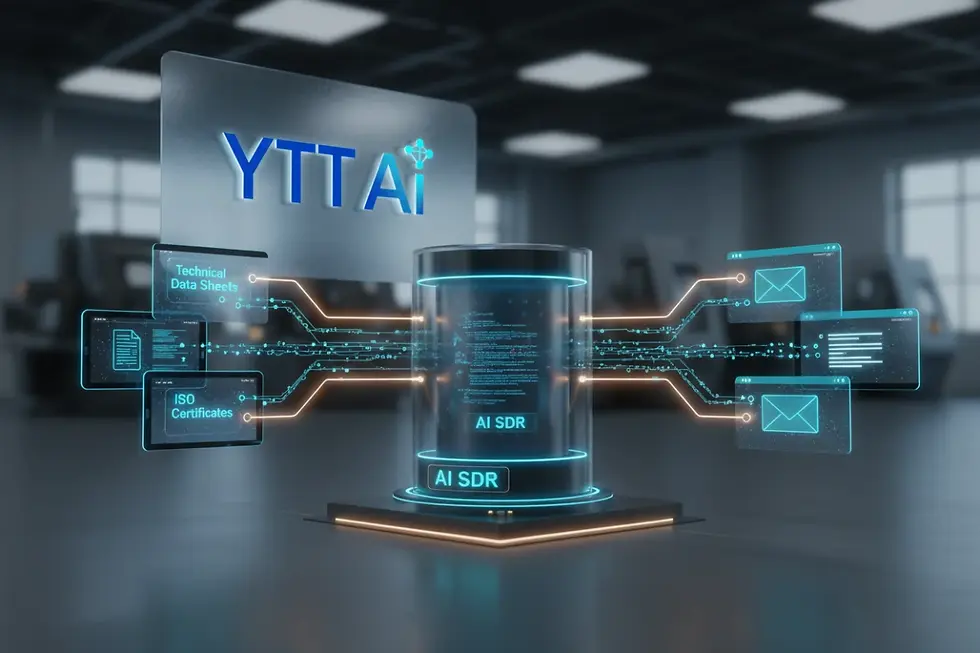
At its core, the operation of an AI SDR for manufacturing lies in its ability to combine deep product knowledge with autonomous execution. Serving as a dedicated ai sales agent for manufacturers, the system continuously monitors multiple target channels, working through three primary layers:
The Ingestion Layer: The AI reads and understands your company's technical brochures, CAD files, material standards, pricing calculators, and past RFQ transcripts. It builds a structured sales memory.
The Intelligence Layer: When an inquiry arrives, the AI parses the technical requirements. It evaluates whether your factory can meet the specific dimensions, material tolerances, certificates (e.g., ISO, CE, UL), and volume requirements.
The Execution Layer: The AI drafts a highly personalized, context-aware reply in the buyer’s native language and sends it via email, WhatsApp, or LinkedIn. If a prospect is cold, the AI executes targeted outbound sequences tailored to the buyer's specific industry vertical.
Key Capabilities of AI SDRs in Industrial Lead Qualification
One of the most valuable tasks of an AI assistant is separating serious buyers from casual catalog-gatherers. By implementing AI lead qualification for B2B, manufacturers can filter out low-value inquiries and ensure human engineers only spend time on high-margin opportunities.
Parsing Complex RFQs and Technical Data Sheets
Traditional OCR (Optical Character Recognition) tools fail when reading complex technical tables. An AI SDR uses advanced semantic understanding to read non-standardized Excel or PDF sheets containing hundreds of line items—such as electrical components, CNC milled parts, or industrial valves. It automatically maps these items to your manufacturing capabilities.
Multilingual and Multi-Channel Response Automation
Exporters deal with global audiences speaking Spanish, German, Japanese, and more. A modern system uses native translation layers that preserve complex engineering terminology, ensuring your messaging sounds natural and authoritative. It integrates with CRM systems to trigger b2b sales automation workflows across emails, WhatsApp, and social channels, keeping the communication seamless.
Human-in-the-Loop: Setting the Boundaries Between AI Agents and Human Sales Teams
A common fear among executive leadership is that AI might go rogue—agreeing to unrealistic shipping lead times, quoting incorrect custom pricing, or misrepresenting production capacities.

To prevent this, high-converting setups use a Human-in-the-Loop (HITL) framework. Under this system, the AI SDR acts as the co-pilot, not the pilot.
Outbound & TOFU (Top of Funnel): The AI autonomously researches accounts, extracts intent signals, and sends initial outreach emails.
MOFU (Middle of Funnel) & Complex RFQs: When a buyer replies with technical questions or a request for pricing, the AI drafts the response and prepares the quote. However, it places the email into a "Draft" state in the CRM, alerting the human sales manager or engineer to review, adjust, and hit
FAQ
What is an AI SDR for manufacturing?
An AI SDR for manufacturing is an intelligent, autonomous sales agent designed to research accounts, qualify incoming technical RFQs, and handle multi-channel outbound messaging. It specializes in processing technical catalogs, engineering specifications, and industrial standards to support global export operations.
Can an AI sales agent accurately qualify complex engineering specifications?
Yes. Unlike generic AI, a specialized AI sales agent for manufacturers is trained on specific product knowledge bases, technical data sheets, and certification requirements. It can parse complex technical documents, map customer requirements to actual manufacturing capabilities, and draft precise technical replies.
How does human-in-the-loop work in AI-driven B2B sales automation?
In a human-in-the-loop framework, the AI handles time-consuming data processing, drafting, and initial follow-ups. However, critical actions—such as final pricing approval, discount negotiations, and contract confirmations—are held in the CRM for manual review and approval by human sales managers or engineers before sending.
Is our proprietary data safe when using an AI SDR?
Enterprise-grade AI sales platforms deploy secure, private language model instances. Your trade secrets, CAD designs, pricing models, and customer interactions are isolated within your secure CRM and cloud storage, ensuring no proprietary data is leaked to public foundation models.


Comments