
AI Technical Sales Approval Matrix: What AI Can Say and What Engineers Must Approve

Executive Summary
Complex industrial manufacturers and technical B2B suppliers face a structural operational conflict: commercial buyers expect rapid responses during early inquiry stages, yet unverified technical commitments introduce catastrophic financial, safety, and operational liabilities. Leading technical organizations resolve this friction by establishing an ai technical sales approval matrix. This governance system categorizes commercial and engineering communications into three deterministic tiers—autonomous baseline outputs, flagged technical reviews, and mandatory human engineering sign-offs. By enforcing strict boundaries, enterprises accelerate lead qualification while ensuring full technical compliance.
Company Snapshot: High-Precision Industrial Engineering and Custom Manufacturing
To understand why a formal governance matrix is necessary, examine the operating reality of specialized industrial equipment and engineered-to-order manufacturing enterprises. These organizations design, assemble, and distribute mission-critical capital equipment, including fluid handling pumps, precision CNC machine tools, industrial robotics, automated packaging lines, and high-tolerance hydraulic systems.
Their primary customer base consists of original equipment manufacturers (OEMs), engineering procurement contractors (EPCs), plant operations managers, and systems integrators. In this B2B environment, transactions are characterized by multi-month evaluation cycles, six-figure deal sizes, and stringent contractual warranties. Sales cycles do not resemble standard digital commerce; every transaction centers around whether a machine configuration can withstand demanding physical operating conditions without failure.
What the Company Sells: Engineered Performance and Operational Guarantees
In high-stakes industrial markets, suppliers sell verified operational capabilities rather than off-the-shelf commodities. A customer evaluating an industrial pump, for instance, does not merely select a product SKU based on list price. Instead, the buyer evaluates fluid viscosity curves, chemical compatibility tables, maximum operating head pressures, ambient temperature thresholds, explosive environment certifications (such as ATEX or IECEx), and preventive maintenance intervals.
The commercial procurement process requires continuous technical verification at every stage of the pipeline:
Initial Sizing and Configuration: Matching customer process requirements against published motor curves and structural dimensions.
Integration Feasibility: Ensuring physical, electrical, and software compatibility with existing legacy plant infrastructure.
Regulatory and Material Compliance: Providing verifiable documentation covering ISO standards, RoHS, REACH, FDA food-contact standards, or pressure vessel codes.
Commercial and Warranty Terms: Aligning delivery milestones, volume rebate schedules, liquidated damages clauses, and performance warranties with factory production capacity.
Because technical claims carry binding legal liability once embedded in a commercial proposal, sales representatives cannot afford to make unsupported assertions or provide ambiguous tolerances.
The Business Problem: The Chronic Trade-Off Between Speed and Technical Accuracy
Historically, precision B2B manufacturers encounter severe operational bottlenecks during pre-sales discovery and quoting:
Application Engineering Backlogs: Application engineers and technical product specialists frequently spend over 40% of their working hours answering repetitive sizing questions, cross-referencing standard CAD dimensions, and confirming published catalog ratings. This administrative burden leaves inadequate time for high-value custom system engineering.
Inconsistent Technical Commitments: Regional distribution networks and field sales personnel often operate with outdated product documentation. In the rush to close deals, representatives may verbally commit to non-standard tolerances or unverified material combinations without central engineering oversight.
Severe Inquiry Latency: International distributors and enterprise buyers operating in different time zones frequently wait three to five business days for basic confirmation of product specifications, driving prospective buyers toward faster competitors.
Liability and Hallucination Risks: Deploying generic conversational AI tools without architectural constraints introduces severe risks. Large language models are probabilistic by nature; when asked whether a standard valve can handle hot nitric acid at elevated pressures, an unconstrained model might infer compatibility, creating immediate product failure risks.
What Changed: Establishing a Deterministic AI Technical Sales Approval Matrix
To eliminate the trade-off between qualification velocity and engineering safety, forward-thinking manufacturers separate informational retrieval from binding engineering commitments. Rather than permitting an autonomous assistant to answer customer questions freely, enterprises implement an explicit ai technical sales approval matrix that governs every outbound technical parameter.
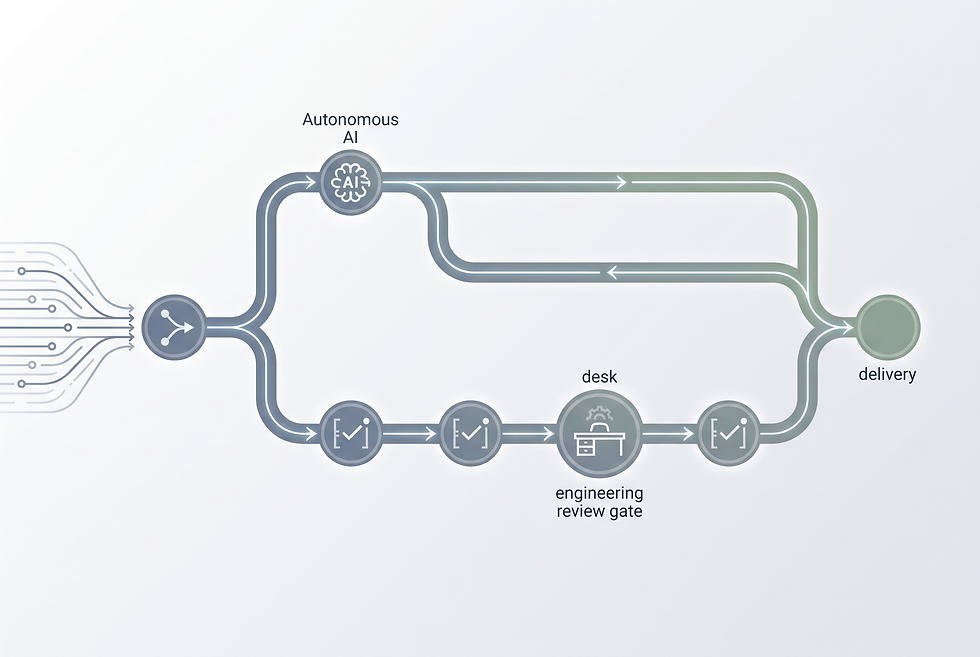
Under this operating model, autonomous systems are restricted to strictly indexed, verified repositories—such as structured ERP databases, published engineering whitepapers, and verified dimension charts. Whenever an inquiry exceeds predefined operational, chemical, or commercial boundaries, the system is blocked from providing a direct customer-facing commitment. Instead, it generates a structured technical draft and escalates the decision to a certified application engineer.
How the Workflow Actually Works: The Step-by-Step Governance Mechanism
The operating mechanism functions through a deterministic multi-stage workflow that routes buyer input through automated validation gates before any message leaves the enterprise boundary:
Inquiry Ingestion and Data Parsing: The customer or channel partner submits an RFQ or technical question via email, supplier portal, or digital inquiry channel. The ingestion engine parses operating inputs, such as target flow rates, operating voltages, environmental temperatures, and chemical exposure factors.
Matrix Evaluation and Logic Gating: The system cross-references the extracted parameters against the corporate approval rules. Each data field is categorized into Tier 1 (Autonomous), Tier 2 (Review Required), or Tier 3 (Mandatory Engineering Sign-Off).
Deterministic Retrieval and Draft Generation: For Tier 1 items, the system directly fetches verified catalog specifications and generates an immediate response. For Tier 2 and Tier 3 parameters, the system creates a draft response containing suggested technical calculations, citing specific engineering log entries and highlighting non-standard variables.
Engineering Routing and Human Validation: Tier 2 and Tier 3 drafts are pushed to designated application engineering queues inside the enterprise CRM or ticketing environment. The engineer verifies calculations, adjusts safety factors, and authorizes dispatch with a single click.
Customer Dispatch and Audit Trail Logging: The final approved response is transmitted to the customer. All interactions, including the initial prompt, engineering modifications, and final output, are stored in an immutable compliance log for continuous auditability.
Technical Domain | Tier 1: Autonomous AI Output | Tier 2: Flagged Technical Review | Tier 3: Mandatory Engineering Sign-off |
Specifications & Sizing | Published catalog dimensions, dry weights, standard voltage options, standard operating temperature ranges (-10°C to +50°C). | Non-standard operating envelopes, continuous elevated ambient temperatures (+51°C to +75°C), dynamic shock loading. | Custom structural modifications, unverified structural mounting interfaces, life-safety critical deployments. |
Material Compatibility | Standard fluid charts, published 316 stainless steel corrosion tables, standard NBR/FKM seal selections. | Mixed chemical exposure, mildly abrasive particulate slurries, non-standard synthetic lubricant interactions. | Concentrated acid systems, high-pressure combustible gas handling, hazardous cryogenic applications. |
Pricing & Discounts | Published list pricing, standard tiered volume discounts within authorized matrix thresholds (up to 15%). | Non-standard distributor discount requests (16% to 25%), customized annual volume rebate agreements. | Fixed-price multi-year supply contracts, custom casting tooling amortization, non-standard payment terms. |
Delivery & Lead Times | Standard stock availability, factory assembly schedules retrieved via real-time ERP integration. | Expedited assembly requests, multi-destination split shipments, component queues with raw material constraints. | Contractually guaranteed delivery dates with liquidated damage clauses, custom prototype build schedules. |
Certifications & Compliance | Published ISO 9001 certificates, standard CE Declarations of Conformity, standard RoHS/REACH compliance letters. | Industry-specific variance requests, custom country-of-origin documentation, site-specific environmental declarations. | Legally binding performance warranties, nuclear/aerospace compliance sign-offs, custom indemnification terms. |
Evidence and Results: Quantifiable Operational Benchmarks
Organizations that deploy a three-tiered technical approval framework achieve dramatic efficiency gains while maintaining zero unvetted commercial liabilities:
Inquiry Turnaround Acceleration: According to an operational analysis by McKinsey & Company on B2B customer journeys, industrial organizations implementing structured pre-sales automation reduce initial customer turnaround times for standard technical specifications from several days to under one hour.
Application Engineering Capacity Reclamation: Field studies conducted across industrial manufacturing organizations show that automating Tier 1 catalog inquiries liberates between 30% and 50% of application engineering work hours, redirecting technical talent toward high-margin custom system designs.
Elimination of Unauthorized Commitments: By implementing deterministic gating on Tier 3 criteria, suppliers eliminate instances of sales personnel inadvertently committing to uncertified performance ratings or non-standard warranty liabilities.
Higher Bid Participation Rates: With baseline RFQs pre-screened and drafted instantly, manufacturers respond to up to 35% more commercial tenders each quarter without increasing engineering headcount.

What Other Companies Can Learn: Replicable Governance Principles
Engineering and sales operations leaders seeking to build an effective technical approval architecture should apply four core methodological principles:
Define Explicit Negative Guardrails First: Before enabling any automated retrieval, explicitly document what the system is never permitted to calculate or promise, such as custom structural tolerances, unvetted chemical mixtures, or penalty-backed delivery schedules.
Ground Outputs in Single-Source-of-Truth Repositories: Ensure automated systems pull exclusively from controlled technical manuals, ERP tables, and validated engineering datasets, preventing dynamic extrapolation.
Establish Clear Human Accountability Chains: For every Tier 2 and Tier 3 trigger, assign a designated human job role (e.g., Senior Application Engineer, Commercial Director, Quality Assurance Lead) to ensure that review queues do not create new operational delays.
Implement Closed-Loop Escalation Audits: Review flagged Tier 2 and Tier 3 inquiries monthly to identify recurring catalog gaps, emerging customer application trends, and areas where published documentation requires expansion.
What This Could Look Like for Industrial Equipment Manufacturers
To visualize how this operating model functions in practice, consider an industrial fluid handling and pump manufacturer serving international chemical processing plants.
When a distribution partner submits an online inquiry requesting the power consumption, flange dimensions, and standard seal options for a baseline centrifugal pump model, the system identifies all parameters as Tier 1. It delivers the verified engineering data sheet and standard list price within seconds.
Two days later, the same distributor requests a quote for pumping a heated sodium hydroxide solution at 80°C under continuous cyclic pressure. The system flags the fluid temperature and concentration as a Tier 2 chemical variance, immediately generating a draft proposal with a recommended PTFE seal upgrade and routing the draft to the chemical application engineering desk. The application engineer verifies the corrosion resistance chart, approves the material upgrade, and transmits the verified quotation in under two hours.
YTT AI Worker Mapping: The AI Technical Sales Rep
For industrial manufacturing and B2B technical suppliers implementing this governance framework, the corresponding role profile within the YTT AI framework is the AI Technical Sales Rep.
Worker Job Title: AI Technical Sales Rep
Main Daily Tasks: Ingesting inbound technical RFQs, extracting customer operating parameters, matching application requirements against verified engineering data sheets, generating draft commercial proposals, and automatically routing high-liability inquiries to certified engineers.
Primary Work Channels: Corporate email, technical support portals, and enterprise CRM workflow queues.
Authority Boundary: Fully authorized to deliver Tier 1 catalog specifications and standard pricing structures; strictly prohibited from confirming Tier 2 non-standard operating conditions or Tier 3 regulatory and warranty commitments without explicit engineer authorization.
First Value Event: The first automated technical proposal generated from an inbound complex RFQ within 15 minutes, fully compliant with pre-configured engineering thresholds and routed for review without manual data entry.
Daily Report Result: A structured daily log summarizing total inquiries parsed, Tier 1 autonomous responses delivered, Tier 2 and Tier 3 engineering reviews queued, average review latency, and identified documentation gaps.
FAQ
What is an AI technical sales approval matrix?
An AI technical sales approval matrix is a structured governance framework that explicitly defines which product specifications, pricing terms, lead times, and compliance claims an autonomous system can provide directly to buyers versus which scenarios require mandatory human application engineering or managerial review.
Why can AI not handle all technical sales inquiries autonomously in B2B manufacturing?
Complex B2B equipment sales involve significant safety, performance, and legal liabilities. Inaccurate assertions regarding mechanical tolerances, chemical compatibility, or custom delivery dates can lead to catastrophic field failures, expensive warranty claims, and breach of contract.
How does an approval matrix prevent AI hallucinations in technical sales?
By restricting the AI system exclusively to verified, indexed ground-truth documentation (such as official product manuals and ERP data) and using deterministic logic gates that automatically stop the AI from generating answers when inquiries exceed standard operating thresholds.
What is the practical difference between Tier 2 and Tier 3 approval events?
Tier 2 events involve moderate non-standard conditions—such as elevated operating temperatures or custom volume discounts—requiring brief application engineer confirmation. Tier 3 events involve high-liability scenarios—such as custom structural modifications, hazardous environment compliance, or penalty-backed delivery terms—requiring formal engineering sign-off.
How do application engineers interact with the approval matrix workflow daily?
Application engineers receive pre-drafted technical evaluations in their standard CRM or ticketing inbox, complete with calculations and source citations. Instead of building proposals from scratch, they review, adjust if necessary, and approve drafts with a single click.
Define Your AI Worker Authority
Establish clear boundaries between automated technical qualification and human engineering approvals. Deploy an AI Technical Sales Rep configured to your enterprise governance matrix today.


Comments