
What Are the Strongest Buying Signals in Industrial B2B Sales?

Executive Summary: Industrial manufacturing and capital equipment enterprises frequently struggle with prolonged sales cycles, technical friction, and misallocated commercial effort. By establishing a rigorous multi-tier intent hierarchy—differentiating direct commercial actions like 3D CAD downloads and custom spec configurations from passive web visits—revenue leaders can systematically prioritize high-probability accounts. This study examines how leading industrial suppliers capture, score, and route composite behavioral telemetry to expand sales engineering capacity and shorten pipeline velocity.
Company Snapshot: Commercial Realities in Technical Supply Chains
To understand commercial intent in heavy industry, consider the operational model of a representative tier-1 industrial automation and component manufacturer serving global discrete manufacturing, automotive OEM, energy, and precision engineering sectors. Operating across North America, Western Europe, and East Asia, such manufacturers typically generate between $50 million and $500 million in annual revenue through a hybrid commercial model combining direct application sales engineers and authorized regional distributor networks.
These organizations operate in an environment characterized by high average order values ($25,000 to $250,000+), distributed procurement committees (spanning plant operations, control systems engineers, maintenance heads, and procurement directors), and rigorous technical validation cycles that span 6 to 18 months. In this high-stakes operating model, commercial efficiency depends entirely on distinguishing early exploratory research from active, funded procurement readiness.
Decoding buying signals in industrial B2B sales requires commercial leaders to look beyond basic website hits and treat technical asset utilization as primary commercial intent. When engineering teams interact with digital engineering collateral, they leave behind high-fidelity telemetry that reveals project timelines, application envelopes, and production volumes long before a formal request for quotation is delivered.
What Industrial Manufacturers Sell and How Procurement Happens
Industrial equipment suppliers do not market transactional off-the-shelf commodities; they provide mission-critical systems and engineered components such as multi-axis robotic end-effectors, precision servo drives, industrial pumping skids, and custom CNC sub-assemblies. The purchasing journey for these components is heavily governed by strict engineering specifications, thermodynamic limits, duty cycles, and integration compatibility.
The industrial procurement lifecycle follows a structured, multi-phase technical evaluation:
Specification and Operating Envelope Definition: Engineering teams identify mechanical load parameters, electrical bus architectures, environmental tolerances, and footprint constraints.
Digital Verification and Model Ingestion: Engineering teams download CAD models (STEP, IGES, Parasolid) and technical specification sheets to verify geometric and physical compatibility inside their proprietary digital twins or factory simulation tools.
Commercial Feasibility and Compliance Check: Procurement teams review volume price breaks, regulatory certifications (such as CE, UL, RoHS, and ISO 9001), regional delivery lead times, and distributor stocking levels.
Formal RFQ and Engineering Feasibility Review: A detailed request for quotation is submitted, requiring technical validation from application sales engineers before contract execution.
Because industrial buyers complete up to 70% of their technical evaluation anonymously before ever reaching out to a human sales representative, commercial organizations must decode behavioral telemetry into actionable commercial intelligence.
The Business Problem: Signal Blindness and Sales Follow-Up Friction
Historically, industrial commercial teams have treated all incoming digital activity with uniform prioritization or ignored behavioral telemetry entirely. This creates three critical operational points of failure across the revenue engine:
Engineering Resource Exhaustion: Application sales engineers spend unbillable hours answering generic informational requests while high-value project inquiries linger in unmonitored sales inboxes.
Premature and Ineffective Sales Outreach: Commercial teams frequently treat single, isolated events—such as downloading an introductory overview document or browsing an industry trend article—as an immediate buying signal, triggering premature, aggressive sales calls that alienate engineering buyers.
High-Intent Routing Latency: High-intent buying signals in industrial B2B sales, such as repeated 3D CAD downloads across multiple IP addresses from the same manufacturing plant, sit unflagged in web analytics databases for weeks, allowing regional competitors and alternative distributor networks to capture the opportunity.
Without a structured framework to categorize behavioral telemetry, industrial manufacturers face escalating customer acquisition costs, prolonged sales cycles, and lost revenue across key accounts.
What Changed: Establishing a Multi-Tier Intent Signal Architecture
To overcome signal blindness, forward-thinking industrial suppliers have transitioned from treating inbound interactions as binary leads to deploying a structured, three-tier intent hierarchy. In this operating model, commercial organizations categorize telemetry into distinct intent tiers and require composite signal clusters before triggering high-touch engineering intervention.
1. High-Intent Direct Commercial Signals
High-intent signals represent unambiguous actions tied directly to an active design cycle, capital project, or procurement timeline:
3D CAD Model and BIM Asset Downloads: An engineer downloading native CAD or STEP models is actively placing the component into a virtual machine assembly or factory layout drawing.
Pricing Tier and Volume Discount Configuration: Direct interaction with interactive quoting portals, multi-tier pricing matrices, or freight/duty calculators.
Formal RFQ and Application Dossier Submissions: Direct submission of operating duty cycles, electrical schematics, and volume requirements for manufacturing feasibility review.
Distributor Inventory and Stock Lead-Time Lookups: Inquiries into localized stock availability, minimum order quantities, and delivery schedules for specific part numbers.
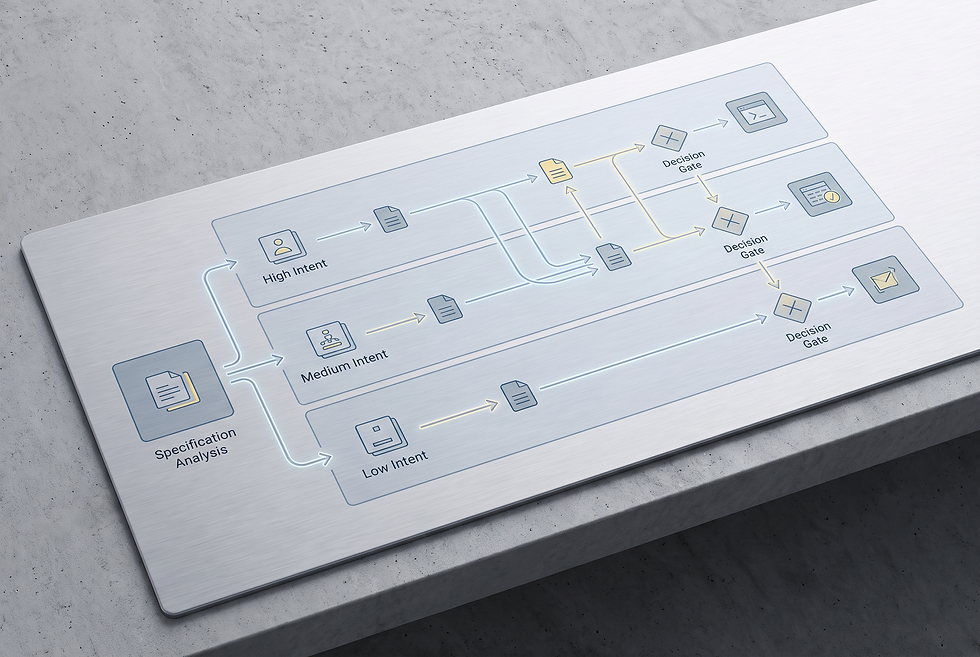
2. Medium-Intent Technical Evaluation Signals
Medium-intent signals indicate structured engineering evaluation without immediate commercial commitment:
Repeated Product Specification Page Views: Multiple sessions reviewing detailed technical data sheets, operating temperature curves, and compatibility tables across several days.
Distributor Locator Usage: Searching for certified integration partners or stocking distributors within a specific geographic territory.
Product Comparison Tool Engagement: Comparing two or more specific SKU configurations side-by-side to evaluate performance trade-offs.
Corporate Expansion and Capital Expenditure Telemetry: Public market data showing plant expansions, facility tooling permits, or hiring sprees for specialized automation and controls engineers.
3. Low-Intent Brand and Informational Signals
Low-intent signals reflect top-of-funnel awareness or general industry research:
Top-of-Funnel Content Consumption: Reading general educational articles, market trend reports, or overview infographics.
Single Homepage or Career Page Visits: General exploratory browsing without interaction with product taxonomy or technical documentation.
Social Media Engagements: Passive likes, impressions, or general webinar attendance without subsequent technical inquiries.
How the Workflow Actually Works: Multi-Signal Intent Orchestration
Capturing value from buyer telemetry requires a closed-loop operational workflow that connects web analytics, product data systems, and CRM routing. The operational process spans six clear steps:
Step 1: Multi-Channel Data Ingestion
Telemetry is collected in real time across the corporate product portal, CAD library servers, documentation repositories, and external intent networks (including technographic installs and industrial media consumption).
Step 2: IP and Account Resolution
Anonymous web visits and CAD downloads are mapped back to verified corporate accounts using reverse-IP lookup, corporate email domain verification, and single-sign-on (SSO) CAD repository authentications.
Step 3: Signal Scoring and Intent Clustering
The system evaluates behavioral signals based on decay rate, recency, and compounding thresholds. A single CAD download triggers a moderate score; a CAD download combined with a pricing view and a distributor search from the same corporate IP within 72 hours triggers a high-intent composite flag.
Step 4: Automated Decision and Boundary Routing
Based on the composite intent score, the system executes predefined routing rules:
Low Intent: Retained in automated educational technical nurture tracks.
Medium Intent: Routed to automated account monitoring; surfaces dynamic technical case studies tailored to the specific component family.
High Intent: Enriched with application context, bill-of-materials (BOM) requirements, and company profile, then dispatched directly to the responsible Territory Sales Director or Application Engineer.
Step 5: Human Engineering Review and Consultative Outreach
The technical sales engineer receives a structured account brief detailing the exact SKUs evaluated, CAD files extracted, and operating parameters investigated. Outreach focuses entirely on technical compatibility, engineering review, and sample validation rather than generic sales pitches.
Step 6: Closed-Loop Feedback and Model Calibration
Opportunity status updates in the CRM continuously calibrate the intent scoring model, refining weightings for specific SKU categories and regional purchasing behaviors.

Evaluating the Strongest Buying Signals in Industrial B2B Sales
The following framework illustrates how industrial equipment suppliers categorize buyer signals, balance automated logic against engineering intervention, and drive measurable pipeline outcomes:
Intent Tier | Core Behavioral Signals | Automated System Action | Engineering / Sales Human Role | Expected Business Outcome |
High Intent | 3D CAD download, RFQ submission, pricing matrix lookup, customized spec sheet generation. | Enrich account data, parse CAD metadata, generate instant commercial summary. | Conduct technical validation call within 2 business hours; verify application tolerances. | 3x to 5x higher conversion from inquiry to validated technical quote. |
Medium Intent | Multiple SKU spec visits, distributor search, integration partner lookup, plant expansion signals. | Map buying committee across engineering and procurement; trigger tailored application notes. | Review account profile weekly; initiate consultative technical introduction if cluster forms. | Early pipeline engagement before competitors are invited to bid. |
Low Intent | Blog post reading, general whitepaper download, career page view, newsletter sign-up. | Add contact to automated technical newsletter; track domain for future behavioral changes. | No direct human sales intervention; preserve engineering time. | Efficient top-of-funnel nurture with near-zero sales overhead. |
Composite Cluster | CAD download + 3 engineering sessions + distributor lookup within 72 hours across same domain. | Issue priority operational alert to regional sales leadership and flagged partner distributor. | Executive application engineer prepares formal feasibility review and proposal package. | Accelerated sales velocity and higher win rate on multi-stakeholder deals. |
Evidence and Results: Operational Impact in Industrial Distribution
Across industrial manufacturing benchmarks and published enterprise case studies, organizations transitioning to signal-based commercial operations demonstrate significant efficiency improvements:
Reduced Sales Velocity Latency: According to industrial commercial excellence studies published by McKinsey & Company (2022–2023), B2B commercial organizations utilizing automated lead enrichment and intent-based routing achieve a 20% to 30% reduction in sales cycle duration across complex capital projects.
Higher Conversion on High-Intent Inquiries: A partner study conducted by Forrester Research on B2B revenue engines highlighted that marketing-generated inquiries backed by verified product-level intent (such as technical asset ingestion) convert to closed revenue at four times the rate of static form submissions.
Preservation of Technical Engineering Capacity: Equipment manufacturers deploying structured signal thresholds report up to a 45% reduction in non-qualified engineering consultations, freeing application engineers to focus on active, revenue-generating project validation.
When operationalizing buying signals in industrial B2B sales, cross-functional alignment between application engineering and sales operations is critical to ensure that data enrichment directly supports technical consultation rather than cold commercial solicitation.
What Other Industrial Companies Can Learn
Executive teams looking to implement a signal-driven commercial model should focus on four foundational principles:
Treat the CAD/Spec Library as a Primary Commercial Engine: In technical manufacturing, CAD model downloads are the industrial equivalent of an e-commerce checkout step. Treat model downloads as high-priority buying signals in industrial B2B sales rather than passive marketing collateral.
Rely on Composite Signal Clusters Rather Than Isolated Actions: An isolated download by a junior intern or student should not trigger an executive sales call. Require multi-touch validation—such as cross-referencing corporate IP, multiple page views, and verified business email domains.
Decouple Technical Triage from General Lead Routing: Ensure high-intent technical inquiries are delivered directly to engineers equipped with application context, eliminating multi-layered administrative handoffs.
Maintain Strict Qualification Boundaries: Protect direct sales representatives from low-intent noise. Use digital nurturing until an account exhibits measurable behavioral progression.
Applying Intent Signal Workflows to Other Industrial Sectors
This operating logic extends directly across specialized technical B2B verticals:
For a Precision CNC Machining Supplier: Intent signals center on raw material selector tool usage, tolerance specification downloads, and STEP file uploads into instant quoting engines. High intent triggers a production engineer review of geometric feasibility.
For a Water Treatment and Industrial Pump Manufacturer: Intent signals encompass duty point calculators, chemical compatibility lookup charts, and municipal bid registry alerts. High intent routes the spec sheet directly to a regional project estimator.
For a Packaging Machinery OEM: Intent signals involve throughput configuration calculators, pouch/carton format guide downloads, and factory footprint schematics. Clustering signals prompt immediate territory sales manager outreach for line layout evaluations.
Industrial Commercial Automation with an AI Global Sales Rep
For industrial manufacturers seeking to operationalize this framework without ballooning commercial headcount, establishing dedicated digital revenue infrastructure is critical.
Target Role: AI Global Sales Rep
Primary Work Channel: Corporate technical inquiry portal, incoming RFQ inboxes, global distributor communications, and synchronized CRM pipeline.
Main Daily Tasks: Real-time ingestion and validation of inbound technical RFQs, matching customer operating requirements against master SKU catalogs, parsing CAD metadata, and verifying regional distributor coverage.
Authority Boundary: Operates autonomously in preliminary technical qualification, specification matching, and data enrichment; requires human technical approval for custom pricing concessions, engineering deviations, and formal proposal issuance.
First Value Event: Automatically capturing, verifying, and packaging an inbound CAD download and RFQ into a fully enriched engineering briefing within 5 minutes of customer submission.
Daily Report Result: Delivers an automated summary to executive sales management detailing newly identified high-intent account clusters, verified RFQ pipeline value, and response latency across global territories.
FAQ
What is the single most predictive buying signal in industrial B2B sales?
In technical B2B and industrial manufacturing sales, 3D CAD model and engineering specification downloads are consistently the strongest individual buying signals. When an engineer downloads a technical drawing, it indicates that the component is actively being designed into a larger machine or plant layout, signaling imminent commercial procurement.
Why are single intent signals often insufficient for industrial sales qualification?
Single intent signals, such as an isolated whitepaper download or website visit, frequently represent academic research, student browsing, or competitive benchmarking. Relying on signal clusters—such as combining a verified manufacturing corporate IP, multiple specification page visits, and CAD downloads within 72 hours—ensures sales engineers only invest time in legitimate commercial opportunities.
How should an industrial manufacturer handle low-intent digital interactions?
Low-intent interactions, such as viewing general blog posts or introductory videos, should remain entirely within automated digital nurture workflows. They should not be routed to technical sales engineers until the prospective account demonstrates compound behavioral engagement with product specification or pricing resources.
How does an AI Global Sales Rep support technical sales engineering teams?
An AI Global Sales Rep acts as an always-on qualification layer that ingests technical inquiries, parses operating parameters and CAD metadata, validates enterprise contact details, and routes fully enriched project dossiers directly to regional sales directors, eliminating manual administrative triage.
Build an Intent-Based Sales Workflow
Transform your technical product catalog, CAD libraries, and inbound inquiries into an automated, high-velocity commercial engine. Deploy specialized digital sales workflows that qualify high-intent buyers, eliminate sales response latency, and empower your technical sales team to close complex industrial deals faster.



Comments