
Content Marketing for CNC Machining Companies: What Technical Buyers Actually Need

Executive Summary: Precision machine shops often struggle with low-converting website traffic and poorly qualified inquiries. By shifting from generic promotional blogging to technical, application-driven content marketing for CNC machining companies, precision manufacturers can address sourcing friction, clarify manufacturability standards upfront, and convert high-intent engineers into production-ready RFQs. This case analysis breaks down how technical precision suppliers re-engineer their content systems to power measurable commercial growth.
Company Snapshot: Navigating the Precision Manufacturing Landscape
Precision CNC machine shops and contract manufacturers operate in a highly specialized, capital-intensive environment. These organizations provide multi-axis milling, turning, micro-machining, and post-processing services to mission-critical sectors such as aerospace, medical devices, defense, automotive, and industrial automation.
Unlike consumer-facing enterprises or standardized SaaS businesses, a precision machining supplier sells engineering execution, tight tolerances (often down to ±0.0001 inches), material integrity, and regulatory compliance (such as ISO 9001, AS9100, or ISO 13485). The buyers are not casual consumers; they are mechanical design engineers, procurement specialists, VP of Engineering leaders, and sourcing managers who evaluate vendors based on strict technical capability, risk mitigation, lead times, and total cost of ownership.
In this B2B landscape, commercial transactions begin long before a formal contract is signed. Sourcing teams perform extensive online technical research before reaching out to sales teams. Consequently, a manufacturer's digital footprint serves as an upfront technical audit rather than a superficial digital storefront.
What CNC Machining Companies Sell and How Sourcing Decisions Happen
Contract machining providers do not sell off-the-shelf catalog products. Instead, they sell specialized manufacturing capacity, material processing expertise, and engineering problem-solving. A customer’s journey involves custom CAD models, 2D technical drawings with Geometric Dimensioning and Tolerancing (GD&T) callouts, precise material certifications (e.g., Titanium Grade 5, PEEK, Inconel, 6061-T6 Aluminum), and secondary processing requirements like anodizing, heat treatment, or passivation.
The commercial procurement process in precision manufacturing follows a rigorous path:
Design & Prototyping: Engineering teams design a custom component and identify potential manufacturing bottlenecks.
Supplier Research & Feasibility: Engineers search for manufacturing partners capable of meeting exact tolerances, material constraints, and volume requirements.
Request for Quotation (RFQ) Submission: Sourcing professionals prepare a data package (STEP files, prints, volume projections) and submit it for quoting.
Design for Manufacturability (DFM) Review: Machine shop estimators and manufacturing engineers review the geometry, flag high-cost features, suggest design modifications, and calculate machine cycle times and tooling costs.
Quote Finalization & Vendor Selection: Sourcing evaluates the proposal on lead time, unit cost, tooling investment, and documented quality systems.
Because technical risk directly impacts project timelines, engineers and procurement managers scrutinize supplier credibility meticulously before submitting proprietary CAD files.
The Business Problem: RFQ Friction and Mismatched Inquiries
Many precision machining suppliers experience structural sales bottlenecks that stem from a disconnected commercial front end. Traditional industrial marketing approaches often produce two major operational problems:
Unqualified or Mismatched RFQs: General marketing campaigns generate inquiries for low-volume hobby projects, unmachinable geometries, or materials the facility does not support. Estimating teams spend dozens of hours reviewing prints that never turn into viable purchase orders.
Lengthy Sales Cycles and High RFQ Friction: Technical buyers abandon the submission process if they cannot quickly verify equipment capabilities, tolerance limits, quality certifications, or design guidelines on the supplier's website. If an engineer cannot confirm whether a shop can handle 5-axis simultaneous machining of 316 stainless steel, they move on to a competitor.
When a machine shop relies purely on generic company overviews—such as "highest quality at competitive prices"—they force prospective buyers to guess their technical boundaries. Estimators become overwhelmed with administrative clarification emails, while high-value production opportunities slip through unaddressed.
What Changed: Building a High-Utility Technical Content Matrix
To overcome these conversion barriers, progressive precision manufacturers implement structured, highly technical content frameworks. Rather than treating their website as a digital brochure, they transform it into an engineering knowledge repository that answers the exact questions design engineers ask during the CAD stage.
Effective content marketing for CNC machining companies focuses on seven core structural pillars:
Application Scenarios: Detailed breakdowns of complex components manufactured for specific operating environments (e.g., fluid manifold machining for semiconductor processing).
Technical FAQs & Tolerance Guides: Direct explanations of attainable tolerances across standard vs. exotic alloys, explaining cost drivers associated with non-standard Callouts.
Material Selection & Machinability Matrices: In-depth comparisons of alloys (e.g., 7075-T6 vs. 6061-T6 Aluminum, Delrin vs. PEEK) regarding dimensional stability, chip formation, and cost.
Process Comparison Guides: Clear technical evaluations comparing 3-Axis vs. 5-Axis milling, Swiss turning vs. standard lathe operations, and CNC machining vs. metal 3D printing for specific production volumes.
Design for Manufacturability (DFM) Rules: Actionable documentation guiding engineers on internal corner radii, wall thickness minimums, deep-hole drilling depth-to-diameter ratios, and thread depths to minimize machining cycle times.
Cost & ROI Breakdowns: Transparent discussions of setup charges, batch economics, raw stock sizing, and secondary finishing impacts on final part cost.
Comprehensive RFQ Guidelines: Exact requirements for quote submissions, detailing acceptable CAD formats, 2D print requirements, and critical inspection criteria (CMM, First Article Inspection/AS9102).
By addressing these operational topics systematically, machine shops educate the prospect, filter out ill-fitting projects, and position their engineering team as an authoritative manufacturing partner.
How the Workflow Actually Works: From Technical Readership to Verified RFQ
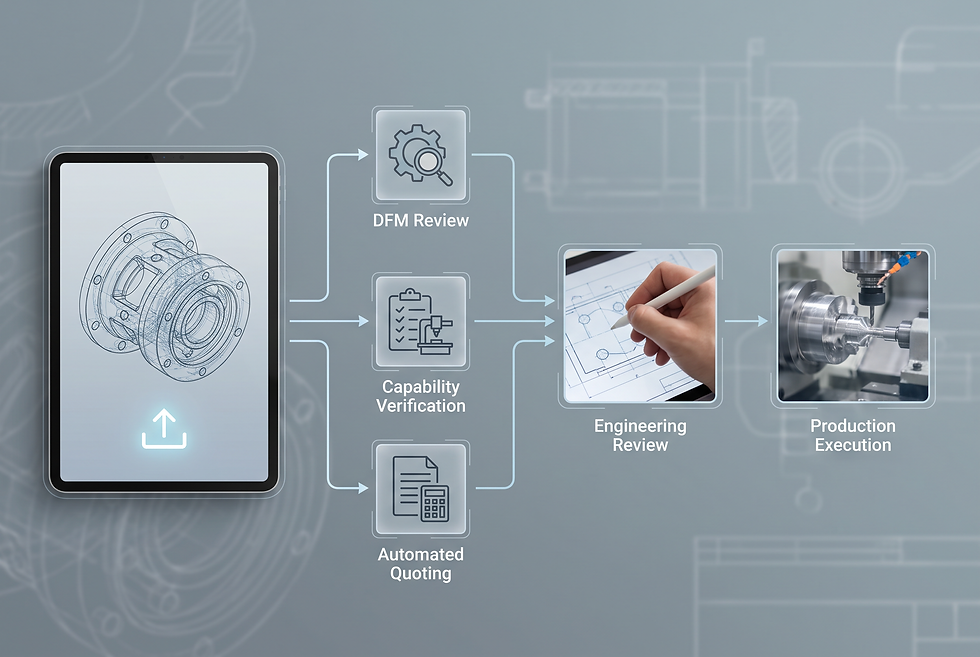
A modern manufacturing content strategy operates as a multi-stage operational workflow that bridges digital engagement and shop-floor estimating. The process unfolds across seven distinct phases:
Technical Problem Search (Data Input): An engineer encounters a design challenge (e.g., preventing tool deflection when milling thin-walled aerospace housings) and searches for technical benchmarks online.
Content Resolution & Engineering Proof: The engineer lands on a dedicated DFM guide explaining feed rates, pocket depth ratios, and recommended wall thicknesses for that specific alloy.
Specification Verification: The engineer reviews the shop's machine envelope, 5-axis milling capabilities, spindle speeds, and CMM inspection capabilities embedded directly within the article.
Structured RFQ Submission: Convinced of the shop’s capability, the buyer clicks through to a dedicated RFQ portal with pre-configured validation fields (STEP file upload, 2D print attachment, volume tiers, NDA execution, and material specifications).
Automated Triage & Human Review: The inbound RFQ package is automatically categorized based on machine envelope, material type, and target delivery date. An experienced estimator reviews the technical package without needing back-and-forth emails for missing data.
Commercial Execution & Feedback: The estimator issues an accurate, manufacturability-checked quotation within 24–48 hours, supported by DFM notes.
Knowledge Base Optimization: If recurring questions arise during estimating reviews, the technical insights are fed back into the content engine to create new technical briefs or update existing guides.
Operational Stage | Traditional Brochure Approach | Technical Content Marketing Model | Commercial Impact |
Buyer Discovery | Generic company claims ("High quality, fast delivery") | High-intent DFM guides, tolerance tables, alloy machinability sheets | Attracts credentialed design engineers and sourcing directors |
Inquiry Qualification | Open contact forms yielding incomplete project details | Structured RFQ portal with required CAD formats, tolerances, and volume tiers | Eliminates 70%+ of administrative follow-ups for missing prints |
Estimating Cycle | 5–10 business days due to missing GD&T and alloy specs | 24–48 hours due to complete initial data package | Significantly increases quote-to-order conversion rates |
Customer Perception | Interchangeable commodity job shop | Specialized manufacturing engineering partner | Justifies healthy margins and lowers price sensitivity |
Evidence and Operational Results
According to the Content Marketing Institute's B2B Manufacturing Research, top-performing industrial content programs generate significantly higher lead quality by addressing real engineering workflows rather than publishing generic brand awareness campaigns. Furthermore, industrial sourcing studies by ThomasNet have consistently shown that technical buyers make up to 70% of their vendor evaluation decision before directly contacting a supplier's sales representative.

Precision machining facilities that transition to an engineering-first content matrix routinely observe substantial operational improvements:
Reduction in Clarification Latency: Quoting turnaround times drop dramatically when RFQs arrive with complete 3D models, explicit tolerance callouts, and clear secondary finishing requirements.
Higher Win Rates on High-Complexity Parts: Shops receive fewer unqualified hobby inquiries and a higher proportion of complex, high-margin multi-axis components aligned with their exact capital equipment capabilities.
Shortened Sales Cycles for Tier-1 Accounts: Enterprise buyers in aerospace and medical sectors shorten their vendor qualification audits when quality certifications, equipment lists, and traceability documentation are transparently organized online.
What Other Precision Companies Can Learn
Precision manufacturers seeking to replicate this content framework should apply four foundational business principles:
Treat Content as Pre-Sales Engineering: Write for the engineer designing the part, not the casual web visitor. Include exact numerical tolerances, machine models, tooling strategies, and finish designations (Ra values).
Solve the Design-to-Cost Dilemma: Provide practical design guidelines that help customers cut cycle time on your machines. When you demonstrate how to reduce raw stock waste or avoid deep-pocket reaming, buyers view your shop as a technical asset rather than a basic vendor.
Eliminate Inbound Quoting Ambiguity: Align your web forms directly with your estimating team's required input checklist. Never allow an RFQ to enter your CRM without essential manufacturing data.
Document Specialized Capabilities Deeply: If your shop excels at micro-drilling, multi-axis wire EDM, or machining exotic nickel-chromium superalloys, build dedicated content silos around those exact operational capabilities.
What This Could Look Like for Industrial Equipment & Machining Manufacturers
For precision machine shops, CNC subcontract suppliers, tooling manufacturers, and custom fabrication facilities, establishing a continuous flow of technical content and managing subsequent buyer inquiries requires disciplined execution.
When scaling technical marketing, industrial companies often face an execution gap: application engineers have the deep domain expertise but lack the time to draft content, while traditional marketing personnel lack the technical background to converse credibly with aerospace or mechanical engineers.
This operational bottleneck can be bridged by structured digital systems that combine programmatic technical content generation with specialized commercial sales agents.
Operationalizing Industrial Inquiries with YTT AI Worker
To bridge the gap between technical content engagement and responsive sales execution, precision manufacturing operations can deploy a dedicated autonomous digital specialist.
Assigned Role: AI Business Development Rep (Precision Manufacturing & CNC)
Primary Work Channel: Inbound website RFQ portal, technical inquiry chat, and integrated corporate email (e.g., quotes@yourcompany.com / CRM integration).
Main Daily Tasks:
Ingests inbound technical inquiries, verifying completeness of attached STEP/IGES files, 2D drawings, and material specifications.
Cross-references required part tolerances, batch sizes, and alloy types against the company's internal equipment profile (e.g., 5-axis envelope, lathe bar capacity, ISO certifications).
Pre-qualifies commercial parameters, obtaining missing delivery deadlines, batch sizing, or ITAR/export compliance requirements via professional asynchronous communication.
Prepares structured quotation briefs for senior estimators, eliminating manual administrative data entry.
Authority Boundary: Automatically gathers technical specifications, validates files, and triages inbound requests. Never issues final binding price quotes, accepts liability for part tolerances, or approves custom payment terms without signed authorization from the Sales Director or Lead Estimator.
First Value Event: Successfully processes an inbound engineering inquiry, verifies the CAD model and tolerance package, captures missing finishing specifications, and presents a complete, quote-ready RFQ file to the estimating department within 15 minutes of submission.
Daily Report Deliverable: A consolidated Daily RFQ Pipeline Summary highlighting: (1) Validated production RFQs routed to estimating, (2) Incomplete submissions actively being clarified with buyers, (3) Material/capability mismatches politely redirected, and (4) High-intent enterprise sourcing accounts reviewing technical content.
FAQ
What is the core focus of content marketing for CNC machining companies?
The core focus is providing technical, application-driven content such as DFM guides, tolerance specifications, material machinability comparisons, and detailed RFQ guidelines to help design engineers and procurement professionals evaluate manufacturing feasibility and submit production-ready inquiries.
How does technical content improve the quoting and estimating process for machine shops?
Technical content educates buyers on proper CAD file preparation, required 2D drawings, and realistic tolerance callouts upfront. This eliminates incomplete inquiries, reduces back-and-forth clarification emails, and enables estimators to generate accurate quotes in 24 to 48 hours.
Which content formats generate the highest conversion rates from precision engineering buyers?
High-converting content formats include alloy machinability guides (e.g., Titanium vs. Inconel), Design for Manufacturability (DFM) rules for multi-axis milling, surface finish (Ra) comparison charts, and comprehensive checklists detailing exact requirements for custom RFQ submissions.
How can precision manufacturers balance proprietary shop knowledge with public content marketing?
Manufacturers should publish generalized design best practices, standardized tolerance capabilities, material behavior data, and publicly shareable case examples while keeping proprietary tooling configurations, internal cycle time algorithms, and customer-confidential CAD geometries strictly protected.
Build an Industry Content Growth System
Transform your precision machining capabilities into a steady pipeline of qualified, production-ready RFQs. Explore how YTT AI helps industrial manufacturers operationalize technical content marketing and accelerate engineering-to-quote workflows.



Comments