
Content Marketing for Food Processing Equipment Companies: Engineering Inbound RFQs

Executive Summary: Industrial food processing equipment manufacturers frequently struggle with generic marketing campaigns that fail to address the complex requirements of technical buying committees. Effective content marketing for food processing equipment companies requires transforming engineering schematics, hygienic validation standards, clean-in-place protocols, and utility consumption data into structured commercial assets. This case study analyzes the mechanisms required to connect technical content directly to qualified RFQs and engineering-led sales workflows.
Company Snapshot and Market Architecture
Food processing machinery manufacturers operate in a specialized, highly regulated industrial B2B environment. Companies within this vertical design, build, assemble, and integrate complex capital equipment—ranging from continuous spiral freezers, thermal blanchers, and aseptic filling systems to automated sanitary conveyors, optical sorters, and high-speed multi-head weighers.
Primary Sector: Food and Beverage Capital Equipment & Processing Automation Systems
Core Products: Primary processing units, thermal processing machinery, automated packaging lines, sanitary bulk material handling systems, and turnkey line integrations
Key Buyers: Multi-disciplinary buying teams comprising Plant Operations Managers, Chief Technology Officers, VP of Engineering, Directors of Sanitation, Quality Assurance Specialists, and Project Engineers
Commercial Model: Direct capital equipment sales, engineer-to-order (ETO) custom machinery, modified-standard equipment builds, turnkey system installations, and long-term aftermarket spare parts and maintenance contracts
Strategic Imperative: Capital investments in this sector typically range from $150,000 for modular sub-systems to well over $5,000,000 for complete greenfield processing lines. Purchasing decisions require rigorous cross-functional alignment across hygiene compliance, mechanical reliability, line speed, utility consumption, and long-term operational profitability.
What Food Processing Equipment Buyers Actually Evaluate
Unlike standard discrete manufacturing equipment, food processing machinery operates under rigorous regulatory oversight, aggressive chemical washdown environments, and zero-tolerance microbial safety mandates. When a food manufacturer seeks new machinery, technical buyers rarely browse broad marketing claims or glossy corporate brochures. Instead, their purchasing evaluations are driven by specific engineering constraints, operational risk reduction, and regulatory compliance.
Technical buying teams evaluate four core architectural pillars before initiating contact with an equipment OEM:
Sanitary Standards and Hygienic Design Compliance: Machinery must strictly comply with regional and international hygiene directives, such as 3-A Sanitary Standards, European Hygienic Engineering & Design Group (EHEDG) guidelines, FDA food-contact surface regulations, and USDA sanitary requirements. Plant engineers inspect documented surface roughness finishes (e.g., Ra < 0.8 µm or 32 µin), self-draining tubular frames, hermetically sealed hollow bodies, and IP66/IP69K washdown-rated drive enclosures.
Clean-in-Place (CIP) and Sanitation Overhead: Facilities operate around tight production schedules governed by cleaning windows. Technical buyers assess how easily equipment can be stripped down through tool-less disassembly, its chemical resistance to caustic and acidic sanitizers, and the efficiency of automated CIP spray coverage to reduce changeover downtime.
Throughput, Yield, and Changeover Flexibility: Plant engineers demand exact mass flow rate specifications, yield tolerance ranges, product drop heights to prevent product damage, thermodynamic heat transfer coefficients, and recipe changeover parameters across different Stock Keeping Units (SKUs).
Utility Consumption and Total Cost of Ownership (TCO): Over a ten-year operational lifecycle, expenses related to electricity, water, steam, compressed air, and liquid nitrogen often eclipse the initial capital purchase price. Buying teams demand transparent utility curves and detailed preventative maintenance schedules.
The Business Problem: The Generic Content Trap in Machinery Marketing
For decades, food processing equipment OEMs relied primarily on trade exhibitions, distributor networks, regional sales agents, and established commercial rolodexes to sustain their revenue pipelines. However, shifting demographic dynamics among B2B buyers have permanently altered the industrial procurement landscape. Contemporary plant engineers, project managers, and operations directors conduct up to 70% of their evaluation anonymously online before ever agreeing to speak with an equipment sales representative.
When food processing machinery manufacturers fail to produce deep, technically rigorous digital documentation, they face severe operational bottlenecks:
High-Friction RFQs: Inbound inquiries arrive with incomplete mechanical parameters, ambiguous utility specifications, and mismatched production throughput expectations. As a result, sales engineering teams spend dozens of non-billable hours qualifying baseline feasibility.
Prolonged Sales Cycles: Without accessible compliance documentation, engineering integration drawings, or sanitation protocols, purchasing committees stall project evaluations while waiting for basic answers from the manufacturer's technical staff.
Price Commoditization: When an OEM presents only surface-level specification bullet points online, buyers perceive the machinery as an undifferentiated mechanical asset, eroding pricing power and gross margins during competitive bidding.
Marketing and Sales Disconnect: Marketing departments often generate top-of-funnel trade articles that fail to capture the technical intent of plant operations teams, yielding website traffic that does not convert into commercial capital project opportunities.
Why Content Marketing for Food Processing Equipment Companies Demands Technical Depth
To overcome these commercial hurdles, leading machinery manufacturers are transforming content marketing for food processing equipment companies from superficial promotional campaigns into a structured, engineering-led decision architecture. Instead of broadcasting vague claims of quality, high-performing OEMs build a comprehensive matrix of technical documentation tailored to each stakeholder in the procurement committee.
This modern approach organizes technical knowledge into structured, accessible assets designed to address specific technical Jobs-to-be-Done (JTBD):
Detailed Application Guides: Demonstrating how machinery handles specific raw ingredient rheologies—such as highly viscous sauces, abrasive frozen vegetables, sticky bakery fillings, or fragile extruded snacks.
Sanitary Integration Blueprints: Providing clear explanations of weld passivation, chemical drainage channels, continuous seal designs, and hygienic cable routing.
Mechanical Tradeoff Analyses: Objectively comparing engineering configurations, such as servo-driven versus pneumatic actuation, continuous versus batch thermal processing, and mechanical versus cryogenic blast freezing.
Engineering Calculators and Sizing Tools: Providing interactive digital tools that allow process engineers to compute thermal load, residence time, mass flow rates, and utility demands based on their facility's specific production parameters.
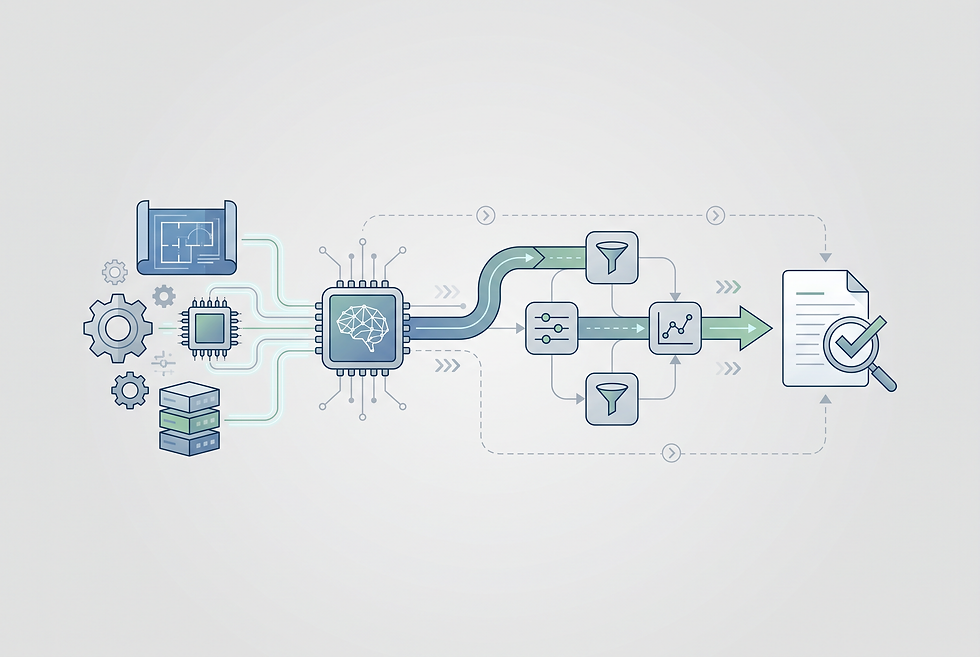
How the Workflow Actually Works: From Technical Knowledge to Commercial RFQ
A modern technical content engine is not an isolated corporate blog—it operates as an integrated commercial qualification workflow. The six-stage framework below demonstrates how structured technical content captures engineering intent and transforms it into fully qualified capital equipment RFQs.
Stage 1: Engineering Knowledge Extraction
Content originates directly from internal Subject Matter Experts (SMEs)—including senior mechanical design engineers, controls specialists, and sanitation managers. Rather than requiring engineers to write promotional copy, dedicated technical editors conduct structured debriefs focusing on customer installation challenges, mechanical failure modes, and integration friction points.
Stage 2: Structured Asset Creation
Extracted technical insights are organized into standardized formats: 3-D dimensional layouts, hygiene certification sheets, product flow simulations, and utility consumption matrices. Each asset resolves one specific validation barrier encountered by plant engineering teams.
Stage 3: Search Architecture and Natural Discovery
Assets are indexed around deep technical search intents—such as "CIP validation procedures for industrial twin-screw pumps" or "reducing product breakage in continuous bucket elevators." This ensures plant engineers searching for immediate operational answers discover the OEM directly during project feasibility scoping.
Stage 4: Interactive Parameter Capture
When technical buyers interact with high-value digital assets—such as a continuous cooker dwell-time calculator or sanitary conveyor belt sizing tool—the system captures operational parameters: target throughput (kg/hr), product temperature differentials, CIP washdown pressure, and facility footprint limitations.
Stage 5: Intelligent Qualification and Commercial Routing
Collected project data is parsed through structured technical validation rules. Inquiries that satisfy mechanical feasibility and project scope criteria are enriched with CAD integration notes and automatically routed to the regional Sales Director or Application Specialist.
Stage 6: Accelerated Sales Engineering Follow-Up
Instead of initiating contact with a generic discovery call, the sales engineer receives a pre-qualified technical summary detailing the buyer’s product characteristics, utility limitations, and project timeline. The initial sales consultation focuses directly on line layout, customized mechanical options, and commercial budget approval.
Structured Comparison: Legacy Machinery Marketing vs. Technical Content Engine
The table below contrasts traditional industrial machinery marketing practices with a modern engineering-led content workflow across critical operational dimensions.
Operational Dimension | Legacy Machinery Marketing | Technical Content Marketing Engine |
Primary Asset Focus | High-level brochures, trade show booths, generic promotional videos | Application guides, CIP protocols, CAD models, utility consumption calculators |
Target Audience | Generic corporate buyer / Purchasing department | Cross-functional buying team: Plant Manager, Sanitation Lead, Quality Assurance, Project Engineer |
Buyer Touchpoint | Gated PDF downloads requesting immediate phone numbers | Open technical validation tools, self-service specs, interactive sizing charts |
Inquiry Quality | Unqualified requests with missing line parameters ("Please quote machine X") | Structured technical data packages with throughput, recipe, and utility parameters |
Sales Engineering Role | Spends 60% of time gathering basic mechanical specifications | Focuses 80% of time on line integration, customized layout, and commercial closing |
Sales Cycle Impact | 9 to 18 months due to prolonged technical back-and-forth | 4 to 8 months due to pre-validated customer expectations and specifications |
Evidence and Operational Impact
Industrial machinery manufacturers that modernize their technical communication channels report measurable operational improvements across their sales and engineering divisions.
According to an industrial equipment marketing benchmark published by the Association for Packaging and Processing Technologies (PMMI), over 74% of food and beverage packaging machinery buyers conduct autonomous online technical research before reaching out to an OEM supplier. When engineering teams have direct access to downloadable 3-D CAD models, sanitary compliance documentation, and clear cleanability specifications, the initial technical scoping window decreases significantly.

Furthermore, industrial sales data reported across major manufacturing integration case studies indicates that capital equipment suppliers providing upfront, transparent sizing calculators and utility documentation experience up to a 35% reduction in non-viable RFQs. By filtering out buyers whose plant parameters or utility supplies cannot support the equipment, application engineering teams can focus their capacity on high-margin, technically viable projects.
What Other Equipment Manufacturers Can Learn: Core Principles
To build a scalable, revenue-generating content marketing engine, food processing equipment OEMs must execute four fundamental operating principles:
1. Eliminate Content Ambiguity and Fluff
Technical buyers immediately discard superficial marketing claims such as "industry-leading quality" or "revolutionary efficiency." Replace generic adjectives with quantifiable engineering metrics: mechanical yield percentages, thermal transfer coefficients, mean time between failures (MTBF), and verified chemical exposure ratings.
2. Design for the Multi-Stakeholder Buying Committee
Food manufacturing capital investments are never made in isolation. A single purchase requires approval from operations, hygiene, maintenance, and finance. Create distinct content assets that answer the specific concerns of each role:
Sanitation Directors: Tool-less strip-down procedures, weld passivation reports, CIP spray-ball coverage diagrams.
Maintenance Engineers: Spare parts availability, drive component standardization, lubrication intervals.
Finance/Plant Directors: Payback modeling, energy consumption comparisons, line scrap reduction rates.
3. Treat Technical Specifications as Sales Accelerators
Do not lock basic technical specifications behind rigid contact gates. Providing open, well-structured dimensions, utility requirements, and throughput ranges builds engineering trust early. Gate only high-value interactive tools—such as custom line simulation models or downloadable engineering CAD files—where the capture of detailed project parameters is naturally expected.
4. Systematize Technical Feedback from Field Service Engineers
Your field service and commissioning engineers handle customer friction points daily. Build a systematic internal feedback loop that captures recurring questions asked during installation and factory acceptance tests (FAT). Turn these operational friction points directly into technical FAQs, troubleshooting guides, and selection articles.
What This Looks Like for Food Processing Equipment Manufacturers
Applying this technical content architecture depends on the specific machinery sub-segment and application environment:
For an Industrial Thermal Processing & Freezing OEM: Develop detailed thermodynamic cooling curves, air-velocity distribution models, and defrost cycle frequency comparisons across varying food moisture levels.
For a High-Pressure Processing (HPP) or Thermal Pasteurization Supplier: Publish microbiological reduction validation studies (e.g., Log-5 reduction data for Listeria and Salmonella), cycle dwell calculations, and vessel cycle-fatigue analysis.
For a Sanitary Conveying & Material Handling Manufacturer: Create guides explaining transfer transitions for fragile snack foods, belt sanitation methods, magnetic drive advantages, and clean-in-place spray header sizing.
For an Aseptic Liquid Packaging OEM: Provide cleanroom compatibility documentation, seal integrity validation procedures, chemical sterilant consumption metrics, and fast-changeover protocol overviews.
YTT AI Worker Mapping: AI Equipment Sales Rep
To execute this technical content and inbound qualification framework without overloading human engineering teams, industrial machinery OEMs can deploy a dedicated autonomous digital worker.
Worker Job Title: AI Equipment Sales Rep
Main Daily Tasks:
Ingests technical engineering manuals, CAD specifications, 3-A/EHEDG compliance standards, and utility guides.
Engages technical site visitors 24/7 in real-time, technical dialogues regarding line throughput, utility requirements, and product compatibility.
Collects and structures critical operational parameters (mass flow, product viscosity, cleanroom rating, washdown chemistry) into a standardized Project Engineering Brief.
Filters out non-viable inquiries based on manufacturer boundary rules (e.g., minimum project size, incompatible power supplies, out-of-scope materials).
Primary Work Channels: OEM Website Technical Portals, CAD Download Hubs, Direct Inbound RFQ Forms, and B2B Portal Integrations.
Authority Boundary: Operates strictly within pre-validated engineering specifications and factory boundary guidelines; cannot issue final binding commercial pricing or custom mechanical drawings without formal Application Engineering review.
First Value Event: Successfully captures a complete, multi-parameter technical project scope (product type, target capacity, sanitation requirements, facility footprint) from an anonymous plant engineer and converts it into a fully structured RFQ package for the engineering team.
Daily Report Deliverables: A consolidated morning dispatch highlighting qualified capital project inquiries, mechanical parameter summaries, missing customer technical requirements, and direct CRM stage assignments for regional sales managers.
FAQ
Why does standard B2B content marketing fail for food processing equipment companies?
Standard B2B marketing often relies on broad promotional claims and generic messaging. Food processing equipment buyers are plant engineers, sanitation managers, and operations directors who require precise mechanical metrics, hygienic certifications (3-A, EHEDG), utility consumption data, and CIP washdown validation before taking commercial action.
What content assets generate the highest conversion rates for industrial machinery RFQs?
Interactive sizing calculators, product-specific application guides, utility consumption comparison charts, tool-less sanitation disassembly videos, and downloadable 2D/3D CAD models consistently drive the highest engagement and generate fully qualified technical inquiries.
How can food machinery OEMs protect intellectual property while sharing technical content?
OEMs can share high-level dimensional drawings, utility envelope requirements, and cleanability principles publicly, while gating detailed internal component schematics, proprietary PLC logic, and customized CAD configurations behind validated business email verification and NDA workflows.
How does technical content marketing shorten the capital equipment sales cycle?
By answering common engineering, sanitation, and regulatory compliance questions upfront, technical content eliminates weeks of introductory back-and-forth emails. Buyers enter the sales pipeline with pre-validated mechanical parameters, enabling sales engineers to focus immediately on line layout, integration, and final commercial terms.
Build an Industry Content Growth System
Transform your engineering expertise into a reliable, high-intent capital equipment pipeline. Discover how our specialized industrial growth frameworks turn technical documentation into qualified machinery RFQs.


Comments