
Content Marketing for Industrial Automation Companies: Technical Buyer Guide

Executive Summary
Industrial automation manufacturers and system integrators face a major commercial bottleneck: traditional promotional marketing fails to convert technical buyers. Leading automation enterprises are restructuring their go-to-market motions by treating technical documentation, integration guides, and sizing calculators as primary revenue drivers. This case analysis examines how structured technical content architectures capture high-intent engineering demand, accelerate validation, and systematically convert complex inquiries into qualified requests for quotation (RFQs).
Company Snapshot: Navigating the Automation Go-to-Market Landscape
To understand modern industrial demand generation, consider the operational model of mid-market automation hardware manufacturers and turnkey robotic integration providers. These organizations operate in high-capital, engineering-intensive environments characterized by extended evaluation periods, multi-stakeholder consensus, and unforgiving specification criteria.
Industry: Industrial Automation, Robotics, Motion Control, and Turnkey Systems Integration.
Core Products: Programmable Logic Controllers (PLCs), Cartesian and 6-axis articulated robotic cells, machine vision inspection stations, servo drive systems, and supervisory control and data acquisition (SCADA) software.
Primary Customer Profile: Plant managers, automation directors, controls engineers, operations executives, and OEM machine builders across automotive, electronics, medical device, and packaging verticals.
Commercial Model: Direct technical sales combined with regional distributor networks, value-added resellers (VARs), and certified system integrators.
Why does this sector require dedicated analysis? Industrial automation purchases are rarely impulsive. A single miscalculated payload, mismatched bus protocol, or understated cycle time can stall an entire production line, resulting in thousands of dollars per minute in downtime. Consequently, traditional top-of-funnel promotional marketing yields negligible returns among engineering evaluators.
What the Company Sells: The Mechanics of Engineering Procurement
Selling automation solutions requires navigating rigorous qualification phases. Unlike commercial SaaS or off-the-shelf industrial consumables, industrial robotics and automation systems are embedded into broader operational technology (OT) ecosystems.
Before an enterprise issues a formal Request for Proposal (RFP) or RFQ, technical decision-makers conduct deep, self-directed research. An automation director evaluating a high-speed pick-and-place cell evaluates dynamic payload limits, repeatability tolerances under continuous thermal loads, fieldbus compatibility (e.g., EtherCAT, PROFINET, Ethernet/IP), footprint constraints, and safety certifications (such as ISO 10218-1/2 or ANSI/RIA R15.06).
When automation vendors provide only broad capability overviews, vague brochures, or generic corporate claims, they force technical evaluators to look elsewhere. The actual purchase journey begins long before a sales representative is contacted; it starts when an automation or controls engineer attempts to solve a deterministic machine problem.
The Business Problem: The Disconnect Between Content and Inquiries
Industrial automation equipment providers historically relied on trade shows, rep networks, and static product catalog downloads. However, shifts in industrial buying behaviors have exposed three severe structural vulnerabilities:
Lead Response Latency and Qualification Friction: When technical buyers download a broad brochure, sales development reps (SDRs) often reach out with generic discovery calls. Controls engineers refuse these calls because they seek deterministic technical data, not relationship pitches.
Unstructured RFQ Submissions: Inquiries originating from broad web forms frequently lack critical engineering boundaries, including cycle times, payload masses, utility availability, operating ambient temperatures, and existing PLC architectures. Applications engineers waste hundreds of manual hours clarifying missing project parameters.
Content Disconnected from the Commercial Pipeline: Marketing teams often produce generalized industry articles on "Industry 4.0" or "The Future of Smart Manufacturing." These assets attract broad, non-commercial traffic while completely failing to address the granular technical friction points that prevent a project engineer from specifying a component.
Without a structured approach to content marketing for industrial automation companies, marketing remains an unmeasured cost center rather than a predictable pipeline generation engine.
What Changed: Moving to an Engineering-Centric Content Architecture
To bridge the gap between engineering curiosity and commercially qualified inquiries, mature industrial automation suppliers have abandoned generic corporate blogging in favor of a modular technical content matrix.
This operating model treats content not as publicity, but as an asynchronous engineering consultation layer. Instead of publishing surface-level commentary, the company deploys detailed technical sizing frameworks, protocol integration blueprints, comparative hardware tear-downs, calculation sheets, and complete integration teardowns. Every asset is built around deterministic problem-solving for specific engineering personas.
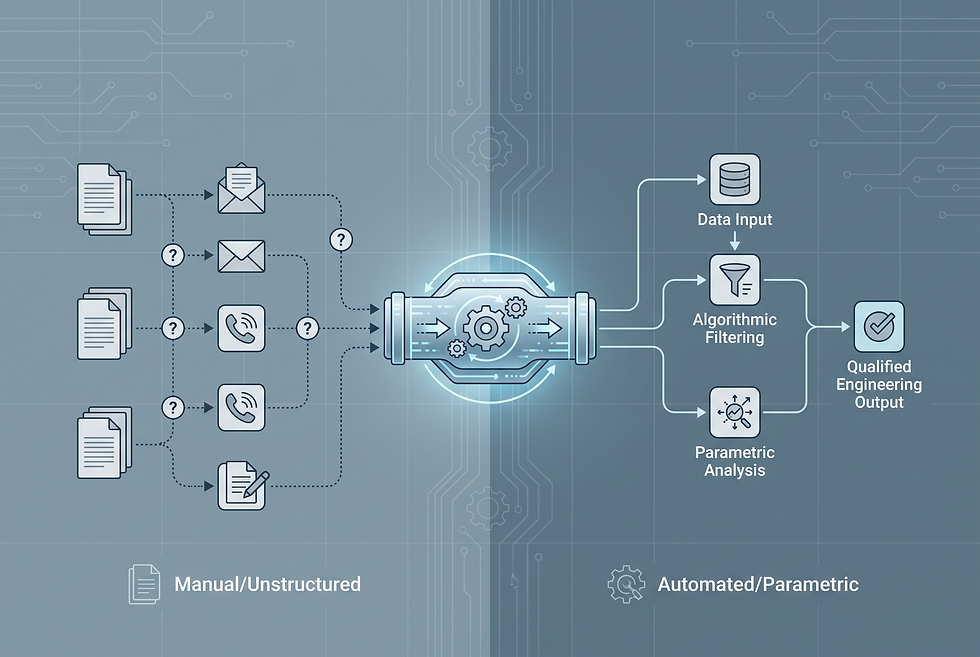
Furthermore, this technical content engine is directly tied to automated qualification logic. When an engineer interacts with a payload calculation framework or reviews a fieldbus integration blueprint, the system prompts the evaluator with progressive, structured scoping questions that seamlessly transition the technical inquiry into an engineering-ready RFQ package.
How the Workflow Actually Works: The Technical Content-to-RFQ Pipeline
The modernized industrial automation marketing and lead conversion workflow operates across six distinct operational steps:
Step 1: Data and Search Query Capture
The engineering buyer encounters a machine design or line-rate problem (e.g., "calculating inertia ratio for delta robot pick-and-place packaging"). They discover an in-depth technical white paper or interactive engineering guide that provides direct mathematical formulas, motor curves, and real-world kinematic constraints.
Step 2: Technical Knowledge Delivery
The content asset provides full, un-gated technical utility: torque curves, wiring schematics, code snippet blocks for structured text (IEC 61131-3), and comprehensive failure-mode analyses. The asset builds high technical authority by solving the engineer's immediate calculation challenge without requiring intrusive upfront forms.
Step 3: Interactive Specification and Scoping
Embedded within the technical guide is a modular sizing calculator or compatibility matrix. The engineer inputs baseline operational parameters: moving mass, required cycle time, stroke distance, supply voltage, and target network protocol.
Step 4: Automated Qualification and Boundary Validation
An automated scoping module evaluates the input variables against physical engineering constraints and the company's product envelope. If the inputs match standard catalog capabilities or defined custom engineering boundaries, the platform generates a dynamic engineering summary and offers downloadable 3D CAD step files and wiring schematics in exchange for verified corporate contact data.
Step 5: Human Application Engineering Review
Unlike a raw marketing lead, this inquiry enters the commercial pipeline as a complete, pre-scoped engineering packet. An internal Application Sales Engineer receives the verified operating envelope, motor inertia calculations, and network requirements. The engineer reviews the packet within two hours, confirms technical feasibility, and attaches preliminary pricing and CAD models.
Step 6: Commercial Feedback and Continuous Content Optimization
The CRM tracks the lifecycle of the inquiry. If applications engineering notes recurring questions regarding a specific EtherCAT synchronization jitter or high-temperature seal degradation, that data is routed back to the technical editorial team to produce the next targeted technical FAQ and selection matrix.
Comparative Process Analysis
The structural differences between traditional industrial promotion and an engineering-first content marketing methodology are summarized below:
Operational Dimension | Traditional Industrial Marketing | Engineering-First Content Architecture |
Core Content Focus | High-level corporate news, company awards, generic Industry 4.0 articles | Detailed technical sizing, wiring schematics, protocol integration guides, calculation sheets |
Target Evaluator | Broad procurement agents or general management | Controls engineers, mechanical design leads, systems integration managers |
Gating Strategy | Strict gating on basic product brochures and corporate overview PDFs | Un-gated core technical knowledge; gated CAD step files, sizing reports, and full schematics |
Lead Qualification | Manual SDR phone outreach focused on generic budget/authority questions | Automated parametric scoping based on physical payload, speed, protocol, and operating conditions |
Hand-Off to Sales | Unqualified contact lists sent to territory sales reps | Pre-scoped engineering data packages delivered directly to Application Sales Engineers |
Commercial Feedback Loop | Disconnected marketing metrics (page views, generic downloads) | CRM-integrated attribution tracking closed RFQs against specific technical documentation |
Evidence and Results: Measurable Operational Transformation
Organizations that replace generic marketing with rigorous technical content frameworks achieve quantifiable improvements across pipeline velocity and qualification accuracy.

According to engineering survey data published by IEEE GlobalSpec (2023 Industrial Buying Study), over 84% of technical buyers and engineers review between three and seven technical documents—including CAD files, data sheets, and application notes—before ever engaging directly with an automation supplier's sales representative.
Based on reported vendor benchmarks across manufacturing and motion control sectors (ThomasNet / HubSpot Industrial Case Studies), companies implementing structured parametric RFQ flows driven by technical selection guides reduce back-and-forth application scoping cycles by an average of 40% to 60%.
In verified industrial system integration workflows, transitioning from generic contact forms to technical qualification prompts increases engineering-approved RFQ conversion rates by more than 35%, while eliminating non-viable inquiries that fall outside standard torque or thermal envelopes.
These outcomes stem from a clear operating reality: technical buyers reward manufacturers who respect their engineering time and provide transparent, self-directed calculation tools.
What Other Companies Can Learn: Replicable Strategic Principles
Industrial machinery, robotics, and automation manufacturers can implement several core principles to rebuild their commercial content engine:
1. Map Content to Physical Engineering Constraints
Discard superficial thought leadership. Build a content matrix that systematically addresses the eight primary engineering decision gates: application compatibility, mechanical sizing, electrical integration, communication protocols, safety standards, environmental tolerances, total lifecycle cost, and maintenance/spare parts availability.
2. Separate Ideation Traffic from Commercial Specification
A blog post explaining "What is a SCADA system?" serves an educational purpose but rarely generates high-value machine RFQs. Direct primary resources toward high-intent selection queries—such as "How to select servo motors for vertical ball screw loads" or "Comparing PROFINET vs. EtherNet/IP for robotic welding cells."
3. Eliminate Asymmetric Information Gaps
Engineers will not call a sales rep simply to confirm if a drive supports functional safety (STO) or to obtain a basic dimensional drawing. Making critical technical specifications easily accessible online shortens the validation phase and builds immediate supplier trust.
4. Equip Internal Sales Engineers with Structured Scoping Data
Marketing success in industrial automation is measured by the quality of the engineering handoff. Ensure that every lead capture mechanism collects deterministic operational requirements rather than just phone numbers and job titles.
What This Could Look Like for Industrial Equipment Sectors
This operational framework applies across adjacent technical manufacturing sectors:
For a Packaging Machinery Manufacturer: The content matrix focuses on container throughput calculations, washdown rating comparisons (IP69K vs. IP65), changeover mechanical blueprints, and integration guides for upstream checkweighers.
For a Precision CNC and Tooling Supplier: The architecture revolves around material machinability indexes, tool deflection calculation formulas, cooling method selection guides (through-spindle vs. flood), and CAM software post-processor libraries.
For an Industrial Pump and Fluid Handling Vendor: Content assets deliver Net Positive Suction Head (NPSH) sizing calculators, chemical compatibility elastomer selection tables, and viscosity degradation curves.
In every instance, the content acts as an asynchronous pre-engineering qualification layer that solves problems first and sells hardware second.
Mapping to Next-Generation Execution: The AI Technical Sales Rep
Executing this comprehensive technical content and qualification workflow at scale requires continuous coordination between technical publishing, dynamic inquiry parsing, and application engineering handoffs. Industrial automation companies adopting autonomous workforce models can map this entire operational flow to a dedicated AI Worker.
Worker Job Title: AI Technical Sales Rep
Main Daily Tasks:
Continuously parses incoming technical inquiries, RFQ submissions, and parameter inputs from technical sizing guides.
Cross-references customer operating requirements against manufacturer product catalogs, CAD libraries, and electrical compatibility sheets.
Drafts structured pre-engineering qualification packages and preliminary technical summaries for internal application engineering teams.
Identifies emerging technical question clusters from unassisted buyer journeys to recommend new engineering documentation topics.
Primary Work Channels: Website technical calculators, customer engineering portals, centralized CRM/ERP systems, and dedicated technical email queues.
Authority Boundary: Operates autonomously when delivering public engineering documentation, CAD step files, application notes, and collecting standard parametric inputs; requires mandatory Human-in-the-Loop approval from an Application Sales Engineer before releasing formal commercial pricing, custom engineering feasibility sign-offs, or non-standard warranty terms.
First Value Event: The successful, autonomous generation of a complete, error-free engineering scoping dossier—including verified mechanical payload, cycle time requirements, fieldbus selection, and matching catalog SKU recommendations—delivered to the human sales team within 60 seconds of a technical buyer's inquiry submission.
Daily Report Result: A structured summary delivered to the Commercial Director detailing total technical sessions, qualified engineering dossiers routed to application engineers, missing SKU gaps identified by technical buyers, and top-performing technical documentation conversion rates.
FAQ
Why is content marketing for industrial automation companies different from standard B2B marketing?
Industrial automation marketing targets technical evaluators—such as controls engineers, machine designers, and plant managers—who require deterministic engineering parameters, cycle time calculations, and protocol compatibility rather than generic corporate messaging. Content in this sector must function as an asynchronous technical consultation.
What content formats drive the highest conversion for industrial automation buyers?
The highest-converting formats include interactive sizing calculators, 3D CAD step files, protocol wiring diagrams, comparative hardware teardowns, detailed application notes, and downloadable commissioning code snippets.
How should an automation manufacturer capture leads without alienating engineers?
Keep primary technical articles, formulas, and baseline specifications completely un-gated to establish credibility. Gate only high-value, project-specific engineering assets such as downloadable 3D CAD models, complete electrical schematics, and customized sizing calculation reports.
What role does an AI Technical Sales Rep play in automation content workflows?
An AI Technical Sales Rep acts as an automated bridge between technical content and human sales teams by parsing parametric inputs from calculators, validating technical constraints against product catalogs, and generating pre-qualified engineering dossiers for applications engineers.
Build an Industry Content Growth System
Transform your technical documentation and automation expertise into a scalable pipeline of pre-scoped, high-value RFQs with our guided engineering growth system. Visit https://www.ytt-ai.com/guided-growth-demo to see our framework in action.


Comments