
Content Marketing for Packaging Machinery Companies: What Technical Buyers Actually Need

Executive Summary
Packaging machinery manufacturers operate in complex, risk-sensitive B2B sales cycles where generic inbound marketing consistently underperforms. This study examines how leading industrial equipment builders transition from vanity traffic generation to an engineering-driven commercial architecture. By aligning technical documentation, sizing calculators, and integration blueprints directly with buyer risk mitigation, equipment builders turn complex engineering queries into high-converting commercial RFQs while significantly reducing pre-sales engineering workloads.
Company Snapshot: Industrial Packaging Equipment in Global Trade
Industrial packaging machinery companies design, manufacture, and integrate mission-critical automated packaging systems. These machines operate across secondary and tertiary packaging environments, encompassing primary flow-wrapping, vertical form fill seal (VFFS) systems, multi-head weighing integration, case packing, cartoning, shrink bundling, and robotic end-of-line palletizing cells.
Industry Sector: Industrial Automation, Packaging Machinery & End-of-Line Production Systems
Primary Machinery Portfolio: Primary flow wrappers, VFFS baggers, continuous-motion cartoners, robotic case packers, tray formers, stretch wrappers, and robotic palletizers
Target Enterprise Buyers: Plant Managers, Packaging Engineering Directors, VP of Manufacturing, Operations Directors, Contract Packagers (Co-packers), and OEM System Integrators
Commercial Model: Engineered-to-order (ETO) and configured-to-order (CTO) capital equipment, high-ticket capital expenditure ($80,000 to over $1,500,000 per automated line), long-term spare parts, maintenance agreements, and operational tooling
Strategic Relevance: Demonstrates how capital equipment manufacturers replace broad-brush inbound tactics with structured technical documentation that accelerates enterprise RFQ velocity.
What Industrial Packaging Machinery Companies Actually Sell
Packaging machinery is rarely bought off-the-shelf. When a contract packager or consumer packaged goods (CPG) enterprise invests in capital equipment, they are not merely purchasing structural steel framing, pneumatic cylinders, and servo drives. They are investing in guaranteed line efficiency, Overall Equipment Effectiveness (OEE), throughput speed (measured in packs per minute or PPM), rapid changeover capabilities, and compliance with stringent sanitary or electrical standards (such as FDA 21 CFR Part 11, USDA 3-A sanitary guidelines, or CE machinery directives).
In this sector, the customer journey is highly collaborative, technical, and risk-averse. A typical enterprise buying committee brings together technical project engineers, plant safety officers, financial controllers, and maintenance supervisors. Purchasing involves rigorously verifying physical factory footprint limitations, electrical panel architecture (e.g., Allen-Bradley Rockwell Automation versus Siemens PLC standardization), compressed air consumption (CFM), reject-handling mechanisms, and pneumatic duty cycles.
Because capital deployment requires board-level approvals, packaging buyers do not respond to generic marketing slogans. They require actionable technical specifications, detailed CAD envelopes, integration protocols, and payback validation before initiating formal commercial discussions.
The Business Problem: The Disconnect Between Content and RFQ Generation
Most industrial equipment builders suffer from a chronic structural breakdown between their marketing activities and commercial engineering teams:
Vanity Traffic vs. Technical Authority: Standard content programs focus on shallow thought leadership (e.g., "Trends in Sustainable Packaging 2025") that attracts students or casual researchers instead of project engineers searching for precise line clearances, sealing jaw pressure curves, and film thickness limitations.
The Pre-Sales Engineering Bottleneck: Senior sales engineers spend up to 40% of their billable working hours repeatedly answering basic technical suitability questions, redrawing floor plans, or clarifying film tensile tolerances for unqualified prospects.
RFQ Ambiguity: Inbound inquiries arrive with missing operational parameters—such as pouch dimensions, product viscosity, factory floor dimensions, power supply ratings, or target line speeds—forcing sales teams into multi-week clarification delays.
Undocumented Integration Risk: Prospective buyers stall purchasing decisions when machine builders fail to document upstream and downstream integration capabilities, such as handshakes with checkweighers, metal detectors, x-ray inspection, and labeling machines.
Executing Content Marketing for Packaging Machinery Companies: What Changed
High-performing packaging OEMs solve this challenge by treating their content library as an asynchronous sales engineering platform. Executing strategic content marketing for packaging machinery companies requires shifting from top-of-funnel volume to middle-and-bottom-of-funnel technical clarity, providing the precise data points technical buyers require to build internal capital expenditure business cases.
Instead of publishing disconnected articles, high-performing OEMs construct a unified technical knowledge graph mapped across eight fundamental content archetypes:
Application Scenarios: Deep-dive teardowns of specific product handling challenges (e.g., handling fragile bakery items at 120 PPM without breakage, or sealing barrier films with bio-degradable coatings).
Engineering FAQs & Technical Diagnostics: Granular answers addressing seal jaw pressure curves, servo synchronization, OEE impact factors, and clean-in-place (CIP) washdown procedures.
Sizing & Specification Selectors: Self-service interactive matrices and sizing guides that allow packaging engineers to match container volume, line velocity, and product characteristics to the correct machine footprint.
Direct Technology Comparisons: Objective architectural comparisons (e.g., Rotary vs. Intermittent Motion Cartoners, or Pneumatic vs. Full Servo Motion Control).
ROI & Lifecycle Cost Models: Transparent financial frameworks covering utility consumption (electricity, compressed air), changeover downtime, preventative maintenance schedules, and labor displacement.
Integration & Line Architecture Blueprints: Detailed documentation on fieldbus protocols (EtherNet/IP, PROFINET, IO-Link), PLC architecture, upstream accumulation tables, and downstream robotic sorting interfaces.
Comprehensive Case Studies: Quantitative engineering briefs outlining initial factory baseline OEE, installed packaging automation footprint, changeover time reduction, and verified scrap rate reduction.
Actionable RFQ Engineering Briefs: Downloadable, structured scoping worksheets that guide the buyer on how to capture pouch tolerances, fill volumes, environment humidity, and duty cycles prior to quotation.
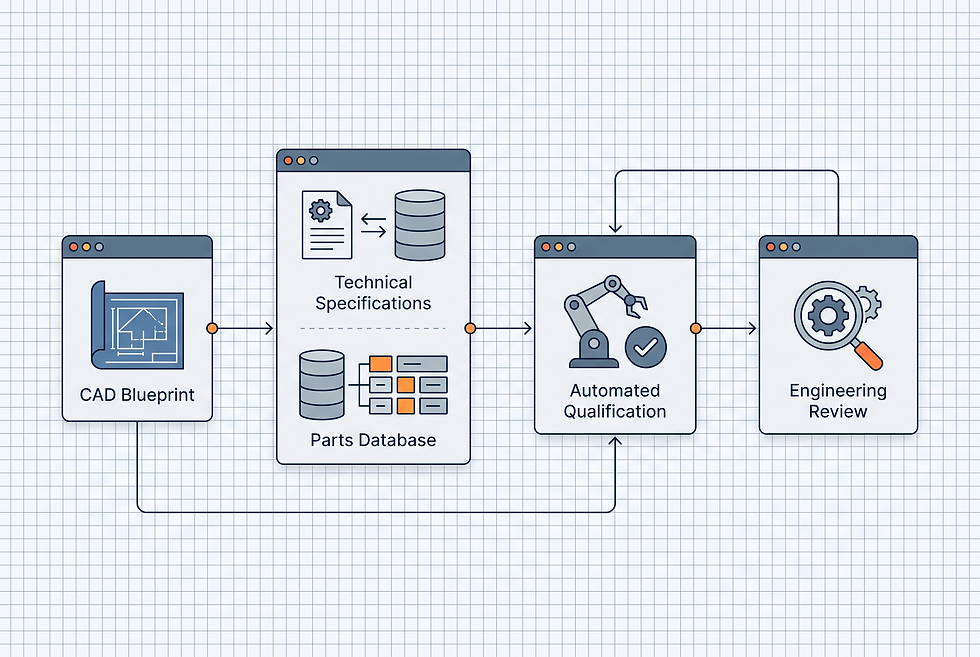
How the Workflow Actually Works: From Technical Search to Commercial Proposal
Transforming technical content into closed equipment contracts requires a structured, multi-step operating workflow that unifies content distribution, buyer qualification, and sales engineering handoff.
Step 1: Technical Query and Discovery
A packaging engineer or procurement director encounters an indexing technical resource while diagnosing an operational challenge (e.g., "VFFS vertical seal jaw leakage troubleshooting on multilayer metallized film"). The landing resource delivers immediate engineering analysis without gating basic technical realities.
Step 2: Interactive Validation and Sizing
Within the resource, the visitor accesses interactive sizing parameters: selecting target container dimensions, product consistency, packaging material grade, and target throughput. The content framework dynamically presents suitable chassis models and kinematic configurations.
Step 3: Structured Engineering Brief Capture
When the buyer requests a budget estimation, integration review, or custom layout drawing, the system presents an engineering scoping interface. Rather than a standard "Contact Us" form, the prospect submits critical boundary parameters: product type, line speed requirements, plant ceiling height, ambient temperature, air pressure supply, and upstream conveyor interfaces.
Step 4: Automated Feasibility and Triage
An automated qualification engine maps the submitted specifications against the OEM's standardized machinery envelope. Inquiries matching target operating parameters are prioritized, categorized by machine series, and enriched with manufacturing intelligence.
Step 5: Sales Engineering Review and Verification
The technical sales representative receives a complete scoping package with preliminary layout recommendations, reducing discovery call duration by 60%. The engineer verifies electrical specifications, factory floor fitment, and custom tooling feasibility.
Step 6: Commercial Proposal and Buyer Committee Enablement
The sales representative issues an indicative proposal bundled with machine layout CAD files, utility connection schematics, and an ROI validation sheet tailored to the buyer's target output.
Step 7: Continuous Feedback and Knowledge Iteration
Unanswered engineering questions or recurring objections raised during technical reviews are automatically routed to the technical content team to update sizing selectors, comparison guides, and technical FAQ documentation.
Comparative Framework: Traditional Inbound vs. Technical Content Architecture
The following operational comparison illustrates the shift between traditional inbound marketing models and modern technical content architectures designed for packaging machinery builders:

Operating Metric / Workflow Dimension | Traditional Inbound Content Marketing | Structured Technical Content Architecture |
Content Focus | Broad industry trends, generic blog posts, PR announcements | Application engineering, mechanical specifications, OEE impact, footprint CAD data |
Target Audience Reached | General industry observers, students, low-intent researchers | Packaging Engineers, Plant Managers, VP of Operations, OEM Integrators |
Conversion Entry Point | Gated generic eBooks or vague "Contact Us" forms | Interactive machine selectors, technical FAQ lookup, RFQ scoping worksheets |
Pre-Sales Engineering Burden | High (engineers waste hours clarifying basic packaging parameters) | Low (prospects arrive with pre-qualified technical briefs and container specs) |
Inquiry Quality | Poor operational data; high proportion of unqualified leads | Complete engineering parameters (PPM, film type, PLC preferences, layout constraints) |
Sales Cycle Velocity | Protracted (6–12 months due to continuous back-and-forth qualification) | Accelerated (3–6 months due to upfront risk mitigation and clarity) |
Commercial Alignment | Marketing measured on traffic volume and unsubstantiated leads | Marketing measured on verified RFQ pipeline value and engineering acceptance rate |
Evidence and Results from the Field
According to findings published in the Association for Packaging and Processing Technologies (PMMI) 2023 State of the Industry Report, more than 70% of packaging machinery buyers conduct comprehensive technical evaluations online before contacting vendor sales representatives. Plant engineering teams prioritize equipment manufacturers that offer transparent technical documentation, utility specifications, and sizing clarity directly on their digital channels.
Furthermore, an industrial equipment sales study documented by the Manufacturing Leadership Council indicated that packaging machinery builders providing detailed integration playbooks and self-guided specification tools experienced up to a 35% decrease in the pre-sales engineering cycle. By resolving fundamental operational questions through structured technical documentation, sales teams reported higher quotation-to-order close rates and a substantial reduction in post-commissioning specification mismatches.
What Other Industrial Companies Can Learn: Core Operating Principles
Manufacturers across industrial machinery, robotics, and complex automation equipment can extract four fundamental operating principles from this methodology:
Publish Technical Constraints Transparently: Engineering buyers distrust ambiguity. Explicitly detailing operating limits—such as maximum film roll diameters, seal dwell times, or torque constraints—builds immediate credibility and screens out non-viable projects early.
De-Risk Upstream and Downstream Integration: Packaging lines are complex ecosystems. Documenting how equipment connects with third-party multi-head scales, cartoners, checkweighers, and warehouse AGVs positions the OEM as a turnkey solution partner rather than an isolated hardware seller.
Transform Static Brochures into Interactive Sizing Assets: Converting static PDF specification sheets into searchable, responsive engineering guides allows buyers to validate technical compatibility during off-hours, accelerating consensus across cross-functional buying committees.
Standardize the RFQ Ingestion Process: Never ask a technical buyer to "reach out for more info." Provide an engineering-grade scoping template that guides them in defining pouch dimensions, product characteristics, changeover frequency, and site utility constraints.
What This Could Look Like for Industrial Equipment Sectors
This technical content architecture applies across diverse industrial manufacturing and automation sectors:
For an Industrial Robotics Integrator: Content centers on payload capacities, reach envelopes, cycle-time simulations, EOAT (End of Arm Tooling) compatibility, and robotic safety zone standards (ISO 10218).
For a CNC Machinery Supplier: Content details spindle torque curves, cutting feed rates, thermal stability systems, 5-axis kinematic limits, and CAM post-processor compatibility.
For a Commercial Water Treatment Equipment Manufacturer: Content maps flow rate calculations, membrane filtration flux curves, chemical dosing requirements, and SCADA monitoring architectures.
For a Material Handling and Conveyor OEM: Content addresses belt load ratings, accumulation back-pressure mitigation, motor drive power consumption, and modular sorting diverter configurations.
Operational Mapping: YTT AI Equipment Sales Rep
To help industrial equipment builders execute this operational model consistently, capital equipment manufacturers deploy autonomous AI Workers that bridge technical content and commercial sales engagement.
AI Equipment Sales Rep Profile
Primary Role: Technical Qualification, RFQ Scoping, and Inbound Pipeline Acceleration
Primary Work Channels: Website Interactive Engineering Center, Technical Portal, Inbound Email Ingestion, CRM Pipeline Engine
Authority Boundary: Ingests complex buyer packaging parameters, calculates preliminary equipment sizing, answers deep technical FAQs from verified OEM documentation, and constructs complete engineering briefs. Hand-offs occur before commercial discounting, bespoke mechanical design sign-offs, or binding contractual commitments.
First Value Event: Generating a complete, verified RFQ technical brief—containing container dimensions, line speed, material specification, and utility requirements—within 60 seconds of buyer submission, ready for sales engineering sign-off.
Daily Operational Report Output: Summarizes qualified inbound RFQ volume, highlights high-intent accounts researching line integration content, flags ambiguous technical queries requiring engineering review, and identifies trending packaging automation keywords to guide ongoing content development.
FAQ
Why is conventional B2B content marketing ineffective for packaging machinery companies?
Conventional B2B marketing relies on superficial top-of-funnel topics that fail to provide the operational parameters, mechanical tolerances, and integration specifications required by plant engineers and manufacturing directors evaluating high-capital packaging investments.
What content assets have the highest conversion rate for packaging machinery buyers?
Interactive machinery sizing selectors, detailed application engineering case studies, line integration blueprints, utility consumption models, and structured RFQ scoping guides consistently drive the highest commercial conversion rates.
How does technical content marketing reduce pre-sales engineering workloads?
By answering standard engineering inquiries, clarifying machine limits, and capturing complete operational requirements upfront, technical content eliminates repetitive back-and-forth inquiries and delivers fully scoped RFQs to engineering teams.
How should packaging equipment OEMs structure their RFQ capture process?
OEMs should replace generic contact forms with structured engineering questionnaires that collect critical project parameters, such as target throughput (PPM), container/pouch dimensions, packaging material specifications, and facility utility limits.
Build an Industry Content Growth System
Transform your industrial packaging equipment catalog into an automated, engineering-led customer acquisition engine. Deploy dedicated AI workflows that qualify technical buyers, structure complete RFQ briefs, and accelerate your capital equipment sales pipeline.


Comments