
Daifuku Material Handling Global Sales Case Study: Scaling Complex Project Proof

Executive Summary: Daifuku transformed intralogistics commercialization by integrating global operational benchmarks, rigorous technical validation, and local service execution directly into its consultative sales pipeline. For B2B industrial leaders, this case reveals how converting disparate engineering achievements into structured, real-time customer proof reduces commercial friction and shortens multi-million-dollar capital expenditure evaluation cycles worldwide.
Company Snapshot: Global Leadership in Automated Material Handling
Daifuku Co., Ltd. is an international market leader in automated material handling systems, warehouse automation, cleanroom transport systems, airport baggage handling solutions, and automotive assembly conveyor technology. Founded in Osaka, Japan, in 1937, the enterprise has progressively expanded its manufacturing footprint, software engineering hubs, and field installation networks across the Americas, Europe, Asia-Pacific, and Greater China.
The organization operates on an enterprise B2B capital equipment and systems integration business model. Its end-user clientele spans Fortune 500 e-commerce enterprises, semiconductor fabricators, cold-chain grocery distributors, pharmaceutical distribution hubs, automotive original equipment manufacturers (OEMs), and global air transport hubs. Serving such diverse sectors requires navigating distinct regional regulatory environments, strict cleanroom or temperature standards, rigorous uptime expectations, and multi-year investment horizons. Analyzing Daifuku provides indispensable strategic insight for industrial machinery, packaging, and robotics executives seeking to scale cross-border project sales without diluting engineering precision.
What the Company Sells and the Dynamics of Enterprise Capital Procurement
Daifuku designs, manufactures, integrates, and services automated material handling infrastructure. Key product lines include Automated Storage and Retrieval Systems (AS/RS), autonomous vehicle systems (AGVs and AMRs), high-speed sortation transfer systems, overhead monorail cleanroom transports (OHTs), and proprietary warehouse execution software (WES) alongside warehouse management systems (WMS).
In the industrial automation and material handling sector, systems are never bought off the shelf. Purchasing an automated distribution center or a high-throughput cleanroom transport grid involves an intricate, high-stakes consultative procurement cycle typically spanning 9 to 24 months. Capital expenditures routinely range from five million to well over one hundred million dollars per facility.
Procurement decisions involve multi-disciplinary buying committees consisting of Chief Supply Chain Officers, Vice Presidents of Logistics, plant managers, safety directors, systems integration consultants, and procurement executives. In this environment, conventional promotional collateral fails. Prospective enterprise clients demand verifiable proof of throughput, mean time between failures (MTBF), local spare parts availability, software integration interoperability, and demonstrated compliance in comparable operational environments. This daifuku material handling global sales case study illustrates how enterprise automation vendors can bridge the divide between complex technical scoping and commercial deal acceleration.
The Business Problem: Multi-Market Friction and Technical Qualification Overhead
As global manufacturing and retail supply chains diversified across regions, industrial equipment providers encountered substantial commercial hurdles. Daifuku faced three interconnected operational challenges inherent to global system sales:
Technical Qualification Bottlenecks: Every Request for Proposal (RFP) required deep engineering consultation, custom cycle-time calculations, and facility simulation studies. Frontline commercial reps frequently relied on senior application engineers to qualify opportunities, creating proposal turnaround delays and draining engineering bandwidth on early-stage leads.
Dispersed Global Reference Data: While the enterprise executed landmark projects across diverse geographies, field sales teams in North America or Europe often lacked rapid access to granular performance data, facility footprints, or operational uptime proof from peer installations in Japan, Korea, or Southeast Asia.
Cross-Border Trust and Lifecycle Risk: High-capital intralogistics buyers frequently hesitate to award multi-facility contracts unless vendors provide concrete guarantees regarding local installation management, long-term technical support, and rapid spare-parts availability.
Without an operational mechanism to systematically capture past engineering data and project successes into reusable commercial assets, scaling international sales inevitably inflates overhead, lengthens deal cycles, and increases administrative overhead for technical teams.
What Changed: Moving to a Structured Global Proof and Engineering Sales Model
To overcome these procurement barriers, Daifuku institutionalized a comprehensive solution-selling framework anchored in transparent project verification, regional integration centers, and complete lifecycle assurance. Rather than treating each regional tender as an isolated bid, the organization aligned its international sales workflow around structured operational evidence.
According to Daifuku’s publicly disclosed Integrated Reports and investor presentations, the enterprise reinforced its international go-to-market architecture through several core operating mechanisms:
Demonstration and Simulation Infrastructure: Establishing dedicated engineering demonstration facilities—such as the "Hini Arata Kan" demo center in Japan alongside regional customer experience centers—where prospective buyers evaluate operational AS/RS cells, software routing logic, and hardware speeds under simulated load conditions.
Standardized Solution Modules: Systematizing complex bespoke engineering into modular, validated subsystems (such as standard high-density mini-load AS/RS, modular unit-load cranes, and standard pallet sorting lines) that come with pre-calculated performance benchmarks and integration schematics.
Regional Engineering and Service Deployment: Establishing localized engineering hubs, regional spare parts distribution centers, and field installation units across key manufacturing clusters to eliminate buyer concerns regarding post-handover downtime.
Lifecycle Value Positioning: Transitioning the core sales pitch from purely hardware installation costs to full Total Cost of Ownership (TCO), integrating preventive maintenance agreements, retrofitting pathways, and continuous software tuning directly into initial commercial proposals.
How the Workflow Actually Works: The Engineering-Led Sales Mechanism
The modernized industrial solution sales workflow functions as an interconnected, multi-stage mechanism that balances standardized engineering data with customized local execution.
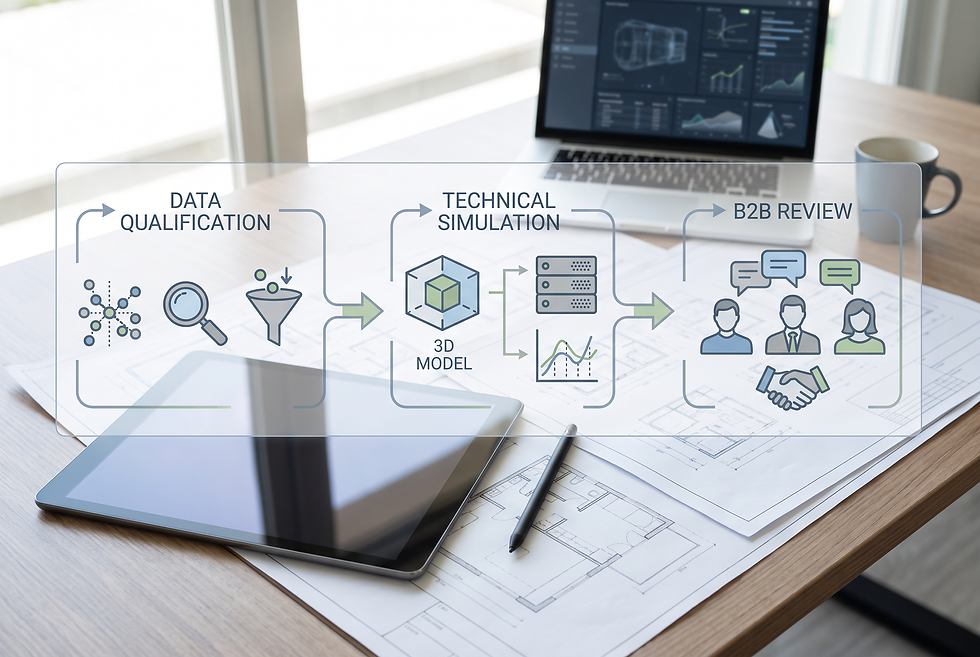
Step 1: Operational Input and Lead Qualification
The workflow initiates when an enterprise client submits initial facility requirements, daily pallet/box throughput targets, building dimensional constraints, and ERP integration specifications. Frontline technical sales representatives capture structured operational parameters rather than generic commercial inquiries, ensuring all necessary technical baselines are captured on first touch.
Step 2: Technical Scoping and Solution Matching
Instead of designing every concept from zero, technical solution architects map customer parameters against standardized system architectures. The system identifies proven operational configurations matching the client’s industry vertical, SKU velocity profiles, and temperature-control environments, reducing preliminary design cycles.
Step 3: Engineering Simulation and Global Proof Retrieval
The team retrieves operational performance data from comparable global deployments. Application engineers simulate facility throughput, bottleneck probabilities, and energy consumption using standardized modeling software. The customer receives verifiable simulation reports alongside verified reference data from relevant global installations.
Step 4: Multi-Stakeholder Review and Human Authorization
Before commercial presentation, senior technical directors, regional service managers, and legal teams review the proposed scope, custom integration risk allocations, and delivery schedules. Human engineering oversight ensures that cycle times, installation milestones, and service level commitments are commercially and operationally viable.
Step 5: Buyer Evaluation and Live Proof Verification
The customer evaluation committee visits regional demo facilities or conducts virtual walk-throughs of active operational sites. The buying team reviews concrete telemetry data, software integration protocols, and maintenance schedules, significantly lowering risk perception.
Step 6: Commercial Handover and Lifecycle Loop
Upon contract award and project commissioning, operational uptime, maintenance logs, and throughput milestones are documented. This performance data is fed back into the centralized system engineering repository, strengthening the proof database for subsequent commercial cycles worldwide.
Evidence and Results: Benchmarking Scaled Global Execution
Publicly available annual disclosures and financial statements highlight the operational power of establishing a proof-driven, localized global sales model in complex manufacturing sectors:
International Revenue Growth: According to Daifuku’s official Integrated Financial Reports, non-Japan revenue grew to represent over 65% to 70% of total consolidated sales over the past decade, demonstrating sustained international competitiveness across the Americas, Europe, and Asia.
Service and Aftermarket Expansion: Daifuku’s published investor data reveals that recurring service, aftermarket support, and maintenance contracts consistently account for roughly 25% or more of consolidated net sales, providing resilient revenue stability regardless of macroeconomic capital expenditure fluctuations.
Enhanced Delivery Predictability: Operating regional assembly hubs and localized service centers enabled the enterprise to consistently execute complex multi-site rollouts for major global semiconductor and retail distribution clients without scaling linear technical support overhead.
Analysis: Core Workflows in This Daifuku Material Handling Global Sales Case Study
The following structural matrix illustrates how engineering-driven organizations modernize their project sales process:
Workflow Stage | Traditional Industrial Sales | Modernized Proof-Led Model | Primary Business Outcome |
Inquiry & Qualification | Unstructured RFPs, high dependency on senior engineers | Structured data intake against standardized system parameters | Eliminates unqualified proposals and reduces qualification time |
Technical Proof | Generic brochures and high-level client reference lists | Live simulation modeling and verified global operational telemetry | De-risks procurement decisions for multi-stakeholder buyer groups |
Proposal Design | Fully custom, ground-up engineering for every bid | Modular subsystem configurations with pre-validated cycle times | Accelerates tender submission velocity with strict cost control |
Post-Sales Service | Reactive warranty repair coordinated regionally | Integrated lifecycle management and predictive service contracts | Builds high-margin recurring revenue and customer retention |
What Other Companies Can Learn: Transferable Principles for B2B Leaders
Industrial automation, machinery, and equipment manufacturers can extract several operational strategies from this commercial model:
Convert Engineering Data into Sales Collateral: Do not treat project completion files as static archives. Structure past installation telemetry, throughput records, and operational uptime data into searchable reference blueprints that commercial teams can present during RFP evaluations.
De-Risk the Customer Decision Early: Enterprise procurement committees reject ambiguity. Using interactive simulations, verified reference metrics, and clear service frameworks early in the dialogue minimizes buyer perceived risk.
Decouple Initial Qualification from Deep Engineering: Establish standardized qualifying criteria and modular product frameworks so commercial teams can qualify leads accurately without consuming engineering hours on low-probability tenders.
Embed Service Lifecycle into Initial Negotiations: B2B capital equipment sales should never conclude with delivery. Structuring maintenance, software updates, and long-term parts availability into the initial bid increases customer lifetime value and establishes recurring margins.
What This Could Look Like for Industrial Equipment and Robotics Manufacturers
For an industrial machinery builder, packaging equipment manufacturer, or robotics integrator, adopting a structured proof model resolves critical commercial bottlenecks.
Consider an industrial robotics supplier exporting automated palletizing or CNC-tending systems to international markets. In many mid-sized operations, sales reps spend weeks emailing engineers back and forth to confirm cycle times, payload capacities, and footprint drawings. Leads cool down, and competitors with faster qualification systems win early consideration.
By systematizing technical specifications, CAD library rules, and industry-specific proof into an automated commercial workflow, the manufacturer can instantly deliver preliminary layout validations, reference studies, and accurate budget guidelines to overseas prospects. Frontline commercial reps handle initial discovery and technical scoping systematically, escalating only fully qualified, high-probability projects to senior systems engineers.
YTT AI Worker Mapping: AI Global Sales Rep for Industrial Automation
To help automation and industrial equipment manufacturers execute this operational logic, YTT AI provides dedicated digital workers tailored to complex B2B engineering workflows.
Worker Job Title: AI Global Sales Rep
Main Daily Tasks: Qualifying international inbound RFPs against technical parameter thresholds; mapping customer payload and throughput requirements to standard equipment catalogs; retrieving relevant industry reference sheets; and drafting customized technical solution summaries.
Primary Work Channel: Global B2B website inquiry portals, enterprise email communication, and integrated CRM systems.
Authority Boundary: Independently executes preliminary technical qualification, delivers pre-approved reference portfolios, and schedules discovery calls; escalates bespoke engineering requirements, custom pricing negotiations, and final contract sign-offs to human Sales Directors and Application Engineers.
First Value Event: Automatically parsing a complex multi-parameter inbound RFP, validating dimensional and throughput compatibility against product libraries, and generating a structured technical qualification brief within 15 minutes of inquiry receipt.
Daily Report Result: Delivering an executive morning brief summarizing new overseas inquiries received, qualification status, matched reference cases, and recommended next commercial actions for human account executives.
FAQ
What is the primary commercial challenge highlighted in this daifuku material handling global sales case study?
The primary challenge is navigating high-stakes, multi-stakeholder capital procurement cycles by bridging the gap between technical engineering verification and commercial sales execution across international markets.
How do automated simulation and demonstration centers shorten industrial sales cycles?
They provide objective, verifiable performance proof regarding throughput, cycle times, and software integration before installation, resolving technical doubts and de-risking capital expenditure decisions for enterprise buying committees.
Why is lifecycle service integration critical for complex material handling system sales?
Industrial buyers prioritize long-term system uptime over pure upfront hardware discounts. Bundling preventive maintenance, local parts supply, and retrofitting pathways protects customer operations and builds predictable recurring aftermarket revenue for the vendor.
How can mid-sized equipment manufacturers replicate a global proof-led sales model?
Manufacturers can modularize their product specifications, turn completed project data into searchable customer case benchmarks, and deploy automated technical qualification workflows to handle inbound tenders rapidly without straining engineering teams.
Scale Your Global Industrial Sales with Intelligent Automation
Equip your commercial team with specialized AI Solution Sales Reps to qualify technical inquiries, deliver instant project proof, and accelerate high-value equipment tenders across international markets.


Comments