

How Can Machinery Manufacturers Find Overseas Buyers Online: The Ultimate AI-Driven B2B Playbook
- Kelvin

- 2 days ago
- 6 min read
Machinery manufacturers can find overseas buyers online by combining search-optimized technical content (SEO and GEO) to attract inbound RFQs, deploying targeted outbound campaigns driven by overseas lead generation AI, and leveraging intelligent sales agents to ensure rapid, context-rich follow-ups. By bridging the gap between digital marketing and automated B2B sales processes, industrial exporters can build a highly predictable, 24/7 global sales pipeline.
Why are traditional offline channels failing machinery exporters today?
Traditional B2B export channels—such as international trade shows, regional agents, and paper catalogs—are no longer sufficient to sustain long-term growth. Industrial buyers and procurement officers have fundamentally changed how they purchase heavy equipment, CNC machines, and custom components. Today, up to 70% of the B2B buying journey takes place online before a prospect ever contacts a sales representative.
According to global buyer feedback on industrial sourcing forums, procurement managers face three major frustrations when dealing with traditional machinery exporters:
Lack of Online Information: Buyers frequently encounter websites with zero technical specifications, no configuration options, and hidden pricing structures, making preliminary evaluations impossible.
Slow Response Times: When buyers submit a request for quotation (RFQ), they often wait several days for a response, during which they have already engaged with more responsive competitors.
Language and Communication Barriers: Misunderstandings regarding complex, custom engineering requirements during the initial inquiry stage often stall or kill deals early on.
For machinery manufacturers, relying solely on face-to-face exhibitions means missing out on the vast majority of active searchers who are looking for immediate solutions. To capture these high-value opportunities, exporters must shift their focus toward an integrated online customer acquisition engine.
How can machinery manufacturers find overseas buyers online using SEO and GEO?
To capture inbound interest from overseas decision-makers, machinery manufacturers must build a digital presence optimized for both traditional search engines (SEO) and modern Generative Engine Optimization (GEO). Industrial buyers do not search for generic keywords; instead, they enter highly specific, long-tail technical queries such as "high-precision multi-cavity injection mold manufacturers with ISO 9001 certification" or "automated packaging lines for pharmaceutical cleanrooms."
To satisfy these queries, your website must serve as an authoritative technical knowledge hub. This involves publishing detailed product specifications, 3D CAD models, case studies of successful production line installations, and comprehensive compliance documentation.
Additionally, with the rise of AI-powered search engines like ChatGPT, Perplexity, and Google's AI Overviews, your content must be structured so that these algorithms can easily crawl and cite your brand. Generative Engine Optimization (GEO) relies heavily on clear entity relationships and direct answers to complex engineering questions. When your website provides highly structured technical specifications and clear application cases, AI search tools are far more likely to recommend your machinery directly to buyers asking complex procurement questions.

How can manufacturers use AI to scale targeted outbound prospecting?
While inbound SEO and GEO are exceptional for capturing active searchers, proactive outbound prospecting is critical for securing high-value accounts. The combination of targeted lead generation for manufacturers and intelligent outreach technology allows machinery exporters to identify and pitch premium, high-intent buyers around the globe.
Instead of wasting hundreds of hours on manual research, exporters can utilize an overseas lead generation AI engine to automate the prospecting cycle. This technology executes the following workflow:
Intent and Fit Analysis: The AI scans global trade databases, customs data, patent registries, and corporate announcements to identify companies that are currently expanding factories, upgrading production lines, or sourcing new industrial equipment.
Contact Intelligence: The system extracts verified contact information for key decision-makers, such as procurement directors, plant managers, and chief engineering officers.
Hyper-Personalized Outreach: Rather than sending generic, low-conversion blast emails, the AI drafts tailored outreach sequences. It references the prospect's exact industry, local regulatory standards, and potential production bottlenecks, presenting your machinery as the ideal solution to their operational challenges.
By automating this highly personalized top-of-funnel activity, your sales team can bypass cold calling and focus entirely on negotiating with prospects who have already expressed interest in your technical capabilities.
How can an AI sales agent for manufacturers qualify technical inquiries?
One of the most common bottlenecks in industrial manufacturing is the "leaky pipeline." Sales teams are often flooded with vague, low-quality RFQs. Evaluating these inquiries requires significant technical expertise, often forcing expensive senior engineers to spend hours clarifying basic specifications (e.g., raw material specifications, voltage configurations, or output capacities).
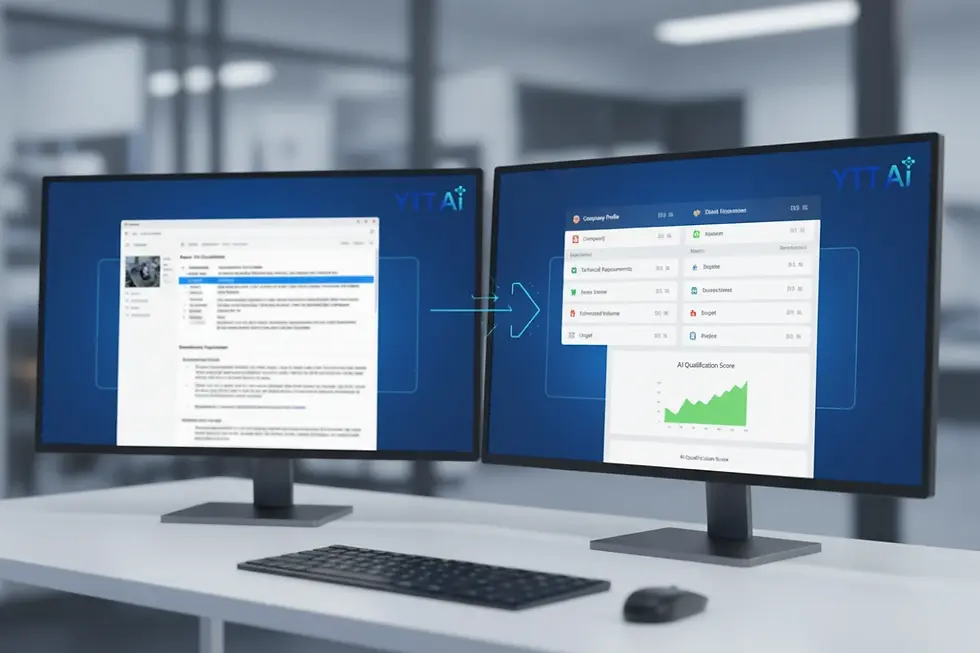
Deploying an AI sales agent for manufacturers helps solve this operational bottleneck by acting as an intelligent, round-the-clock technical triage. Working directly within email, contact forms, or instant messaging platforms, the AI sales agent can:
Instantly Acknowledge Inquiries: The agent responds to global buyers within minutes, regardless of their time zone, preventing lead drop-off.
Clarify Technical Parameters: The agent engages the buyer in a conversational manner to gather necessary engineering specifications, operating conditions, and budget expectations.
Score and Route Leads: Once the details are collected, the AI scores the lead based on fit, intent, and urgency. High-priority inquiries are immediately transferred to human sales engineers alongside a neatly structured briefing document.
This division of labor ensures that your technical sales team spends 100% of their time on highly qualified opportunities, accelerating the sales cycle and significantly improving conversion rates.
How does B2B sales automation prevent context loss in long-cycle deals?
Industrial machinery sales feature long cycles, high contract values, and multiple stakeholders on the buyer's side (procurement, engineering, finance, and operations). In these multi-month negotiations, "customer context loss" is a major threat. When a lead passes from marketing to sales, or when a negotiation stalls for weeks, critical technical details, past quotation feedback, and custom requests often get lost in messy email threads or separate spreadsheet files.
Implementing structured B2B sales automation ensures that every technical requirement and customer interaction is preserved. Advanced systems compile this data into a centralized "Sales Memory," which acts as a single source of truth for the entire accounts history.
Furthermore, sales automation tools eliminate follow-up negligence. When a quotation is sent, the automation system schedules targeted follow-ups based on the buyer's past behavior. If the buyer interacts with a technical datasheet or views a video of the machine in operation, the system alerts the sales representative and drafts a contextual follow-up email, ensuring the manufacturer remains top-of-mind throughout the prolonged decision-making process.
What is the optimal digital technology stack for machinery exporters?
To build a cohesive digital sales system, machinery manufacturers need to integrate their inbound, outbound, and qualification tools. The table below outlines how these technologies work together to manage the entire global customer journey:
Operational Stage | Core Strategy / Tool | Primary Business Objective | Key Performance Indicators (KPIs) |
|---|---|---|---|
:--- | :--- | :--- | :--- |
Inbound Attraction | Technical SEO & GEO | Attract organic inquiries from global procurement managers and engineers. | Organic search traffic, AI engine citation share, technical RFQ volume. |
Outbound Prospecting | Overseas Lead Gen AI | Proactively identify and contact factory owners and industrial project managers. | Email open rate, positive response rate, outbound demo bookings. |
Lead Qualification | AI Sales Agent / AI SDR | Instantly qualify inbound inquiries and extract engineering specifications. | Lead response time, inquiry-to-qualified lead conversion rate. |
Deal Progression | CRM & B2B Sales Automation | Store "Sales Memory" and orchestrate automated, context-rich follow-up. | Quote follow-up consistency, pipeline velocity, win-rate. |

By connecting these four layers, machinery exporters can eliminate the unpredictability of traditional trade shows and establish a highly automated, data-driven system for generating and closing international sales.
To build a highly resilient global sales pipeline, industrial machinery exporters must adapt to the modern buyer's journey. Embracing AI-driven inbound SEO/GEO, automated outbound prospecting, and intelligent technical qualification allows your business to engage high-value buyers worldwide, streamline the complex RFQ process, and maintain absolute communication consistency. If you want to identify gaps in your current digital strategy and accelerate your international sales, Request a Growth Assessment today.
FAQ
How do AI sales agents handle highly customized machinery specs or unique engineering requirements?
AI sales agents do not replace human engineers for highly custom designs. Instead, they act as an intelligent first-line triage. Armed with your technical product catalog, documentation, and historical inquiry data (known as Sales Memory), the AI can answer standard technical queries (e.g., power requirements, dimensions, material compatibility) and ask the buyer clarifying questions to extract detailed specifications. Once the precise requirements are gathered, the structured lead is seamlessly handed over to a human sales engineer.
What is 'Sales Memory' and why is it crucial for machinery manufacturers?
Sales Memory refers to the centralized consolidation of all historical communication, pricing negotiations, and technical specifications exchanged with a prospect across emails, website forms, and messaging apps. Because industrial machinery features long sales cycles and multiple stakeholders, Sales Memory ensures that no context is lost during handovers or multi-month gaps. This structured context allows your sales team—or an AI assistant—to pick up exactly where negotiations left off with highly personalized messaging.
How does GEO differ from traditional SEO for B2B exporters?
While traditional SEO focuses on driving organic traffic from search engine results pages (SERPs) to your site, Generative Engine Optimization (GEO) focuses on optimizing your technical content so that generative AI platforms (like ChatGPT, Gemini, and Google's AI Overviews) mention and cite your brand when answering users' conversational questions. For B2B exporters, GEO is critical because modern procurement managers increasingly use AI tools to research machinery specifications and compile supplier shortlists.


Comments