
How Manufacturers Build Trust With Overseas Buyers in Global B2B Trade

Executive Summary
Cross-border industrial procurement involves severe commercial and operational risk for international procurement directors, plant managers, and design engineers. When evaluating foreign suppliers for precision components, custom automation cells, or heavy machinery, buyers prioritize technical verifiability over aggressive marketing outreach. Leading export manufacturers address this friction by restructuring their commercial operations around transparent technical qualification, immediate contextual responsiveness, and validated engineering evidence, turning initial commercial skepticism into durable, high-margin supply partnerships.
Company Snapshot: Navigating the Industrial Trust Deficit
To understand modern B2B purchasing dynamics, consider an engineered equipment and precision tooling group serving Tier-1 automotive, energy, and industrial automation clients across North America and Europe. Operating in a high-consequence sector where dimensional tolerances, material certifications, and machine uptime dictate supplier survival, the company relies on direct B2B contracting, long-cycle equipment tenders, and recurring spare-parts procurement.
In this environment, buyers do not execute impulse purchases. Sourcing teams frequently commit hundreds of thousands of dollars to custom tooling, structural fabrication, and control integration. Any failure in geometric tolerance, metallurgical compliance, or delivery reliability risks halting downstream assembly plants, triggering massive financial penalties. Consequently, procurement teams evaluate vendors through a defensive, risk-mitigation lens: how likely is this prospective overseas vendor to create a supply chain vulnerability?
Traditional export models relied heavily on annual trade fairs, static factory brochures, and outbound sales emails. However, as international engineering teams increasingly conduct their supplier evaluations online prior to initiating direct contact, traditional commercial models face severe headwinds. Overseas buyers now demand immediate proof of capability, process repeatability, and compliance before they ever agree to an introductory discovery call.
What the Company Sells: High-Consequence Engineering
Industrial manufacturing transactions differ fundamentally from standard commodity sales. Sourcing teams do not buy simple physical items off a shelf; they procure precision manufacturing capabilities governed by strict geometric dimensioning and tolerancing (GD&T), ISO 9001 and IATF 16949 quality management standards, and rigorous Factory Acceptance Testing (FAT).
In international manufacturing trade, the buyer journey involves multiple internal stakeholders with distinct operational priorities:
Procurement Officers: Focus on landed unit costs, commercial payment terms, currency risk, and long-term financial stability.
Lead Manufacturing Engineers: Validate technical feasibility, machine envelope constraints, toolpath repeatability, surface finish parameters, and metallurgical grain structures.
Plant Operations Managers: Assess post-commissioning maintenance cycles, spare-parts availability, technical field support, and machine documentation clarity.
When an overseas enterprise submits a complex request for quotation (RFQ) with attached 3D CAD files and multi-page technical specification sheets, they are evaluating whether the foreign supplier truly understands their engineering specifications, local safety directives (such as CE marking or UL standards), and operational constraints without requiring weeks of fragmented clarification.
The Business Problem: Structural Friction in Cross-Border Procurement
Export manufacturers face clear structural barriers when expanding into distant geographic territories. When analyzing the root causes of lost export deals, four distinct friction points emerge:
Timezone Latency and Communication Drop-off: When an engineer in Chicago, Stuttgart, or Birmingham submits a technical inquiry, a twelve-hour time difference typically produces a two-to-three-day delay just to confirm requirement completeness. In competitive sourcing environments, this latency stalls buyer momentum and drives the prospect toward regional alternatives.
The International Credibility Gap: Overseas buyers often question whether stated factory certifications, material traceability documentation, and testing lab reports are authentic, up-to-date, and applicable to their specific product class. Without independent verification or transparent technical data, the default posture is skepticism.
RFQ Ambiguity and Incomplete Technical Inputs: Initial customer inquiries frequently lack critical operational parameters—such as surface roughness ratings (Ra), operating duty cycles, batch volume tolerances, or specific heat-treatment requirements. Traditional sales teams lack the technical fluency to identify these gaps immediately, leading to protracted email exchanges that frustrate engineering buyers.
Context Fragmentation Across Commercial Touchpoints: Sales representatives often fail to connect an overseas buyer's application history with relevant engineering case studies and historical production runs, forcing technical buyers to re-explain operational constraints repeatedly across different commercial representatives.
According to industry benchmark studies by Gartner and the IEEE Engineering Management Society, B2B buyers complete more than 70% of their evaluation before engaging directly with a vendor's commercial representative. If initial touchpoints lack technical depth and immediate responsiveness, international buyers abandon the inquiry in favor of regional alternatives.
What Changed: How Manufacturers Build Trust With Overseas Buyers Through Structured Proof
To overcome cross-border skepticism, advanced industrial exporters move away from generic marketing decks and siloed email threads. Instead, they implement an integrated, evidence-backed commercial workflow designed to address how manufacturers build trust with overseas buyers at every digital touchpoint.
Rather than treating initial inquiries as administrative leads to be forwarded to busy sales managers, the operational model uses structured technical qualification engines, contextual retrieval mechanisms, and systematic human-in-the-loop engineering reviews. The commercial system immediately interprets technical engineering drawings, matches specifications against certified factory capabilities, verifies testing standards, and presents verifiable historical production data within hours of inquiry submission.
By transforming the initial inquiry phase from an administrative data collection exercise into an immediate engineering consultation, manufacturers demonstrate competence before asking for commercial commitments. The exporter establishes credibility not by asserting quality, but by providing immediate, transparent proof of manufacturing capability, material traceability, and quality control rigor.
How the Workflow Actually Works: The End-to-End Engagement Model
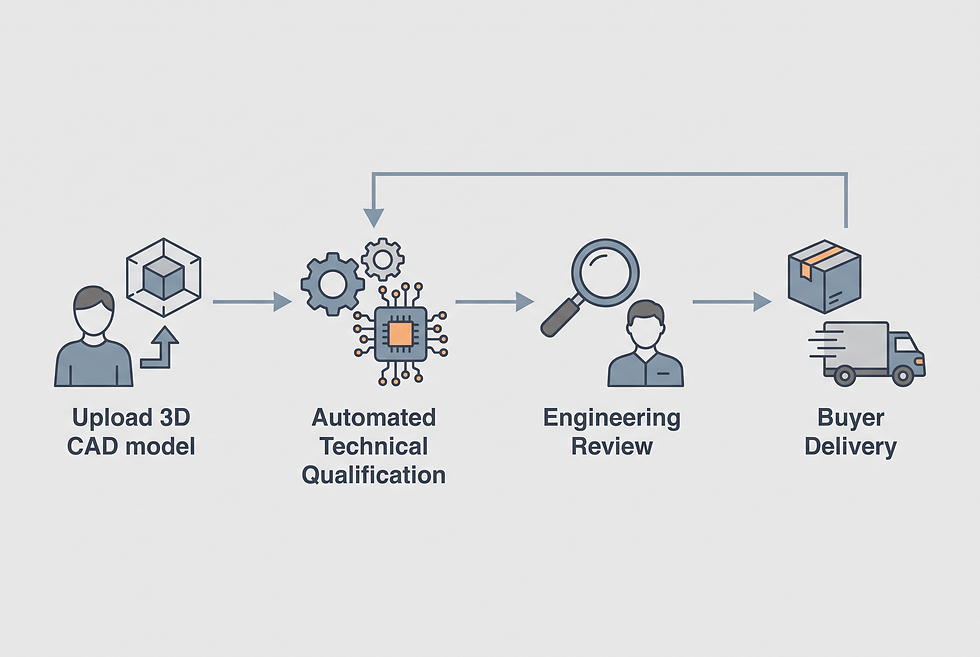
Modern cross-border trust generation relies on a closed-loop six-step operational architecture that unites automated qualification with experienced engineering oversight:
Inbound Data Ingestion & Technical Extraction: Technical inquiries arriving via RFQ portals, CAD file uploads, or direct engineering emails are ingested into a structured parser. The system extracts geometric requirements, target alloy grades, volume expectations, surface treatment specifications, and delivery timelines.
Automated Feasibility & Credibility Cross-Check: A specialized technical qualification system cross-references the extracted parameters against the factory's certified equipment envelope, machine tool precision limits (such as 5-axis CNC tolerance bounds), tooling availability, and active material lot certifications.
Contextual Proof Assembly: The system retrieves identical or closely matched historical production runs, non-confidential coordinate measuring machine (CMM) inspection reports, third-party material mill test certificates (EN 10204 3.1), and relevant quality test logs to demonstrate verified capability.
Human Engineering Review: A senior application engineer reviews the compiled technical dossier, confirms toolpath assumptions, verifies realistic factory lead times, and approves the preliminary engineering proposal within an internal dashboard.
Buyer-Facing Technical Dispatch: The overseas buyer receives a detailed preliminary response containing validated design-for-manufacturing (DFM) feedback, clear certification attachments, dimensional risk evaluations, and a transparent pricing breakdown within hours of the original inquiry.
Dynamic Feedback Loop & Audit Trail: Buyer engagement with the technical documentation is logged in the central CRM. Follow-up sequences adapt dynamically based on whether the buyer engaged with metallurgical data, tolerance analysis, or compliance documentation, ensuring subsequent communications remain highly relevant.
Evidence and Results: Comparative Operational Analysis
Organizations implementing structured technical responsiveness show measurable improvements in buyer qualification speed, engineering efficiency, and quote conversion. The table below outlines how conventional export sales approaches compare against evidence-driven workflows:
Operating Metric | Traditional Export Approach | Evidence-Driven Trust Workflow |
Initial Technical Response Time | 48 to 96 hours across timezones | Under 2 hours with automated extraction |
RFQ Qualification Completeness | Missing 30–40% of technical variables | Structured capture resolves 95%+ of parameters |
Compliance Verification | Static PDF brochures on request | Automated retrieval of batch-specific mill test reports |
Engineering Review Burden | High administrative triage workload | Pre-compiled DFM dossiers for rapid engineer sign-off |
Quote-to-Order Conversion | High drop-off due to evaluation latency | Predictable progression through clear technical proof |
Post-Quote Clarification Cycles | 4 to 7 back-and-forth email rounds | 1 to 2 focused engineering review calls |
Data Consistency Across Reps | Variable based on individual sales skill | Standardized factory knowledge base across all inquiries |
By replacing manual email triage with structured technical qualification, exporters substantially reduce administrative friction. Plant engineers spend their time reviewing high-probability, well-documented opportunities rather than deciphering incomplete RFQs, while international buyers receive immediate confirmation that their technical requirements have been rigorously understood.
What Other Companies Can Learn: Replicable Operating Principles
Industrial manufacturing leaders looking to replicate this credibility framework should focus on four foundational principles:

1. Treat Technical Data as Primary Sales Collateral
Commercial persuasion in industrial sectors is built on engineering precision, not marketing rhetoric. Overseas buyers do not convert on emotional slogans; they convert on CMM inspection reports, surface roughness profiles, heat-treatment certifications, and validated cycle times. Organizing factory knowledge into instantly retrievable repositories allows commercial teams to provide rigorous proof instantly.
2. Eliminate Asynchronous Timezone Friction
Timezone differences should not stall an active engineering evaluation. By deploying continuous requirement verification workflows, overseas buyers receive immediate confirmation that their technical constraints have been parsed and understood, maintaining purchasing momentum while competitors sleep.
3. Maintain Clear Human-in-the-Loop Authority Boundaries
Automation must never overstate manufacturing tolerances or promise unfeasible delivery windows. Successful manufacturers use automated systems to extract, organize, and assemble evidence, while reserving final pricing approval, process guarantees, and contractual commitments for experienced plant engineers.
4. Provide Proactive Design-for-Manufacturing (DFM) Guidance
When a manufacturer identifies potential manufacturing bottlenecks or cost drivers in a customer's CAD model during the quoting phase, they demonstrate technical partnership rather than simple order-taking. Sharing constructive DFM insights early establishes the supplier as a high-value technical advisor.
What This Looks Like for Industrial Equipment & Machinery Exporters
For a packaging machinery manufacturer or an industrial robotics component supplier, this workflow translates directly into practical commercial execution. When an international plant engineer visits the exporter's platform seeking a custom conveyor system or robotic end-effector, they do not want a generic contact form.
They require an interactive engineering interface that evaluates payload capacities, cycle rates, electrical protocol compatibility (such as EtherCAT, Profinet, or Ethernet/IP), and CE/UL safety directives. By answering these questions systematically and presenting verified case histories from comparable manufacturing environments, the exporter turns an uncertain international inquiry into a high-confidence technical dialogue.
Similarly, for precision CNC machining suppliers, the automated qualification workflow extracts complex geometric tolerances, identifies required 4-axis or 5-axis machining operations, confirms material availability, and matches surface treatment specs with qualified subcontracting partners. The overseas procurement team receives a fully qualified technical response before their local business day ends, eliminating weeks of back-and-forth negotiation.
YTT AI Worker Mapping: Deploying the AI Export Sales Rep
To operationalize this methodology without overburdening existing engineering teams, industrial enterprises deploy specialized autonomous agents dedicated to cross-border commercial execution.
Worker Job Title: AI Export Sales Rep
Main Daily Tasks: Parses inbound international RFQs, extracts technical and CAD constraints, queries the internal factory knowledge base for corresponding material mill test reports and ISO certifications, identifies missing engineering parameters, and prepares draft DFM feasibility packages for engineering approval.
Primary Work Channel: Inbound RFQ portals, corporate email servers, and enterprise CRM pipelines.
Authority Boundary: Can autonomously collect requirements, perform preliminary feasibility screening, and issue standardized capability packages; cannot modify final binding contract pricing, guarantee non-standard delivery terms, or override engineering tolerance thresholds without manual sign-off.
First Value Event: Successfully parsing a complex overseas RFQ across timezones, validating all missing dimensional specifications, and delivering a verified technical qualification package to the buyer before local morning business hours.
Daily Report Result: Delivers a daily executive summary detailing all inbound overseas RFQ volumes, parameter completion rates, extracted engineering constraints, and prioritized deals awaiting final engineer sign-off.
FAQ
What is the biggest barrier overseas buyers face when evaluating foreign manufacturers?
The primary barrier is unverified technical capability and operational risk. Overseas buyers worry about dimensional deviations, material authenticity, delayed communication across time zones, and inadequate post-delivery technical support.
How do technical certifications influence B2B procurement decisions?
Certifications such as ISO 9001, IATF 16949, and accredited third-party lab test reports provide objective proof of process repeatability, significantly lowering the perceived risk for foreign procurement committees.
How does rapid RFQ qualification improve export conversion rates?
Immediate technical qualification eliminates the typical 48-to-72-hour email delay across timezones, capturing active buyer intent and resolving engineering ambiguities before competitors respond.
What role does human oversight play in automated technical qualification?
Human application engineers maintain final review authority over tolerance guarantees, binding price calculations, and production scheduling to ensure operational feasibility and prevent contractual errors.
Build a Trusted Global Growth System
Equip your manufacturing enterprise with structured technical qualification workflows that eliminate overseas buyer friction, demonstrate verified engineering capability, and accelerate international export revenues.


Comments