

How to Build a Global Robotics Sales Pipeline with AI and Brand Marketing
- Kelvin

- 12 minutes ago
- 6 min read
Robotics companies can build a robust global sales pipeline by integrating targeted international brand marketing with AI-powered sales automation to systematically capture, qualify, and nurture high-value technical inquiries across long sales cycles. Combining strategic digital outreach with intelligent, automated lead qualification ensures that engineering-heavy organizations convert raw global interest into highly qualified, sales-ready opportunities.
Why is traditional outbound selling failing, and how to build a global robotics sales pipeline instead?
Traditional cold outreach and generic email blasts fall flat in the robotics and industrial automation industry. Robotics systems represent high-value capital expenditure. Because of this, purchasing decisions involve multi-layered committees comprising plant managers, control engineers, procurement executives, and finance directors. Cold outreach rarely provides the technical depth or timing required to capture these buyers at the exact moment they are designing a new manufacturing line.
To address how to build a global robotics sales pipeline, manufacturers must shift from aggressive, manual outbound calling to a structured, inbound-led framework that establishes deep technical authority. Buyers of complex industrial equipment do not purchase from salespeople who lack domain expertise; they purchase from organizations that prove they can solve specific throughput, payload, reach, and integration challenges.
Establishing a global pipeline requires solving three systematic challenges:
Technical Specifications Mismatch: Capturing leads that are a poor fit for your standard product capabilities, draining valuable engineering resources during the discovery phase.
Time-Zone Delays: Losing high-intent global buyers because your regional sales team is asleep when an urgent RFQ arrives from Europe, North America, or Asia.
Customer Context Loss: Allowing vital technical requirements—shared across fragmented channels like WhatsApp, email, WeChat, and Zoom—to slip through the cracks as a deal progresses over several months.
Which robotics lead generation strategies work best for reaching international decision-makers?
To consistently generate high-value inquiries, exporters must implement comprehensive robotics lead generation strategies that attract buyers searching for specific automation solutions. Rather than promoting generic hardware, your marketing must target the real-world problems your systems solve, such as labor shortages in precision machining, cycle-time bottlenecks in automotive assembly, or packaging speed constraints in food production.
An effective inbound system relies heavily on overseas brand marketing for exporters. This positioning transforms your digital presence from a simple static catalog into an authoritative resource hub. When global buyers search for solution-oriented queries, your brand should be highly visible across their research journey.
Key inbound components include:
Generative Engine Optimization (GEO): Optimizing technical content so that AI-powered search engines (like ChatGPT, Gemini, and Google AIO) directly recommend your systems when buyers ask how to solve specific automation problems.
Interactive Engineering Tools: Deploying payload, reach, and cycle-time calculators on your website. This allows prospects to input their application parameters, instantly turning casual website traffic into rich, structured RFQs.
Educational Case Studies: Publishing highly detailed, industry-specific application notes that detail the exact integration challenges, safety standards (such as ISO 10218), and ROI achieved by your existing clients.

How can an AI sales agent for manufacturers qualify highly technical robotics inquiries?
Robotics inquiries are rarely straightforward. A typical inquiry might contain a 3D CAD layout, a detailed component specification sheet, and a list of cycle-time targets. Sorting through these technical packages to separate viable leads from low-probability inquiries is a massive bottleneck for industrial sales teams.
Deploying an AI sales agent for manufacturers solves this constraint by acting as a 24/7 digital pre-sales engineer. Using an advanced system like YTTAI Sales Master, the AI agent instantly parses incoming complex technical requests, cross-references them with internal product databases, and performs initial qualification.
This intelligent automated agent qualifies inquiries based on three critical vectors:
Ideal Customer Profile (ICP) Fit: The AI reviews the prospect’s company profile, factory location, and industry vertical to ensure they match your strategic target markets.
Technical Compatibility: By reading the uploaded technical requirements, the AI assesses whether your standard robotic arms, grippers, or software systems can meet the requested payload, speed, and precision specifications.
Intent and Budget Urgency: Through responsive, multi-turn conversational interactions, the AI identifies whether the prospect has an active project budget or is merely gathering general estimates for a future fiscal year.
How do you implement B2B sales automation for industrial equipment to prevent customer context loss?
In long-cycle sales, the greatest enemy of conversion is information decay. Important details discussed in initial emails are often omitted during technical design meetings, leading to incorrect quotes, design revisions, and lost trust. Implementing B2B sales automation for industrial equipment must focus heavily on preserving the continuous thread of communication.
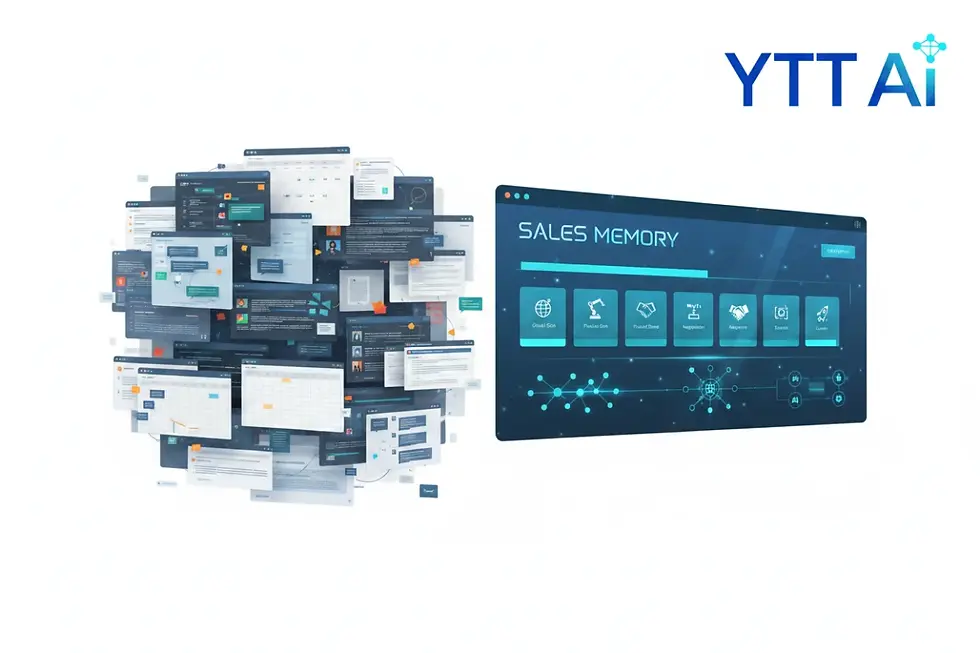
YTTAI's core technology solves this with Sales Memory. Sales Memory automatically organizes and archives every customer interaction across all communication channels—including email, messaging apps, and virtual meetings—into a single, unified profile.
When multiple stakeholders from the buyer's company interact with different representatives from your team, Sales Memory ensures that no context is lost. If an automation engineer mentions a specific floor space limitation on a WhatsApp chat, that constraint is automatically highlighted in the system when your application engineer drafts the final system layout. This seamless transfer of knowledge eliminates repetitive questioning and shows global buyers that your organization is highly professional and deeply aligned with their needs.
What is the best multi-channel follow-up workflow for securing long-cycle robotics contracts?
Because robotics procurement cycles can easily last from six months to over a year, deals frequently stall because sales teams fail to maintain consistent communication. When sales representatives get busy with active proposals, they neglect dormant or mid-funnel leads.
A systematic Sales Follow-up cadence ensures your brand remains top-of-mind. Rather than sending generic, low-value "just checking in" emails, the automated follow-up workflow prompts your sales team to share highly targeted, technical touchpoints that keep the project moving forward.
An optimal follow-up sequence for a global robotics prospect looks like this:
Day 1 (Immediate Response): The AI system delivers a structured confirmation email in the buyer's native language, summarizing their technical constraints and requesting any missing payload or environment details.
Day 5 (Educational Value): The system shares a case study detailing a similar integration in the buyer's specific industry sector, illustrating how another company resolved similar throughput challenges.
Day 15 (Technical Deep-Dive): The AI offers an invitation to a customized virtual demonstration of the robotic arm's software interface or offline programming environment.
Day 30 (Value-Added Re-engagement): The system sends an updated guide on international safety compliance standards or a whitepaper on calculating the total cost of ownership (TCO) for robotic cells.
How should a global robotics exporter design its Revenue Operations (RevOps) tech stack?
To manage a global sales pipeline without dramatically expanding administrative headcount, exporters must transition from traditional, siloed sales tools to an integrated, AI-driven Revenue Operations (RevOps) architecture.
The table below outlines the structural differences between a traditional, manual export sales department and a modern, AI-integrated RevOps framework:
Operational Component | Traditional B2B Export Model | Modern AI-Driven RevOps (YTTAI) |
|---|---|---|
:--- | :--- | :--- |
Lead Capture & Routing | Static contact forms; manual routing based on geography, leading to delays. | Multilingual AI chat and dynamic technical forms with instant routing. |
Technical Qualification | Manual engineering review; takes 3 to 7 business days per RFQ. | Instant AI parsing of CAD files, payloads, and specifications. |
Data Integrity | Manual CRM entry; critical technical context is lost across emails and WhatsApp. | Unified Sales Memory capturing cross-channel context automatically. |
Nurturing & Follow-Up | Irregular, manual follow-up; sales reps forget dormant leads after 2-3 attempts. | Automated, personalized Sales Follow-up triggers based on behavior. |
Global Communication | Constrained by local team working hours and native language capabilities. | 24/7 technical communication in multiple languages with localized engineering terms. |

By unifying your global lead generation, qualification, and follow-up workflows into a single system of intelligence, your human sales professionals can focus exclusively on high-value consultations, solution design, and final contract negotiations.
Ready to transform your global sales process and eliminate lead leakage? Request a Growth Assessment with YTTAI today to build a modern, high-converting robotics pipeline.
FAQ
How does an AI sales agent handle highly customized or non-standard technical robotics requests?
When an inquiry contains highly customized engineering requirements, the AI sales agent analyzes the text using its trained knowledge base. It extracts key variables such as payload, reach, and material constraints, matches them against past project records in the Sales Memory, and drafts a technical summary. If the request requires custom design, the system automatically flags the lead and escalates it to a human application engineer for custom configuration.
Can we integrate the AI sales workflows with our existing CRM, like Salesforce or HubSpot?
Yes. YTTAI’s AI-powered workflows are designed to integrate seamlessly with major enterprise CRMs, including HubSpot and Salesforce. The AI syncs contact details, communications logs, and custom technical fields directly into your existing CRM, ensuring your current revenue operations run smoothly without interruption.
How does the system handle multi-language communication for global buyers in Europe or Latin America?
The AI Sales Master features native multilingual capabilities. It can receive technical specification documents, emails, or chat messages in languages such as German, Spanish, French, or Japanese, analyze them with full contextual understanding, and reply instantly in the buyer's native language using accurate local industrial and engineering terminology.


Comments