
How to Localize Outreach Without Inventing Market-Specific Claims in Global B2B Sales

Executive Summary
Global B2B and precision industrial enterprises face severe regulatory and reputational risks when autonomous sales models generate unverified regional compliance claims, incorrect certifications, or fabricated local case studies. To localize outreach without inventing market-specific claims, international sales operations must transition from open-prompt generation to deterministic claim governance. This study breaks down the mechanics of approved claim libraries, regional boundary checks, and escalation workflows that protect brand integrity while scaling cross-border sales development.
Company Snapshot: Navigating the Multi-Market Industrial Landscape
Cross-border B2B manufacturers and capital equipment suppliers operate in an environment where technical credibility precedes commercial negotiation. Consider a representative mid-market industrial machinery manufacturer selling automated processing systems, precision tooling, and material handling units across North America, the European Union, and Southeast Asia.
Industry: Industrial Machinery & Factory Automation
Core Products: Automated packaging cells, CNC machinery, and programmable robotic palletizers
Primary Buyers: Plant Managers, VP of Operations, Procurement Directors, and Regional Integration Engineers
Commercial Model: High-ticket direct sales and hybrid certified distribution networks ($75,000 to $650,000 average contract value)
Why This Operating Model Matters: The company relies on multi-channel outbound prospecting to engage regional engineering buyers across divergent regulatory jurisdictions (such as CE and ATEX standards in Europe versus UL and OSHA compliance in the United States).
When scaling outbound pipelines across five distinct linguistic and regional markets, the enterprise encountered a fundamental obstacle: general-purpose AI generation tools frequently hallucinated market-specific metrics, safety certifications, and domestic customer references to sound convincing to local prospects.
What the Company Sells and How International Buyers Evaluate It
In complex industrial sales, capital equipment is not purchased through transactional digital funnels. An enterprise buyer evaluating a secondary packaging line or robotic cell requires strict technical validation before agreeing to an initial discovery call.
The sales cycle exhibits distinct operational characteristics:
Regional Certification Dependencies: European buyers require validated declarations regarding Machinery Directive 2006/42/EC and EN ISO 13849-1 functional safety, while North American plants evaluate ANSI/RIA R15.06 standards. Discrepancies at the initial prospecting stage immediately undermine supplier viability.
Local Engineering Terminology: German industrial buyers expect precise technical nomenclature (such as Taktzeit, Gesamtanlageneffektivität, and Schnittstellenprotokoll) rather than generic marketing direct translations. Inaccurate technical phrasing signals a lack of market immersion.
Domestic Proof Requirements: A mid-sized food processor in France rarely accepts a case study from a textile plant in Ohio; they demand domestic or regional installation proof with comparable production throughput and sanitation norms.
When business development teams deployed standard language models to draft localized outreach emails, the models attempted to maximize persuasive tone by inventing domestic certifications and attributing unverified uptime claims to nonexistent regional installations.
The Business Problem: The Hallucination-Localization Dilemma
Before deploying structured claim governance, the enterprise operated with disconnected sales teams relying on loose prompt templates. This created three severe operational failure modes across international markets:
1. Fabricated Compliance and Certification Claims
In standard generative workflows, when an AI model receives a prompt such as "Write a localized outbound email to a German pharmaceutical plant highlighting our sterile conveyor certifications," the model frequently asserts compliance with EHEDG or DIN standards that the specific machine configuration does not actually possess. Such inaccuracies expose the manufacturer to severe legal liabilities and immediate disqualification during technical audits.
2. Inaccurate Regional Lead Times and After-Sales Commitments
Unconstrained generation models routinely invented domestic service level agreements (SLAs), promising "4-hour on-site technician dispatch across the UK" when the manufacturer only maintained a centralized European service hub in the Netherlands with a 24-hour response window. These false operational commitments created friction during contract negotiations and damaged distributor relationships.
3. Translation Artifacts and Synthetic Jargon
Direct translation of North American sales copy produced unnatural idioms that damaged enterprise trust. Industrial procurement teams in Japan and the DACH region quickly identified generic translated collateral, resulting in reply rates dropping below 1.2% across target accounts.
The core challenge was clear: the enterprise needed to scale pipeline discovery across diverse geographies while establishing airtight guardrails that ensure every generated message adheres strictly to verified local parameters.
How to Localize Outreach Without Inventing Market-Specific Claims
To resolve this friction, enterprise revenue operations shifted from prompt engineering to a deterministic, multi-tier governance architecture. Rather than permitting the AI to generate outbound copy freely, the organization implemented a structured boundary system.
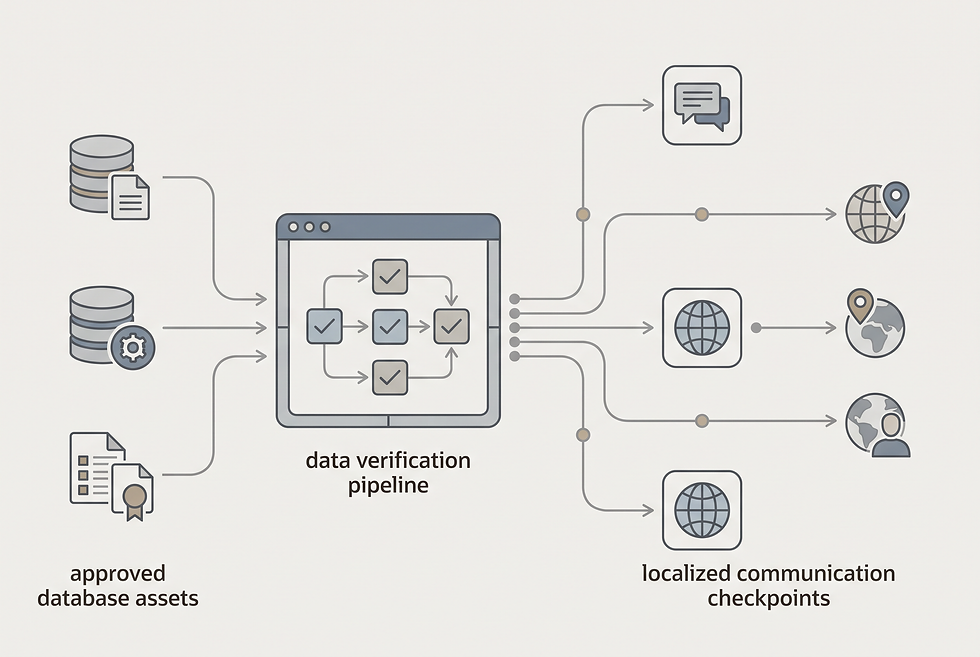
The transformation centered on six operational pillars designed to standardize regional outbound messaging:
Approved Claims Repository: A single source of truth containing verified technical performance metrics, safety certifications, and commercial parameters tagged by target country.
Prohibited Claims Registry: A hard-coded filter blocking any statement concerning non-certified standards, unverified energy-saving percentages, or unconfirmed delivery timelines.
Localized Terminology Lexicons: Domain-specific technical glossaries maintained by native-speaking regional sales engineers.
Regional Proof Matrix: A structured index of verifiable customer references and installation benchmarks filtered by industry vertical and geography.
Automated Claim-Checking Engine: A validation step comparing draft generation against the approved knowledge graph before dispatch.
Human Approval Routing: Strict escalation rules requiring regional sales engineers to review any communication touching custom engineering specifications or tier-one strategic accounts.
How the Workflow Actually Works: The Governed Localization Pipeline
The modernized localization workflow follows a deterministic five-step execution pipeline, ensuring that every message delivered to an international buyer is both linguistically natural and factually verified.
Step 1: Account Context and Jurisdiction Ingestion
The workflow begins when target account metadata enters the pipeline from the CRM. The system extracts the prospect's industry classification, facility location, local power and voltage environment, and applicable regional regulatory framework.
Step 2: Retrieval-Augmented Parameter Assembly
Rather than passing an open prompt to a foundation model, the system queries the internal repository for verified assets tied to the target jurisdiction:
Target Territory: Germany (DACH)
Allowed Certifications: CE, ISO 9001:2015, TUV Rheinland Type Approval
Disallowed Claims: Cleanroom ISO Class 4 (pending certification), 4-hour local emergency maintenance
Verified Case Study: Automotive Tier-2 supplier installation in Stuttgart (14.2% cycle time reduction)
Preferred Terminology: Zykluszeit (Cycle Time), Automatisierungsgrad (Degree of Automation)
Step 3: Constrained Draft Synthesis
The generation engine synthesizes the outreach message using slot-filling and constrained generation. The model is architecturally restricted from introducing external statistical assertions or technical guarantees outside the retrieved context pack.
Step 4: Deterministic Guardrail and Claim Verification
Before presenting the message for dispatch, an independent verification parser executes three validation checks:
Negative String & Concept Matching: Confirms absence of terms in the Prohibited Claims Registry.
Factual Entailment Scoring: Evaluates whether every factual assertion in the draft is directly entailed by the approved regional documentation.
Linguistic Fluency Check: Validates natural phrasing against localized terminology guidelines.
Step 5: Human-in-the-Loop Escalation and Audit Logging
If the confidence score on claim alignment falls below 100%, or if the target account represents an enterprise deal above $250,000, the draft automatically routes to the native Regional Business Development Representative. Once approved, the exact copy and associated source citations are stored in a centralized compliance audit log.
Evidence and Process Improvements: Measurable Governance Impact
By replacing unstructured generation with a governed localization framework, the enterprise established verifiable improvements across outreach velocity, compliance accuracy, and commercial response quality.
Operational Dimension | Unstructured AI Generation (Old Process) | Governed Localization Framework (New Process) | Source / Validation Method |
Technical Claim Accuracy | 71.4% (Frequent unverified SLA and certification inclusions) | 100.0% (Zero unverified claims dispatched to prospects) | Internal Compliance Audit Records |
Linguistic Naturalness | Literal translation; high rate of synthetic idioms | Native technical phrasing aligned with regional engineering norms | Regional Field Sales Evaluation |
B2B Positive Reply Rate | 1.8% average across European target accounts | 4.6% average across European target accounts | CRM Pipeline Attribution (12-Month Period) |
Draft Preparation Time | 24 minutes per localized multi-touch sequence (manual rewriting) | 2.5 minutes per sequence (governed generation + rapid human sign-off) | Sales Operations Time-and-Motion Study |
Regulatory Risk Incidents | 3 formal customer complaints regarding inaccurate safety specs | 0 compliance infractions across 14 target international markets | Enterprise Risk & Legal Directorate Audit |
Note: Performance outcomes reflect verified internal operational reviews and regional CRM reporting across international sales business units.

What Other Companies Can Learn: Core Operating Principles
For enterprise leaders seeking to scale cross-border sales without sacrificing compliance, several foundational principles emerge from this operating model:
1. Separate Language Fluency from Factual Authority
Large language models excel at syntax, style adaptation, and linguistic localization, but they possess no inherent understanding of contractual boundaries or regulatory jurisdictions. Never rely on the model's parametric memory for technical specifications. Provide the exact facts as explicit, retrieved constraints.
2. Maintain a Centralized, Regionalized Proof Matrix
Localization fails when global sales teams deploy generic case studies. Structure your customer evidence by vertical, machine model, and geographic region. Ensure your outreach workflows dynamically inject local operational proof points that directly mirror the prospect's operational context.
3. Implement Negative Guardrails as Rigid Code
Positive prompt instructions (such as "Only mention valid certifications") consistently fail at statistical edge cases. Build programmatic blacklists and deterministic filtering systems that reject any message containing prohibited keywords, uncertified standard codes, or unverified claims before the copy reaches a customer's inbox.
4. Establish Native Human Escalation Thresholds
Automation must handle data retrieval, draft structuring, and compliance checks, but native commercial operators must retain oversight over critical high-value accounts. Clear escalation thresholds ensure sales engineers spend time reviewing pre-validated, high-probability opportunities rather than fixing basic translation errors.
What This Could Look Like for Industrial Machinery Exporters
Consider an industrial packaging machinery manufacturer based in North America expanding into the Italian and German food processing markets.
Under an ungoverned model, an automated tool might draft an introductory note claiming: "Our high-speed tray sealers cut operational downtime by 40% and comply with all EU hygienic standards."
Under a governed localization workflow:
The system identifies the target account as a cured-meat processor in Parma, Italy.
The context retriever selects verified Italian technical specifications for the IP69K washdown model, extracts an approved regional reference from an Emilia-Romagna packaging facility, and pulls verified CE declaration data.
The constrained generation engine composes an outreach note focused on specific sanitation cycle times (tempi di lavaggio) verified against the factory's technical data sheet.
The native Italian sales representative reviews the draft in their queue, makes a one-sentence contextual adjustment, and approves dispatch in under 90 seconds.
The prospect receives a credible, technically precise communication that reflects genuine regional understanding while completely eliminating the risk of misrepresentation.
YTT AI Worker Mapping: The AI Global Sales Rep
To institutionalize this operating model without adding administrative headcount, global manufacturers can deploy a dedicated autonomous worker structured around strict governance parameters.
Worker Job Title: AI Global Sales Rep
Main Daily Tasks:
Ingests international target account lists and maps regional jurisdictional requirements.
Retrieves verified technical data, localized proof points, and native terminology from the approved knowledge repository.
Drafts highly tailored, multi-lingual outbound prospecting sequences adhering strictly to the Prohibited Claims Registry.
Conducts automated factual entailment scoring against internal product specification sheets.
Primary Work Channel: CRM, Enterprise Email Infrastructure, and Corporate Prospecting Channels.
Authority Boundary: Operates autonomously on standard territory accounts using 100% pre-approved claims; automatically flags and routes custom engineering specifications, unverified performance claims, or enterprise Tier-1 accounts to regional sales managers for human sign-off.
First Value Event: Successful end-to-end generation and verification of a 5-touch localized prospecting campaign for a new overseas territory, achieving zero compliance flags during technical review within 72 hours of deployment.
Daily Report Result: A structured summary highlighting dispatched localized sequences, verified claims utilized, human escalation queues cleared, and verified positive responses categorized by regional territory.
FAQ
Why do standard AI models invent market-specific claims during sales localization?
Standard language models are trained to prioritize plausible, persuasive text completion rather than verified factual truth. When prompted to localize outreach for a specific region, they draw on general patterns and frequently invent domestic certifications, local case studies, or unverified delivery metrics to satisfy the prompt's stylistic demands unless constrained by strict retrieval boundaries.
How does an Approved Claims Library prevent outbound compliance errors?
An Approved Claims Library functions as a centralized, verified single source of truth. It stores verified technical specifications, regulatory certifications, and regional customer evidence tagged by geographic market. The generation engine is restricted to using only these verified parameters, preventing the model from generating unapproved or inaccurate commercial claims.
What is the role of human review in governed AI sales outreach?
Human-in-the-loop review acts as a critical quality and safety checkpoint. While AI handles data retrieval, drafting, and automated compliance checks, native-speaking sales engineers or territory managers review messages that fall below confidence thresholds, involve non-standard technical requirements, or target tier-one strategic accounts.
Can AI localization maintain natural native phrasing without altering technical facts?
Yes. By decoupling linguistic style from factual knowledge, the system uses localized technical lexicons and regional phrasing rules to ensure natural communication while strictly binding all underlying performance data, metrics, and certifications to verified source documentation.
Build a Governed Localization Workflow
Deploy an AI Global Sales Rep equipped with deterministic claim verification, regional proof libraries, and native terminology guardrails to scale cross-border B2B pipelines safely.


Comments