
How to Qualify Website Inquiries Before Assigning Them to Sales: A B2B Routing Framework

Executive Summary: Industrial equipment and precision component manufacturers frequently lose high-value contracts because quota-carrying sales engineers spend disproportionate time manually reviewing unqualified form submissions, catalog requests, and incomplete RFQs. When industrial enterprises systematically qualify website inquiries before assigning them to sales, commercial teams eliminate inbound triage latency and protect technical engineering capacity. By structuring qualification around six core operational dimensions—Fit, Intent, Urgency, Technical Readiness, Timeline, and Decision Role—industrial suppliers can triage inbound volume within minutes, ensure accurate human-in-the-loop escalation, and dramatically increase win rates on complex enterprise opportunities.
Company Snapshot: Commercial Operations in Precision Equipment Manufacturing
To understand the operational bottlenecks in industrial intake qualification, consider the structural profile of a mid-market machinery and engineered subassembly manufacturer. Operating with annual revenues between $40 million and $180 million, such enterprises design and fabricate precision CNC machine tools, automated packaging systems, high-pressure fluid valves, and custom engineered-to-order (ETO) processing skids.
The commercial model of these manufacturers depends on high-touch technical consultation rather than transactional sales. Average contract values (ACVs) range from $45,000 for standard modular replacement units to more than $600,000 for fully integrated production line installations. The primary buyer committee consists of plant engineering directors, manufacturing operations executives, VP-level supply chain leaders, and tier-1 corporate procurement officers. In this environment, purchasing decisions demand multi-stakeholder technical alignment, strict regulatory compliance reviews, and detailed feasibility validation before commercial terms can be finalized.
What the Company Sells: Highly Engineered Solutions and Specification Friction
Industrial manufacturing products are governed by complex operating parameters: geometric tolerances, structural tensile strengths, operating temperatures, cycle throughputs, voltage constraints, and raw material certifications. Consequently, buyers cannot make instant digital purchases via self-service e-commerce.
When a prospective client visits an equipment manufacturer's digital portal, their research journey includes downloading CAD files, reviewing engineering whitepapers, requesting customized application engineering advice, or submitting an online Request for Quote (RFQ). However, because these products must interface seamlessly with existing plant architectures, quote generation requires deep technical discovery. If an inbound inquiry lacks critical operating specifications—such as line duty cycle, fluid viscosity, or facility footprint dimensions—a commercial sales engineer cannot calculate component costs or propose a solution. Therefore, the intake process requires structured technical discovery before any formal commercial negotiation can begin.
The Business Problem: Triage Paralysis and the Qualified Lead Bottleneck
In standard B2B industrial operations, all digital form fills, generic email inquiries, and RFQ submissions flow directly into a central email inbox or an unsegmented CRM lead queue. In most organizations, senior Application Engineers (AEs) or Regional Sales Directors are tasked with manually opening, reading, and triaging each inbound message. This legacy triage process creates four major operational points of failure:
Severe Response Latency on Tier-1 Prospects: According to the Harvard Business Review's study on sales lead management, firms that contact prospective customers within an hour are nearly seven times more likely to qualify the lead compared to those waiting even two hours. In custom manufacturing, where inbound inquiries sit in unassigned inboxes for 48 to 72 hours awaiting manual review, high-intent enterprise buyers often contact competing suppliers who respond faster with technical validation.
Application Engineering Resource Dilution: Sales engineers routinely spend 35% to 45% of their working hours chasing missing baseline specifications—emailing prospects to request CAD files, power availability, operating temperature ranges, and facility locations—only to discover that the contact is an academic researcher, a student, or a competitor benchmarking prices.
Inconsistent Rep-Level Subjectivity: Without programmatic rules, inquiry assignment relies on ad-hoc geographic territory spreadsheets or subjective rep judgment. Inquiries containing multi-facility requirements or specialized technical parameters are frequently misrouted to junior sales reps who lack the application knowledge to qualify them, resulting in stalled conversations and pipeline leakage.
Lack of Clear System Boundaries: Many organizations either burden sales staff with low-grade inquiries or rush to automate sales without guardrails, leading to inaccurate automated pricing quotes or mishandled enterprise relationships.
What Changed: Deploying a Multi-Factor Pre-Sales Qualification Architecture
To overcome triage paralysis, progressive manufacturing enterprises implement an automated intake architecture designed to qualify website inquiries before assigning them to sales teams. Rather than treating all inbound form submissions as equal commercial opportunities, the organization separates automated technical qualification from high-touch commercial closing.
Under this modernized operating model, incoming inquiries pass through an automated evaluation layer that inspects six specific operational dimensions:
Ideal Customer Profile (Fit): Domain-level validation of enterprise industry vertical, estimated annual revenue, employee count, and geographic operational presence.
Commercial Intent: Distinction between educational asset downloads, academic research, vendor service solicitations, and active capital expenditure RFQs.
Operational Urgency: Verification of whether the inquiry addresses an urgent line-down scenario, an active plant expansion project, or exploratory long-term research.
Technical Readiness: Audit of provided technical data, including CAD file availability, operating duty cycles, tolerance parameters, and compliance standards.
Procurement Timeline: Assessment of the target commissioning date, installation milestones, and committed capital budget cycles.
Decision Authority Role: Identification of the prospect's organizational role (e.g., Plant Director, VP Operations, Sourcing Specialist vs. junior intern).
How to Qualify Website Inquiries Before Assigning Them to Sales: The Operational Workflow
The modernized qualification mechanism operates across six deterministic steps, integrating data enrichment, automated technical discovery, and strict human-in-the-loop escalation rules.
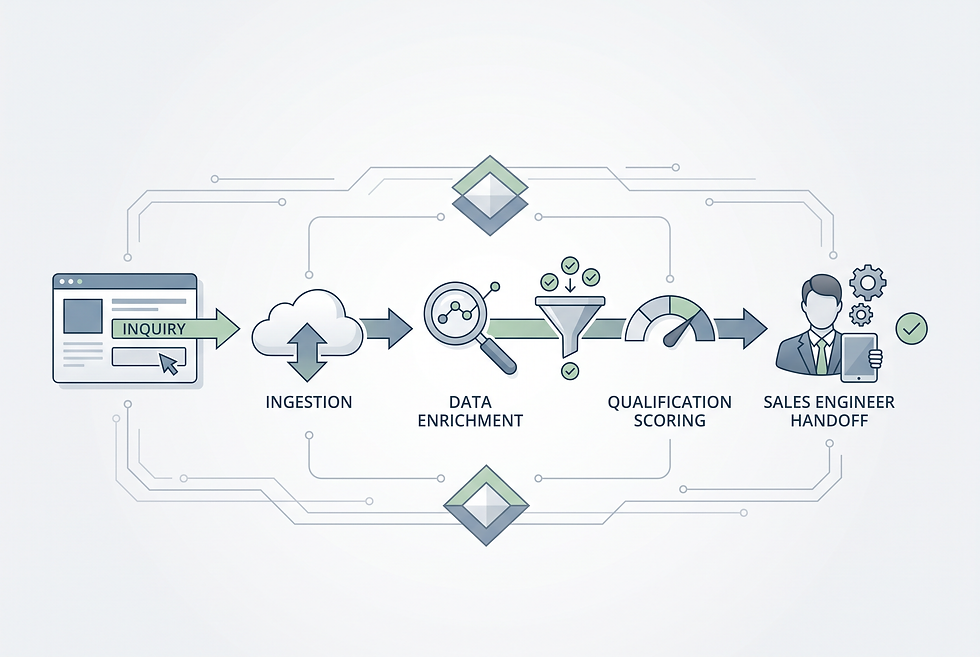
Step 1: Ingestion of Structured and Unstructured Inbound Data
When a prospect submits an RFQ form, requests engineering assistance, or interacts with a digital intake channel, the ingestion engine captures both structured data fields (business email, company name, phone, part number) and unstructured text (message notes, custom design constraints, attached engineering drawings, PDF spec sheets).
Step 2: Automated Firmographic and Parameter Enrichment
Prior to notifying any human team member, the system performs an immediate domain lookup against commercial firmographic databases to verify company registration, manufacturing footprint, parent entity structure, and annual revenue. Simultaneously, natural language processing models extract technical parameters from unstructured text, mapping tolerances, voltages, throughput requirements, and operating media into structured CRM properties.
Step 3: Execution of the 6-Factor Qualification Scoring Logic
The enriched payload is evaluated against the multi-factor scoring matrix, generating one of three operational routing decisions:
Priority Route A (Direct Commercial Escalation): Meets Fit (Enterprise/Tier-1), demonstrates High Intent (RFQ/Project), possesses Complete Technical Specs, and has a defined implementation timeline (<90 days).
Discovery Route B (Autonomous Clarification Loop): Meets Ideal Customer Profile Fit and Intent criteria, but lacks critical Technical Readiness data (e.g., missing drawings, operating pressure, or facility voltage).
Nurture Route C (Self-Service / Digital Nurturing): Fails ICP Fit thresholds (e.g., hobbyist, unverified personal email, unserviceable country) or represents low-intent catalog browsing.
Step 4: Autonomous Clarification Loop (For Route B Inquiries)
For inquiries flagged under Route B, the automated system immediately issues an autonomous clarification message on behalf of the application engineering department. It asks targeted questions: "To route your technical RFQ to our specialized tooling engineers, please provide your operating pressure requirements, material grade preference, and target monthly production volume." This eliminates manual follow-up emails by engineering staff.
Step 5: Context-Rich Handoff and Direct Engineering Calendar Booking
Once an inquiry achieves full qualification status, the system compiles a standardized Technical Brief containing verified firmographic attributes, extracted engineering specifications, and validated timelines. The system dynamically assigns the lead to the dedicated Regional Technical Sales Director or Application Specialist based on product line specialty and territory capacity, automatically providing a calendar booking link for a discovery call.
Step 6: CRM Closed-Loop Feedback and Scoring Optimization
Every qualified handoff outcome is logged in the CRM. If a sales engineer disqualifies an assigned lead during the technical discovery call (e.g., due to unfeasible chemical compatibility requirements), the rejection reason is logged. This feedback updates the qualification weighting parameters to continuously refine routing accuracy.
Structured Framework: Legacy Inbound Handling vs. Automated Multi-Factor Qualification
The following operational comparison contrasts traditional manual inquiry handling with a systematic, multi-factor qualification framework.
Operational Dimension | Legacy Manual Inbound Handling | Automated Multi-Factor Qualification Framework |
Initial Triage Latency | 24 to 72 hours awaiting manual inbox review | Under 5 minutes via real-time ingestion and scoring |
Technical Data Collection | 3–5 manual back-and-forth emails handled by sales engineers | Autonomous discovery loops collect required specs automatically |
Filtering Criteria | Subjective rep judgment and basic email domain checks | Algorithmic scoring across Fit, Intent, Urgency, Readiness, Timeline, Role |
Engineering Time Allocation | 35–45% of working hours spent on unqualified or incomplete inquiries | 85%+ of engineering hours focused on quote-ready enterprise deals |
Routing Precision | Broad geographic territory assignments with frequent re-routing | Multi-variable routing by product line, project scale, and rep capacity |
CRM Record Integrity | Incomplete notes with missing technical specification fields | Standardized Technical Brief automatically created before sales meeting |

Evidence and Results: Quantifiable Operational Gains
Industrial organizations that transition from manual triage to structured qualification workflows demonstrate measurable improvements across commercial velocity and conversion metrics:
According to LeanData's State of Lead Management Report, B2B organizations deploying automated, multi-factor lead routing frameworks experience up to a 45% reduction in overall sales cycle duration, primarily driven by the elimination of manual handoff delays between inbound marketing channels and specialized sales desks.
Furthermore, research published by the Sales Management Association indicates that industrial firms enforcing formal pre-sales qualification standards achieve 28% higher win rates on forecasted opportunities compared to organizations relying on informal rep-level screening. By shielding expensive application engineers from incomplete or non-viable submissions, companies accelerate quotation delivery for high-margin enterprise accounts.
What Other Companies Can Learn: 4 Strategic Implementation Principles
Industrial manufacturing leaders seeking to optimize their commercial intake workflows should adopt four foundational principles:
Establish Non-Negotiable Sales-Ready Data Thresholds: Never route an inbound submission to a quota-bearing sales professional without verified baseline data. Define explicit mandatory fields (e.g., operating parameters, estimated project volume, and target delivery quarter) required for human assignment.
Automate Information Gathering, Not Just Lead Assignment: Routing an incomplete lead faster only accelerates internal frustration. The qualification system must autonomously gather missing technical attributes before triggering human handoff.
Define Rigid Human-in-the-Loop Authority Guardrails: The automated system may collect drawings, verify firmographic credentials, and schedule calendar appointments, but it must never negotiate commercial payment terms, issue binding price commitments, or guarantee custom engineering delivery dates without human sign-off.
Adapt Intake Scoring to Plant Capacity: When a specific manufacturing line operates at 95% utilization, the qualification engine should dynamically elevate the minimum threshold for that product line, ensuring sales engineers prioritize high-margin or long-term programmatic contracts.
What This Looks Like Across Industrial Sectors
Applying this qualification framework across distinct manufacturing verticals highlights how rules adapt to different engineering demands:
Industrial Automation & Robotics: The intake system validates payload limits, arm reach requirements, cycle speed targets, and facility power configurations, filtering out academic hobbyists and routing enterprise plant engineers directly to dedicated automation systems specialists.
Precision CNC Machining & Subcontract Manufacturing: The qualification system checks CAD file geometry, material specifications (e.g., 316L stainless steel vs. titanium), surface finish tolerances, and batch volumes (>10,000 units/year vs. one-off prototypes) before routing to cost estimation estimators.
Water Treatment & Industrial Fluid Handling: The workflow validates volumetric flow rates, fluid viscosity, chemical corrosion profiles, and environmental compliance certifications before assigning the inquiry to a certified fluid application engineer.
YTT AI Worker Mapping: Deploying the AI Technical Sales Rep
To execute this rigorous qualification framework continuously without adding administrative headcount, industrial equipment manufacturers can deploy a purpose-built AI Worker.
Worker Job Title: AI Technical Sales Rep
Main Daily Tasks: Ingests 100% of website form submissions, RFQ portal entries, and inbound technical emails 24/7; enriches corporate domain records; initiates autonomous clarification dialogues to gather missing operating parameters and CAD models; evaluates inquiries against the 6-factor qualification matrix; compiles standardized pre-sales Technical Briefs for engineering teams.
Primary Work Channel: Integrated directly with corporate web intake forms, technical RFQ inboxes, CRM platforms (such as Salesforce and HubSpot), and sales engineering scheduling software.
Authority Boundary: Fully authorized to conduct technical information discovery, request engineering files, verify firmographic fit, and book discovery meetings on sales engineering calendars. Strictly prohibited from providing unapproved pricing discounts, signing NDAs, or guaranteeing production lead times without sales management review.
First Value Event: Autonomous extraction of missing technical specifications and delivery of a complete, quote-ready Technical Brief to the assigned Application Engineer within 10 minutes of initial website submission.
Daily Report Result: An operational summary delivered every morning at 08:00 AM to the VP of Sales and Sales Operations, detailing: total inbound inquiries triaged, percentage classified as Tier-1 opportunities, volume of missing parameters successfully collected via automated clarification loops, and a list of high-value engineering meetings scheduled for the day.
FAQ
What are the most critical criteria to qualify website inquiries before assigning them to sales?
Industrial manufacturers must evaluate six foundational dimensions: Ideal Customer Profile Fit (company size, vertical, and revenue), Commercial Intent (active RFQ vs. informational asset download), Technical Readiness (complete CAD drawings, operating tolerances, and specifications), Project Urgency, Procurement Timeline, and the Decision Role of the submitter.
How does automated lead qualification protect application engineers?
Automated qualification prevents skilled sales engineers from wasting 35% to 45% of their working hours chasing basic missing data or handling unqualified hobbyists. Instead, engineers receive complete, pre-screened Technical Briefs ready for immediate feasibility analysis and quotation.
When should an automated qualification system hand off an inquiry to a human sales engineer?
A human handoff should occur immediately once an inquiry meets pre-defined thresholds for fit, commercial intent, and technical specification completeness, or whenever an enterprise customer requests complex custom engineering validation that exceeds automated discovery limits.
Can automated qualification handle unstructured technical inquiries and CAD attachments?
Yes. Modern qualification systems leverage natural language processing and technical parameter extraction models to parse unstructured email text and form notes, extracting operating metrics, part numbers, and project constraints into structured CRM fields.
Request a Lead Qualification Diagnosis
Discover how establishing an intelligent qualification and routing architecture can eliminate triage latency, protect your technical sales engineering capacity, and accelerate high-value industrial pipeline.


Comments