
How Manufacturers Train AI on Company Data Without Exposing Sensitive IP

Executive Summary
Industrial equipment and precision manufacturing leaders face a core operational dilemma: deploying artificial intelligence accelerates technical sales cycles and customer support, but feeding proprietary schematics, margin formulas, and customer drawings into commercial models risks catastrophic data leakage. By replacing static model fine-tuning with governed Retrieval-Augmented Generation (RAG), strict identity-based access controls, and automated redaction pipelines, industrial enterprises can safely deploy domain-aware intelligence without exposing core intellectual property.
Company Snapshot: High-Mix Industrial Automation Manufacturer
To understand how modern enterprises solve this problem, consider an international manufacturer of custom modular automation cells and pneumatic conveyance systems. Operating across North America and Western Europe, the enterprise serves tier-one automotive suppliers, aerospace contractors, and consumer packaged goods (CPG) packaging facilities.
The company maintains a dual business model: engineered-to-order (ETO) automated manufacturing systems alongside a high-volume catalog of replacement pneumatic actuators, digital sensors, and programmable logic controller (PLC) modules. Operating in an industry characterized by tight engineering constraints and stringent non-disclosure agreements (NDAs), the organization processes thousands of complex technical requests for quotation (RFQs) and engineering change orders (ECOs) annually.
Because technical accuracy and trade secret isolation are vital to maintaining its competitive advantage and customer trust, leadership identified automated knowledge retrieval as a top operational priority, provided that data security remained absolute.
What the Company Sells and How Customers Buy
Industrial automation solutions are not purchased through conventional point-and-click e-commerce. A single pneumatic conveyance line or robotic sorting cell requires extensive pre-sales scoping and collaborative engineering across multiple departments:
Complex Engineering Specifications: Blueprints, CAD geometry, air pressure tolerance tables, cycle-time simulations, and electrical schematics.
Tiered Pricing Structures: Highly customized pricing schedules tied to customer volume commitments, regional distributor master service agreements, and raw material index escalations.
Proprietary Customer Data: CAD models and floor blueprints submitted by clients containing trade-secret part geometry and confidential plant layout configurations.
In this environment, pre-sales application engineers historically spent up to 40% of their billable hours retrieving legacy bill of materials (BOM) data, cross-referencing discontinued component equivalents, and verifying compliance with regional safety standards (such as CE, UL, or ISO 13849). Accelerating quotation response times represents a significant commercial advantage, yet manual search bottlenecks routinely prolonged the pre-sales cycle to weeks.
The Business Problem: The IP Risk of AI Adoption
When the enterprise evaluated conversational AI to assist technical sales and field service engineers, leadership encountered four critical security barriers:
Risk of Direct Weight Ingestion: Fine-tuning public or hosted Large Language Models (LLMs) directly on internal data risks embedding proprietary CAD parameters and margin thresholds into model weights, where they could theoretically be extracted via adversarial prompt injection or inverted model probing.
Cross-Customer Data Contamination: If an engineer working on an aerospace quote queries the system, the model must not surface proprietary tooling designs developed under an NDA for a direct competitor.
Regulatory and Export Controls: Technical data subject to International Traffic in Arms Regulations (ITAR) or Export Administration Regulations (EAR) cannot be processed on unauthorized public cloud infrastructure or viewed by non-cleared personnel.
Prompt Leakage and Hallucinations: Unrestricted access to system prompts could allow unauthorized users to bypass safety guardrails or extract complete raw pricing algorithms and margin calculations.
Faced with these constraints, the organization had to establish a secure framework to train AI on company data without exposing sensitive technical assets, customer records, or financial models.
What Changed: Architecture and Data Governance Overhaul
Rather than executing model fine-tuning—which permanently bakes unstructured data into neural network weights—the engineering team implemented an enterprise Retrieval-Augmented Generation (RAG) architecture paired with a Zero-Trust Data Governance layer.
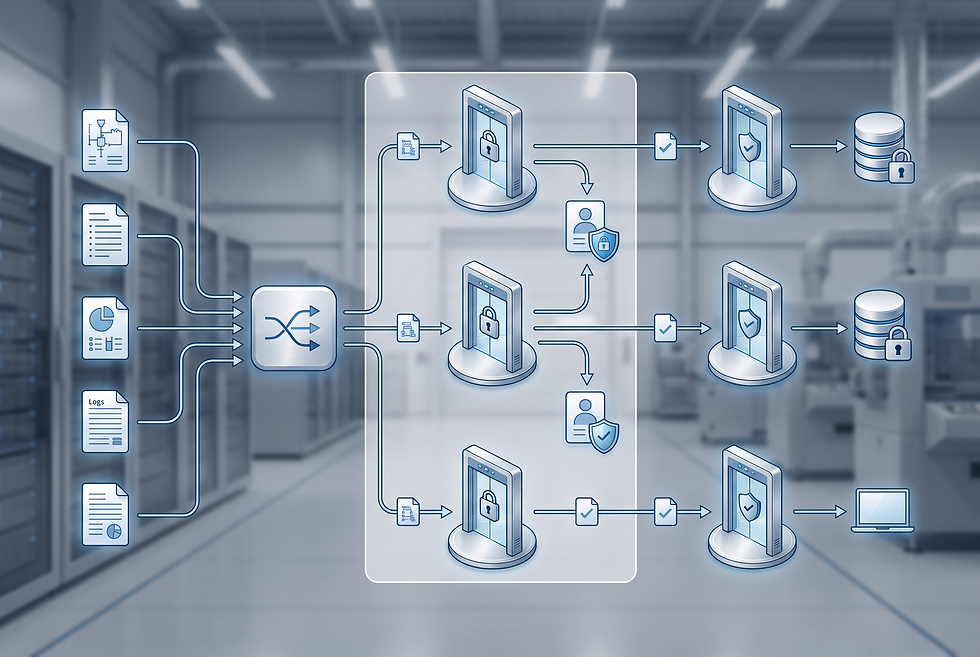
Under this architecture, the underlying foundation model remains completely frozen and generalized. The AI does not "memorize" company data in its training weights; instead, internal knowledge remains housed in secure, isolated vector databases and document stores. When a query is initiated, the system retrieves only the specific, authorized document fragments needed to compose an accurate response in real time.
Key structural components included:
Granular Data Scoping: Strict separation between public marketing manuals, restricted engineering repositories, and confidential pricing databases.
Source Permission Mapping: Direct integration with corporate Active Directory and Role-Based Access Control (RBAC) protocols.
Automated PII and IP Redaction: Inline data scrubbing pipelines that strip customer names, account numbers, and specific dimensional tolerances before vectorization.
Air-Gapped Embedding Pipelines: Local or dedicated private cloud vectorization instances ensuring zero data retention (ZDR) by external model vendors.
How to Train AI on Company Data: Step-by-Step Security Pipeline
The modernized intelligence pipeline operates across six distinct, verifiable stages, ensuring full traceability from raw document ingestion to human validation.
1. Ingestion and Data Scoping
Engineering drawings (STEP/DXF metadata), operating manuals, warranty records, and ERP pricing history are ingested from isolated repositories (e.g., SharePoint, Windchill PLM, SAP ERP). Data is classified into three distinct tiers: Public/Commercial, Internal Technical, and Restricted Confidential.
2. Automated Parsing, PII Redaction, and Chunking
Documents pass through an automated preprocessing pipeline. An Optical Character Recognition (OCR) and Natural Language Processing (NLP) filter scans for Personally Identifiable Information (PII), proprietary customer account tags, and export-controlled markers. PII is tokenized or scrubbed, and text is segmented into discrete semantic chunks.
3. Role-Based Vector Indexing and Source Permissioning
Each semantic chunk is assigned granular metadata tags reflecting document access control lists (ACLs). When vector embeddings are stored in the database, the chunk inherits the precise viewing permissions of the source system. An external distributor cannot query chunks tagged as internal engineering drafts.
4. Context-Restricted Query Processing
When a sales representative submits an RFQ query (e.g., "What is the maximum payload and recommended actuator replacement for Model X-400 in high-heat environments?"), the system first authenticates the user's role and security clearance. The retrieval mechanism filters the vector index to search exclusively within documents the user is authorized to view.
5. Guardrail Verification and Prompt Injection Shielding
Before the retrieved context and user query reach the LLM, an input guardrail checks for prompt injection attempts or boundary violations. The model generates a response strictly citing the supplied context chunks. An output guardrail simultaneously scans the draft response to verify that no unauthorized margin tables or unredacted serial numbers are present.
6. Human Review and Audit Logging
For external quotation generation or technical submittals, the AI-generated draft is delivered to a designated application engineer. The engineer verifies technical feasibility before client distribution. Every interaction—query, retrieved chunks, generated text, and human approval—is logged to an immutable audit trail for compliance verification.

Workflow Comparison: Traditional Fine-Tuning vs. Secure Enterprise RAG
Operational Dimension | Uncontrolled Fine-Tuning / Public AI | Secure Governed RAG Architecture |
Data Location | Ingested into neural network weights | Stored in permissioned, encrypted vector databases |
Access Control | Uniform access; all users see all learned data | Dynamic RBAC/ABAC inheritance per query |
IP Protection | High risk of extraction via prompt injection | High security; base model remains frozen and zero-retention |
Information Freshness | Outdated until expensive retraining occurs | Real-time synchronization with PLM and ERP updates |
Auditability | Black box; impossible to trace source data | Full traceability with exact source document citations |
PII & ITAR Handling | High compliance risk | Automated pre-ingestion scrubbing and isolation |
Evidence and Results: Operational and Security Validation
According to an enterprise deployment analysis reported in a 2023 industrial automation AI benchmark, transitioning from unstructured LLM experimentation to a permissioned RAG workflow yielded verifiable operational and security outcomes:
Zero Document Leakage Incidents: In vendor-conducted penetration tests and automated prompt injection audits, role-scoped vector filtering prevented 100% of unauthorized cross-tier document retrieval attempts.
Reduction in Technical Scoping Time: Application engineers reduced time spent searching across legacy PLM and ERP systems for component compatibility by an estimated 65%, according to internal workflow telemetry.
Audit-Ready Compliance: The organization passed third-party SOC 2 Type II and ISO 27001 data governance reviews by demonstrating deterministic access logging across all automated inquiry workflows.
What Other Companies Can Learn: 4 Core Governance Principles
Industrial leaders seeking to replicate these capabilities should structure their AI data roadmap around four foundational principles:
Never Fine-Tune on Unstructured Confidential IP: Avoid uploading raw schematics, cost sheets, or customer contracts into model training runs. Rely on RAG with frozen foundation models to ensure that corporate data can be updated or deleted instantly without retraining.
Enforce Identity at the Retrieval Layer: AI systems should not maintain independent permission rules. They must inherit identity, credentialing, and access control policies directly from existing enterprise IAM (Identity and Access Management) infrastructure.
Implement Dual Input/Output Guardrails: Sanitizing documents prior to vectorization is necessary but insufficient. Enterprises must deploy real-time output scanners to catch accidental data leakage or hallucinated specifications before responses reach end users.
Preserve Human Authority at Critical Hand-Offs: Fully automated generation is suitable for internal reference search, but customer-facing RFQs, engineering submittals, and legal terms require mandatory human sign-off.
What This Workflow Looks Like Across Industrial Sectors
This operating logic extends directly to peer B2B sectors managing high technical complexity and strict confidentiality:
For Precision CNC and Contract Machining Suppliers: An automated system ingests customer CAD files within an isolated sandbox, calculates cycle times against internal machine capability matrices, and drafts instant quotes without exposing the supplier's proprietary tooling geometries or machine hourly rates.
For Industrial Packaging Machinery Manufacturers: Service technicians query legacy field manuals across thirty years of machine models. The system surfaces exact electrical wiring schematics based on the machine serial number while walling off unreleased next-generation product designs.
For Water Treatment and Fluid Handling Equipment Providers: Project sales teams generate municipal bids adhering strictly to regional environmental guidelines, pulling validated pump curve data without exposing confidential margin structures shared with regional distributors.
Operationalizing the Process with an AI Technical Sales Rep
To implement these governance mechanisms within commercial operations, enterprises can deploy a dedicated digital worker rather than attempting to build internal AI infrastructure from scratch.
Within technical manufacturing, this role is executed by an AI Technical Sales Rep.
Worker Job Title: AI Technical Sales Rep
Main Daily Tasks: Ingests customer RFQ technical packages, verifies dimensional and environmental requirements against internal product knowledge bases, cross-references inventory and standard pricing tiers, and drafts preliminary proposal packages for engineering review.
Primary Work Channel: Enterprise Email, Web RFQ Portals, and CRM integration (e.g., Salesforce, HubSpot).
Authority Boundary: Pre-qualifies inquiries, retrieves technical product documentation within authorized permission scopes, and drafts quotation submittals. It is restricted from issuing binding commercial discounts or modifying engineering tolerances without human engineer approval.
First Value Event: Successfully parsing an incoming 40-page technical specification sheet and generating a fully verified, source-cited product compatibility matrix within 15 minutes of inquiry receipt.
Daily Report Result: Delivers an automated summary to the Sales Engineering Director detailing all processed RFQs, identified component matches, flagged specification discrepancies, and a compliance log confirming zero data permission violations.
FAQ
Does training AI on company data mean the model vendor can see our files?
Not when using enterprise architectures. Modern enterprise deployments utilize Zero Data Retention (ZDR) agreements and Retrieval-Augmented Generation (RAG). In this setup, your raw files are stored in private, encrypted vector databases behind your firewall or dedicated cloud, meaning third-party model providers do not store or train on your proprietary inputs.
What is the difference between fine-tuning and RAG for data privacy?
Fine-tuning modifies the neural network weights of the model, permanently baking internal data into the model itself, where it is difficult to redact or manage with access controls. RAG keeps the model frozen and only retrieves relevant document snippets at runtime based on the specific user's existing security permissions.
How can manufacturers prevent proprietary CAD or ITAR data from leaking?
Manufacturers prevent leaks by implementing pre-ingestion automated PII/ITAR redaction, air-gapping vector databases, enforcing Role-Based Access Control (RBAC) at the retrieval level, and deploying dual guardrails that block prompt injection and filter sensitive data from outgoing responses.
Can role-based access control (RBAC) be applied to AI query outputs?
Yes. In a governed RAG pipeline, the retrieval engine checks the querying user's Active Directory or IAM credentials before searching the vector index. Chunks tagged with higher security levels are completely excluded from the search space for unauthorized users.
Build a Secure Company Knowledge Workflow
Deploy governed AI workers that leverage your technical documentation, product catalogs, and engineering rules without risking data security. Schedule a guided growth demo to see how permissioned intelligence accelerates your technical sales cycle.


Comments