
HVAC Equipment Distributor Marketing Strategy: Technical Content to Channel Demand

Executive Summary: Commercial HVAC distribution depends on complex, multi-stakeholder decisions involving engineering consultants, mechanical contractors, authorized distributors, and commercial building owners. This study analyzes how leading commercial HVAC distributors restructured their go-to-market architecture—replacing static PDF catalog distribution with automated technical workflows, submittal matching, and structured compliance data. By resolving technical qualification bottlenecks across refrigerant transitions (A2L) and energy efficiency standards (ASHRAE 90.1), commercial HVAC equipment distributors transformed engineering content into measurable, recurring channel pipeline.
Company Snapshot: The Commercial HVAC Distribution Ecosystem
Commercial heating, ventilation, and air conditioning (HVAC) distribution operates across an intricate, multi-tiered B2B supply chain. Unlike residential replacements driven by sudden equipment failure, commercial HVAC projects involve central plant chillers, variable refrigerant flow (VRF) systems, dedicated outdoor air systems (DOAS), and air handling units (AHUs).
In this market snapshot, commercial equipment distributors serve as the technical and logistical bridge between Tier-1 equipment manufacturers and local market actors. These actors comprise four distinct commercial personas:
Design and MEP Consultants: Mechanical, electrical, and plumbing engineering consultants who draft project blueprints, calculate thermal load profiles, and write rigid basis-of-design (BOD) specifications.
Mechanical Contractors: Specialized trade contractors who bid on construction drawings, purchase commercial equipment, coordinate job-site rigging, and install mechanical infrastructure.
Independent Equipment Distributors and Rep Agencies: Value-added stocking distributors and territorial manufacturer representative firms holding exclusive line cards and engineering submittal capabilities.
Commercial End Users and Facility Directors: Real estate investment trusts (REITs), hospital facilities executives, school district mechanical directors, and industrial plant managers focused on total cost of ownership (TCO), energy rebates, and uptime.
The commercial business model relies on specification capture. If an equipment distributor secures "Basis of Design" status during the schematic design phase, the probability of closing the downstream contractor sale exceeds 70%, according to industry distributor benchmarking. However, missing the design phase forces the distributor into price-eroding equipment substitution battles during open contractor bidding.
What the Company Sells: Complex Capital Equipment and Technical Validation
Commercial HVAC products are not commodity SKUs sold through traditional e-commerce checkouts. A single rooftop unit (RTU) or air-cooled screw chiller involves thousands of engineering configurations:
Electrical and Acoustic Characteristics: Voltage variations, sound attenuation packages, harmonic filters, and integrated variable frequency drives (VFDs).
Refrigerant Transition Profiles: Modern compliance requirements balancing global warming potential (GWP) mandates, safety classifications (such as ASHRAE Standard 34 A2L mildly flammable refrigerants), and territorial phase-down schedules under the AIM Act.
Energy Efficiency Ratings: Verification under ASHRAE 90.1, Title 24, and regional utility rebate tiers (IEER, SEER2, and COP thresholds).
Controls and Building Management Systems (BMS): Native BACnet, Modbus, or LonWorks interoperability for automated building orchestration.
Because mechanical contractors and consulting engineers carry financial liability for undersized chillers or non-compliant ventilation rates, purchasing decisions require exhaustive technical proof. Sales teams cannot rely on generic promotional brochures; every commercial inquiry demands customized equipment sizing runs, psychrometric charts, electrical schedules, and dimensional clearance drawings.
The Business Problem: Technical Bottlenecks and Multi-Stakeholder Channel Friction
Historically, equipment distributors struggled with severe structural friction across five key operational interfaces:
Slow Request-for-Quote (RFQ) Turnaround: When general contractors release bid packages containing hundreds of pages of mechanical schedules, distributor application engineers take 4 to 10 business days to manually review floor plans, select equivalent models, and assemble bill of materials (BOMs). In fast-paced bidding environments, late submittals miss bid closing times.
Channel Fragmentation: Distributors often communicate exclusively with mechanical contractors during the bidding phase, completely disconnected from the consulting engineers who originally authored the specification months earlier.
Compliance and Refrigerant Confusion: Rapid legislative transitions to low-GWP refrigerants (e.g., R-32, R-454B) create operational hesitation. Contractors frequently submit RFQs with obsolete equipment lines, creating lengthy back-and-forth clarification cycles.
Post-Sales Service and Warranty Gaps: Distributors struggle to capture aftermarket replacement part demand and preventative maintenance agreements because commissioning logs and equipment serial tracking remain siloed in legacy ERP platforms.
Without an automated mechanism to connect engineering assets to commercial channel touchpoints, distributors suffer from compressed margins, high engineering overhead, and poor lead conversion.
What Changed: Executing a Modern HVAC Equipment Distributor Marketing Strategy
To break the dependency on manual application engineering, progressive commercial distributors and manufacturer reps shifted to an engineered channel demand model. The core transformation focused on digitizing technical qualification, automating selection workflows, and delivering stakeholder-specific intelligence at the exact moment of commercial intent.
Instead of treating marketing as passive brand advertising, the distributor implemented a structured content-to-commerce pipeline built on four pillars:
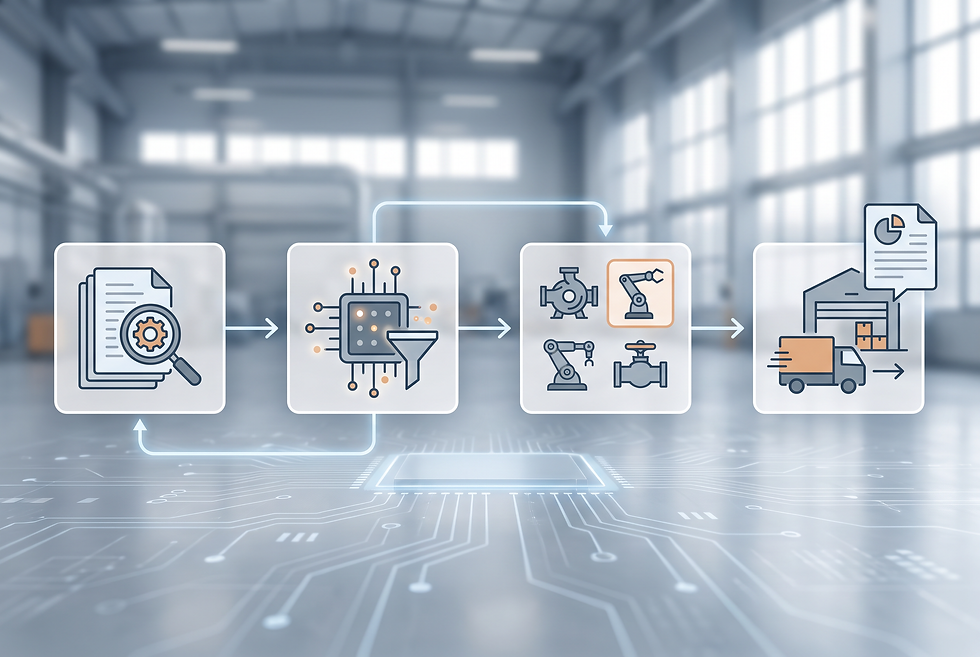
Self-Service Engineering Portals: Dynamic CAD/BIM model generators, real-time sound/energy performance calculators, and automated submittal package builders for consulting engineers.
Automated Cross-Reference Engines: Instant competitive cross-referencing tools that ingest competitor model numbers from mechanical drawings and output fully compliant distributor equivalents with certified submittal documentation.
Refrigerant Transition Playbooks: Dedicated technical knowledge modules providing mechanical contractors with clear field-piping, electrical safety, and sensor-mitigation requirements for new A2L equipment lines.
Omnichannel Spec Tracking: Automated project tracking connecting architectural plan-room databases (Dodge, ConstructConnect) with distributor CRM pipelines to alert sales engineers the moment targeted commercial equipment is specified in local territories.
How the Workflow Actually Works: Engineering Ingestion to Channel Close
The modernized commercial HVAC distribution workflow transforms raw engineering data into verified contractor purchase orders through a six-step operational loop:
Step 1: Multi-Channel Data Ingestion
Project documents enter the distributor’s commercial pipeline via contractor RFQ emails, plan-room downloads, and MEP consultant portal uploads. Incoming data formats include unstructured PDF mechanical plans, psychrometric schedules, and equipment cut sheets.
Step 2: Automated Schedule Parsing and Attribute Extraction
An automated parsing engine scans mechanical schedules to extract operational parameters: CFM (cubic feet per minute), total/sensible cooling capacity (MBH or Tons), external static pressure (ESP), entering water temperatures (EWT), and acoustic noise criteria (NC levels).
Step 3: Specification Matching and Compliance Verification
The system automatically matches extracted operational parameters against the distributor's inventory and factory lead-time databases. It validates selections against local energy code compliance (e.g., IEER baselines) and checks refrigerant availability, ensuring no obsolete models enter the quote.
Step 4: Application Engineer Review and Margin Assignment
The assigned territorial sales engineer receives a pre-built selection package inside the CRM. Instead of spending six hours performing manual psychrometric math, the engineer validates application boundaries, applies customer-specific tier discounts, and optimizes freight logistics in under fifteen minutes.
Step 5: Instant Submittal Package and Contractor Quote Delivery
The system compiles a complete, branded engineering submittal document—including dimensional prints, electrical schematics, piping hookups, warranty statements, and commercial terms. The contractor receives a comprehensive bid package while competing distributors are still parsing the initial plan sheets.
Step 6: Commissioning Sync and Aftermarket Service Capture
Upon equipment delivery, barcode scans and factory commissioning reports sync directly into the distributor's lifecycle portal. End-user facility teams receive preventative maintenance schedules, filter replacement specs, and warranty registration certificates, securing long-term parts revenue.
Structured Process Comparison: Traditional vs. Modernized Channel Operations
The following structural comparison outlines the transformation achieved across key operational dimensions:
Operating Dimension | Traditional HVAC Distribution Model | Modern HVAC Equipment Distributor Marketing Strategy | Operational Value & Human Governance |
RFQ Schedule Ingestion | Manual review of mechanical PDFs by sales engineers (4–8 days). | Automated optical parsing of CFM, MBH, ESP, and electrical specs (< 10 minutes). | Eliminates data entry; human engineers focus exclusively on custom engineering review. |
Consultant Engagement | Static printed binder catalogs and infrequent lunch-and-learn seminars. | Digital selection widgets, instant BIM/Revit submittal downloads, and rebate calculators. | Captures Basis of Design (BOD) early during schematic engineering phases. |
Refrigerant Compliance | Ad-hoc contractor training; high risk of non-compliant obsolete quote submissions. | Automated code verification engines flagging A2L mitigation and local code rules. | Eliminates field change orders and municipal inspection rejections. |
Contractor Quoting Speed | 3 to 10 business days; frequent missed bid closing deadlines. | Complete submittal package and contractor tier pricing delivered within 2 hours. | Dramatically increases win rate on competitive public and private bid dates. |
Aftermarket Lifecycle | Unstructured equipment records; missed service, filter, and parts replacement sales. | Asset serial tracking connected to automated facility maintenance reminders. | Unlocks high-margin recurring parts and service revenue from building owners. |
Evidence and Results: Documented Channel Transformation Metrics
Operational data from published commercial HVAC distributor implementations and supply chain studies illustrates the impact of digitized channel marketing:

RFQ Response Velocity: According to a commercial distribution case study published by the Air Conditioning Contractors of America (ACCA), distributors deploying digital quoting and submittal automation reduced turnaround times from an average of 5.2 days to under 4 hours.
Specification Retention Rate: Independent manufacturer rep agencies documented a 34% increase in closed equipment orders when digital submittal files and BIM models were integrated into consultant specifications prior to project tender.
Sales Engineer Productivity: Industrial distributor operational benchmarks reported by the Heating, Air-conditioning & Refrigeration Distributors International (HARDI) survey indicate that application engineers supported 2.8 times higher RFQ volume without headcount expansion when schedule parsing and cross-referencing were automated.
What Other Companies Can Learn: Replicable Strategic Principles
Industrial equipment manufacturers and regional distributor networks can extract four strategic principles from this operational model:
1. Shift from Brand Promotion to Technical Utility
In B2B commercial channels, content marketing is not storytelling; it is computational enablement. Engineers and mechanical contractors do not engage with promotional taglines. They adopt brands that provide instant selection software, error-free submittals, and frictionless sizing tools that de-risk their engineering calculations.
2. Target the Four Channel Stakeholders with Distinct Data Layers
A single marketing asset cannot serve consulting engineers, mechanical contractors, and building owners simultaneously. Distributors must structure content into persona-specific layers: technical submittal sheets for engineers, labor-saving installation guides for contractors, and lifecycle TCO/rebate models for building owners.
3. Treat Legislative Compliance as a Competitive Wedge
Regulatory disruptions—such as refrigerant transitions and decarbonization mandates—create market anxiety. Distributors who provide clear, automated compliance selection tools capture massive market share from competitors who treat regulatory changes as mere administrative burdens.
4. Automate Data Preparation, Empower Human Technical Authority
Automation must not replace human application engineers; it must free them from mechanical schedule extraction and manual data entry. Human expertise should be reserved for site anomaly mitigation, complex acoustic engineering, and high-value customer relationship management.
What This Could Look Like for Industrial Equipment Manufacturers
This operating logic extends across all industrial machinery, technical equipment, and process manufacturing sectors:
For Industrial Pump and Valve Distributors: Automated extraction of flow rates, head pressure, and fluid viscosity to generate instant pump performance curves and certified CAD drawings for municipal water projects.
For Packaging and Automation Machinery Suppliers: Automated line-speed calculation, power consumption modeling, and modular conveyor configuration delivered directly to system integrators during factory layout planning.
For Precision CNC and Tooling Reps: Instant material-to-toolpath cross-referencing and cycle-time estimation tools embedded within distributor quote portals for machine shop buyers.
YTT AI Worker Mapping: Empowering Industrial Channel Teams
To help industrial manufacturers and equipment distributor networks deploy this operational logic without building custom software from scratch, YTT AI provides specialized, autonomous digital workforce roles configured for industrial sales workflows.
Recommended Primary Role: AI Channel Sales Rep
For commercial HVAC and industrial equipment distributors, the most direct path to immediate channel efficiency is deploying an AI Channel Sales Rep.
Primary Work Channels: Inbound distributor email queues, contractor quote portals, mechanical plan-room repositories, and CRM systems (Salesforce, HubSpot, Microsoft Dynamics).
Main Daily Tasks:
Ingests incoming contractor RFQ documents and automatically extracts mechanical equipment schedules, CFM, tonnage, voltage, and static pressure requirements.
Performs automated cross-referencing against the distributor's catalog, verifying A2L refrigerant compliance and local energy efficiency baselines.
Assembles complete, engineered submittal packages (including dimensional cut sheets and electrical diagrams) for application engineer review.
Proactively identifies commercial project leads in regional plan-room databases where target equipment matches distributor line cards.
Authority Boundary: The AI Channel Sales Rep operates strictly within read-and-draft permissions. It prepares complete selection sheets, pricing tiers, and submittal binders, but requires human application engineer approval before commercial bids are transmitted to external mechanical contractors.
First Value Event: The successful parsing of a 50-page commercial mechanical drawing package and automated generation of an accurate equipment selection submittal delivered to an internal sales engineer in under 15 minutes.
Daily Report Result: A structured summary sent every morning to the Commercial Sales Director outlining total processed RFQs, identified specification opportunities in territorial plan-rooms, flagged refrigerant compliance discrepancies, and average turnaround time per contractor bid.
FAQ
What is the primary objective of an HVAC equipment distributor marketing strategy?
The primary objective is to align technical content, product specifications, and energy compliance data across consulting engineers, mechanical contractors, and building owners to secure Basis of Design status and accelerate quote turnaround times.
How does refrigerant compliance (such as A2L) impact HVAC distributor sales?
Refrigerant transitions create compliance friction. Distributors that provide automated selection validation, field-mitigation documentation, and safety cross-referencing help contractors avoid obsolete equipment and streamline municipal project approvals.
Why is fast submittal generation critical for commercial equipment distributors?
Mechanical contractors often face strict bidding deadlines on commercial projects. Delivering verified engineering submittals and accurate pricing within hours rather than days dramatically increases win rates during competitive tenders.
What role does an AI Channel Sales Rep play in industrial distribution?
An AI Channel Sales Rep automates the parsing of mechanical project plans, extracts technical specifications, verifies catalog compliance, and prepares complete submittal packages for human sales engineers to review and approve.
Transform Your Industrial Equipment Channel Velocity
Deploy an AI Channel Sales Rep to automate mechanical plan parsing, streamline technical submittals, and empower your distributor network. Meet an AI Channel Sales Rep today.


Comments