
Lead Generation for Packaging Machinery Companies: Modern B2B Playbook

Executive Summary: Packaging equipment manufacturers face extended sales cycles, complex engineering specifications, and fragmented global inquiries. Successful commercial teams no longer rely solely on trade exhibitions and passive contact forms. By systematizing technical qualification, structuring incoming RFQs, and accelerating inquiry triage, machinery builders turn technical discovery into qualified pipeline. This analysis breaks down the operating mechanisms behind effective lead generation for packaging machinery companies.
Industry Snapshot: The Packaging Machinery Landscape
Packaging machinery manufacturers operate at the intersection of heavy engineering, discrete automation, and fast-moving consumer goods supply chains. The global packaging machinery sector serves diverse industrial end-markets, including food and beverage processing, pharmaceuticals, cosmetics, chemical distribution, and e-commerce logistics. Manufacturers in this domain produce primary packaging systems such as form-fill-seal (FFS) machines, secondary packaging units like cartoners and case packers, and end-of-line robotic palletizing cells.
Commercial transactions in this sector are characterized by high average order values, custom engineering requirements, and cross-functional buying committees comprising plant managers, packaging engineers, procurement directors, and chief operating officers. Sales cycles routinely span six to eighteen months. Unlike standard catalog products, packaging lines must integrate with existing conveyor systems, respect strict floor space constraints, and meet rigorous throughput and sanitation compliance standards. Consequently, commercial success depends not merely on generating traffic, but on capturing precise technical intent and converting raw interest into verifiable capital expenditure projects.
What Packaging Machinery Companies Sell and How Buyers Procure
Packaging machinery companies do not sell standalone hardware in a vacuum; they sell line efficiency, reduced total cost of ownership (TCO), and output reliability measured in units per minute (UPM) or overall equipment effectiveness (OEE). The commercial path involves three distinct buying archetypes:
Contract Packagers (Co-packers): Driven by rapid turnaround times, extreme machine flexibility, and fast changeover capabilities across variable package formats.
Brand Owners and FMCG Producers: Focused on high-speed reliability, hygiene compliance (such as FDA or 3-A Sanitary Standards), digital traceability, and long-term aftermarket parts support.
Industrial and Chemical Converters: Focused on rugged construction, hazardous environment safety ratings (such as ATEX or Class I Div 2), and bulk handling capabilities.
Because procurement decisions involve multiple engineering and financial stakeholders, the typical buyer journey begins long before direct sales contact. Engineering teams research footprint schematics, material compatibility (e.g., recyclable films, rigid plastics, corrugate grades), and integration protocols with upstream processing equipment. When a buyer initiates contact, they expect deep technical competence, rapid line layout viability assessments, and transparent budgetary estimations.
The Core Business Problem in Machinery Lead Generation
The fundamental challenge in lead generation for packaging machinery companies lies in the friction between inbound inquiry quality and technical sales responsiveness. Industrial manufacturers face several operational bottlenecks across their commercial pipelines:
Slow Technical Inquiry Response: Inbound website leads and trade directory inquiries often take three to five business days to triage because sales teams must cross-reference product parameters with engineering departments before providing meaningful answers.
Incomplete RFQ Submissions: Up to 70% of initial buyer inquiries arrive through generic contact forms lacking essential parameters, such as target container geometry, production speed, product viscosity, film thickness, or sealing method.
Cross-Border Time Zone and Language Gaps: Export-oriented machinery builders frequently lose momentum when handling inquiries from North America, Europe, Southeast Asia, or Latin America due to time zone differences and delayed translation of technical specifications.
Sales Rep Misallocation: Highly compensated technical sales managers spend substantial hours disqualifying out-of-scope inquiries or manually chasing missing engineering specifications instead of closing qualified opportunities.
When high-intent buyers encounter friction or delayed responses, they immediately submit requests for quotation (RFQs) to competing domestic and international builders.
What Modern Industrial Leaders Changed
High-performing packaging equipment builders have shifted away from static digital brochures toward structured technical qualification architectures. Rather than treating lead generation as a superficial marketing activity, leading organizations treat it as an engineered workflow.
Key strategic adjustments include:
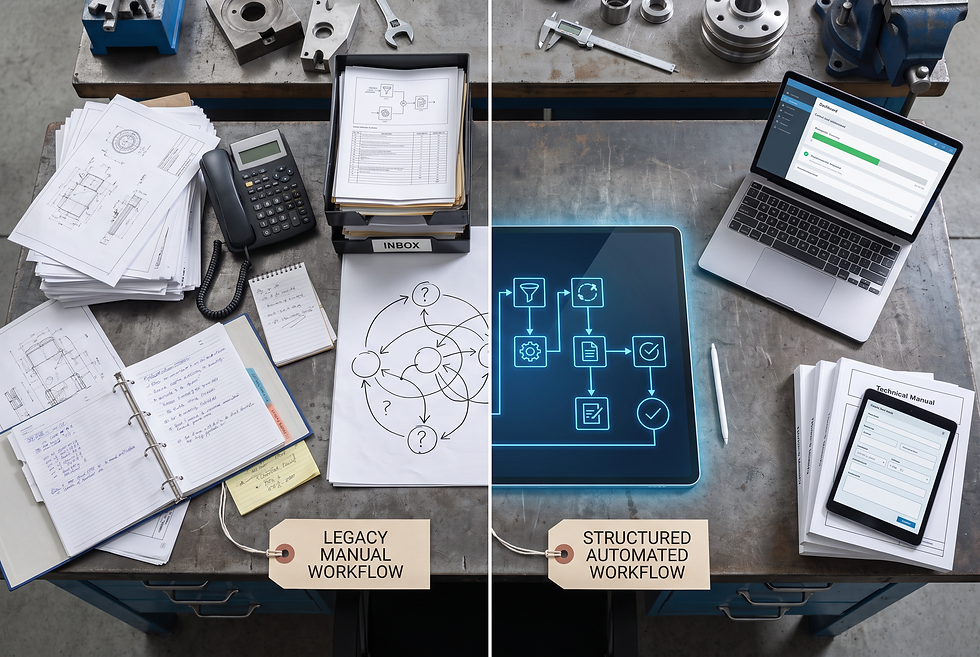
Interactive Technical Discovery: Replacing generic "Contact Us" forms with dynamic specification capture workflows that collect container dimensions, speed requirements, and substrate types directly from prospective engineering buyers.
Instant Feasibility and Budgetary Scoping: Providing preliminary application assessments and estimated capital ranges based on verified historical project data without exposing sensitive proprietary engineering data.
Unified Inquiry Orchestration: Consolidating international website traffic, exhibition badge scans, distributor inquiries, and supplier portal leads into a single triage pipeline.
Tiered Qualification Boundaries: Establishing clear rules for routing inquiries: technical clarifications and parameter collection are automated or handled asynchronously, while fully scoped opportunities are routed instantly to senior regional application engineers.
How the End-to-End Equipment Qualification Workflow Works
To understand how modern machinery builders resolve commercial friction, consider the standard operational workflow spanning discovery to sales acceptance.
Step 1: Multi-Channel Data and Spec Ingestion
Inquiries enter the system across multiple channels: technical web pages, regional subdomains, distributor portals, and trade show lead capture forms. The system ingests structured text, specification attachments, and container drawings.
Step 2: Automated Parameter Capture and Gap Detection
The workflow automatically parses the inquiry against a rigorous engineering taxonomy. It identifies whether core variables are present: machine category (e.g., vertical form fill seal vs. horizontal flow wrapper), product state (liquid, granular, powder, solid), throughput requirements (PPM/BPM), package dimensions, and environmental constraints. If critical parameters are missing, the system automatically drafts a targeted technical questionnaire for the prospective buyer.
Step 3: Engineering Feasibility and Project Scoring
The inquiry is scored against manufacturing capabilities, factory floor capacities, lead-time availability, and regional territory exclusivity agreements. Inquiries falling outside standard modular configurations or custom design capabilities are flagged early for standard partner routing or polite disqualification.
Step 4: Asynchronous Technical Clarification
Before scheduling a live engineering call, the system engages the buyer via structured communication channels to collect missing floor layouts, sample packaging materials, or utility requirement confirmations (compressed air, electrical voltage, steam).
Step 5: Human Application Engineering Review
Once an inquiry contains complete technical and budgetary parameters, the application sales engineer receives a structured Project Brief rather than an ambiguous form submission. The engineer reviews the line concept, validates machine frame compatibility, and confirms commercial margins.
Step 6: High-Value Customer Action
The qualified buyer receives a customized Preliminary Application Summary, complete with machine concept diagrams, estimated footprint calculations, and an invitation to a direct technical discovery call with the dedicated regional account team.
Comparative Analysis: Traditional vs. Modern Machinery Lead Handling
The following table outlines the operational differences between legacy sales processes and structured, modern qualification pipelines.
Pipeline Dimension | Legacy Machinery Sales Process | Structured Qualification Workflow |
Initial Data Intake | Static website webform with open text fields | Parameter-guided spec capture and drawing upload |
Average Triage Time | 48 to 96 hours across distributed regional teams | Under 15 minutes for parameter capture and acknowledgment |
Incomplete Inquiries | Abandoned or chased via manual, ad-hoc emails | Automated parameter clarification workflow |
Engineering Involvement | Application engineers spend 40% of time vetting bad fits | Engineers receive complete project briefs with validated specs |
Global Inquiry Coverage | Delayed by regional working hours and language barriers | 24/7 technical intake across multiple languages |
Primary Commercial Metric | Total raw form inquiries received | Fully qualified RFQs with validated budget and timeline |
Evidence and Industry Benchmarks
Industrial market research and equipment manufacturing studies highlight the direct correlation between rapid response, technical clarity, and win rates in capital goods.
According to the 2023 Packaging Machinery State of the Industry Report published by PMMI (The Association for Packaging and Processing Technologies), machinery buyers rank technical responsiveness and rapid access to application expertise among their top three vendor selection criteria, alongside machine reliability and total cost of ownership. The report indicates that over 60% of packaging machinery buyers finalize their vendor shortlists within the first three weeks of initiating a project search.
Furthermore, broad industrial research from McKinsey & Company demonstrates that B2B buyers across industrial sectors frequently allocate significant portions of their capital expenditure budget to the vendor that provides the fastest initial technical feasibility assessment. In competitive RFQ environments, equipment builders that deliver comprehensive technical clarifications within 24 hours achieve significantly higher conversion rates to formal proposal stages compared to suppliers taking several days to acknowledge specifications.
Core Principles Other Machinery Companies Can Apply
Machinery builders looking to modernize their commercial operations should focus on four foundational principles:
Standardize Technical Requirements Before Sales Calls: Never allow sales reps or application engineers to attend discovery meetings without confirmed packaging formats, speeds, and container dimensions. Use structured technical intake to collect this upfront.
Eliminate Response Latency on International Leads: Export buyers operate across conflicting time zones. Establish an always-on intake mechanism that clarifies technical requirements while the domestic office is closed.
Decouple Inquiry Clarification from Solution Engineering: Collecting missing specs does not require senior mechanical engineers. Build automated or structured workflows to gather data, reserving engineering hours for custom line design and final proposal generation.
Maintain Strict Qualification Thresholds: Not every inquiry represents a viable project. Early identification of budget misalignment, unfeasible timelines, or incompatible packaging films prevents expensive commercial distraction.
Applying This Methodology to Industrial Equipment Sectors
This operating logic extends across multiple discrete manufacturing and equipment categories:
For Bottling and Liquid Filling Manufacturers: The intake workflow captures liquid viscosity, foaming characteristics, fill tolerances, container neck dimensions, and CIP (clean-in-place) sanitation requirements before generating machine concept recommendations.
For Secondary Packaging and Case Packing Builders: The system gathers primary pack dimensions, collating patterns, payload weights, and downstream palletizer interface requirements.
For Flexible Packaging and Form-Fill-Seal Suppliers: The intake workflow identifies roll stock properties, barrier properties, zipper/spout attachments, and sealing temperature requirements.
In each sector, the objective remains constant: transform ambiguous buyer interest into precise, machine-ready operational parameters before engaging expensive human engineering resources.
Operationalizing the Process: AI Worker Implementation
To institutionalize this workflow without dramatically increasing sales overhead, industrial equipment companies deploy dedicated AI workers tailored specifically to technical export sales and inbound pipeline management.
AI Equipment Sales Rep Profile
Worker Job Title: AI Equipment Sales Rep
Main Daily Tasks: Ingest inbound technical inquiries from website forms, distributor networks, and email; cross-examine customer inputs against equipment capability databases; conduct automated parameter clarification for missing packaging specifications; route validated project dossiers directly to regional sales directors.
Primary Work Channels: Corporate website technical forms, inbound sales mailboxes, industrial portal messaging systems, and integrated CRM platforms.
Authority Boundaries: Can acknowledge inquiries, validate specification completeness, send standard technical questionnaires, and provide preliminary non-binding equipment catalog matches; cannot commit to final price discounts, sign custom engineering warranties, or modify formal legal contracts without executive approval.
First Value Event: The first time an incomplete global RFQ is automatically converted into a fully specified, formatted Application Brief—with confirmed container dimensions, speed targets, and material specs—delivered to the application engineering team in under 30 minutes.
Daily Report Result: A structured commercial summary detailing new inquiries received, parameter completion rates, qualified RFQs routed to engineering, and stalled prospects flagged for sales rep follow-up.
FAQ
What makes lead generation for packaging machinery companies uniquely difficult?
Packaging machinery purchases involve complex engineering constraints, multi-stakeholder decision committees, high capital expenditure, and long sales cycles. Unlike standard industrial catalog products, packaging systems require detailed custom specifications—such as container geometry, throughput speed, material compatibility, and factory floor footprint—before an accurate quote can be prepared.
How can packaging equipment builders reduce incomplete RFQ submissions?
Equipment manufacturers can reduce incomplete RFQs by replacing generic contact forms with guided technical discovery forms that require fundamental engineering parameters (such as packaging substrate, units per minute, container dimensions, and automation level) before submission.
What role does response speed play in winning packaging machinery contracts?
Packaging buyers typically finalize their vendor shortlists early in the project scoping phase. Machinery manufacturers that respond within minutes with technical parameter confirmations and preliminary feasibility guidance establish authority and capture project momentum before competitors reply.
How does an AI Equipment Sales Rep assist existing sales teams?
An AI Equipment Sales Rep handles initial inquiry triage, gathers missing engineering specifications, qualifies buyer budgets and timelines, and prepares structured project briefs. This allows human sales engineers to focus their time exclusively on custom line engineering, relationship building, and closing deals.
Scale Your Equipment Pipeline with Autonomous Sales Execution
Deploy an AI Equipment Sales Rep to qualify complex technical inquiries 24/7, eliminate response delays, and deliver ready-to-quote project briefs directly to your engineering team.


Comments