
Manufacturing Marketing Agency vs In House: Cost, Speed, and Control

Executive Summary
Industrial equipment manufacturers, robotics builders, and precision engineering firms face an operational impasse when scaling global revenue. Traditional outsourcing through a generalist marketing firm often dilutes engineering precision, while building internal teams creates heavy recurring overhead and management friction. This operational analysis evaluates the commercial mechanics of choosing a manufacturing marketing agency vs in house team, compares unit economics and execution velocity, and examines how deploying autonomous AI workers creates a third, higher-leverage operating model for industrial exporters.
The Go-To-Market Dilemma for Industrial Manufacturers
Industrial manufacturing operates under fundamentally different commercial dynamics than standard business-to-business (B2B) software or consumer brands. When capital equipment costs range from $50,000 to over $2,000,000, purchasing cycles span six to eighteen months, and buying committees include plant managers, chief technology officers, procurement officers, and maintenance directors, standard marketing playbooks fail.
Commercial leaders in machinery, precision tooling, and automation components repeatedly encounter the same structural decision point: should demand generation, technical content, and initial commercial qualification be outsourced to an external agency, staffed internally with full-time personnel, or automated through domain-specific workflows?
Choosing between a manufacturing marketing agency vs in house infrastructure is not merely a staffing decision; it determines how quickly an industrial enterprise can respond to global requests for quotation (RFQs), how accurately engineering specifications are translated into pipeline opportunities, and who retains ownership over proprietary market intelligence.
Company Snapshot: The Commercial Reality of Technical Manufacturers
To understand why this choice creates operational friction, consider the typical operating profile of mid-market industrial manufacturers:
Target Customers: Original equipment manufacturers (OEMs), tier-one automotive suppliers, pharmaceutical packaging facilities, electronics contract manufacturers, and regional distribution partners.
Commercial Model: Direct technical sales combined with overseas distributor networks, engineered-to-order (ETO) bidding, or standardized industrial machinery catalogs.
Sales Cycle Characteristics: Highly technical specifications, rigorous vendor validation stages, CAD drawing reviews, on-site audits, and protracted contract negotiations.
Operational Bottleneck: Skilled application engineers and export directors are forced to spend hours fielding unqualified inquiries, manually parsing RFQ documents, and translating catalog data across multiple time zones.
In this environment, marketing cannot operate as a detached branding exercise. It must directly support technical qualification and feed ready-to-quote pipeline into the engineering and commercial sales teams.
The Core Friction: Why Traditional Models Struggle
When evaluating a manufacturing marketing agency vs in house setup, industrial leadership teams routinely run into deep operational bottlenecks on both sides.
The Agency Dilemma: High Retainers, Low Technical Context
Outsourcing demand generation to an external agency promises immediate bandwidth without the burden of long-term employment commitments. However, traditional B2B agencies face inherent structural limitations:
Engineering Knowledge Gaps: Agency copywriters and media buyers rarely grasp the nuances of multi-axis CNC tolerance, servo drive duty cycles, or cleanroom compliance. This leads to superficial content that fails to engage technical buyers.
Incentive Misalignment: Agencies are structurally incentivized to report vanity metrics—such as page impressions, generic form downloads, or unqualified click volume—rather than verified engineering inquiries and pipeline velocity.
High Retainers with Slow Iteration: Standard agency retainers range from $6,000 to $20,000 monthly. When technical revisions must pass through account managers, copywriters, and client approvers, turnaround times for market campaigns stretch into weeks.
The In-House Dilemma: Fixed Overhead, Talent Scarcity, and Siloed Execution
Building an internal marketing department guarantees direct access to product managers and internal engineers, but introduces distinct operational risks:
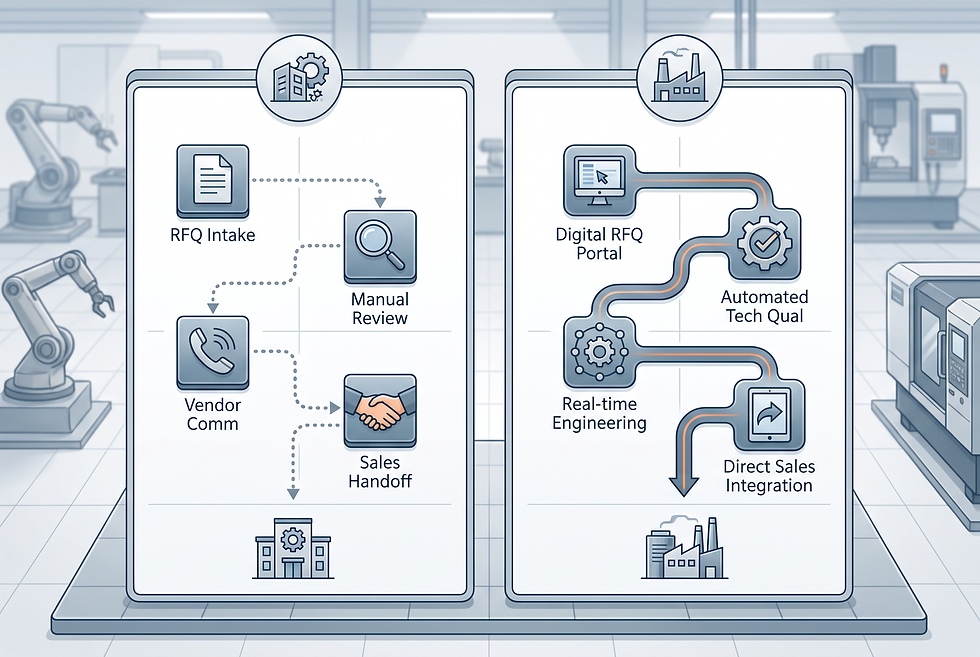
High Overhead and Recruitment Latency: Hiring a marketing director, a technical copywriter, a search specialist, and an SDR requires significant annual capital allocation—often exceeding $300,000 to $450,000 fully burdened in North America and Western Europe.
Single-Point Dependency: Small internal teams quickly become overwhelmed. If the primary technical marketer resigns, institutional knowledge departs with them, stalling commercial momentum.
Fragmented Tooling and Execution: Internal teams frequently juggle multiple disconnected platforms for CRM, email sequencing, translation, and data enrichment, resulting in manual data entry rather than active market engagement.
The Emergence of the AI-Driven Operating Model
Rather than oscillating between costly agency retainers and rigid in-house headcount, forward-thinking manufacturers are adopting an automated hybrid architecture. In this paradigm, autonomous digital workers execute repetitive market monitoring, technical qualification, and outbound engagement, while human technical leaders maintain authority over pricing, engineering approvals, and final contract execution.
By leveraging structured product catalogs, technical documentation, and clear decision boundaries, an autonomous workforce bridges the gap between marketing generation and sales execution without requiring additional management layers.
How the Workflow Actually Works: From Market Signal to Sales Pipeline
To see how an advanced commercial workflow operates in practice, examine the end-to-end path of an industrial RFQ through a modern automated system:
Step 1: Signal Capture and Ingestion: Multi-channel inquiries (website technical forms, inbound procurement emails, international marketplace messages) enter a centralized intake engine alongside monitored procurement portals.
Step 2: Technical Parsing and Data Enrichment: The system parses engineering requirements (e.g., payload capacity, cycle time, voltage, environmental certifications), validates the prospect's corporate domain, and verifies whether the company matches ideal buyer criteria.
Step 3: Automated Specification Matching: Using verified internal product databases, the automated engine identifies matching machinery models or manufacturing capabilities, extracting relevant technical datasheets and certification records.
Step 4: Draft Proposal Generation: An initial technical response or preliminary scoping brief is generated instantly in the prospect's native language, adhering strictly to pre-defined corporate pricing guidelines and engineering constraints.
Step 5: Human Engineering Check: If an inquiry exceeds defined tolerance parameters or involves custom design-for-manufacturing (DFM) adjustments, it is routed to a human application engineer with a single-click verification interface.
Step 6: Commercial Sales Hand-off: Fully qualified, enriched leads with complete specification summaries are pushed into the CRM and scheduled directly onto the regional sales director's calendar.
Comparative Breakdown: Agency vs In-House vs Autonomous Workforce
To evaluate the strategic trade-offs objectively, the following table compares key operating dimensions across the three models.
Operational Dimension | Manufacturing Marketing Agency | In-House Team | Autonomous AI Workforce Model |
Fully Burdened Monthly Cost | $7,000 – $20,000 retainer + media spend | $25,000 – $40,000 (salaries, benefits, software) | Fixed software subscription / output-based |
Time to Ramp & Full Deployment | 60 – 90 days onboarding & discovery | 90 – 180 days (hiring, training, tooling) | 7 – 14 days configuration on technical data |
Technical Domain Depth | Low to moderate; generalist writers | High; direct access to factory engineers | High; trained on proprietary datasheets & CAD specs |
24/7 Global Response Speed | Slow; business hours in agency time zone | Limited; depends on regional shift coverage | Instantaneous (< 5 minutes) across all time zones |
Data Ownership & IP Retention | Stored across agency accounts & tools | Retained internally in company systems | 100% owned and housed within private infrastructure |
Sales Team Alignment | Poor; handoffs often consist of cold leads | Good; close physical/cultural collaboration | Exceptional; directly maps to CRM pipeline stages |
Scalability Across New Markets | Expensive; requires extra retainers per territory | High cost; requires bilingual local hires | Seamless; real-time localization across 30+ languages |
Evidence and Economic Implications for Manufacturers
Industry benchmarks consistently illustrate the high cost of delayed responses in industrial procurement. According to published studies on B2B buyer behavior by McKinsey & Company, over 70% of industrial buyers prefer digital, self-service interactions and expect vendor responses within hours, not days.
When evaluating a manufacturing marketing agency vs in house strategy, the hidden cost is almost always response latency and technical misalignment:
The Cost of Slow RFQ Response: In competitive bidding for precision machining or standard automation modules, the first vendor to provide an accurate technical response wins the contract in over 50% of evaluated procurement scenarios.
The Overhead of Misqualification: When an agency delivers unqualified inquiries to senior sales engineers, it consumes 15% to 25% of the engineering team's billable capacity on proposals that never close.
Continuous Learning Loops: Unlike an agency that resets its learning curve with staff turnover, an internal or autonomous system retains every customer interaction, objection, and technical parameter, compounding enterprise value over time.
Strategic Principles: What Industrial Leaders Must Systematize
Regardless of which organizational structure an industrial executive selects, high-performing commercial operations adhere to three non-negotiable principles:
1. Separate Administrative Routing from Engineering Judgment
Senior sales engineers should never spend their time checking basic prospect credentials, converting imperial to metric units, or searching for standard compliance certificates. These administrative and initial qualification tasks must be fully automated.
2. Maintain Absolute Authority Boundaries
Automation must never guess. When an automated system encounters a non-standard operating environment, customized alloy requirement, or unlisted pricing tier, it must escalate cleanly to a human director with clear context, preserving customer trust.
3. Own the Data Asset
All prospect questions, competitive objections, technical inquiries, and interaction histories must live inside the manufacturer's secure database. Outsourcing your entire pipeline generation mechanism to an agency without direct data integration creates dangerous platform risk.
Translating the Framework: Application in Industrial Machinery and Exporting
Consider an industrial packaging machinery exporter seeking to expand distribution into North America and Southeast Asia.
Under a traditional model, the company would either hire local sales agencies in each target country (costly, fragmented, and difficult to manage) or hire bilingual marketing staff domestically (slow to scale, difficult to find).
By adopting an automated commercial worker approach:
The manufacturer standardizes all machine specifications, speed ratings, and power requirements into a centralized knowledge repository.
An automated system proactively engages potential manufacturing plant directors across overseas markets in their local language.
Inbound technical questions regarding floor layout compatibility, voltage requirements, and spare parts availability are answered automatically based on verified technical documentation.
Once a plant manager confirms a project timeline and machinery budget, the qualified opportunity is handed directly to the regional export director for contract negotiation.
Operationalizing with YTT AI: The AI Global Sales Rep
To bridge the gap between high-level demand generation and technical deal closing, industrial manufacturers can deploy targeted autonomous roles designed for export commerce.
Assigned AI Worker: AI Global Sales Rep
Primary Role: End-to-end commercial discovery, technical specification qualification, and multi-lingual global pipeline acceleration for industrial manufacturers.
Primary Work Channels: Corporate email, technical website inquiries, international procurement portals, and CRM synchronization.
Authority Boundary: Strictly operates within verified engineering datasheets, standard catalog pricing matrices, and pre-approved commercial terms. Automatically flags custom engineering requests or high-value enterprise accounts for direct executive oversight.
First Value Event: Ingesting the manufacturer's technical machinery catalog, establishing qualification rules, and delivering the first fully qualified, multi-lingual RFQ package to the sales director within 48 hours of deployment.
Daily Report Output: A structured executive summary detailing inbound leads parsed, technical specifications matched, overseas inquiries engaged, and high-priority deals prepped for sales engineer review.
FAQ
What is the primary difference when comparing a manufacturing marketing agency vs in house team?
A manufacturing marketing agency provides immediate external capacity but often lacks deep engineering understanding, whereas an in-house team possesses strong internal product knowledge but carries high fixed overhead and hiring latency.
Can an automated AI workforce completely replace human sales engineers in manufacturing?
No. Autonomous AI workers handle repetitive qualification, technical document retrieval, and multi-lingual initial outreach, freeing human sales engineers to focus on custom engineering, pricing negotiation, and closing high-value contracts.
How quickly can an industrial machinery business deploy an AI Global Sales Rep?
An AI Global Sales Rep can be configured on existing product catalogs, technical manuals, and qualification criteria within 7 to 14 days, generating immediate pipeline visibility without months of agency discovery.
How do AI commercial workers maintain accuracy with complex technical specifications?
AI workers operate within strict authority boundaries, retrieving facts directly from verified company documentation and escalating non-standard engineering tolerances or custom DFM requests directly to human engineers.
Transform Your Industrial Sales Pipeline
Stop choosing between expensive agency retainers and rigid headcount. Explore how an autonomous AI workforce accelerates your global manufacturing pipeline with engineering precision.


Comments