
Manufacturing RFQ Qualification Checklist: What to Collect Before Quoting

Executive Summary: Industrial suppliers lose hundreds of valuable engineering hours every year preparing quotes for incomplete or poor-fit inquiries. By deploying a structured qualification architecture before allocating estimating resources, contract manufacturers and machine shops accelerate response velocity, protect high-margin engineering bandwidth, and substantially raise quote-to-win conversion on core capabilities.
Company Snapshot: Commercial Realities in Custom Manufacturing
Contract manufacturers, precision CNC machine shops, industrial automation builders, and bespoke machinery producers operate in demanding commercial environments. Unlike standard component distributors, custom manufacturing suppliers do not sell off-the-shelf catalog SKUs with fixed unit economics. Instead, they sell specialized engineering capacity, machine spindle time, tight-tolerance fabrication, and regulatory compliance.
In a standard mid-market manufacturing enterprise ($15M to $100M in annual revenue), commercial operations are directly tied to engineering bandwidth. Sales directors, export sales teams, and technical estimators handle dozens of incoming RFQs every week across email inboxes, distributor portals, web forms, and global trade platforms. Because every project involves custom geometric drawings, raw material procurement, specialized surface treatments, and strict quality assurance standards, preparing a single quotation can require anywhere from two to sixteen hours of senior engineering review.
When sales intake processes lack structure, commercial teams treat all incoming requests with equal urgency. This lack of upstream qualification creates severe operational bottlenecks, inflating the cost-to-quote while depressing conversion rates on target business.
What Industrial Manufacturers Actually Sell: Engineering Risk and Machine Capacity
To understand why sales qualification breaks down in custom manufacturing, one must examine how industrial projects are evaluated and procured. A buyer—typically a procurement agent, mechanical engineer, or supply chain manager—issues an RFQ to assess technical capability, unit cost, and production lead time.
However, a quotation is not just an estimate; it is a binding technical commitment to manufacture physical parts within defined metallurgical, dimensional, and regulatory constraints. When an application engineer prepares a quote, they must calculate:
Raw material stock sizing, billet availability, and scrap allowances.
Machining cycle times across multiple axes, custom fixturing, and specialized cutting tooling.
Secondary post-processing, including heat treatment, anodizing, powder coating, and passivation.
Quality inspection requirements such as CMM inspection, non-destructive testing, and Material Test Reports (MTRs).
Packaging standards, export documentation, freight tariffs, and incoterms.
When an RFQ arrives without critical dimensional tolerances, complete CAD geometry, or volume forecasts, estimators are forced to make unverified assumptions or spend days in email back-and-forth. This friction delays responses to high-margin, ideal-fit opportunities.
The Business Problem: The Operational Cost of Unqualified RFQ Triage
Unqualified inquiries create systemic waste across three operational areas:
The Estimating Bottleneck: Senior application engineers, whose time should be spent optimizing production paths and programming high-value orders, often spend up to 40% of their working hours deciphering incomplete drawings or pricing prototype runs for low-budget inquiries that never convert.
The Velocity Penalty: Industry procurement data shows that the first qualified suppliers to return an accurate technical bid win the order more than 60% of the time. Delays caused by clarifying missing drawing details frequently hand deals to faster competitors.
Margin Erosion from Bad-Fit Work: Quoting projects outside the plant's core capabilities—such as quoting high-volume stamping on low-volume CNC equipment, or bidding uncertified aerospace alloys without NADCAP approvals—leads to unprofitable production runs or expensive rework.
To eliminate this friction, suppliers must implement a rigorous manufacturing rfq qualification checklist at the commercial intake gate.
The Manufacturing RFQ Qualification Checklist: 12 Critical Data Points
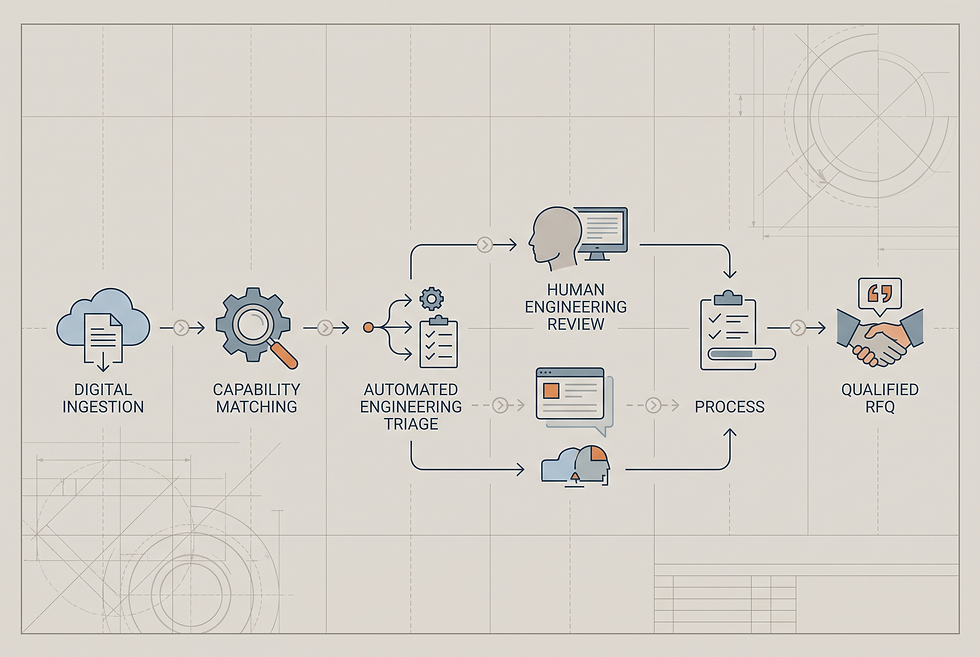
A structured qualification framework creates clear boundaries between automated data collection, AI extraction, and mandatory human engineering review across twelve essential parameters.
1. Company & Strategic Fit
Data to Collect: Corporate identity, primary industry vertical, production volume tier, and creditworthiness.
AI / Automation Role: Automatically match company domain against internal CRM records, verify business addresses, and check credit ratings.
Human Engineering Role: None. Fully programmatic.
2. Application & Operating Environment
Data to Collect: End-use application, environmental operating conditions (temperature ranges, chemical exposure, vibration, dynamic load).
AI / Automation Role: Extract application context from customer notes; flag high-risk operating classifications (e.g., subsea, aerospace flight-critical, medical implant).
Human Engineering Role: Review application suitability if operating parameters exceed standard product thresholds.
3. File Formats & Technical Documentation
Data to Collect: Native 3D CAD models (.STEP, .IGES, .SLDPRT) and fully dimensioned 2D engineering drawings (.PDF) with title block details.
AI / Automation Role: Validate file integrity, check for 2D/3D file pairing, and flag missing drawing sheets.
Human Engineering Role: Verify geometry if CAD translation errors occur.
4. Material Specifications & Equivalencies
Data to Collect: Exact alloy grade, temper, standard designations (ASTM, DIN, ISO, JIS), and acceptable material substitutes.
AI / Automation Role: Parse drawing notes for material callouts; match against current raw material inventory and mill supplier pricing feeds.
Human Engineering Role: Confirm substitution approvals with the buyer if the requested alloy has extended mill lead times.
5. Geometric Tolerances & GD&T Requirements
Data to Collect: Critical-to-function dimensions, general linear tolerances, and Geometric Dimensioning & Tolerancing (GD&T) callouts (e.g., true position, flatness, runout).
AI / Automation Role: Optical character recognition (OCR) and drawing analysis to identify tolerances tighter than the plant's standard capability (e.g., +/- 0.0002" or +/- 0.005 mm).
Human Engineering Role: Perform manufacturability review (DFM) on flagged tight-tolerance features.
6. Quantity Tiers & Batch Release Schedule
Data to Collect: Prototype quantity, First Article Inspection (FAI) quantity, annual estimated usage (EAU), and blanket order release schedules.
AI / Automation Role: Classify inquiry into production tier (Rapid Prototype vs. High-Volume Production) and route to appropriate operational workflow.
Human Engineering Role: None for standard routing.
7. Surface Finishing & Post-Processing
Data to Collect: Surface roughness (Ra), plating specifications (Mil-Spec, ISO), anodizing type/class, heat treat hardness (HRC), and masking requirements.
AI / Automation Role: Match finish specifications against approved outside-vendor processing (OVP) networks to calculate subcontractor lead times and standard costs.
Human Engineering Role: Coordinate with specialized chemical processors for non-standard proprietary coatings.
8. Inspection, Testing & Quality Assurance
Data to Collect: CMM inspection reports, 100% dimensional inspection requirements, Non-Destructive Testing (NDT/X-ray/Dye Penetrant), and Material Test Reports (MTR / Mill Certs).
AI / Automation Role: Identify required quality gates and automatically append standard inspection hourly rates to the preliminary cost model.
Human Engineering Role: Quality Director signs off on custom inspection fixture design requirements.
9. Industry Certifications & Regulatory Compliance
Data to Collect: ISO 9001, AS9100, IATF 16949, ISO 13485, ITAR restrictions, RoHS/REACH compliance, or DFARS domestic sourcing mandates.
AI / Automation Role: Compare requested compliance standards against plant certifications. Instantly reject or flag ITAR export-controlled documents requiring secure handling.
Human Engineering Role: Compliance officer review for ITAR and defense-related documentation.
10. Production & Delivery Timeline
Data to Collect: Target delivery date, prototype turnaround expectations, production ramp schedules, and required shipping Incoterms (EXW, FOB, DDP).
AI / Automation Role: Check delivery milestones against live shop-floor scheduling capacity and raw material lead times.
Human Engineering Role: Production manager approves expedited shop schedules that require overtime shifts.
11. Target Budget & Commercial Parameters
Data to Collect: Target cost per part (if available), payment terms, tooling amortization preferences, and packaging/labeling specs.
AI / Automation Role: Benchmark historical win-loss pricing data on similar geometry to predict price sensitivity.
Human Engineering Role: Commercial Director approves custom payment terms (e.g., Net 60/90) or customer-funded tooling terms.

12. Decision Stakeholders & Procurement Stage
Data to Collect: Identity of the budget owner, technical evaluator, purchasing timeline, and whether this is a single-source bid, competitive benchmark, or feasibility study.
AI / Automation Role: Score deal probability based on buyer role, project urgency, and past conversion history.
Human Engineering Role: Account Executive builds multi-threaded contact cadence with both engineering and procurement contacts.
How the Workflow Actually Works: Step-by-Step Triage and Routing
Implementing a robust intake checklist requires an operational pipeline that processes inquiries before estimators open CAD files:
Step 1: Digital Ingestion: The buyer submits RFQ packages via email, web forms, or supplier networks. Intake parsers extract text, notes, attached PDF drawings, and 3D files into a centralized intake queue.
Step 2: Automated Technical Extraction: AI extraction models read title blocks, drawing notes, GD&T symbols, and BOM tables, parsing material grades, surface treatments, critical tolerances, and quantities.
Step 3: Capability and Certification Matching: The system checks extracted parameters against machine envelopes (e.g., maximum 5-axis travel, spindle power, certified materials) and compliance standards. Non-fitting inquiries are flagged immediately.
Step 4: Clarification Gate: If an RFQ is a strategic fit but lacks critical specifications (e.g., missing 2D PDF to verify tolerances, or unstated surface finish), the system triggers an automated, structured technical clarification to the buyer before engineering hours are committed.
Step 5: Human Engineering Verification: Once all checklist items are validated, the enriched package is delivered to the designated application estimator alongside calculated bounding boxes, surface areas, material weights, and historical pricing benchmarks.
Step 6: Commercial Proposal Delivery & Follow-Up: The finalized quote is delivered to the customer. The system tracks engagement, manages follow-ups, and logs quote outcomes to improve future triage rules.
Operational Comparison: Ad-Hoc RFQ Quoting vs. Structured Qualification
Operational Parameter | Traditional Ad-Hoc Quoting | Standardized RFQ Qualification Architecture |
Intake Channel Management | Disjointed inboxes and unorganized file attachments | Centralized digital ingestion with automated data extraction |
Incomplete Drawing Handling | Estimator manually drafts emails; waits days with an idle file | Automated data check flags missing parameters to buyer within minutes |
Out-of-Envelope Filtering | Discovered by engineers after hours of manual review | Instant automated capability check filters non-core inquiries |
Estimating Turnaround Time | 5 to 9 business days | 24 to 48 hours for standard custom parts |
Engineering Time per Quote | 3.5 hours average across all incoming inquiries | 45 minutes focused exclusively on pre-qualified packages |
Quote-to-Win Conversion | 12% to 18% (diluted by poor-fit bids) | 28% to 42% on core-capability target opportunities |
Commercial Follow-Up | Inconsistent; dependent on individual sales rep memory | Automated multi-threaded cadence triggered by buyer engagement |
Evidence and Results: Measurable Operational Impact
Operational benchmarks across contract manufacturing networks show clear performance gains from front-end technical qualification:
Quote Response Velocity: A published digital contract manufacturing vendor case study reported that reducing quote turnaround times from four business days to under four hours increased conversion rates on target bids by more than 30%.
Engineering Capacity Recovery: An industrial equipment benchmark study showed that implementing automated drawing extraction and checklist triage reduced non-productive estimating hours by 65%, allowing senior application engineers to focus on design-for-manufacturability (DFM) and production optimization.
Estimation Accuracy: Eliminating missing-data assumptions prior to quoting reduced post-award engineering change orders (ECOs) and margin erosion by an average of 22%, according to supplier network reviews.
What Other Industrial Companies Can Learn: Core Operating Principles
Manufacturing leaders looking to optimize commercial operations should adopt four foundational practices:
Protect the Engineering Gate: Never allow incomplete drawing packages onto an application engineer's desk. Treat engineering hours as finite, revenue-generating assets.
Standardize Commercial Intake: Ensure every commercial channel—field sales reps, regional distributor agents, and website visitors—funnels inquiries through the same 12-point intake checklist.
Automate Frictionless Clarification: Buyers frequently omit specifications because they do not know what the shop floor requires. Deploy structured, frictionless inquiry forms to capture missing details quickly.
Establish Clear Decision Boundaries: Clarify what software executes autonomously (OCR extraction, capability filtering, CRM hygiene) versus what requires human authority (DFM exceptions, pricing markups, contract risk sign-off).
Applying This Logic Across Manufacturing Verticals
For Precision CNC and Sheet Metal Suppliers: The qualification engine scans CAD step files for deep internal pockets, micro-hole drilling, or non-standard sheet bend radii, ensuring machine tool compatibility before estimating cycle times.
For Industrial Automation and Robotics System Integrators: The checklist validates cycle time requirements, payload specifications, electrical voltage standards, factory communication protocols (EtherNet/IP, PROFINET), and factory floor space constraints before sizing robot arms.
For Custom Process Equipment and Pump Manufacturers: Intake protocols verify media viscosity, fluid corrosiveness, operating pressure, explosion-proof motor ratings (ATEX/NEC), and flange connection standards prior to engineering submittals.
Deploying the Architecture: The Role of an AI Business Development Rep
To execute this qualification workflow autonomously without overburdening front-line commercial staff, industrial manufacturers deploy dedicated digital agents such as an AI Business Development Rep or an AI Export Sales Rep.
Worker Job Title: AI Business Development Rep (Precision Manufacturing & Custom Equipment).
Main Daily Tasks: Ingest inbound RFQ packages across global inboxes and portals; extract drawings, tolerances, and material specifications; execute the 12-point manufacturing rfq qualification checklist; verify export compliance; assemble structured technical briefing files for human estimators; execute timely commercial follow-ups.
Primary Work Channels: Corporate Sales Inboxes, Customer Quotation Portals, Enterprise ERP/CRM Systems, WhatsApp/WeChat for international export clients.
Authority Boundary: The AI agent autonomously extracts technical parameters, checks facility envelopes, and requests missing data from buyers. It cannot modify baseline profit margins, grant credit terms, or finalize commercial agreements without human Commercial Director authorization.
First Value Event: The first complete, verified RFQ package—with all 12 checklist points validated, 2D/3D CAD files paired, and materials matched to current inventory—delivered directly to the estimating team within 10 minutes of buyer submission.
Daily Report Result: Every morning at 08:00, the Commercial Director receives a summary outlining: new RFQs received, projects filtered as non-core with reasons, clarification requests pending buyer response, fully qualified bids queued for engineering review, and follow-up engagement metrics on outstanding quotes.
FAQ
What is the most common reason manufacturing quotes are delayed?
The leading cause of quoting delays is missing technical data in the initial RFQ submission—specifically missing 2D tolerance prints, undefined material specifications, absent surface finishing details, or unstated annual order quantities. This forces estimators to halt work and engage in lengthy back-and-forth email clarifications.
How can contract manufacturers filter out low-value inquiries without alienating prospects?
Implement an automated front-end qualification system that instantly reviews incoming files. If an RFQ falls outside the plant's core capabilities or minimum volume thresholds, the system immediately provides a professional, automated referral or polite decline with clear explanations, preserving brand goodwill while protecting internal engineering hours.
Does automating the RFQ intake process replace the application engineer?
No. Automating the intake process eliminates clerical data entry, CAD file verification, and administrative clarification tasks. Application engineers remain indispensable for Design for Manufacturability (DFM) reviews, custom fixturing strategies, tooling optimization, and complex technical risk evaluations.
Why is pairing 2D drawings with 3D CAD models essential in custom manufacturing RFQs?
While 3D CAD models provide exact spatial geometry for CAM toolpath programming, 2D PDF drawings contain critical manufacturing requirements that 3D files often omit, such as geometric dimensioning and tolerancing (GD&T), surface roughness callouts, tapped thread specifications, and specialized quality control inspection notes.
Standardize Your RFQ Qualification Architecture
Stop wasting senior engineering capacity on incomplete RFQs. Implement our battle-tested qualification workflow, automate technical drawing intake, and accelerate quote-to-win velocity across your global sales operations.



Comments