
Market Entry Cost for Manufacturers: What to Budget Before You Expand

Executive Summary
Expanding industrial operations across borders requires rigorous capital planning. When evaluating the total market entry cost for manufacturers, leadership teams frequently underestimate indirect operating friction, channel enablement overhead, and continuous regulatory adaptation. This operational analysis examines ten foundational budget categories, contrasts traditional field-heavy deployment against modern lean architectures, and outlines how technical exporters build predictable international sales pipelines while protecting operating margins.
Company Snapshot: How Global Industrial Leaders Structure Expansion
Industrial equipment makers, automation builders, precision tooling suppliers, and advanced component producers operate within high-stakes B2B commercial ecosystems. Unlike consumer brands that scale via mass-market digital marketing, capital goods manufacturers sell complex engineered solutions characterized by six-to-eighteen-month sales cycles, custom engineering specifications, and multi-stakeholder procurement committees.
Historically, global expansion for an industrial manufacturer followed a predictable sequence: hire an international business development executive, retain local commercial search agencies, contract regional distributor networks, and sponsor heavyweight industry trade exhibitions. While this established commercial footprint generated relationship-driven opportunities, it introduced substantial fixed overhead before achieving repeatable commercial traction.
Analyzing international market entry requires examining not just the upfront capital expenditure of corporate establishment, but the underlying operational mechanisms that drive customer acquisition, technical qualification, and channel governance.
What Industrial Exporters Actually Sell: Capital Equipment and Complex Engineering
To budget accurately for international expansion, commercial directors must first recognize the fundamental operational characteristics of what industrial manufacturers deliver to overseas accounts.
High-Touch Solution Engineering: Industrial machinery and advanced components are rarely purchased off-the-shelf. Buyers require detailed application engineering, cycle-time calculations, factory integration schematics, and customized safety compliance reviews.
Multi-Tiered Decision Units: The purchasing committee routinely includes plant managers, VP of Operations, lead automation engineers, environmental health and safety directors, and corporate procurement officers, each requiring distinct technical documentation and commercial validation.
Extended Lifecycle Obligations: Selling equipment overseas commits the manufacturer to multi-year warranty obligations, spare-parts supply chain logistics, remote diagnostics, and on-site field maintenance agreements.
Because the commercial engagement demands deep technical expertise, traditional global market entry cost structures have been heavily front-loaded with specialized personnel and localized infrastructure.
The Core Business Problem: Hidden Market Entry Cost for Manufacturers
When calculating the market entry cost for manufacturers, corporate balance sheets often capture visible upfront expenses like entity registration, patent filings, and initial exhibition booth rentals. However, hidden operational friction typically accounts for the majority of unbudgeted expenditure.
First, distributor dormancy creates substantial drag on capital. Manufacturers frequently sign non-exclusive agreements with local overseas distributors, only to find that these channel partners focus exclusively on established, high-margin catalog lines. Activating an overseas distributor requires continuous technical training, joint pipeline development, and dedicated field engineering support that domestic sales teams rarely have the capacity to maintain.
Second, slow response latency on international Requests for Quotation (RFQs) drains commercial momentum. When an overseas prospect requests detailed equipment specifications or custom parameter testing, time-zone disconnects and internal engineering bottlenecks cause multi-week delays. According to industrial buying behavioral studies, technical inquiries answered within 24 hours convert to active engineering reviews at significantly higher rates than delayed responses.
Third, recurring exploratory travel and administrative drift consume substantial operational budget without guaranteeing pipeline visibility. Business development teams often expend significant capital attending overseas events without establishing the digital inbound workflows required to qualify prospects before booking international flights.
Deconstructing the Budget: 10 Core Cost Categories in Global Expansion
An exhaustive international expansion budget must segment expenditure across distinct commercial, operational, and regulatory categories rather than aggregating them into general selling expenses.
Target Market Intelligence & Market Research: Direct expenditures on market-sizing datasets, competitor import/export shipment customs audits, local labor wage benchmarks, and territory-specific customer discovery interviews.
Linguistic & Technical Localization: Translating technical manuals, PLC interface screens, computer-aided design (CAD) libraries, machinery safety documentation, and compliance labeling into territory-specific vernacular.
Channel Intermediary & Distributor Enablement: Margin concessions (typically 15% to 35% discount structures), initial consignment inventory requirements, regional distributor onboarding programs, and channel conflict management.
Local Representation & In-Market Sales Staffing: Direct compensation, executive search agency fees, local social security/pension mandates, statutory benefits, and severance liabilities for local business development personnel.
International Commercial Travel & Site Audits: Flights, accommodations, ground logistics, client factory walkthroughs, and executive customer delegations during pre-award engineering discussions.
Trade Exhibitions & Industry Summits: Physical booth fabrication, overseas freight logistics for live demonstration machines, floor space leasing, electrical/compressed air hookups, and promotional asset distribution.
After-Sales Engineering & Technical Support Infrastructure: Regional field-service technician dispatch networks, remote telemetry infrastructure, local spare-parts warehousing, and localized ticketing help desks.
Regulatory Compliance, Testing & Certification: Mandatory testing protocols such as CE marking, UL certification, UKCA conformity, explosion-proof ATEX testing, environmental RoHS/REACH filings, and territory machine safety compliance audits.
Technical Content Asset Development: Engineering white papers, application teardowns, cycle-time case studies, interactive 3D product visualizers, and detailed integration guides tailored to overseas operational realities.
Commercial Software & Communication Systems: Territory-specific telecommunications, cross-border customer relationship management (CRM) software instances, localized website infrastructure, and automated workflow tracking platforms.
Workflow Breakdown: Operational Mechanisms of Traditional vs Modern Market Entry
The financial profile of international expansion changes dramatically when manual business development workflows are replaced with automated technical capture and qualification systems.
In traditional commercial models, step one through step four relied entirely on expensive overseas sales representatives manually reading emails, requesting missing dimensional tolerances from prospective buyers, and querying factory engineers across twelve-hour time-zone gaps. This manual chain inflated personnel costs while slowing inquiry turnaround.
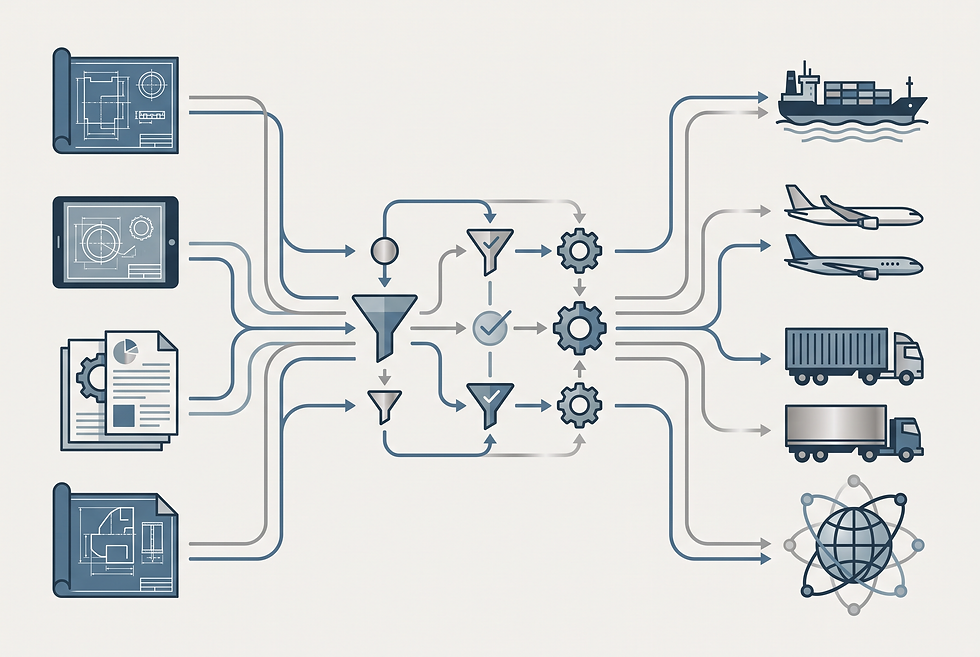
Under a modern operational architecture, initial technical validation, standard parametric qualification, and documentation dispatch occur programmatically, allowing core engineering teams to engage only when high-intent opportunities meet defined manufacturing criteria.
Comparative Analysis: Traditional Expansion vs Structured Digital Enablement
Cost Category | Traditional Deployment Model | Scalable Modern Mechanism | Primary Operational & Financial Risk |
Market Discovery | External consulting retainer ($40,000–$90,000) with static regional reports | Data-driven customs analytics and digital demand testing | Static reports age rapidly; lack of direct buyer engagement |
Sales Staffing | Dedicated local rep hire ($140,000–$220,000 base + local statutory taxes) | Centralized export desk paired with asynchronous AI technical reps | High fixed payroll before confirming market product-fit |
Technical Inquiries | Manual engineering review via back-and-forth email chains (5–12 days) | Automated extraction of technical specs and standard parameter matching (< 1 hour) | Lost deals due to procurement latency and competitor responsiveness |
Distributor Management | Periodic regional visits with limited visibility into dealer pipelines | Shared digital deal rooms and real-time distributor inquiry routing | Distributor dormancy and channel partner neglect |
Compliance & Localization | One-time third-party document translation agency retainers | Dynamic technical localization integrated into the central engineering repository | Outdated machine documentation across international product revisions |
Trade Event Execution | Physical booth presence ($50,000–$150,000 per major international fair) | Targeted hybrid attendance combined with pre-qualified regional meeting booking | High cost-per-lead with unverified post-show follow-up mechanisms |
Evidence and Observations: Budget Allocation Shifts in Industrial Manufacturing
Publicly available commercial reports and industrial trade surveys demonstrate a clear shift in how manufacturing enterprises allocate international expansion budgets.
According to published B2B buyer behavior research from Gartner, enterprise industrial buyers spend only 17% of their total purchase journey meeting with direct supplier sales representatives, spending significantly more time conducting independent technical research and internal consensus-building. Furthermore, industrial trade organizations report that over 65% of mid-market machinery manufacturers identify distributor inactivity as a major source of wasted expansion expenditure.
Rather than committing upfront capital to physical overseas offices during Year 1, resilient exporters increasingly deploy lean, centralized digital operations. By validating demand, automating technical qualification, and building inbound authority first, companies reduce unrecoverable sunk costs and shorten the runway required to achieve cash-flow positive international operations.
Strategic Playbook: What Capital Goods Exporters Can Learn
Industrial leaders evaluating overseas market expansion should apply four foundational operating principles to protect capital efficiency:
1. Separate Inquiry Qualification from Commercial Negotiation
Do not deploy high-cost international sales executives to collect basic machinery specifications, plant voltage details, or material throughput requirements. Automate parametric discovery through structured technical capture workflows, reserving human sales talent for pricing strategy, relationship development, and contract finalization.

2. Tie Physical Deployment to Validated Commercial Demand
Avoid opening local subsidiaries or retaining on-the-ground sales representatives until the target territory produces consistent, qualified inbound technical requests. Use digital channel validation and centralized export management to establish baseline territory interest before incurring fixed international employment liabilities.
3. Institutionalize Channel Enablement Infrastructure
Treat distributors as internal sales teams by equipping them with instant technical retrieval systems, localized product calculation tools, and structured deal registration protocols. Distributors actively promote the product lines that are easiest to specify, quote, and sell.
4. Centralize Technical Knowledge Repositories
Ensure that machine manuals, engineering tolerance tables, cycle-time calculators, and regulatory certificates reside in a single, continuously updated knowledge architecture. This eliminates the operational friction of engineering teams repeatedly answering identical international inquiries.
What This Operating Model Looks Like for Industrial Machinery
Consider an industrial packaging machinery manufacturer based in Europe or North America looking to enter the Southeast Asian or Latin American food processing sector.
Under a conventional expansion model, the manufacturer would budget for a regional sales manager ($180,000 annual compensation), multiple international flights ($45,000), regional packaging trade shows ($80,000), and distributor listing fees. If local sales cycles take twelve months, the business expends over $350,000 before validating whether local production lines require their specific machine footprint.
Under a modern operational architecture, the manufacturer executes a progressive market entry:
Phase 1 (Validation): Publish localized technical application guides and deployment schematics tailored to regional factory standards.
Phase 2 (Automated Capture): Deploy an automated export desk capable of qualifying incoming plant specs, factory dimensions, and electrical requirements across regional time zones.
Phase 3 (Targeted Engagement): Human commercial directors step in exclusively for verified plant audits and commercial contract execution with pre-qualified industrial accounts.
This disciplined approach lowers initial cash expenditure while establishing robust pipeline visibility.
YTT AI Worker Mapping: Deploying the AI Global Sales Rep for Scalable Market Entry
To help manufacturers execute this progressive expansion model without ballooning fixed payroll, YTT provides dedicated autonomous digital roles designed for cross-border industrial commerce.
AI Worker Role: AI Global Sales Rep
Main Daily Tasks: Autonomously capturing international RFQs, extracting complex technical machinery parameters from customer blueprints or inquiry emails, cross-referencing factory engineering tolerance tables, generating preliminary specification summaries, and maintaining real-time CRM pipeline records across international time zones.
Primary Work Channels: Corporate international web portals, dedicated export email gateways, distributor inquiry portals, and integrated messaging systems.
Authority Boundary: The AI Global Sales Rep independently conducts technical qualification, delivers standardized technical product sheets, and requests missing engineering constraints. It cannot issue legally binding commercial pricing, sign distributor exclusivity agreements, or grant unapproved warranty concessions without the explicit sign-off of the Export Director.
First Value Event: The first time an overseas plant engineer submits an unstructured RFQ in a foreign time zone, and the AI Global Sales Rep parses the technical requirements, confirms product compatibility, and delivers a structured engineering briefing to the commercial team within thirty minutes.
Daily Report Output: A consolidated morning dispatch to the VP of International Sales highlighting qualified international opportunities, missing technical parameters awaiting customer input, distributor activity logs, and flagged high-intent opportunities requiring executive commercial review.
FAQ
What is the single largest hidden market entry cost for manufacturers expanding abroad?
The most significant hidden cost is channel partner dormancy and slow technical qualification. Manufacturers frequently spend substantial capital signing overseas distributors, but without dedicated enablement workflows and rapid RFQ response mechanisms, those partners fail to generate active deals, resulting in lost time and unrecoverable market setup expenditure.
How should an industrial machinery manufacturer budget for regulatory compliance overseas?
Regulatory budgeting should account for both upfront laboratory certification (such as CE, UL, or regional machinery safety directives) and ongoing operational compliance audits. Manufacturers should treat compliance not as a one-time legal expense, but as an active engineering category that includes continuous localization of technical manuals, safety documentation, and component traceability.
Can digital sales workflows replace physical sales offices during initial market entry?
Digital workflows do not eliminate the need for physical delivery or on-site commissioning, but they successfully replace the need for early, high-cost overseas physical sales offices. By automating technical lead qualification, engineering specification reviews, and initial proposal generation, manufacturers can validate market demand and build pipeline before committing to fixed international real estate and local payroll.
How long does it typically take for an industrial manufacturer to break even on new territory entry?
Due to long B2B procurement and engineering evaluation cycles, capital goods manufacturers typically experience an 18-to-24-month horizon to reach operating break-even in a new international territory. Implementing structured digital qualification workflows can compress this timeline by eliminating multi-week administrative delays during early-stage RFQ evaluations.
Optimize Your Global Market Entry Strategy
Use the Global Expansion Cost Framework to benchmark your international expenditure, eliminate commercial friction, and scale overseas export operations efficiently.


Comments