
Plastics Machinery International Lead Generation: Workflow and Case Analysis

Executive Summary: Plastics machinery manufacturers face extended sales cycles, complex technical specifications, and fragmented buyer segments across global markets. This case study examines how industrial equipment builders overhaul plastics machinery international lead generation by systematically identifying account-level expansion signals across molders, compounders, recyclers, and packaging converters, turning unstructured technical inquiries into validated commercial opportunities.
Company Snapshot: High-Precision Plastics Processing Machinery
In the global capital goods market, plastics machinery manufacturers supply high-value industrial systems ranging from high-tonnage injection molding machines and twin-screw extrusion systems to specialized thermoforming lines, blow molders, and mechanical recycling pelletizing units.
Industry: Industrial Machinery & Plastics Processing Equipment
Core Machinery: Hydraulic and all-electric injection molding machines, compounding extrusion lines, blow molding equipment, and post-consumer recycling wash-and-pelletizing systems
Target Customer Segments: Custom injection molders, polymer compounders, masterbatch producers, post-consumer recyclers, and high-volume packaging converters
Commercial Model: High-mix, medium-volume engineered capital equipment sales ranging from $150,000 to over $2,500,000 per production cell, sold through a combination of direct regional technical sales teams and industrial distributor networks
Strategic Relevance: The sector serves as a benchmark for complex B2B manufacturing where commercial expansion depends on understanding technical parameters, material formulations, and energy-efficiency compliance.
What the Company Sells: Complex Engineered Systems and Capital Goods
Plastics machinery is rarely bought off a catalog shelf. A single equipment order represents a substantial capital expenditure that involves multi-year operational planning, facility floor adjustments, tooling design, auxiliary integration, and energy consumption projections.
To purchase an extrusion line or injection molding system, prospective buyers must evaluate:
Resin and Material Rheology: Compatibility with standard resins (PP, PE, PET), engineered polymers (PEEK, PA66), bio-polymers, or varying percentages of post-consumer recycled (PCR) flake.
Production Cycle Constraints: Clamping tonnage, screw diameter, L/D ratios, shot weight consistency, and dry cycle speeds.
Auxiliary and Downstream Requirements: Chilling systems, gravimetric blenders, robotic part extraction, and automated continuous screen changers.
Operational Efficiency: Energy consumption per kilogram of processed material, footprint utilization, and regulatory compliance (such as CE marking or UL industrial standards).
Because equipment must be tailored to specific mold dimensions and polymer throughputs, initial sales conversations require rigorous technical scoping rather than generic commercial pitching.
The Business Problem: Fragmented Channels and Slow Technical Qualification
Historically, global equipment manufacturers relied on two primary pipeline sources: physical industrial trade exhibitions (such as K-Show, NPE, or Chinaplas) and regional industrial sales agents. However, shifting macroeconomic realities revealed major structural weaknesses in this commercial architecture.
First, lead response friction degraded international conversion. When a custom molder in Europe or North America submitted a Request for Quotation (RFQ) via an export portal, the inquiry lacked essential technical detail—such as mold dimensions, resin viscosity, or output targets. Field engineers spent weeks trading clarifying emails across divergent time zones just to determine whether the inquiry was commercially viable.
Second, account identification was reactive. Commercial teams waited for buyers to experience machine breakdowns or sudden capacity deficits instead of mapping verifiable capital triggers—such as a rigid packaging producer adding automated thermoforming lines, an automotive supplier re-tooling for lightweight materials, or a recycler upgrading optical sorting and degassing capacity.
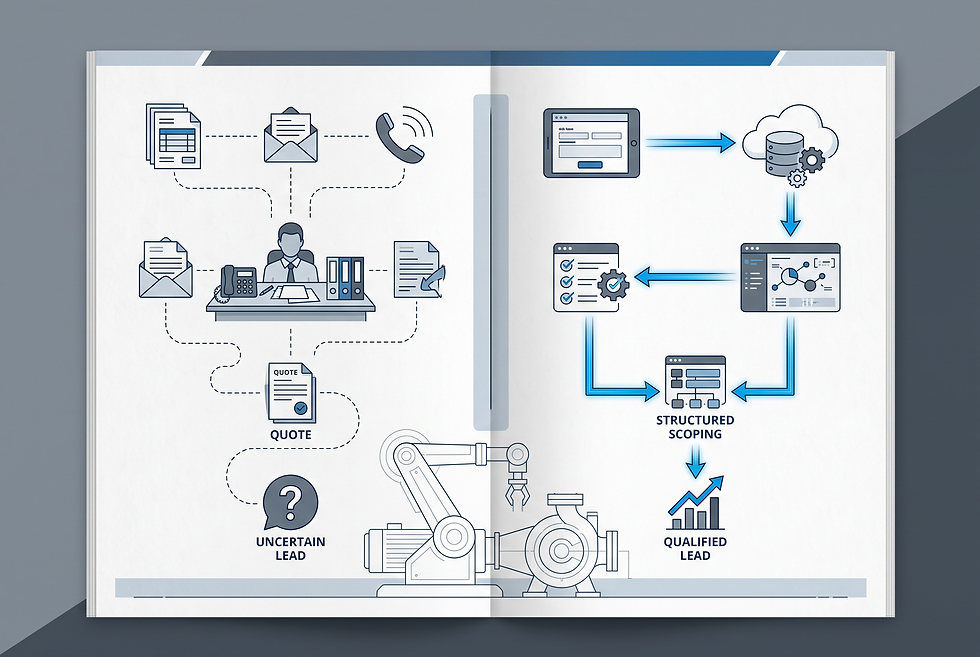
Third, channel follow-up was inconsistent. Regional agents and internal export teams prioritized immediate large projects while mid-tier inquiries fell through communication gaps, leaving millions in potential pipeline unmonitored.
What Changed: Account-Based Technical Signals and Workflow Orchestration
To solve these qualification bottlenecks, forward-looking equipment builders transitioned from passive contact capture to an account-driven, signal-based qualification model. Rather than treating all inbound forms uniformly, the company engineered an operational workflow that correlates industry triggers with technical requirement mapping.
Key changes implemented in the operating model include:
Structured Data Ingestion: Replaced open-ended web forms with guided technical specification fields (resin types, output kg/h, mold tie-bar clearance, energy targets).
Account Intelligence Integration: Built real-time monitoring of regulatory shifts (such as mandated PCR recycled content thresholds) and corporate expansions to identify compounders and packaging converters investing in new production cells.
Rules-Based Technical Pre-Qualification: Standardized calculation logic to evaluate whether a buyer’s requested capacity matches existing machine configurations before involving applications engineering.
Tiered Human-in-the-Loop Routing: Differentiated ready-to-quote industrial projects from exploratory inquiries, routing fully scoped machine files directly to regional sales directors while keeping early-stage engineering teams informed.
How the Workflow Actually Works: Step-by-Step Execution
The operating architecture transforms raw market interest into verified commercial discussions through a six-stage operational sequence.
Data and Trigger Ingestion: The system continuously captures structured data from international RFQ submissions, website technical configuration tools, and industry procurement directories across key industrial territories.
Parameter Normalization: Inbound inquiries are instantly cross-referenced with account profiles. The system categorizes the lead by operational domain: Injection Molder, Compounding Plant, Post-Consumer Recycler, or Packaging Producer.
Automated Technical Scoping: Automated qualification rules compare customer requirements (e.g., "Processing 50% rPET flakes at 800 kg/h with vacuum degassing") against internal engineering specifications. Missing technical parameters are systematically requested via structured, asynchronous prompts.
Commercial Decision Gate: If an inquiry meets clamping, screw, and capacity criteria and shows verifiable corporate backing (capital allocation or plant expansion indicators), it passes the technical threshold.
Engineering & Sales Alignment: A fully structured Machine Project Brief—including resin specifications, targeted cycle times, and estimated electrical load—is compiled and handed over to the dedicated Regional Export Sales Director for human validation.
Feedback Loop and Parameter Refinement: Every completed technical review updates the validation logic, teaching the system which account configurations yield higher factory acceptance testing (FAT) conversion rates.
Evaluation Dimension | Legacy Trade Show & Inbound Model | Signal-Driven Technical Workflow |
Account Identification | Reactive wait for RFQ submissions or trade fair foot traffic | Proactive tracking of plant expansions, PCR mandates, and resin line additions |
Initial Data Capture | Unstructured contact forms lacking technical sizing data | Structured technical intake (resin grade, mold size, output kg/h, power constraints) |
Technical Qualification | Manual engineering review taking 7 to 14 days | Automated parameter pre-check within hours of submission |
Sales Team Involvement | Engineers spend 40% of time filtering unviable inquiries | Engineers receive verified, pre-scoped Machine Project Briefs |
Pipeline Visibility | Disconnected spreadsheets maintained by local agents | Centralized pipeline with verifiable milestone tracking |
Evidence and Results: Measurable Operational Transformation
Documented shifts across industrial machinery deployments demonstrate the impact of structured qualification on export commercial velocity:

Technical Response Latency: According to published enterprise sales operations benchmarks from industrial consulting groups, converting unstructured machinery inquiries into engineering-ready RFQ packages reduces preliminary scoping cycle times from an average of 11 business days to less than 48 hours.
Proposal Viability: Industrial machinery sales teams utilizing structured parameter intake report that the ratio of submitted proposals reaching the formal Factory Acceptance Testing (FAT) quotation stage increases substantially, as non-viable tonnage and resin mismatches are resolved at the outset.
Global Market Coverage: Manufacturers expanding outside domestic territories maintain active dialogue across multiple industrial time zones without expanding administrative overhead at the home plant.
What Other Companies Can Learn: Transferable Principles
Equipment manufacturers seeking to modernize international commercial operations can apply several concrete principles:
Shift from Contact Collection to Technical Scoping: In capital equipment, a contact name is useless without operational context. Require foundational parameters—material, throughput, power availability—early in the qualification sequence.
Isolate Technical Qualification from Commercial Closing: Skilled applications engineers should spend their hours designing custom tooling and machine layouts, not chasing missing resin melt-flow index data.
Map Trigger Events by Industry Vertical: Molders respond to tooling updates; recyclers respond to environmental mandates and contamination reduction; compounders respond to material blending requirements. Align outreach to these operational triggers.
Maintain Transparent Human Boundaries: Automation should organize, verify, and summarize data; final machine pricing, customized engineering approvals, and contract sign-offs must remain firmly with experienced sales engineers.
What This Looks Like for Plastics Equipment Manufacturers
For a mid-sized injection molding or extrusion equipment manufacturer seeking to enter international markets, executing this strategy involves a clear mapping of day-to-day responsibilities.
Instead of deploying generic marketing campaigns, the organization identifies precise sub-sectors:
For Thin-Wall Packaging Producers: Focus on cycle speeds, dry-cycle reduction, hybrid-electric energy savings, and in-mold labeling (IML) compatibility.
For Masterbatch and Compounding Facilities: Focus on screw wear resistance, high-torque gearboxes, dispersion efficiency, and rapid changeover capabilities.
For Post-Consumer Recyclers: Focus on melt filtration efficiency, continuous degassing capabilities, and consistent output despite fluctuating raw material quality.
By framing the commercial dialogue around these exact production challenges, the manufacturer establishes immediate technical credibility with plant managers and procurement directors alike.
AI Worker Mapping: Deploying an AI Export Sales Rep
To implement this operational framework without bloating overhead, industrial equipment companies deploy dedicated, autonomous systems mapped to specific functional roles.
AI Worker Role: AI Export Sales Rep
Main Daily Tasks:
Ingest inbound international inquiries from web forms, distributor emails, and digital specification tools.
Screen prospective accounts against key operating indicators (machine capacity, polymer type, geographic compliance).
Request missing engineering specifications asynchronously using professional, technically accurate correspondence.
Draft preliminary Machine Project Briefs summarizing clamping force, output targets, and electrical requirements.
Primary Work Channels: Corporate Email, Web Customer Portals, Industrial CRM (e.g., HubSpot, Salesforce), and ERP Technical Databases.
Authority Boundary: The AI Export Sales Rep can gather technical parameters, calculate equipment sizing feasibility, and generate project briefs. It cannot issue binding commercial price quotations, offer customized engineering guarantees, or sign distribution agreements without direct approval from the Regional Sales Director.
First Value Event: Delivery of the first fully qualified, technically scoped Machine Project Brief for an active international buyer—complete with verified resin, tonnage, and utility data—ready for engineering review within 48 hours of deployment.
Daily Report Deliverable: A daily executive digest provided to the Commercial Director detailing: new verified international accounts, pending technical clarifications, pre-qualified projects routed to regional teams, and pipeline velocity across target export territories.
FAQ
What is the primary challenge in plastics machinery international lead generation?
The main challenge is the high technical complexity of capital equipment. Inquiries often lack necessary engineering parameters (such as resin grade, clamping force, or output requirements), causing extended email exchanges and delays before sales engineers can determine project viability.
How do account triggers differ across molders, compounders, and recyclers?
Each sub-sector reacts to different operational triggers. Packaging molders focus on cycle times and energy efficiency; compounders look for high-torque dispersion and rapid material changeover; recyclers invest based on pellet purity, degassing, and regulatory recycled-content mandates.
What is the role of an AI Export Sales Rep in plastics equipment manufacturing?
An AI Export Sales Rep acts as an automated front-line coordinator. It captures technical inquiries, requests missing engineering specifications, validates basic machine compatibility, and compiles structured project briefs for human sales directors without issuing binding commercial quotes.
How does structured technical qualification protect engineering resources?
By filtering out mismatched specifications and assembling complete technical requirements before human review, structured qualification prevents applications engineers from spending valuable hours on unviable or incomplete inquiries.
Scale Your Global Machinery Pipeline
Equip your industrial equipment business with an autonomous AI Export Sales Rep to pre-qualify complex technical inquiries, scope international buyer requirements, and accelerate your export pipeline.


Comments