
How CNC Suppliers Reduce RFQ Back-and-Forth to Win Orders

Executive Summary
Precision CNC machine shops frequently lose high-margin commercial contracts not on price or manufacturing capability, but on quoting velocity. When buyers submit incomplete technical drawing packages, engineering estimators spend days in email loops clarifying missing tolerances, materials, and finishes. By implementing structured parameter qualification workflows, precision manufacturers eliminate administrative drag, validate design parameters within minutes, and allow senior estimators to focus purely on manufacturability and pricing.
Company Snapshot: Custom CNC Contract Manufacturing
To understand how precision manufacturers solve sales engineering friction, one must examine the operational structure of high-mix, low-volume (HMLV) precision machining suppliers. Consider a typical mid-sized contract CNC manufacturer operating 20 to 50 CNC milling and turning centers, serving Tier-1 automotive, aerospace, medical device, and industrial automation original equipment manufacturers (OEMs).
These suppliers generate revenue by converting raw billet, castings, and forgings into complex custom components based on engineering drawings provided by customer design teams. Their customer base spans corporate procurement managers, mechanical design engineers, project leads, and hardware founders. The commercial model depends on maintaining machine spindle utilization above 75% across 3-axis, 4-axis, and 5-axis machining centers. However, before a single chip is cut, every potential project must pass through a labor-intensive engineering estimation phase.
What Precision Machining Suppliers Actually Sell
Contract CNC machine shops do not sell off-the-shelf catalog products; they sell certified manufacturing capacity, engineering problem-solving, and adherence to micro-inch tolerances. The procurement journey begins when a buyer issues a Request for Quote (RFQ) containing 3D CAD files (STEP, IGES, Parasolid) and 2D engineering drawings (PDF, DWG) with geometric dimensioning and tolerancing (GD&T).
In this industrial buying cycle, sales and engineering are tightly coupled. Estimators cannot provide a binding commercial quote simply by looking at a part's bounding box. They must verify raw material availability, calculate cycle times per toolpath, determine machine setup counts, evaluate surface roughness requirements, and price secondary operations such as anodizing, heat treating, passivating, and coordinate measuring machine (CMM) inspection.
Because buyers routinely distribute identical RFQ packages to four or five competing machine shops simultaneously, the supplier who returns a comprehensive, technically validated quote first often establishes the commercial benchmark and wins the purchase order.
The Business Problem: The Hidden Cost of Incomplete RFQs
In standard contract manufacturing operations, over 60% of inbound buyer RFQs arrive missing at least one critical production parameter. Common omissions include:
Ambiguous Material Grades: The RFQ specifies "aluminum" or "stainless steel" without denoting exact alloy numbers (e.g., 6061-T6 vs. 7075-T6, 304 vs. 316L).
Missing Linear & Geometric Tolerances: The 3D model lacks an accompanying 2D drawing to define critical tight tolerances (e.g., ±0.0002" on bearing bores vs. standard shop tolerance ±0.005").
Unspecified Surface Treatments & Coatings: Surface finish (Ra value), hardcoat anodizing specifications (MIL-A-8625 Type III), or powder coat RAL codes are omitted.
Vague Inspection and Quality Requirements: Buyers do not clarify whether standard certificate of conformance (CoC), First Article Inspection Report (FAIR per AS9102), or full material test reports (MTR) are required.
Undefined Volume Breakdowns & Target Delivery Dates: Blanket orders lack release batch quantities, preventing volume-tiered tooling amortization.
When these gaps occur, the quoting process stalls. A senior sales engineer or estimator must halt cycle-time modeling to draft an email asking for clarification. The buyer's purchasing agent frequently does not know the answer and forwards the query to their internal mechanical engineering team. Days pass between email exchanges.
During this latency window, three major operational failures occur:
Estimator Burnout: Highly paid manufacturing engineers spend 30% to 40% of their day acting as administrative clerks chasing drawing revisions.
Sales Pipeline Stagnation: High-potential prospective accounts lose interest or award the contract to a competitor with a faster automated qualification intake.
Margin Erosion: Estimators make assumptions to expedite quotes, only to discover during post-award production that the customer expects rigorous Nadcap heat treatment or high-precision CMM reports not factored into the original price.
How Precision Suppliers Reduce RFQ Back-and-Forth
To overcome this operational bottleneck and reduce RFQ back-and-forth, high-performing precision suppliers have fundamentally redesigned their front-end sales engineering workflow. Instead of relying on manual inbox triaging, these suppliers implement systematic intake validation systems and AI-assisted qualification architectures.
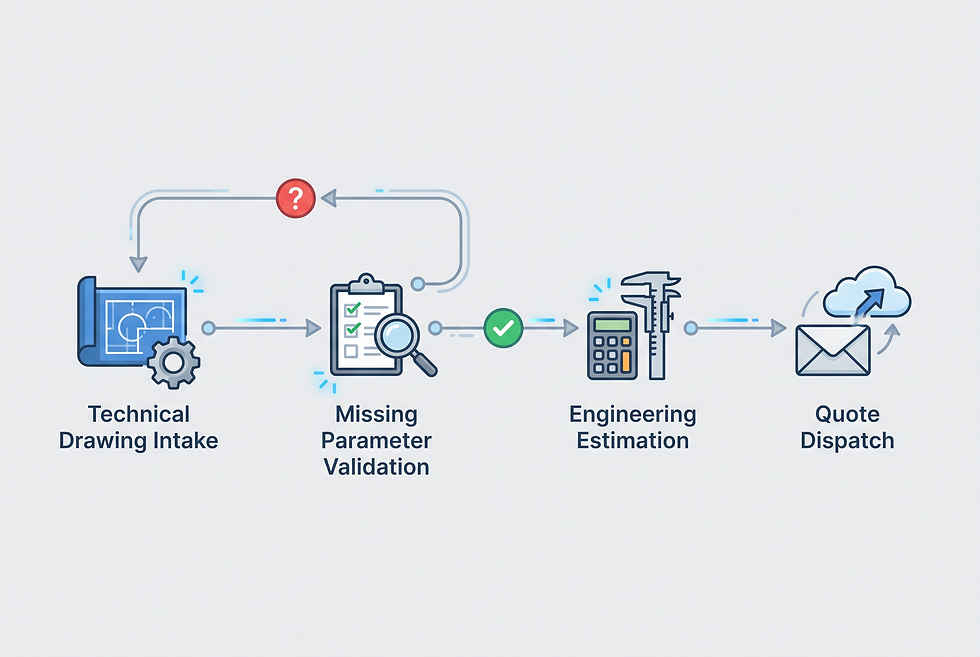
Rather than treating an RFQ as an unstructured email with attachments, the new operating model treats every RFQ as an eight-parameter data schema. Before an RFQ is assigned to an estimator's queue, automated logic conducts an instant technical completeness audit across:
CAD 3D file geometry integrity
2D print attachment presence and title-block correlation
Material alloy and temper designation
Critical tolerance definition
Post-machining surface finishes and coatings
Order quantity breakdown and release schedules
Quality inspection, certification, and traceability standards
Target delivery timeline and shipping terms
If any essential variable is missing, the workflow initiates an immediate, structured technical follow-up inquiry to the buyer within minutes of receipt—while the buyer is still seated at their desk evaluating their vendor list.
How the Technical Intake Workflow Actually Works
The following operating workflow illustrates how precision CNC suppliers establish an automated technical qualification pipeline before allocating engineering hours to pricing.
Step 1: Inbound Data Extraction & Parameter Auditing
When an RFQ arrives via sales email or web upload, the system extracts the text body, metadata, and attached file types. Automated parsers evaluate whether both 3D CAD files and 2D engineering drawings exist. An intake rule engine checks whether material alloy, quantity breaks, tolerance standards, and delivery deadlines are explicitly documented.
Step 2: Automated Clarification Triggering
If critical production criteria are absent, the workflow immediately generates a professional, contextual clarification query. Rather than sending a generic form, the system drafts a specific engineering question: "We received your CAD file for Part-1042. To ensure accurate cycle-time modeling and surface pricing, could you confirm whether 6061-T6 aluminum is acceptable, and if a standard Ra 63 µin machined finish or Type II anodize is required?"
Step 3: Buyer Response Ingestion & Package Updating
When the buyer replies, the system automatically correlates the new specifications with the original project file, updates the master project card, and marks the technical package as verified. If the customer indicates that standard commercial tolerances apply, the project status shifts immediately to estimation-ready.
Step 4: Estimator Technical Review & CAM Feasibility
The senior manufacturing estimator receives a fully qualified, complete technical dossier. Because all administrative ambiguities have been resolved, the engineer focuses 100% of their effort on manufacturability analysis: selecting optimal toolpaths, determining fixture design, evaluating machine envelope constraints, and getting real-time raw stock pricing from metal service centers.
Step 5: Commercial Pricing and Quote Dispatch
The estimating system compiles machine hour rates, setup labor, material costs, tooling consumption, and outside vendor processing into a formal quotation. The sales team reviews the gross margin profile, applies customer tiering rules, and dispatches the quote to the client—frequently within 2 to 4 hours of the initial inquiry.
Step 6: Follow-up Orchestration & Closed-Loop Feedback
Once the quote is delivered, automated tracking monitors client engagement. If the quote remains unviewed or unconfirmed after 48 hours, the system triggers a professional commercial follow-up to address engineering questions, explore batch split adjustments, or verify project release timelines.
Operational Comparison: Legacy Quoting vs. Automated Intake Workflow
The table below contrasts traditional manual RFQ handling with an automated, parameter-driven intake workflow in a custom CNC machine shop.
Workflow Dimension | Legacy Manual RFQ Process | Automated Parameter Intake Workflow |
Intake Triage | Estimator manually opens emails, downloads attachments, checks drawings (30–60 mins) | Automated intake audits 8 parameters and file completeness instantly (< 2 mins) |
Handling Incomplete Data | Stalls in estimator queue; generic emails sent 24–48 hours later | Contextual clarification sent to buyer within 5–15 minutes of RFQ receipt |
Estimator Capacity | 35% of time spent on administrative data chasing and clarification emails | 90%+ of engineering time focused on CAM planning, DFMA, and cycle-time accuracy |
Average Quote Turnaround | 3 to 7 business days per custom assembly or multi-part package | 4 to 24 hours for fully qualified precision component packages |
Follow-up Consistency | Ad-hoc manual emails; lost quotes rarely audited for win/loss insights | Automated cadence tracking buyer engagement and logging RFQ feedback |
Win Rate Impact | Lower conversion due to competitor quote speed and lost buyer attention | Significantly higher conversion driven by rapid response and clear technical rigor |
Evidence and Results from Manufacturing Benchmarks
Published manufacturing intelligence and supply chain benchmarking consistently highlight the direct correlation between quotation speed, technical precision, and contract win rates in custom manufacturing.
According to an industry benchmark analysis by the National Tooling and Machining Association (NTMA), contract machine shops that consistently deliver validated quotes within 24 hours capture up to 40% higher win rates compared to peers requiring 4 or more business days. In on-demand manufacturing vendor case studies published by digital manufacturing networks, automating front-end CAD validation and design-for-manufacturability (DFM) checks reduced overall engineering estimating overhead by 50% to 70% while drastically lowering post-order drawing change orders (ECOs).
Furthermore, third-party operational studies from the Society of Manufacturing Engineers (SME) demonstrate that early technical clarity protects gross margins. When material certifications, special deburring criteria, and CMM inspection requirements are confirmed before quote submission, post-machining margin disputes and unrecovered scrap rates decline by over 25%.
What Other Precision Manufacturers Can Learn
Industrial contract suppliers seeking to optimize their commercial front-end should adopt four fundamental operating principles:
Standardize Intake as Data, Not Freeform Text: Treat incoming RFQs as structured records. Enforce the mandatory eight-parameter checklist (CAD, 2D print, material, tolerance, finish, quantity, inspection, timeline) before letting an estimator touch the file.
Engage Buyers in Their Decision Window: Engineering buyers typically prepare RFQs during specific project design milestones. Prompt clarification questions sent within 15 minutes of submission signal technical competence and catch the buyer while project context is fresh in their minds.
Decouple Technical Triage from Core Estimation: Do not burden senior CAM programmers or toolmakers with email follow-up logistics. Allow automation or dedicated front-end workers to prepare clean, ready-to-price project folders.
Maintain a System of Record for Lost RFQs: Track every un-awarded quotation. Document whether the loss was driven by price, lead time, machine envelope limitations, or lack of certified secondary operations to inform capital expenditure and sales strategy.
Applying This Operating Model Across Industrial Verticals
This structured technical intake model is not limited to standard 3-axis milling shops. It directly translates across precision industrial manufacturing verticals:
For Precision CNC & Swiss Machining Suppliers: Enforcing immediate checks on micro-tolerances, concentricity requirements, bar-feed capacities, and specialized cleaning standards (e.g., ultrasonic degreasing for medical implantables).
For Sheet Metal Fabrication & Laser Cutting Job Shops: Instantly identifying missing bend deduction parameters, sheet gauge specifications, flat pattern CAD files, and hardware insertion callouts (PEM studs/nuts).
For Custom Plastic Injection Molders & Tooling Makers: Validating resin grades, shrink rates, mold cavitation preferences, surface texture standards (SPI/VDI), and expected mold life cycles before committing tooling engineering hours.
For Industrial Automation & Robotic System Integrators: Auditing payload specifications, duty cycles, cycle-time targets, and electrical interface compatibility prior to generating custom turnkey system proposals.
Mapping the Workflow to an AI Business Development Rep
For precision machining and contract manufacturing enterprises seeking to modernize their RFQ pipeline without adding headcount, deploying a specialized AI Business Development Rep establishes the necessary front-end discipline.
Role Profile: AI Business Development Rep
Primary Work Channel: Inbound commercial email inboxes, supplier portal notifications, web RFQ intake forms, and CRM integration.
Main Daily Tasks:
Ingest inbound customer RFQ packages and parse attached 2D drawings and 3D CAD files.
Cross-reference drawings against the 8 core production parameters (Material, Tolerance, Finish, Quantity, Inspection, Certification, Timeline, Tooling access).
Draft and dispatch structured, polite technical clarification inquiries to buyers for missing variables.
Consolidate confirmed buyer responses into an estimation-ready project file.
Conduct automated follow-ups on delivered quotes to assess buyer intent and competitive positioning.
Authority Boundary:
Autonomous: Extracts metadata, validates parameter completeness, sends pre-configured engineering qualification queries, logs project records in CRM.
Requiring Human Approval: Generating final machine-hour pricing, approving non-standard payment terms, accepting liability on aerospace/medical quality standards, signing master service agreements (MSAs).
First Value Event: Successfully identifying an unstated material temper or missing tolerance callout on an inbound RFQ, querying the buyer within 10 minutes, and assembling a 100% complete technical package before an estimator opens the file.
Daily Report Result: A morning management dashboard detailing total inbound RFQ volume, parameter completion rate, average time-to-clarification, estimator queue readiness, and quotation conversion metrics across target accounts.
By systematically structuring the front-end intake, precision CNC suppliers protect valuable engineering resources, outpace market competition, and transform quoting from an operational bottleneck into a sustainable competitive advantage.
FAQ
Why is an automated parameter check critical for CNC machine shops?
Incomplete RFQs represent the largest source of quoting delays in precision machining. By automatically auditing incoming packages for CAD geometry, 2D prints, material specs, tolerances, finishes, quantities, inspection requirements, and delivery schedules, machine shops prevent estimator downtime and eliminate days of email back-and-forth.
How quickly should a CNC supplier follow up on an incomplete RFQ?
Best-in-class manufacturers initiate technical clarification within 5 to 15 minutes of RFQ submission. Immediate outreach reaches the buyer while they are actively working on the procurement package, resulting in much faster response rates compared to queries sent days later.
Does automated RFQ qualification replace skilled manufacturing estimators?
No. Automated qualification removes the administrative burden of chasing missing drawing parameters, allowing senior estimators and CAM engineers to dedicate their time exclusively to cycle-time estimation, manufacturability analysis, tooling strategy, and competitive pricing.
What are the eight core parameters every precision CNC RFQ must contain?
Every comprehensive CNC RFQ requires a 3D CAD model, 2D engineering drawing with GD&T, defined material alloy and temper, critical tolerances, surface finishes/coatings, order volume breaks, quality/inspection certifications (such as CoC or FAIR), and a target delivery date.
Eliminate Quoting Bottlenecks with an AI Business Development Rep
Deploy an AI Business Development Rep to automatically audit inbound RFQs, clarify missing technical drawing specifications, and deliver estimation-ready packages to your engineering team in minutes.


Comments