
Streamlining Global B2B Sales: The Ultimate Guide to RFQ Automation Software for Manufacturers

For global B2B manufacturers, industrial product exporters, and custom engineering firms, the Request for Quote (RFQ) process is the lifeblood of business. Yet, it is often plagued by delays, manual entry errors, and missed opportunities. When technical buyers ask for custom quotes, they expect swift, detailed, and highly accurate pricing. A delay of even 24 hours can cost you a million-dollar contract.
The Solution?
The best RFQ automation software for B2B manufacturers dynamically integrates CRM data with AI to qualify inquiries instantly. Crucial capabilities include multi-language parsing, automatic technical specifications extraction, immediate fit-and-intent scoring, and draft quote generation, allowing sales teams to approve and deliver accurate quotes within minutes instead of days.
Why Traditional RFQ Handling Fails B2B Manufacturers and Exporters
Traditional sales workflows in manufacturing rely heavily on manual triage. When a prospect submits an RFQ via email, a website form, or WhatsApp, the inquiry typically sits in an inbox until a sales representative manually reviews it.
This delay causes several critical pain points:
Slow Response Times: In complex B2B buying, speed is a primary competitive advantage. Buyers frequently complain about waiting days just to receive an acknowledgment of their RFQ.
Incomplete Technical Specifications: Many RFQs lack key details (such as voltage requirements, materials, dimensions, or lead time expectations). Sales reps must spend days chasing down prospects for details.
Inefficient Resource Allocation: Highly technical sales engineers spend up to 40% of their time filtering out low-quality inquiries instead of focusing on high-intent, high-value deals.
What Is RFQ Automation Software and How Does It Work?
RFQ automation software is a specialized category of digital tools designed to ingest, analyze, prioritize, and draft responses to complex B2B inquiries automatically. Unlike generic email autoresponders, an advanced AI-driven RFQ system acts as an intelligent digital SDR (Sales Development Representative) that understands engineering blueprints, manufacturing capacities, and pricing logics.
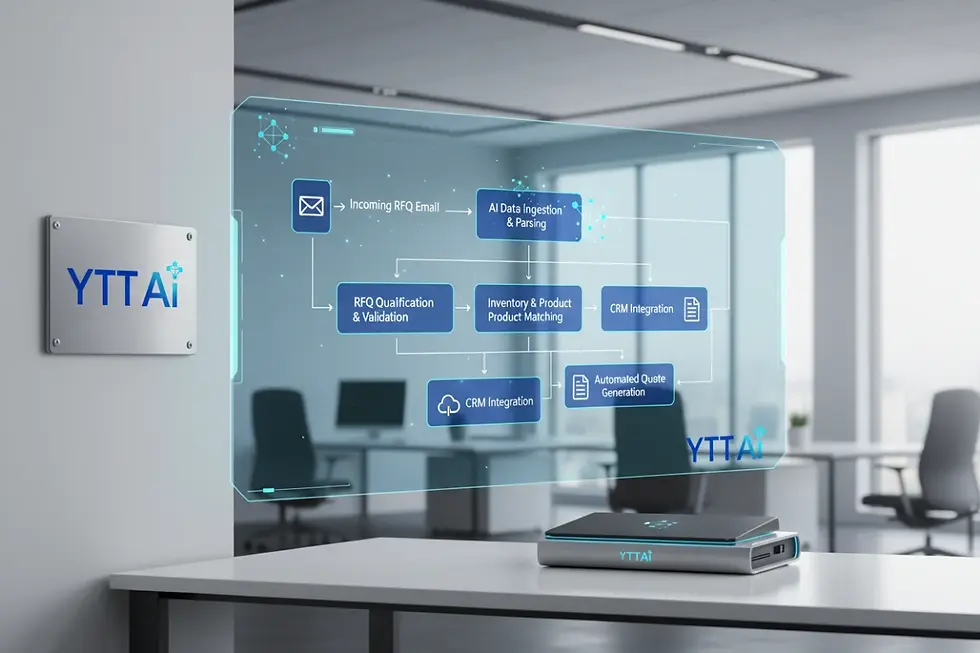
Here is how a state-of-the-art RFQ automation workflow operates from ingestion to output:
Omnichannel Ingestion: The software monitors emails, web inquiries, and instant messaging apps (like WhatsApp) to capture incoming RFQs.
Contextual Analysis: Advanced Large Language Models (LLMs) parse the message and attachments (such as PDFs, Excel spreadsheets, or CAD file metadata).
CRM Synchronization: The system automatically checks your CRM to see if the prospect is an existing customer or a cold lead.
Draft Generation: The platform prepares a highly detailed, professional reply—including pricing, technical data sheet references, and shipping terms—ready for human sales approval.
Key AI Capabilities That Matter Most for Complex Quoting
When evaluating sales automation tools for manufacturers, standard email templates are not enough. High-value engineering and export businesses require specific cognitive AI capabilities.
AI Lead Qualification for B2B Buyers
Not all RFQs are created equal. Some come from students doing research, competitors checking prices, or low-fit buyers. Implementing AI lead qualification for B2B inquiries allows you to score incoming leads based on corporate fit, purchasing intent, and urgency. By examining historical deal records and company firmographics, the software automatically routes hot, high-value opportunities to your top account executives while automating standard responses for smaller accounts.
Multi-Language Technical Parsing
Global trade involves diverse languages. If a buyer from Germany submits a custom technical specification sheet in German, the software instantly translates, understands, and aligns the parameters against your manufacturing inventory without losing technical nuance. This ensures seamless cross-border communication and shortens response cycles.
RFQ Automation vs. Traditional Configure-Price-Quote Software
Many enterprises ask: Do I need RFQ automation software if I already have a CPQ system?
While traditional configure-price-quote software is excellent for guiding sales reps through complex product configurations during active calls, it does not solve the upstream problem of inbound inquiry sorting, technical specification extraction, or automatic email response generation.

Feature | Traditional Configure-Price-Quote (CPQ) | Modern RFQ Automation Software |
|---|---|---|
:--- | :--- | :--- |
Primary User | Internal Sales Representatives | AI Engines + Sales Managers |
Lead Intake | Manual data entry by sales rep | Automated ingestion from email, web, and chat |
Technical Parsing | No (requires human input) | Yes (extracts specs from raw emails and PDFs) |
Lead Qualification | No | Yes (built-in AI lead qualification for B2B) |
Quoting Speed | Hours to Days | Minutes (Automated draft generation) |
Follow-Up | Manual follow-up prompts | Intelligent, automated multi-channel follow-up |
Human-in-the-Loop: Balancing AI Efficiency with Technical Human Review
Automation does not mean removing the human touch. In manufacturing and industrial engineering, a small quoting error can lead to significant financial losses. Therefore, the ideal workflow utilizes a "Human-in-the-Loop" (HITL) model.
Under this paradigm, the AI handles 90% of the administrative heavy lifting—categorizing the inquiry, qualifying the buyer, retrieving catalog prices, and drafting the email. However, the final draft is always presented to an experienced technical sales manager inside their dashboard. The manager can review, edit, and approve the quote with a single click. This ensures absolute precision while maintaining lightning-fast turnaround times.
Stop Losing Deals with Smart Quote Follow-Up Software
Sending the quote is only half the battle. Statistics show that over 60% of sales representatives never follow up more than once on an issued quotation, leaving significant revenue on the table.
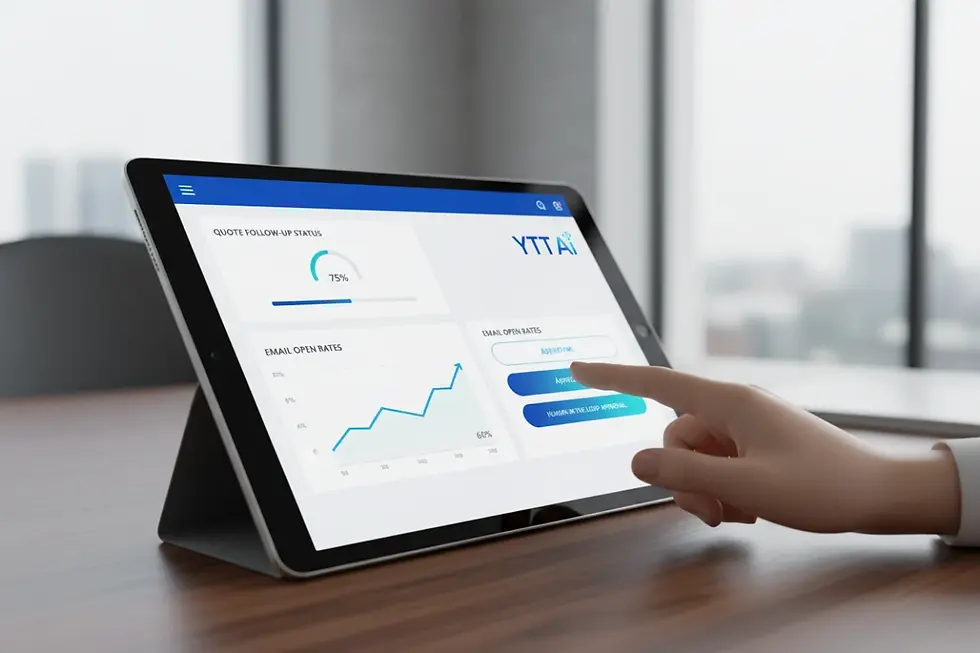
By leveraging automated quote follow-up software, you can establish multi-step, contextual follow-up sequences. The system tracks whether the buyer has opened the email, downloaded the quote PDF, or clicked the product link. If no response is received, the AI automatically drafts personalized follow-up emails, referencing their specific technical requirements and addressing common buyer hesitations. This ensures your brand remains top-of-mind and helps resurrect dormant opportunities.
Step-by-Step Guide to Implementing RFQ Automation
Transitioning your global sales team to an automated workflow can be completed in five practical stages:
Map Your Quoting Logic: Document your pricing matrices, product catalogs, shipping policies, and frequently asked technical questions.
Connect Ingestion Channels: Route your sales inquiry inboxes, website quote request forms, and global instant messaging accounts into your AI workflow.
Integrate with CRM: Synchronize the system with platforms like HubSpot or Salesforce to ensure no customer history is fragmented.
Train the AI Agent: Supply the AI engine with your past successful quotes, product brochures, and technical specs to train it on your company's tone and domain expertise.
Define Approval Rules: Set thresholds for automatic dispatch vs. human review (e.g., automatically send catalog quotes under $5,000, but route custom engineered configurations over $50,000 to the senior engineering team).
Key Performance Metrics (KPIs) to Measure Quoting Success
To justify your investment and continuously optimize your operations, track the following operational KPIs:
Average Response Time (Speed-to-Lead): Target a reduction from 24-48 hours to under 15 minutes.
Inquiry-to-Quote Conversion Rate: The percentage of inbound RFQs that receive a finalized quote.
Sales Rep Efficiency: The total volume of quotes processed per sales rep monthly.
Follow-up Engagement Rate: Open rates and response rates on your automated follow-up sequences.
Propel Your Overseas Sales Growth with YTTAI
In the competitive landscape of global B2B manufacturing, speed and accuracy are your ultimate differentiators. Don't let valuable opportunities get buried in your inbox. With YTTAI's Sales Master, you can seamlessly automate lead qualification, technical specification extraction, and quote follow-ups, empowering your sales team to close deals faster than ever.
Are you ready to optimize your sales pipeline? Request an RFQ and lead conversion diagnosis today and find out how AI can elevate your global business growth.
FAQ
What is the difference between RFQ automation software and traditional CRM tools?
Traditional CRMs are static databases used to track client contact information and deal stages, requiring manual entry. RFQ automation software sits on top of your CRM, using AI to dynamically read emails, qualify leads, extract complex technical specifications, and generate draft quotes for human approval within minutes.
Can RFQ automation software handle custom, non-standard engineering requests?
Yes. Advanced AI-driven RFQ platforms utilize deep learning and large language models to understand custom dimensions, engineering drawings, and specific material requests, matching them against historical pricing frameworks to draft accurate responses for technical sales review.
Is human approval still required with automated quoting software?
Absolutely. For high-value, complex manufacturing products, we recommend a Human-in-the-Loop (HITL) model. The AI handles data entry, qualification, and initial drafting, while your expert sales engineers review, tweak, and authorize the final quote before dispatch.
How does automated quote follow-up software increase win rates?
It ensures that no quote is forgotten. By tracking buyer engagement (such as when a quote PDF is opened), the software sends timely, personalized follow-ups tailored to the client's industry and requirements, significantly increasing conversion rates.


Comments