
Schneider Electric AI Sales Assistant: From Product Data to Next-Best Action

Executive Summary: Schneider Electric addressed extreme industrial catalog complexity by unifying disparate product, customer, and transactional data into an AI-guided recommendation engine. This framework equips commercial teams with actionable next-best actions rather than manual catalog lookups. For industrial manufacturers, this blueprint proves that structuring legacy technical knowledge is the primary prerequisite to scaling intelligent sales execution.
Company Snapshot: Global Energy Management and Industrial Automation
Schneider Electric is a global leader in energy management and industrial automation, operating across more than 100 countries. The enterprise designs, manufactures, and services a vast portfolio spanning low-voltage and medium-voltage power distribution, industrial control components, building automation systems, and mission-critical data center infrastructure.
The company serves a diverse B2B customer base comprising electrical contractors, panel builders, system integrators, engineering procurement construction (EPC) firms, original equipment manufacturers (OEMs), and direct industrial enterprise accounts. Operating through an intricate hybrid model of direct technical sales and global distribution networks, Schneider Electric manages hundreds of thousands of active stock-keeping units (SKUs) and complex configured-to-order systems.
Analyzing Schneider Electric provides essential operational insights for commercial leaders. The company demonstrates how an industrial enterprise operating at massive scale can transition from fragmented legacy records to an integrated, data-driven selling motion without disrupting active engineering and distribution channels.
What the Company Sells: Navigating Technical Complexity in B2B Procurement
Industrial automation and energy management systems are rarely purchased as commodity off-the-shelf items. A standard commercial project typically involves complex multi-component specifications where switchgear, circuit breakers, variable speed drives, programmable logic controllers (PLCs), and software layers must integrate seamlessly.
In this operating environment, the procurement journey involves extended evaluation cycles, rigorous regulatory compliance, and multiple stakeholders, including electrical engineers, procurement officers, and installation contractors. Customers require precise technical validation, compatibility checks, and verified lead times before finalizing a bill of materials.
Consequently, the B2B sales cycle is engineering-intensive. Sales representatives and application engineers historically spent hours cross-referencing technical manuals, legacy enterprise resource planning (ERP) databases, past order histories, and regional regulatory standards to assemble accurate proposals or identify viable replacement components.
The Business Problem: Catalog Overload and Fragmented Account Intelligence
As Schneider Electric expanded its hardware and digital software portfolios, commercial teams encountered operational bottlenecks common across legacy industrial manufacturing:
Catalog Complexity: With hundreds of thousands of distinct parts and frequent lifecycle updates, commercial teams struggled to maintain comprehensive knowledge across all product categories.
Data Fragmentation: Transactional data resided in ERP systems, while customer interaction history was scattered across customer relationship management (CRM) platforms, distributor portals, and local spreadsheets.
Delayed Proposal Cycles: Field representatives and technical support teams spent substantial administrative time performing routine SKU lookups, compatibility matching, and cross-reference searches.
Missed Cross-Sell and Modernization Opportunities: Identifying which installed base accounts were due for retrofit, legacy component replacement, or software attach required manual account audits that account managers rarely had bandwidth to execute systematically.
Without an automated layer to synthesize these massive data pools, commercial teams functioned reactively, responding to direct customer requests rather than proactively delivering high-margin, relevant system upgrades.
What Changed: Deploying an AI-Driven Next-Best Action Architecture
To solve catalog overload and unlock latent account value, Schneider Electric invested in centralized digital transformation and enterprise AI initiatives. According to official Schneider Electric case publications and corporate disclosures regarding their internal digital transformation, the organization focused on operationalizing data foundations across their commercial operations.
Rather than relying on ad-hoc spreadsheets or isolated departmental tools, the enterprise deployed an integrated system often referred to as the Schneider Electric AI sales assistant framework. This initiative combined centralized customer master data, machine learning recommendation models, and conversational search interfaces natively integrated into their core CRM workflows.
The core technological shift centered on transitioning from static dashboards to active "Next-Best Action" guidance. Instead of expecting sales engineers to analyze thousands of data rows, the AI models continuously ingest telemetry, order history, and product relationship graphs to surface contextual sales plays directly to commercial representatives.
How the Workflow Actually Works: From Raw Data to Guided Sales Execution
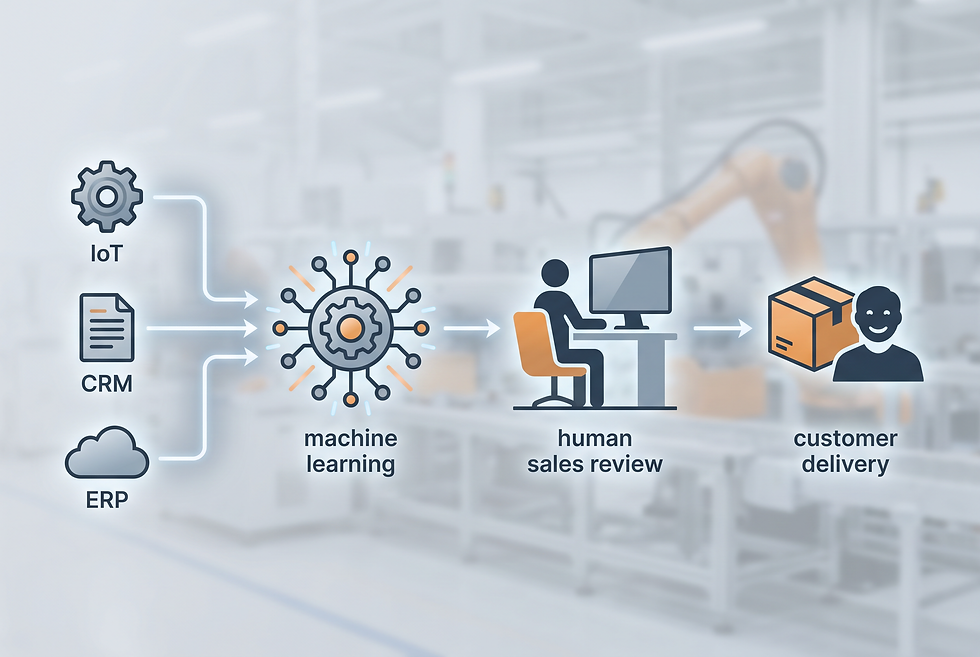
The operational mechanism powering this intelligent commercial workflow follows a systematic six-step progression from data ingestion to human-verified execution.
Step 1: Multi-Source Data Ingestion
The workflow begins by pulling disparate enterprise data into a centralized data lake. Ingested streams include ERP order histories, distributor sell-through reports, CRM interaction logs, digital portal search behavior, and structured engineering product specifications.
Step 2: Knowledge Graph and Recommendation Modeling
The underlying machine learning engine processes structured product relationships (e.g., compatibility matrices, superseded part numbers, mandatory accessories) and aligns them with account-level profiles. The model evaluates buying patterns across similar customer cohorts to identify gaps in existing equipment deployments.
Step 3: Algorithmic Opportunity Scoring and Next-Best Action Generation
The AI system generates discrete, ranked recommendations for each account. These triggers include high-probability cross-sell recommendations, end-of-life replacement notifications, contract renewal alerts, or price-sensitivity flags.
Step 4: Commercial Representative Review and Contextual Outreach
The recommendation appears inside the representative's daily CRM interface with full explainability notes—such as "Recommended because this client purchased Masterpact breakers 7 years ago and has searched for digital monitoring modules." The sales professional evaluates the context, adjusts the pricing or scope if necessary, and initiates contact.
Step 5: Customer Engagement and Commercial Validation
The account executive delivers a tailored proposal, technical retrofit plan, or value assessment directly to the buyer, backed by verified compatibility documentation automatically assembled by the system.
Step 6: Closed-Loop Feedback and Continuous Model Optimization
The outcome of the engagement (e.g., accepted proposal, declined offer with reason, ignored recommendation) is written back to the data repository. This reinforcement loop continuously refines the scoring algorithms and sharpens future recommendations across the global sales force.
Workflow Comparison: Traditional Sales Support vs. AI-Assisted Selling
The table below outlines the structural shift between legacy industrial account management and modern AI-assisted commercial operations.
Operating Dimension | Traditional Industrial Sales Process | AI-Assisted Commercial Workflow | Human vs. System Governance |
Account Opportunity Discovery | Manual review of past invoices and periodic on-site account audits. | Continuous automated pattern recognition across purchase history and installed base data. | AI Action: Identifies and ranks latent cross-sell patterns. |
Product Compatibility Verification | Sales engineer manually references PDF catalogs, specification sheets, and engineering charts. | Automated compatibility mapping through structured knowledge graphs. | AI Action: Generates verified BOM matches instant validation. |
Commercial Recommendation Delivery | Reactive response to incoming customer requests or distributor inquiries. | Proactive "Next-Best Action" surfaced inside CRM with explainable rationale. | Human Role: Sales rep reviews context, validates margin, and leads conversation. |
Proposal Turnaround Time | Days to weeks depending on engineering complexity and internal handoffs. | Minutes to hours for standard configured systems and modernization quotes. | Human Role: Commercial director approves custom pricing exceptions. |
Continuous Workflow Optimization | Anecdotal sales meeting feedback and quarterly pipeline reviews. | Structured win/loss tracking fed back into recommendation engine algorithms. | System Action: Automatically adjusts lead scores and propensity models. |
Evidence and Results: Quantifiable Operational Shifts
Publicly available disclosures, vendor partner case studies, and official Schneider Electric digital transformation presentations highlight clear operational gains from their investments in sales intelligence and automated commercial operations:
Accelerated Proposal Velocity: According to enterprise case studies published by technology partners collaborating on Schneider Electric's commercial automation stack, field commercial teams reduced proposal preparation times for complex industrial product configurations significantly.
Higher Conversion on Cross-Sell Campaigns: By utilizing targeted propensity modeling rather than generic blast marketing, digital campaigns and rep-driven recommendations yielded measurable improvements in qualified opportunity generation.
Enhanced Commercial Productivity: Enterprise reporting indicates that eliminating manual catalog navigation allowed technical sales teams to redirect substantial working hours each month from back-office data compilation to direct, high-value client advisory interactions.

These verified operational shifts demonstrate that the financial return on enterprise AI is realized primarily through workflow compression and the removal of administrative friction from technical personnel.
What Other Industrial Companies Can Learn
Industrial equipment manufacturers, component suppliers, and precision engineering firms can extract four core methodologies from Schneider Electric's commercial evolution:
1. Data Structuring Precedes Intelligence
AI recommendation models cannot function over unstructured, siloed data. Enterprises must first standardize product catalogs, harmonize customer records, and structure technical compatibility rules before expecting machine learning models to deliver reliable sales triggers.
2. Focus on Next-Best Action, Not Passive Dashboards
Traditional business intelligence dashboards present charts that require manual interpretation. High-leverage AI implementations translate analytics into discrete, prioritized tasks that tell the commercial rep exactly who to contact, which product to offer, and why.
3. Keep Technical Experts in the Loop
In complex industrial sales, AI must serve as an assistant rather than an autonomous closer. Preserving human authority over final proposals, contractual terms, and high-stakes relationship management ensures technical safety and maintains commercial trust.
4. Prioritize Workflow Integration Over Standalone Tools
Adoption fails when sales representatives must log into disconnected portals. Intelligence must be injected directly into the primary software environments where teams already operate—such as CRM systems, email clients, and communication channels.
What This Operating Logic Looks Like in Industrial Automation
For mid-sized machinery builders, robotics integrators, and component distributors, deploying this operating logic does not require building an internal multi-million dollar data science division. The same architectural principles can be applied directly to core revenue workflows.
Consider an industrial automation manufacturer selling specialized PLCs, robotic arms, and end-of-arm tooling to automotive and electronics manufacturing plants. By connecting historical shipment records, machine telemetry, and replacement parts lifecycles to an intelligent recommendation system, the manufacturer can automatically identify when an active factory line approaches maintenance milestones or requires performance upgrades.
Instead of waiting for an emergency breakdown call, the system alerts the assigned technical sales team with a pre-configured Bill of Materials and compatibility assessment, transforming reactive customer support into a proactive, high-margin revenue stream.
Deploying the Logic: The AI Technical Sales Rep
For industrial automation and equipment businesses looking to operationalize this approach, assigning a dedicated digital worker provides the fastest path to value without expanding administrative headcount.
Worker Job Title: AI Technical Sales Rep
Main Daily Tasks: Ingesting engineering inquiries and RFQs; parsing complex technical drawings and BOM requirements; cross-referencing internal catalog data for compatibility; drafting accurate technical proposals; and surfacing high-probability next-best actions for account executives.
Primary Work Channel: Integrated into company email infrastructure, customer web portals, and standard CRM platforms.
Authority Boundary: Pre-qualifies inquiries, validates part compatibility, and drafts detailed technical quotes. All commercial pricing discounts, formal contracts, and custom engineering exceptions require explicit human approval.
First Value Event: Successfully ingesting a multi-line technical RFQ from an industrial customer, verifying component compatibility against catalog data, and delivering a complete, human-reviewable proposal draft within 10 minutes of submission.
Daily Report Output: A structured summary delivered to the Sales Director detailing total RFQs processed, top recommended cross-sell product lines, identified legacy accounts overdue for retrofit outreach, and flagged technical compatibility discrepancies requiring senior engineering sign-off.
FAQ
What is the core function of the Schneider Electric AI sales assistant?
The core function is to synthesize massive product catalogs, customer transaction histories, and compatibility data into prioritized 'Next-Best Action' recommendations that guide commercial sales teams during account outreach and proposal generation.
Does AI in industrial sales completely replace technical sales engineers?
No. In complex industrial automation and energy management, AI acts as an enablement layer. The AI assistant handles catalog cross-referencing, initial BOM generation, and lead scoring, while technical sales engineers validate engineering feasibility and manage high-value client relationships.
How can mid-sized manufacturers implement a similar next-best action workflow?
Mid-sized manufacturers can begin by structuring their product compatibility data and ERP order histories, then deploying targeted AI workers—such as an AI Technical Sales Rep—to automate RFQ parsing, catalog cross-referencing, and proactive replacement alerts within their existing CRM.
Modernize Your Industrial Sales Operations
Equip your commercial team with intelligent catalog recommendations and automated proposal generation. Discover how an AI Technical Sales Rep accelerates revenue growth and eliminates engineering bottlenecks.


Comments