
SICK Sensor Selector Digital Sales Case Study: Scaling Complex B2B Buying

Executive Summary
SICK AG transitioned from a traditional, catalog-heavy engineering sales support model into an interactive, self-service digital configuration architecture covering more than 40,000 sensor products. By structuring technical attributes, CAD models, and application criteria into dynamic digital selectors, SICK eliminated substantial pre-sales friction for global technical buyers. This transformation demonstrates how industrial manufacturers can automate complex technical qualification while preserving valuable sales engineering hours for high-margin, custom integration projects.
Company Snapshot: SICK AG
Founded in 1946 and headquartered in Waldkirch, Germany, SICK AG is one of the world's leading manufacturers of intelligent sensor solutions for industrial automation. The company operates across three primary business segments: factory automation, logistics automation, and process automation. Generating more than €2 billion in annual revenue with a global workforce exceeding 12,000 employees, SICK delivers sensing technologies to international discrete manufacturing, automotive, logistics, pharmaceutical, and packaging sectors.
SICK operates on a hybrid go-to-market model comprising direct enterprise sales, regional system integrator networks, and global industrial distributor channels. Its product catalog spans thousands of specialized devices, including optical sensors, inductive proximity switches, safety light curtains, LiDAR scanners, industrial vision systems, RFID transponders, and gas analyzers.
Analyzing this enterprise offers immense value to manufacturing and automation executives. SICK faced the classic industrial dilemma: extreme product variety, high technical specificity, and an engineering-led customer base that required granular data before making a purchase. How the company solved this challenge provides actionable blueprints for manufacturers worldwide.
What SICK Sells and the Mechanics of Industrial Buying
Industrial sensors are not commoditized consumer goods purchased on impulse. They are mission-critical electrical and mechanical components embedded inside automated machinery, robotic packaging cells, sorting conveyors, and chemical plants.
A controls engineer, machine builder (OEM), or maintenance technician evaluates sensors against strict physical and electrical constraints:
Sensing distance, light wavelength, beam geometry, and target material reflectivity.
Output logic (PNP, NPN, push-pull, discrete analog voltage/current, or IO-Link digital communication).
Ingress protection ratings (IP67, IP69K for hygienic food-grade washdown environments).
Connection interface (M8, M12 pinouts, integrated cables, terminal chambers).
Functional safety certifications (EN ISO 13849-1, SIL3, PL e, ATEX explosion-proof compliance).
If an engineer selects a sensor with the wrong switching frequency, inappropriate background suppression, or an incompatible fieldbus interface, an entire automated production line can suffer critical downtime. Consequently, the industrial buying process requires rigorous specification matching, 3D CAD modeling inside machine designs, and commercial validation before a request for quotation (RFQ) or purchase order is placed.
The Business Problem: Technical Complexity and Pre-Sales Friction
As SICK expanded its portfolio to over 40,000 active product variants, traditional sales engineering channels encountered structural bottlenecks:
High Pre-Sales Response Latency: Application engineers and support desks spent significant portions of their workdays answering basic compatibility questions, looking up pinout diagrams, and emailing CAD files.
Catalog Navigation Overload: Multi-hundred-page printed books and massive static PDF catalogs created extreme friction for external design engineers attempting to isolate matching parts.
RFQ Bottlenecks on Low-Complexity Items: Standard replacement orders and routine component purchases clogged engineering queues, diverting top technical talent away from multi-million-euro custom automation deals.
Asynchronous Global Buying Needs: Design engineers in North America, Asia, and Europe working across multiple time zones needed instant verification at midnight or on weekends, which traditional regional branch offices could not support.
SICK recognized that human engineering capacity cannot scale linearly with product catalog expansion. Resolving this friction required embedding deep engineering domain logic directly into digital self-service tools.
What Changed: Digital Selection and Guided Technical Selling
To modernize the discovery and specification experience, SICK built an integrated digital sales architecture combining parametric search engines, application wizards, automated CAD asset delivery, and direct e-commerce workflows.
Instead of treating its website as a static marketing brochure, SICK structured its product master data management (MDM) system around engineering parameters and application logic. Key components of this transition include:
Parametric Product Selectors: Allowing users to filter tens of thousands of SKUs by deterministic electrical, optical, and mechanical specifications.
Application Selectors and Wizards: Guiding buyers through functional operating questions (such as object transparency, ambient temperature, or belt speed) to recommend suitable sensor families.
On-Demand CAD Integration: Embedding instant 3D model generation and electrical wiring macros directly into product detail pages.
Direct Replacement Finders: Cross-referencing legacy, obsolete, or competitor part numbers to suggest active equivalent products.
Self-Service Commercial Workflows: Giving verified B2B accounts instant visibility into contract pricing, warehouse inventory levels, and estimated delivery dates.
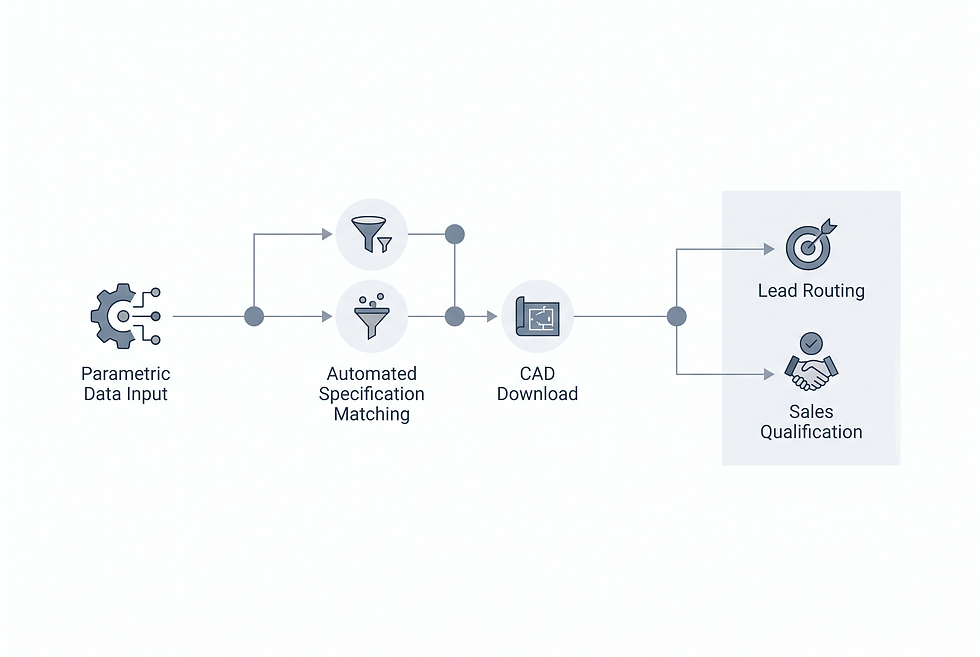
How the Workflow Actually Works
This operational overhaul converted a slow, manual engineering inquiry cycle into an automated, multi-tiered digital qualification pipeline:
Step 1: Application Requirement Input
The machine builder or procurement specialist accesses the digital platform with specific functional requirements. The buyer enters operational constraints—such as a 300 mm sensing range, stainless steel housing, and IO-Link capability—or follows a guided selection questionnaire.
Step 2: Automated Filtering and Attribute Matching
The parametric selector queries structured product databases in real time. It evaluates mathematical tolerances, hides incompatible voltage or output configurations, and refines thousands of potential SKUs down to two or three compatible models.
Step 3: Self-Service Technical Verification
Without waiting for an email response from an application engineer, the customer downloads native 3D CAD models, reviews complete PDF data sheets, verifies wiring pinouts, and tests digital twins inside their mechanical CAD software.
Step 4: Buyer Path Routing and Decision
Once technical compatibility is verified, the workflow branches automatically:
Standard Components & Direct Reorders: The customer adds the SKU to their digital cart, applies organizational contract pricing, and completes the purchase order via web portal or automated EDI.
Complex Custom Projects: If the project requires customized housings, specialized optics, or system-wide safety integration, the selector aggregates the entered technical parameters into a structured project package and routes it directly to the designated sales engineer.
Step 5: Fulfillment, CRM Sync, and Continuous Optimization
Standard orders flow directly into backend enterprise resource planning (ERP) systems for automated fulfillment. For high-touch RFQs, field sales engineers receive pre-qualified project details without having to conduct preliminary discovery calls. Aggregated search queries and missing-attribute logs are fed back into product management to identify customer demand trends.
Analyzing the Operational Shift
This detailed sick sensor selector digital sales case study illustrates how industrial manufacturers can systematically replace manual qualification gates with automated digital workflows. Comparing traditional sales workflows against modern digital selector models highlights significant operational gains.
Operational Dimension | Traditional Engineering Sales Process | Digital Product Selector Workflow |
Product Discovery | Manual navigation through 500+ page PDF catalogs or physical spec books. | Dynamic parametric filtering across thousands of SKUs in seconds. |
Technical Qualification | Repetitive email and telephone consultations with internal application engineers. | Self-service guided application wizards narrowing down compatible models instantly. |
CAD Asset Delivery | Formal ticket submission with 24–48 hour fulfillment turnaround times. | Instant on-demand generation and direct download of 3D CAD and E-CAD models. |
Lead Routing | Unstructured email inquiries requiring manual triage and qualification. | Pre-structured technical specification briefs automatically delivered to CRM. |
Sales Engineering Focus | High percentage of time spent looking up pinouts and standard replacement part numbers. | High-value consultative solution architecture and high-margin system integration. |
Buyer Experience | High friction, significant waiting time, restricted to local business hours. | 24/7 immediate self-service technical certainty and frictionless ordering. |
Evidence and Measurable Impact
According to official SICK AG annual reports and published corporate communications regarding its digital platform strategy, digitizing product catalogs and establishing direct digital customer channels yielded clear operational benefits:
Comprehensive Product Availability: The enterprise maintains digital accessibility and CAD integration for more than 40,000 standard products across global regional domains.
Automated Order Processing: A substantial share of standard sensor component orders and catalog reorders are handled digitally through self-service e-commerce and automated EDI interfaces, eliminating manual order entry overhead.
Engineering Resource Reallocation: Field application engineers have reduced administrative support spent answering routine catalog queries, allowing engineering teams to dedicate time to strategic key accounts, complex multi-sensor vision systems, and custom OEM product development.
(Note: Data points referenced reflect official corporate reports and published business case overviews by SICK AG.)

What Other Industrial Companies Can Learn
Industrial equipment, component, and machinery manufacturers can adopt several core operational principles from SICK’s digital transformation:
1. Structured Product Data Is Foundational
Automation cannot occur if technical domain knowledge is trapped in static PDF tables, printed binders, or the minds of veteran engineers. Manufacturing leaders must invest in centralized master data management with standardized, parametric technical attributes.
2. Technical Buyers Prioritize Autonomy and Speed
Modern design engineers, controls technicians, and procurement managers prefer validating technical feasibility independently before speaking with sales representatives. Offering self-service tools respects the customer's design timeline and accelerates specification cycles.
3. Segment Low-Touch Transactions from High-Touch Consultations
Not every incoming RFQ warrants a multi-day engineering review. Standard components, accessories, and drop-in replacements should move through frictionless automated funnels, leaving human engineering resources available for custom, high-value opportunities.
4. Digital Assets Function as Active Sales Collateral
In industrial manufacturing, providing native 3D CAD files, circuit diagrams, and compliance certificates is not merely technical support—it is a critical sales driver. Once an engineer integrates a digital CAD model into a machine design, the likelihood of winning that long-term production contract increases dramatically.
What This Could Look Like for Industrial Automation & Machinery
Consider an industrial manufacturer producing pneumatic cylinders, linear motion actuators, or custom conveyor assemblies.
Today, many such suppliers rely on generic contact forms. When an inquiry arrives, an application engineer must manually calculate stroke lengths, load capacities, cycle speeds, and operating pressure tolerances before drafting a quote—a process that often takes 3 to 5 business days.
By adopting an automated technical selection workflow:
The prospective buyer inputs load parameters, operating speeds, and mounting orientations into an intelligent interface.
The system validates mechanical constraints, computes sizing requirements, and selects the ideal cylinder bore and accessory package.
The platform delivers instant CAD models for engineering verification and creates an automated pre-quote.
Human sales engineers receive a fully specified, high-intent deal ready for final commercial sign-off.
Deploying an AI Technical Sales Rep
For industrial automation and component manufacturers seeking to execute this operational logic without building complex custom software platforms from scratch, autonomous AI workers provide a scalable implementation path.
In the Industrial Automation & Robotics sector, the ideal initial deployment is an AI Technical Sales Rep.
Worker Role: AI Technical Sales Rep
Primary Work Channels: Website Chat Interface, Technical Customer Portal, Inbound Email Inquiries, WhatsApp Business
Main Daily Tasks:
Ingesting technical datasheets, operating manuals, wiring schematics, and product compatibility matrices.
Answering detailed pre-sales engineering questions regarding voltage tolerances, communication protocol compatibility, mounting dimensions, and replacement part cross-references.
Guiding technical buyers through multi-attribute selection questions to identify matching product models.
Formatting and routing complete technical specification packages directly to human sales teams for complex custom orders.
Authority Boundary: The AI Technical Sales Rep autonomously resolves product identification, specification matching, and documentation delivery. It does not commit to customized pricing discounts, commercial contract terms, or non-standard engineering guarantees without human approval.
First Value Event: Successfully resolving a multi-parameter component matching inquiry and delivering the correct datasheet and CAD model link to a qualified prospective engineer in under 60 seconds.
Daily Report Result: A structured daily log detailing total technical inquiries resolved, top searched technical parameters, identified replacement catalog gaps, and high-value qualified leads transferred to field sales teams.
FAQ
What is the primary takeaway from the SICK sensor selector digital sales case study?
The primary takeaway is that structuring complex product attributes into self-service digital selectors allows industrial manufacturers to eliminate pre-sales friction, support global engineering buyers 24/7, and free high-cost sales engineers to focus on high-value custom opportunities.
How do digital product selectors reduce friction for industrial B2B buyers?
Digital selectors allow design engineers to filter tens of thousands of SKUs by exact technical parameters (e.g., sensing range, enclosure ratings, fieldbus protocols) and download 3D CAD assets instantly without waiting for manual email responses.
Can small to mid-sized industrial manufacturers replicate SICK's digital sales approach?
Yes. Mid-sized industrial manufacturers can achieve similar outcomes by structuring their product documentation and deploying dedicated AI Technical Sales Reps that ingest datasheets and assist buyers with real-time technical qualification.
What role do sales engineers play when product selection is automated?
Sales engineers transition from answering repetitive specification questions and sending CAD files to consultative solution design, high-margin customer integration projects, and key account development.
Automate Complex Technical Inquiries with an AI Sales Rep
Equip your manufacturing or automation business with an autonomous AI Technical Sales Rep to guide buyers, answer complex engineering questions, and accelerate RFQs 24/7.


Comments