
Technical Marketing for Electronics Manufacturing Equipment: What Buyers Need Before a Demo

Executive Summary
Electronics manufacturing equipment buyers—from process engineers to VP of Operations—rarely accept generic sales pitches. Leading industrial equipment vendors are shifting from top-of-funnel hype to rigorous, data-first product documentation that answers engineering validation questions early. By addressing line compatibility, units per hour (UPH), first-pass yield, and manufacturing execution system (MES) integration upfront, capital equipment manufacturers reduce evaluation cycles by months and eliminate unqualified product demonstrations.
Company Snapshot: High-Precision SMT & Inspection Capital Equipment
To understand modern equipment purchasing, examine mid-tier to tier-1 surface mount technology (SMT) and automated optical inspection (AOI) providers operating in the global electronics manufacturing services (EMS) sector.
Industry: Electronics Manufacturing Equipment & Industrial Automation
Core Products: High-speed pick-and-place systems, 3D solder paste inspection (SPI), automated optical inspection (AOI), and selective soldering machines
Primary Buyers: Engineering Directors, Line Managers, SMT Process Engineers, and Operations Executives across automotive, industrial, and consumer electronics
Business Model: High-value capital expenditure ($120,000–$750,000 per unit) combined with long-term maintenance, software licensing, and consumable feeder contracts
Significance for Analysis: High capital intensity and tight production tolerances make this category the ultimate test case for engineering-led buyer qualification.
Electronics assembly lines run on razor-thin margins and uncompromising quality standards. When an EMS provider evaluates new placement or inspection equipment, a failed installation does not simply mean returning a machine; it means idling an entire SMT line at a cost of thousands of dollars per hour. Consequently, the commercial path to purchase is dominated by technical risk mitigation rather than emotional branding.
What the Company Sells and How Modern Buyers Evaluate Lines
In electronics manufacturing, capital hardware is never purchased as an isolated standalone unit. A component placement module or inspection station must operate seamlessly within an integrated SMT ecosystem consisting of stencil printers, reflow ovens, board handlers, and automated conveyors.
When evaluation teams assess technical specifications, they focus on eight critical operational variables:
Line Compatibility & Physical Footprint: SMEMA (Surface Mount Equipment Manufacturers Association) mechanical interfaces, conveyor height adjustability, pin-clearing clearance, and Hermes standard (IPC-HERMES-9852) compliance.
True Units Per Hour (UPH): IPC-9850 compliant placement speeds versus theoretical maximum speeds across mixed component libraries.
Yield Impact & False Call Rates: First-pass yield (FPY) guarantees, gauge repeatability and reproducibility (GR&R), and defect escape rates in parts-per-million (PPM).
Vision & Inspection Capabilities: 3D structured light projection, side-angle cameras, sub-micron resolution, and deep learning algorithms for optical character recognition (OCR) and solder fillet verification.
MES Integration & Industry 4.0 Connectivity: Native bidirectional communication via IPC-CFX, SECS/GEM, or REST APIs to push real-time statistical process control (SPC) data to enterprise MES platforms.
Electrostatic Discharge (ESD) Compliance: Surface resistivity levels, active ionizer placement, and grounding specifications aligned with ANSI/ESD S20.20.
Component Traceability: Board-level 2D barcode reading, reel-level lot verification, feeder slot assignment logging, and full archival audit trails for automotive (IATF 16949) compliance.
Changeover Time & Feeder Flexibility: Intelligent smart feeder setup times, gang feeder carts, off-line programming software, and nozzle auto-exchange capabilities.
If marketing materials treat these parameters as proprietary secrets reserved only for a post-NDA technical sales meeting, buyers abandon the evaluation in favor of transparent competitors.
The Business Problem: Friction in Pre-Demo Engineering Vetting
Historically, industrial equipment manufacturers guarded granular specifications behind gated contact forms and multi-stage discovery calls. Commercial directors assumed that withholding data would force prospective buyers to speak with regional sales representatives.
In practice, this strategy created severe commercial bottlenecks:
Prolonged Sales Cycles: Sales teams spent up to four months fielding basic back-and-forth emails regarding IPC-CFX compatibility, feeder reel pitch dimensions, and power drop requirements before confirming whether the equipment physically fit the customer's line.
Unqualified On-Site Demonstrations: Field application engineers (FAEs) spent days prepping expensive demo units at regional technical centers, only to discover at the eleventh hour that the prospect's legacy MES could not ingest the machine's proprietary data output format.
High Engineering Cost of Sale: Senior systems engineers and product managers spent up to 30% of their billable hours answering repetitive technical questionnaires (RFIs) rather than working on paid customization projects or product development.
Early Disqualification: Modern engineering buyers, who perform over 70% of their vendor research prior to vendor outreach, simply excluded non-transparent equipment vendors from their shortlists.
What Changed: Deploying Deep Technical Marketing for Electronics Manufacturing Equipment
To eliminate this friction, progressive equipment manufacturers overhauled their commercial engine by executing comprehensive technical marketing for electronics manufacturing equipment. Instead of relying on generic product brochures and promotional case videos, they published complete, open-access engineering documentation architectures.
This shift involved three foundational elements:
Self-Service Engineering Portals: Interactive line configurators, downloadable 3D CAD step files, SMEMA interface schematics, and comprehensive electrical/pneumatic drop specifications accessible without forced sales qualification calls.
Validation Libraries & Benchmark Datasets: Publicly verifiable test reports demonstrating IPC-9850 UPH benchmarks across standard high-density boards, GR&R validation studies, and MES connector schema documentation.
Structured Data Dissemination: Granular, indexable technical content structured explicitly for process engineers, manufacturing technologists, and quality assurance directors searching for exact technical tolerances.
How the Workflow Actually Works: The Engineering-Led Content Pipeline
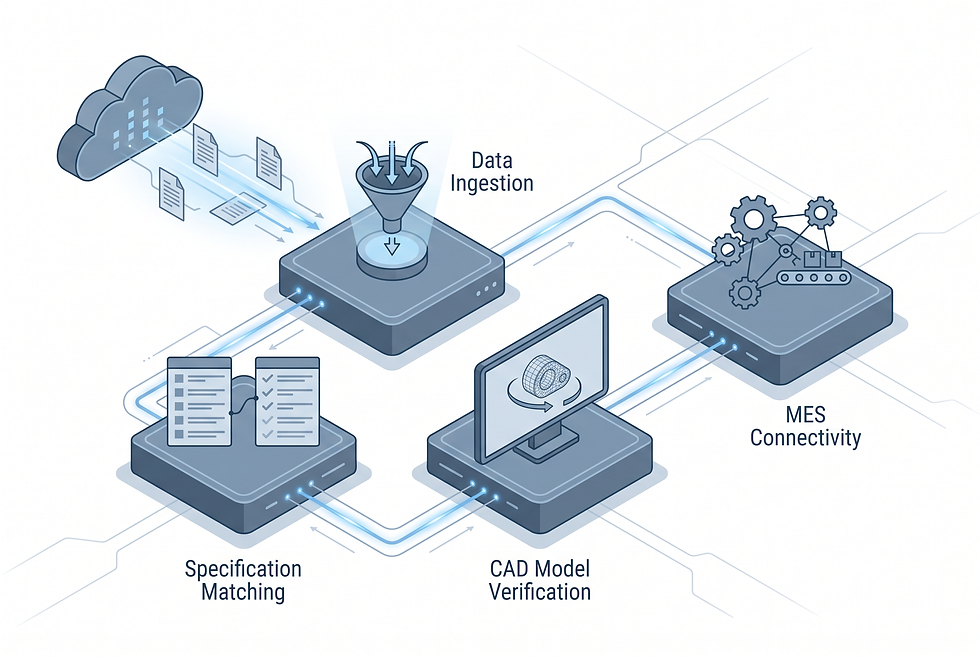
Transitioning from marketing fluff to an engineering-grade technical marketing engine requires a structured, multi-step operating workflow spanning multiple technical and commercial departments.
Step 1: Raw Technical Data Intake and Extraction
Product development teams and FAEs extract production validation logs, mechanical dimension tolerances, optical sensor specifications, and software API documentation directly from internal engineering repositories (PLM/PDM systems).
Step 2: Technical Content Structuring and Standardization
Technical writers and domain marketing specialists translate raw test data into modular buyer-facing assets: line integration diagrams, feeder capacity charts, ESD dissipation curve sheets, and IPC-CFX plug-and-play guides.
Step 3: Self-Directed Digital Evaluation Channel Deployment
Assets are deployed across structured knowledge bases and public technical hubs. Prospective buyers can filter equipment models by board width tolerances, cycle time curves, component size minimums (e.g., 01005 chips vs. large odd-form connectors), and interface protocols.
Step 4: Buyer Evaluation Trigger and Automated Qualification
When a prospect interacts with high-intent technical tools—such as downloading 3D CAD models for line clearance simulations or submitting line parameters into an online UPH calculator—the system logs the technical parameters submitted.
Step 5: FAE Verification and Precision Hand-Off
Instead of a generic discovery call ("Tell me about your budget"), the regional sales team and application engineer receive a pre-populated dossier: target board size, required components per board, existing line equipment, MES platform, and target cycle time.

Step 6: High-Yield Targeted Demonstration
The formal equipment demo focuses exclusively on the customer's high-mix edge cases, running their actual Gerber files and test substrates rather than generic demo boards.
Evidence and Results: Quantifiable Impact on Sales Velocity
Companies adopting structured technical transparency across capital equipment categories demonstrate measurable operational improvements:
Reduction in Sales Cycle Length: According to internal telemetry published in an industrial machinery automation case study by an SMT solutions provider (2023), providing self-service CAD files and interface specifications upfront reduced the average evaluation-to-quote timeline from 114 days to 68 days.
Lower Pre-Demo Engineering Overhead: A manufacturing technology vendor case study reported a 42% decrease in Tier-1 technical RFIs handled manually by field application engineers after publishing verified IPC-HERMES-9852 and IPC-CFX configuration documentation online.
Higher Demo-to-Quote Conversion: Data documented in an automated optical inspection commercial performance review (2024) indicated that prospects who engaged with verified GR&R test reports and false-call validation data prior to a live demonstration converted to formal commercial quotes at a rate 1.8 times higher than prospects driven through traditional cold outbound pitches.
Operational Dimension | Traditional Equipment Sales Model | Structured Technical Marketing Engine |
Initial Spec Access | Gated PDF brochure; mandatory sales call | Open line-compatibility specs, CAD files, & APIs |
UPH & Speed Claims | Theoretical maximums without board context | Standardized IPC-9850 benchmarks with test parameters |
MES Integration | "Custom engineering required upon purchase" | Documented REST APIs, SECS/GEM, and IPC-CFX schemas |
FAE Allocation | Answering basic mechanical & electrical RFIs | Solving advanced customer process & yield challenges |
Demo Preparation | Generic factory demonstration boards | Custom simulation using prospect Gerber/CAD files |
Buyer Experience | High commercial friction; delayed vetting | Rapid self-service engineering validation |
Average Evaluation | 90–150 days across multiple qualification calls | 45–75 days focused on commercial & warranty terms |
What Other Companies Can Learn: Core Methodological Principles
For equipment manufacturers across high-spec industrial sectors, the success of this model provides four actionable operating principles:
Treat Documentation as High-Intent Marketing: High-level promotional claims create suspicion among manufacturing engineers. Publish precise mechanical boundaries, electrical load requirements, and cycle-time degradation formulas openly.
Standardize Against Recognized Industry Benchmarks: Avoid proprietary performance metrics. Frame throughput, accuracy, and inspection precision around established standards (IPC, SMEMA, SEMI, ANSI/ESD, ISO).
Map Content to the Multi-Stakeholder Evaluation Committee: In capital equipment, multiple personas evaluate the purchase. Deliver line dimensions for facility engineers, network protocols for IT/MES architects, yield models for quality directors, and total cost of ownership (TCO) models for plant general managers.
Automate Technical Qualification at the Front End: Free up field application engineers from answering basic compatibility questions so they can focus on high-impact line integration testing and complex custom proposals.
What This Could Look Like Across Industrial Sectors
The principles of engineering-led content transformation apply universally across discrete manufacturing and advanced capital machinery:
For a Semiconductor Packaging Equipment Manufacturer: Publish thermal dissipation profiles, wafer substrate handling limits, die-attach placement accuracy curves (Cpk ≥ 1.66 at ±3µm), and SECS/GEM interface dictionaries.
For a Precision CNC Machine Tool Builder: Provide spindle torque-speed curves, thermal compensation data, kinematic collision models for Mastercam/Siemens NX, and standardized tooling changeover protocols.
For an Industrial Packaging Robotics Integrator: Provide end-of-arm tooling (EOAT) payload moment-of-inertia calculators, conveyor tracking synchronization tolerances, and Allen-Bradley/Siemens PLC communication sample code.
YTT AI Worker Mapping: Deploying the AI Technical Sales Rep
Scaling technical marketing and engineering-grade inquiry qualification without expanding specialized engineering headcount requires an intelligent execution layer. For capital machinery and electronics manufacturing equipment providers, the most effective deployment is the AI Technical Sales Rep.
Worker Job Title: AI Technical Sales Rep (Capital Electronics Equipment)
Main Daily Tasks:
Ingests, indexes, and maintains line-level compatibility documentation, IPC compliance sheets, and MES integration specifications.
Engages technical web visitors and portal users to answer exact questions regarding board clearance dimensions, component size handling, and communication protocols.
Calculates preliminary UPH and cycle-time estimates based on customer-provided component counts and board dimensions.
Pre-qualifies engineering requirements and generates structured Technical Application Briefs for human FAEs.
Primary Work Channel: Website Technical Specification Hub, Engineering Self-Service Portal, and Technical Email Inquiries.
Authority Boundary: Operates strictly within verified product engineering manuals, CAD tolerance limits, and published performance validation data; automatically flags and routes custom engineering modifications, custom software development requests, and pricing negotiations to the Regional Commercial Director and Lead FAE.
First Value Event: The AI Technical Sales Rep captures a visitor's board Gerber specs, validates mechanical line clearance against the machine's SMEMA envelope, confirms IPC-CFX compatibility, and produces a complete technical dossier for the application engineering team within 5 minutes of inquiry.
Daily Report Result: Delivers an automated morning digest to the Sales Director detailing verified engineering inquiries, matched MES compatibility queries, downloaded CAD models, and high-probability demonstration candidates with complete production line parameters pre-populated.
FAQ
Why is technical marketing for electronics manufacturing equipment essential before the demo stage?
Electronics manufacturing equipment requires heavy capital investment and must integrate into existing production lines without disrupting throughput. Providing comprehensive technical marketing—such as line compatibility, IPC-9850 UPH ratings, MES protocols, and ESD specifications—allows process engineers to validate fit before committing time and budget to an on-site or virtual machine demonstration.
What technical specifications must equipment manufacturers publish openly?
Manufacturers should openly provide mechanical dimensions, SMEMA/Hermes interface compliance, component placement/inspection ranges, IPC-CFX and SECS/GEM connectivity documentation, pneumatic/electrical supply requirements, ESD compliance ratings, and standardized GR&R or first-pass yield validation data.
How does deep technical marketing reduce sales cycle friction for capital machinery?
Publishing verified engineering data eliminates weeks of preliminary back-and-forth communication between buyers and field application engineers. Buyers qualify themselves early, arrive at demonstrations with specific application questions, and shorten the evaluation-to-quote timeline significantly.
How does an AI Technical Sales Rep assist electronics equipment sales teams?
An AI Technical Sales Rep automates initial engineering qualification by answering granular technical queries about line tolerances, parsing prospective customer line requirements, and generating pre-demo technical briefs for human engineers, saving billable engineering hours.
Build an Industry Content Growth System
Transform your complex engineering specifications into a high-converting, self-service technical marketing engine. Deploy an AI Technical Sales Rep to qualify technical buyers, validate line compatibility, and accelerate demo conversions.


Comments