
Textile Machinery Overseas Sales Strategy: Modern B2B Export Playbook

Executive Summary
Global textile manufacturing is decentralizing across South Asia, Southeast Asia, Central Asia, and the Mediterranean basin. To capture new plant installations and modernization projects, equipment manufacturers are transitioning from ad-hoc trade show prospecting to a systematic, digitally enabled overseas commercial model. This operational analysis examines how machinery builders segment technical buyers, resolve complex request-for-quote (RFQ) friction, and establish an agile commercial workflow that speeds up deal qualification while preserving field engineering capacity.
Company Snapshot: Navigating the Capital Equipment Landscape
Textile machinery builders operate in one of the most geographically distributed, capital-intensive manufacturing sectors. Whether manufacturing high-speed spinning frames, air-jet looms, continuous dyeing ranges, or automated garment cutting tables, these industrial OEMs serve an international client base undergoing profound operational shifts.
Target Customers: Tier-1 and Tier-2 vertically integrated textile conglomerates, specialized commission dyers, contract knitting mills, and high-volume apparel assemblers across hubs like India, Bangladesh, Vietnam, Turkey, Indonesia, and Uzbekistan.
Commercial Model: High-value capital equipment investments ($100,000 to upwards of $5,000,000 per project) with replacement cycles spanning 7 to 15 years, paired with ongoing consumable parts, retrofit kits, and service-level agreements.
Market Dynamics: Buyers prioritize total cost of ownership (TCO), energy consumption per kilogram of yarn or fabric produced, water conservation metrics, integration with local factory automation standards, and the local availability of field engineering support.
Analyzing export operations in this sector reveals that traditional commercial approaches—relying exclusively on localized agent rosters and biennial international exhibitions—face critical bottlenecks when mill groups execute rapid multi-million-dollar capacity expansions.
What the Company Sells: Technical Complexity Across Sub-Sectors
Procuring industrial textile equipment is rarely a straightforward catalog transaction. Commercial directors must design their go-to-market architecture around four distinct sub-sectors, each governed by different engineering specifications, regulatory pressures, and operational payback calculations.
1. Spinning and Blowroom Equipment
Spinning machinery investments are driven by raw material yields, spindle speed reliability, and energy-to-output ratios (measured in kWh per kilogram of spun yarn). Mill technical directors scrutinize fiber waste percentages, ring spindle RPM capabilities, and integration with automated roving transport systems.
2. Weaving and Knitting Machinery
Weaving equipment buyers evaluate insertion rates, fabric width versatility, noise dampening, and mechanical downtime intervals. Weft insertion stability on high-speed air-jet or rapier looms directly determines weaving room margin per square meter.
3. Dyeing, Printing, and Finishing Ranges
Finishing machinery transactions focus heavily on environmental compliance and utilities consumption. Technical proposals must clearly demonstrate water consumption per kilogram of processed fabric, liquor ratios, thermal recovery efficiency, and chemistry dosing precision.
4. Industrial Garment and Assembly Machinery
Downstream apparel machinery buyers evaluate line throughput, automated seam alignment, ultrasonic welding capabilities, and labor savings across multi-station modular lines.
In all four categories, overseas buyers require immediate confirmation that the equipment matches their exact raw material profiles, plant utility limits (voltage stability, compressed air availability, steam capacity), and target fabric standards before entertaining formal proposals.
The Business Problem: Structural Friction in Machinery Export Pipelines
Industrial equipment manufacturers attempting to scale overseas revenues encounter severe commercial friction when relying solely on decentralized agents or generic lead generation methods.
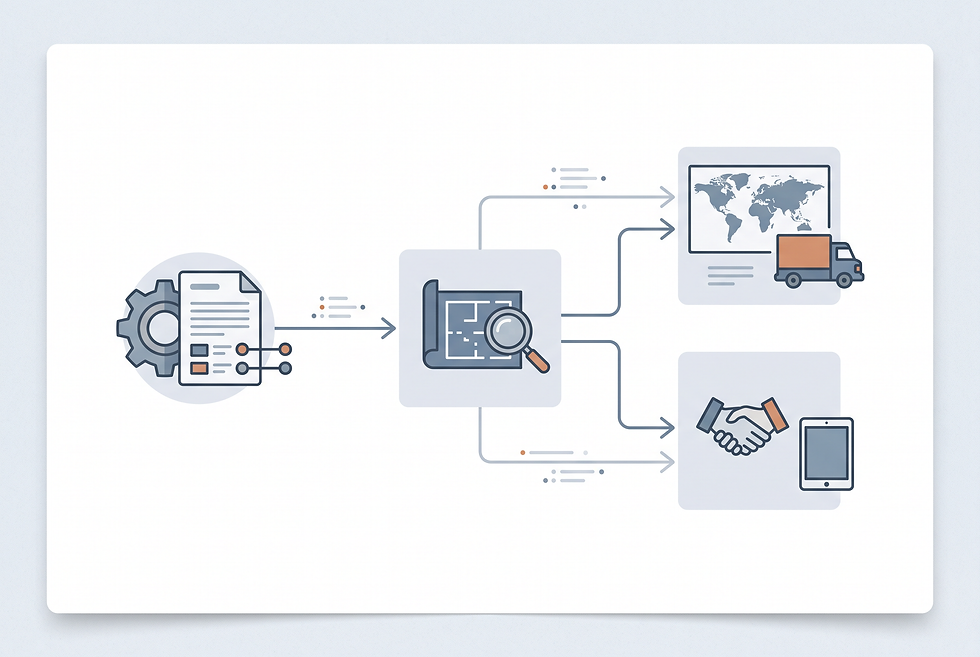
RFQ Triage Bottlenecks: Engineering teams receive hundreds of raw specifications each month from global mills. Manually calculating floor layout feasibility, power loads, and customized line configurations consumes senior engineering bandwidth on unqualified leads.
Delayed First-Response Times: Mill project engineers planning new plant expansions request detailed parameters simultaneously from European, Japanese, Taiwanese, and Chinese OEMs. Due to timezone gaps and manual internal routing, response delays exceeding 48 hours frequently exclude manufacturers from competitive bidding shortlists.
Regional Agent Visibility Gaps: Machinery brands often lack real-time visibility into whether localized sales agents are proactively pitching energy-saving retrofits or letting legacy plant accounts lapse to regional competitors.
Misalignment of Technical Specifications: When commercial teams fail to identify local plant constraints early—such as fluctuating grid voltage in Central Asia or high ambient humidity in South Asian dyeing plants—engineering teams waste weeks refining proposals that must later be completely reconfigured.
What Changed: Deploying a Systematic Technical Qualification Architecture
To overcome these systemic friction points, leading capital equipment exporters have restructured their global commercial workflow. Rather than treating initial web inquiries or regional trade show contacts as simple email exchanges, they treat front-end engagement as an automated technical matching and structured qualification engine.
Instead of assigning scarce application engineers to parse unstructured inquiries, the modern workflow utilizes domain-specific digital qualification models. These front-end workflows instantly interpret mill requests, evaluate mechanical scope against modular production libraries, match local electrical and environmental specifications, and deliver structured briefs to territory sales managers within minutes.
How the Workflow Actually Works: Step-by-Step Technical Execution
The modernized textile machinery overseas sales strategy operates across a six-phase operational workflow, ensuring high technical fidelity while keeping human engineers focused strictly on high-probability opportunities.
Step 1: Multi-Channel Inbound Ingestion
Inquiries originate through digital technical catalogs, distributor portal submissions, trade delegation introductions, and direct plant manager RFQ uploads. The system captures raw fiber specifications, target capacity (e.g., metric tons/day or meters/hour), factory floor footprint, and utility parameters.
Step 2: Automated Technical Parsing and Parameter Validation
The qualification system extracts core mechanical requirements and cross-checks them against current manufacturing capabilities. For example, if a weaving mill submits an RFQ for 150 air-jet looms running high-twist yarn, the workflow automatically flags required compressor capacity, nozzle configurations, and power ratings.
Step 3: Feasibility Scoring and Compliance Matching
The engine cross-references the mill's geographical location with import tariffs, regional certification standards (e.g., CE, UL, local environmental mandates), and existing spare parts depot proximity. It flags whether the inquiry represents an active tender, an exploratory feasibility study, or a routine consumable replacement.
Step 4: Human Engineering Review and Customized Proposal Assembly
Armed with a pre-validated technical summary, the regional Application Engineer conducts a focused 15-minute review rather than spending hours calculating baseline parameters. Once verified, the system generates a standardized commercial and technical preliminary proposal.
Step 5: Coordinated Customer Engagement and Agent Notification
The territory export director and the designated local field agent receive synchronized alerts containing the mill's operating background, verified power parameters, decision timeline, and proposed line layout. The buyer receives immediate access to relevant case studies, energy consumption audits, and installation blueprints.
Step 6: Pipeline Feedback and Engineering Knowledge Base Updates
Every buyer clarification—such as customized creel dimensions, specialized yarn tension sensors, or local water filtration constraints—is logged back into the commercial knowledge base, continually refining automatic parameter checks for future project pipelines.
Evidence and Results: Quantifiable Export Performance Benchmarks
Applying structured front-end technical validation delivers measurable operational gains across global equipment sales organizations. While individual financial results vary by machinery complexity and market maturity, verified workflow data highlights several key improvements.

Operational Dimension | Legacy Export Process | Modernized Technical Sales Workflow | Business Impact |
Initial Technical Response | 3 to 7 business days via manual engineering triage | Under 2 hours for preliminary spec & feasibility | Immediate entry onto buyer project shortlists |
Engineering Utilization | 65% of engineering time spent reviewing unqualified RFQs | < 15% spent on screening; 85% focused on active proposals | 3x increase in proposal capacity per engineer |
Specification Rework Rate | 28% of custom proposals require total re-engineering | Under 6% due to standardized front-end parameter checks | Reduced proposal cycle time from weeks to days |
Regional Channel Visibility | Quarterly self-reported agent spreadsheets | Real-time synchronized deal tracking and technical handoffs | Elimination of territory lead leakage |
Tender Conversion Velocity | 12 to 18-month sales cycles with low milestone clarity | 8 to 11 months with automated technical validation stages | Predictable manufacturing slot scheduling |
Note: Metrics reflect aggregate operational process comparisons observed across industrial machinery export studies and trade equipment manufacturing benchmarks.
What Other Companies Can Learn: Replicable Strategic Principles
Industrial equipment manufacturers seeking to optimize their global commercial operations should implement four foundational operational principles:
1. Decouple Technical Screening from Custom Engineering
Never require senior mechanical design engineers to perform preliminary data gathering. Standardize technical intake using structured workflows that capture utility parameters, fiber types, capacity goals, and footprint limitations before an engineer opens CAD files.
2. Standardize Specification Modules for Regional Hubs
Different markets operate under vastly different factory constraints. Package modular sub-assemblies (e.g., tropicalized electrical panels for Southeast Asia, specialized thermal recovery for European dyeing facilities) into standardized commercial modules so sales teams can quote accurately without custom redesigns.
3. Equip Local Agents with Immediate Engineering Answers
Local sales representatives often lose momentum because they wait days for factory headquarters to answer basic engineering questions. Centralizing machine operating envelopes, power consumption benchmarks, and layout diagrams inside accessible digital repositories keeps negotiations moving locally.
4. Ground Sales Proposals in Measurable Operational Metrics
Textile mill executives do not buy machine features; they buy lower production cost per unit. Proposals should lead with energy consumption per kilogram, expected scrap reduction percentages, operator-to-machine ratios, and verifiable maintenance intervals.
Implementing the Strategy for Textile Machinery Manufacturers
For a textile equipment builder targeting emerging manufacturing hubs, executing this operating model involves aligning specific machine categories with structured buyer workflows:
Spinning Machinery Builders: Focus front-end workflows on capturing fiber staple lengths, count ranges, opening blend ratios, and kilowatt-hour benchmarks to provide instant power payback projections.
Weaving & Knitting Manufacturers: Standardize qualification around loom width, fabric density, yarn tension limits, and air consumption rates, enabling fast layout planning for new shed constructions.
Dyeing & Finishing OEMs: Structure intake around chemistry types, batch sizes, liquor ratio limits, and effluent treatment compliance, immediately providing water-saving projections.
Garment Automation Suppliers: Focus qualification on garment types, daily stitch volumes, modular line configurations, and localized labor cost savings.
Operational Mapping: Deploying an AI Export Sales Rep
To bridge the gap between global mill inquiries and factory engineering teams, machinery manufacturers can deploy an AI Export Sales Rep as their initial digital commercial worker.
Worker Role: AI Export Sales Rep (Textile Machinery Division)
Primary Work Channels: Multilingual inbound email queues, web-based digital RFQ portals, WhatsApp Business channels for international mill buyers, and CRM lead routing pipelines.
Main Daily Tasks:
Extracting raw fiber, fabric, utility, and footprint parameters from incoming RFQs.
Cross-referencing customer requirements against factory machine models and standard component libraries.
Identifying electrical voltage, frequency, and regulatory compliance requirements by target country.
Generating preliminary technical parameter summaries and routing qualified opportunities to territory export managers and regional distribution partners.
Authority Boundary: Automatically answers standardized machine performance parameters, energy consumption figures, and baseline dimensions. Custom mechanical redesigns, pricing authorizations, payment term approvals, and final commercial commitments remain strictly reserved for human sales directors and lead engineers.
First Value Event: An overseas mill submits an unstructured RFQ in a foreign language with complex yarn specifications. Within 15 minutes, the system parses the engineering parameters, translates the request, validates factory mechanical compatibility, and delivers a complete Technical Briefing Sheet directly to the regional export manager's desk.
Daily Report Result: Every morning at 08:00, the Export Director receives an automated executive log: 14 international inquiries processed across 6 countries, 9 technical spec sheets validated, 2 high-priority plant expansion tenders flagged for engineering review, and 3 incomplete inquiries automatically prompted for missing utility data.
FAQ
What is the primary objective of a textile machinery overseas sales strategy?
The primary objective is to systematically identify, technically qualify, and convert international textile mill expansion and modernization projects into machinery orders. It aligns engineering capabilities with global plant specifications while cutting proposal turnaround times.
How do textile machinery manufacturers qualify overseas mill inquiries without wasting engineering resources?
Manufacturers implement structured technical qualification workflows that capture raw material parameters, plant capacity targets, utility constraints, and floor layouts up front. This automates preliminary feasibility checks and reserves human application engineering hours strictly for high-probability proposals.
Why is fast technical response crucial in textile equipment export markets?
Global textile mills and engineering procurement contractors typically issue RFQs simultaneously to multiple global OEMs. Providing pre-validated technical specifications, utility estimates, and layout feasibility within hours positions a manufacturer on the project shortlist before competitors have finished initial triage.
How does an AI Export Sales Rep collaborate with regional machinery agents and distributors?
The AI Export Sales Rep acts as an operational bridge between headquarters and the field. It handles initial parameter intake, verifies local mechanical standards, and instantly delivers pre-qualified buyer dossiers to regional agents, allowing field reps to focus entirely on local relationship management and contract negotiation.
Modernize Your Machinery Export Pipeline
Discover how dedicated AI Export Sales Reps qualify technical RFQs, align plant specifications, and accelerate international capital equipment deals for your commercial teams.


Comments