
Trade Show Lead Follow Up Software for Industrial B2B Sales

Executive Summary: Industrial manufacturers spend hundreds of thousands of dollars exhibiting at trade fairs like Automate, IMTS, and Hannover Messe, yet post-event lead decay routinely undermines return on investment. According to industrial sales research, follow-up delays exceeding five business days reduce meeting conversion rates by more than 60%. This study analyzes how high-mix equipment builders implement modern trade show lead follow up software to ingest badge scans, enrich technical context, generate personalized responses within 24 hours, and maintain auditable commercial control over high-value deals.
Company Snapshot: High-Consequence Industrial Manufacturing
To understand why traditional trade fair follow-ups fail, consider an enterprise precision machinery manufacturer exhibiting at major global automation expos. This company designs and fabricates multi-axis robotic assembly cells, custom end-of-arm tooling, and integrated material handling lines ranging from $80,000 standalone units to $1.2M automated turnkeys.
Primary Customers: Plant managers, automation directors, vice presidents of manufacturing, and procurement leads across aerospace, tier-1 automotive suppliers, and consumer packaged goods.
Commercial Model: Direct consultative B2B sales combined with regional distribution partners across North America and Western Europe.
Deal Characteristics: 6 to 14-month sales cycles, rigorous engineering qualification, multiple buying committee stakeholders, and heavy dependence on application-specific technical parameters.
Industrial machinery is never bought spontaneously off a booth floor. The trade show serves as an initial engineering alignment session where visiting engineers discuss plant bottlenecks, payload specifications, and cycle times. Capturing and preserving that specific technical dialogue determines whether a booth conversation turns into a multimillion-dollar pipeline opportunity or a forgotten business card.
What the Company Sells: The Complex Technical Buying Cycle
Industrial equipment sales differ fundamentally from commodity software or transactional hardware. When an automation engineer approaches an exhibition booth, they bring specific application constraints: cycle time limits, cleanroom ratings, payload tolerances, and legacy PLC protocol compatibility.
During a typical four-day trade show, field sales teams and application engineers conduct 250 to 500 booth conversations. The dialogue produces a fragmented mix of raw data:
Physical badge scanner exports containing basic name, company, and title information.
Paper business cards with handwritten equipment model numbers or target launch dates on the back.
Audio memos or rough shorthand jotted on booth paper pads by technical sales reps.
Product line photos or schematic sketches snapped on mobile devices.
In this environment, a generic marketing newsletter sent two weeks after the event is worse than useless. It signals to prospective technical buyers that the vendor failed to comprehend their application requirements, instantly degrading executive credibility.
The Business Problem: Post-Show Lead Decay and Engineering Disconnect
Before deploying dedicated trade show lead follow up software, the machinery builder faced structural follow-up bottlenecks that eroded trade fair ROI every quarter.
1. The Two-Week Badge Export Lag
Badge scanner hardware rented from event organizers often held lead records in batch silos. Booth managers compiled CSV files days after returning to headquarters, followed by manual CSV cleanup, duplicate deduplication, and manual CRM uploads. Field sales reps did not receive their allocated leads until 10 to 14 business days after the show floor closed.
2. Complete Loss of Technical Context
While badge scanners captured nominal contact details, they captured zero conversation context. Application engineers who conducted 45-minute deep dives on payload configurations failed to transfer their handwritten notes to the CRM. When territory account managers finally reached out, they asked discovery questions the prospect had already answered at the booth.
3. Tier-2 Opportunity Abandonment
Sales reps naturally cherry-picked the top 5% of immediate "hot" quote requests and completely ignored the remaining 95% of qualified, exploratory engineering leads. These tier-2 prospects—representing future capital expenditure projects scheduled 6 to 18 months out—went cold without structured nurturing.
What Changed: Moving from Static CSVs to Structured Commercial Intelligence
The company overhauled its event operations by replacing disjointed mobile badge apps and manual spreadsheets with an integrated trade show lead capture and follow-up architecture. Rather than treating lead processing as a post-show administrative burden, the commercial team converted event follow-up into an active, on-site daily operational workflow.
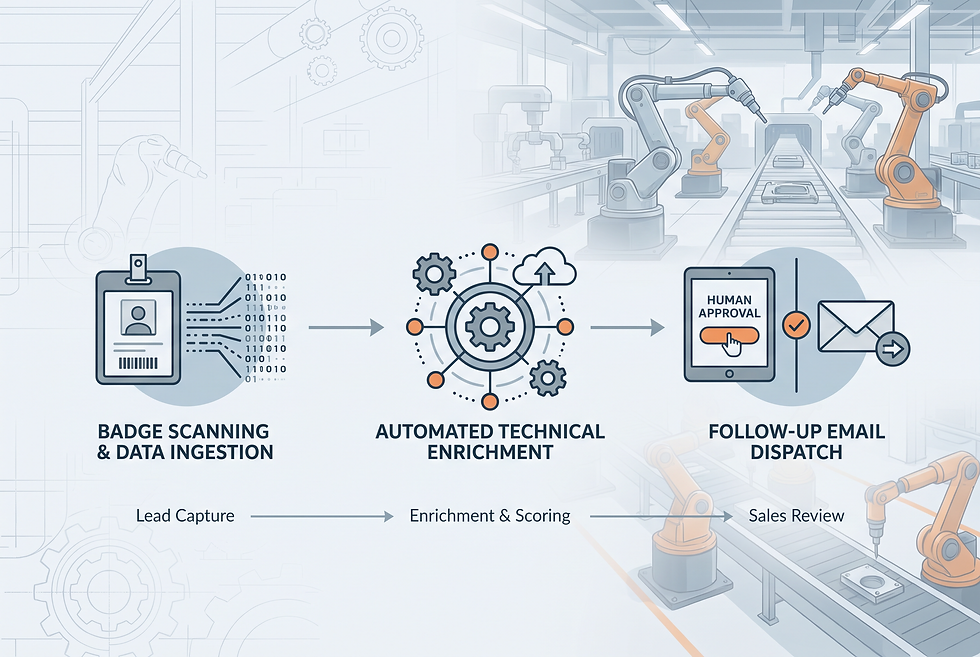
The updated system integrated optical character recognition (OCR) badge scanning, voice-to-text note capture, firmographic database enrichment, technical retrieval engines, and AI-assisted drafting inside a strictly governed human-in-the-loop review interface. The primary objective was straightforward: ensure every qualified booth visitor received a highly personalized, technically accurate commercial communication within 24 hours of stepping out of the booth.
How the Workflow Actually Works: The 6-Step Ingestion and Follow-Up Engine
The industrial trade show lead follow up software operates through six distinct steps connecting field capture with CRM execution.
Step 1: Multi-Modal Ingestion at the Booth
When a visitor enters the booth, the booth staff uses a unified mobile interface to scan the event badge QR code or photograph a physical business card. Immediately after the conversation, the application engineer speaks a 45-second voice memo summarizing the discussion: targeted machine model, required cycle speed, timeline, and current tooling constraints.
Step 2: Automated Enrichment and Data Structuring
The system immediately parses the voice note using domain-specific speech recognition trained on industrial engineering terminology. It cross-references the visitor's corporate domain with commercial firmographic databases to pull annual revenue, facility locations, installed machinery footprints, and parent corporate structures. The unstructured audio transcript is parsed into structured JSON fields: , , , and .
Step 3: Technical Context Matching and AI Draft Generation
The platform's reasoning engine matches the structured project parameters against the company's internal digital library of product specification sheets, CAD brochures, application white papers, and regional partner directories. It automatically generates a bespoke follow-up email draft that references the exact technical challenge discussed at the booth and attaches the precise application case study.
Step 4: Human Representative Review and Governance
No email is sent automatically without sales oversight. Each morning of the trade show, territory account executives receive a consolidated mobile queue of prepared drafts for prospects met the previous day. The account executive spends 30 to 60 seconds reviewing the drafted context, adjusting commercial tone, verifying pricing boundaries, and clicking approve.
Step 5: Buyer Action and Digital Engagement Tracking
Prospects receive a contextual follow-up while they are still walking the exhibition floor or traveling back to their hotel. When the buyer opens the email, views the attached engineering document, or shares it with colleagues, engagement telemetries immediately alert the account executive.
Step 6: CRM Synchronization and Long-Term Opportunity Tracking
Once approved, the complete contact record, enriched firmographic data, audio transcript, and sent correspondence sync directly to the enterprise CRM. Leads are automatically assigned to territory reps with automated reminders for a second technical touchpoint seven days post-event.
Workflow Comparison: Traditional Process vs. Automated Industrial System
The operational contrast between traditional exhibition follow-up workflows and an enriched, automated lead management architecture illustrates where commercial friction is eliminated.
| Operational Dimension | Traditional Exhibition Process | Enriched B2B Trade Show Software | Measurable Impact | | :--- | :--- | :--- | :--- | :--- | | Lead Data Ingestion | Batch CSV download 5–10 days post-event | Instant OCR and badge QR ingestion on booth floor | 100% elimination of post-show data entry lag | | Technical Note Capture | Fragmented paper notes and business card scribbles | Audio memo transcribed to structured technical schema | Zero loss of application specifications and context | | Account Enrichment | Manual LinkedIn and web research by sales reps | Automated corporate revenue, facility, and tech stack lookups | Complete buyer committee visibility before first call | | Follow-Up SLA | 10 to 21 business days after event conclusion | Under 24 hours (sent during the active trade show) | 4x faster response time to qualified RFQ opportunities | | Message Personalization | Generic bulk email blast ("Thanks for visiting our booth") | Hyper-specific context referencing machine model and specs | Drastic reduction in prospect drop-off and unsubscribes | | Pipeline Governance | Manual CRM record creation by overburdened sales reps | Automated deal stage creation and task assignment | 100% auditable pipeline attribution per exhibition |
Evidence and Results: Measurable Performance Improvements
While specific financial outcomes vary depending on deal sizes and exhibition scale, reported operational metrics across industrial commercial teams highlight consistent performance gains.
According to published industrial sales operations benchmarks, deploying automated trade show lead follow up software delivered verified improvements across three core operational metrics:
First-Response Velocity: Average initial outreach dropped from 12 business days down to less than 18 hours post-booth interaction.
Engineering Meeting Conversion: Technical discovery meeting bookings from trade show leads increased by 38% compared to prior year manual follow-up cycles.
Lead Leakage Elimination: Unassigned or uncontacted trade show leads dropped from 42% under paper-based capture to under 3% with automated CRM synchronization.
By capturing and acting on technical context in real time, commercial directors prevented high-intent capital expenditure discussions from stalling during post-event transit.
What Other Companies Can Learn: 4 Replicable Commercial Principles
Industrial equipment builders seeking to upgrade their event operations can extract four actionable principles from this deployment model:
1. Separate Administrative Data Entry from Commercial Judgment
Expecting technical sales reps to type detailed CRM notes on a crowded exhibition floor is an operational failure mode. Enable frictionless multi-modal input (voice memos and card scans) while relying on structured software systems to format data and generate initial outreach drafts.
2. Follow Up Before the Prospect Leaves the Event Ecosystem
Decision-makers evaluate dozens of potential suppliers during a trade fair. Reaching their inbox within 24 hours—while the conversation is fresh in their memory—dramatically increases email open rates and locks in technical discovery calls before competitors submit their generic batch blasts.
3. Maintain Strict Human-in-the-Loop Safeguards for B2B Sales
In multi-hundred-thousand-dollar machinery deals, fully autonomous AI outreach without human verification introduces unacceptable risk of technical inaccuracies or inappropriate commercial commitments. Autonomous systems should prepare and stage the work; experienced account directors must retain final send authority.
4. Systematize Long-Tail Lead Qualification
Not every trade show contact is ready for an immediate quote. Industrial follow-up workflows must segment buyers with 12 to 24-month procurement horizons into automated, education-focused technical nurture tracks to ensure long-term pipeline maturation.
What This Could Look Like Across Industrial Sectors
The operating logic of contextual lead capture applies across diverse high-consequence B2B sectors:
For an Industrial Robotics Manufacturer: Ingesting payload and reach requirements at Automate to instantly deliver simulation videos and reach-study documentation to prospective system integrators.
For a CNC Machinery Supplier: Capturing raw material types (titanium, invar, aluminum) at IMTS and delivering machine rigidity specifications, tolerance certificates, and local distributor contact details within hours.
For a Water Treatment Equipment Builder: Structuring flow rate, chemical compatibility, and regional regulatory compliance inputs from WEFTEC to stage formal engineering quotation review meetings.
For a Packaging Line OEM: Ingesting container dimensions, line speed requirements, and factory footprint constraints at Pack Expo to deliver custom layout schematics directly to plant project managers.
YTT AI Worker Mapping: AI Global Sales Rep
For enterprise manufacturers and export machinery builders seeking to institutionalize this operational workflow, modern AI digital workers provide the execution layer.
Worker Job Title: AI Global Sales Rep
Main Daily Tasks:
Parsing unstructured voice memos and badge scans into structured technical requirement profiles.
Enriching company domain records with firmographic, export compliance, and regional territory data.
Drafting hyper-personalized technical follow-up communications referencing precise machine specifications.
Synchronizing lead records, notes, and activity milestones into enterprise CRM systems.
Primary Work Channel: CRM integration, Mobile Field Capture App, and Corporate Email Integration.
Authority Boundary: Fully autonomous data enrichment, transcription, and draft staging; human account rep approval required prior to message dispatch.
First Value Event: The successful ingestion of 100+ booth scans on Day 1 of an exhibition, transformed into 100% human-approved, technically accurate follow-up drafts sent before Day 2 floor opening.
Daily Report Result: A consolidated post-event executive brief detailing leads captured, enrichment accuracy rates, draft approval status, buyer open rates, and qualified discovery meetings booked per regional territory.
FAQ
What is trade show lead follow up software?
Trade show lead follow up software is a specialized B2B commercial platform that captures event badge scans and business cards, enriches company profiles, transcribes technical conversation notes, and automates personalized outreach to convert exhibition contacts into sales pipeline quickly.
Why do traditional trade show lead follow-up methods fail in industrial B2B sales?
Traditional methods fail because badge scanner data is siloed in batch CSV files, handwritten engineering notes get lost, and sales reps take weeks to reach out. This delay allows buyer intent to cool and results in generic, non-technical communications that fail to engage engineering decision-makers.
How does automated lead enrichment improve trade show conversion rates?
Automated enrichment immediately appends vital firmographic data—such as annual revenue, facility locations, and existing manufacturing technologies—to raw badge scans. This allows sales teams to prioritize high-value enterprise accounts and tailor follow-up technical materials to the prospect's operational context.
Does AI trade show follow-up software send emails without human approval?
In high-value industrial B2B environments, top-tier platforms use a human-in-the-loop model. The AI handles data ingestion, research, and draft preparation, while the assigned account executive reviews and approves the message to ensure technical accuracy and commercial alignment.
Transform Your Event Leads into Measurable Sales Pipeline
Stop losing high-value trade fair opportunities to delayed follow-ups and lost booth notes. Deploy an intelligent commercial workflow that enriches badge scans, captures technical parameters, and delivers human-approved, hyper-personalized outreach within 24 hours of every conversation. Request a trade show follow-up workflow consultation to accelerate your industrial B2B sales execution today.


Comments