
TRUMPF Smart Services Digital Sales: How Machine Builders Monetize Installed Equipment

Executive Summary: TRUMPF transformed its industrial equipment business by embedding connectivity, remote monitoring, and digital ordering directly into its installed machine base. Instead of treating aftermarket support as reactive maintenance, the company engineered an integrated ecosystem where telemetry triggers consumables reorders, preventive maintenance, and software upgrades. This analysis unpacks the operational mechanisms behind the shift and demonstrates how machinery exporters can replicate continuous customer engagement.
Company Snapshot: Industrial Laser and Sheet Metal Manufacturing Leader
TRUMPF Group, headquartered in Ditzingen, Germany, is one of the world's foremost manufacturers of machine tools, laser technology, and electronics for industrial applications. Founded in 1923, the organization serves global manufacturing enterprises ranging from specialized sheet metal job shops to tier-one automotive suppliers and semiconductor equipment integrators.
The company operates primarily on a direct B2B capital equipment sales model supplemented by field service agreements, proprietary software suites, tooling, and consumable supplies. In capital-intensive sectors where cutting systems and punch presses represent major capital expenditures with multi-decade operating lifespans, retaining customer connectivity after commissioning determines long-term enterprise value.
Analyzing TRUMPF offers high utility for industrial machinery leaders because the organization successfully resolved the traditional "sell-and-forget" OEM dilemma. By creating structured service portfolios and digital channels, TRUMPF converted discrete equipment transactions into sustained commercial interactions across international markets.
What the Company Sells: High-Precision Capital Goods and Lifecycle Support
TRUMPF manufactures high-power industrial machinery, including 2D and 3D laser cutting machines, punch laser machines, bending systems, and industrial additive manufacturing hardware. These systems are highly engineered, capital-intensive units requiring precise calibration, specialized tooling, proprietary optical components, and continuous software synchronization.
In standard industrial machinery procurement cycles, customers undergo months of technical feasibility studies, test cuts, CAD/CAM integration reviews, and structured commercial negotiations before issuing a purchase order. Once an OEM delivers and commissions a machine, the operational reality shifts entirely to factory floor uptime, part throughput, and operational efficiency.
For machine buyers, unplanned downtime can cost thousands of dollars per hour in delayed customer orders and idle operator shifts. However, traditional machine tool support models relied heavily on manual intervention: machine operators noticing part wear, placing phone calls to local distributors, manually verifying part numbers from static PDF manuals, and waiting days for field technician dispatches. This dynamic introduced friction, elongated response times, and caused significant aftermarket revenue leakage to third-party parts providers.
The Business Problem: Post-Installation Disconnection and Aftermarket Friction
Industrial machine builders encounter three structural vulnerabilities once equipment leaves the factory floor:
Lead and Service Response Gaps Across Time Zones: As global export volumes increase, regional field service desks and spare parts coordinators struggle to deliver 24/7 technical triage. Global customers operating three shifts frequently experience delays during off-hours.
High RFQ and Reordering Friction for Spare Parts: Identifying the correct replacement nozzle, optical filter, or punch tool across hundreds of machine configurations often involves deep technical navigation. When ordering is cumbersome, customers frequently seek localized aftermarket alternatives.
Uncaptured Equipment Telemetry and Follow-Up Lapses: When machines operate in closed on-premise environments without active telemetry, OEMs lack visibility into duty cycles, cutting hours, or component degradation. Sales teams cannot identify when a customer requires capacity expansion, tooling replenishment, or operator retraining.
Without an integrated digital workflow, the machinery builder remains entirely reactive, discovering customer dissatisfaction or operational expansion only after an account lapses or issues an external tender.
What Changed: Architecture of TRUMPF Smart Services Digital Sales
To bridge the gap between initial hardware delivery and continuous customer lifecycle value, the company established an ecosystem combining smart machine connectivity, digitized parts procurement, and condition-based monitoring. The strategy centered on moving from sporadic emergency repairs to proactive lifecycle orchestration.
Key architectural pillars implemented across the portfolio include:
Condition Monitoring and Predictive Telemetry: Connecting machinery via secure IoT interfaces (such as the Smart View platform and OPC UA standards) to transmit live operational status, error codes, and sensor diagnostics.
Digital Service Portals (MyTRUMPF): A self-service customer environment offering automated part identification, CAD drawing uploads, machine documentation, warranty tracking, and single-click reordering.
Remote Support and Visual Assistance: Equipping service engineers with real-time remote diagnostics and augmented support tools to resolve machine faults without dispatching field technicians.
Service Agreements with Structured Response SLAs: Tiered lifecycle contracts bundling software updates, consumable replenishments, and preventative maintenance into predictable operating expenses.
This framework transformed trumpf smart services digital sales into an automated commercial conduit where physical machines autonomously surface technical and commercial needs directly into customer and sales workflows.
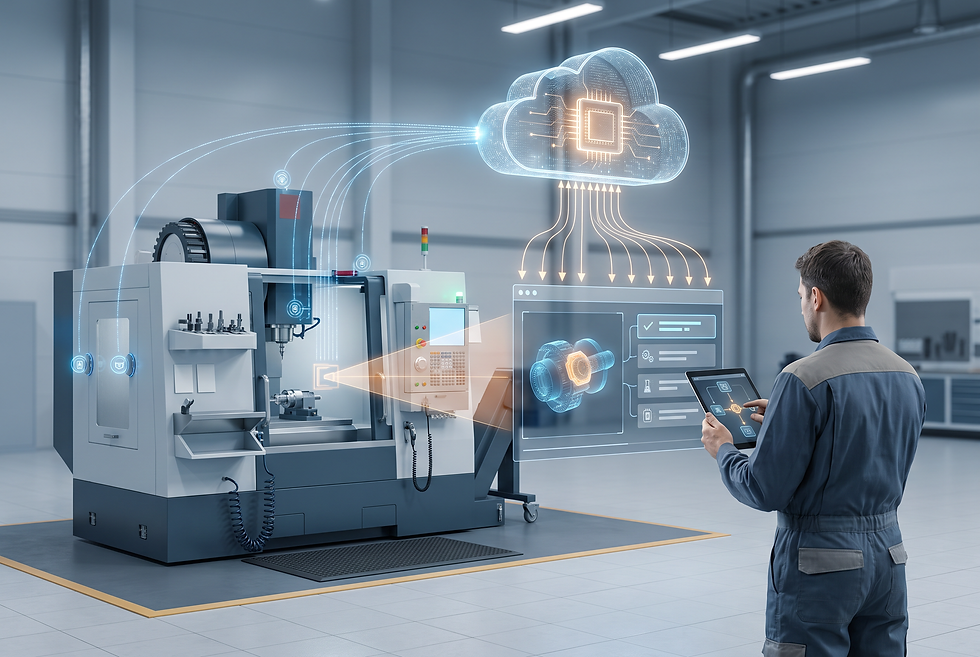
How the Workflow Actually Works: Step-by-Step Operating Mechanism
A resilient digital aftermarket framework does not merely add an online shop; it connects machine diagnostics directly to commercial fulfillment. The underlying operational workflow follows a structured progression:
Step 1: Telemetry and Event Ingestion
Sensors embedded in the cutting head, laser generator, and drive motors record operational variables such as optical temperature, gas pressure, cutting duration, and vibration profiles. This real-time diagnostic payload transmits through a secure gateway to the centralized monitoring architecture.
Step 2: Automated Diagnostic Analysis and Anomaly Detection
The system continuously evaluates telemetry streams against operating benchmarks. When a parameter breaches normal operating tolerances (for instance, laser protective glass contamination or optical degradation), the diagnostic engine flags an imminent failure before the machine triggers an emergency stoppage.
Step 3: Automated Requirement Generation and Part Identification
The system automatically cross-references the specific machine serial number, installed hardware options, and software version to identify the exact consumable part or maintenance kit needed. It generates a pre-configured service ticket and procurement draft, eliminating manual part searching.
Step 4: Customer Notification and Portal Routing
The customer's plant manager or maintenance technician receives an automated notification within their management dashboard or mobile portal. The alert specifies the component reaching end-of-life, displays current operational impact, and provides a direct, pre-populated quote.
Step 5: Customer Approval and Field Service Dispatch Decision
For standard consumable components, the customer confirms the order with one-click authorization. For complex electromechanical faults, the system routes diagnostic telemetry to an in-house technical support specialist who assesses whether remote calibration suffices or an on-site technician dispatch is required.
Step 6: Commercial Fulfillment and ERP Execution
Upon customer authorization, the order routes automatically into the global logistics ERP system. Spare parts ship from the nearest regional fulfillment center, accompanied by digital installation guides or remote technician scheduling.
Step 7: Feedback Loop and Predictive Model Optimization
Once parts are installed and operational parameters return to nominal thresholds, the machine logs maintenance completion. The diagnostic dataset feeds back into the central analytics repository to refine predictive maintenance algorithms across the entire global installed base.
Operational Dimension | Traditional Reactive Machinery Model | TRUMPF Connected Smart Services Workflow |
Trigger Mechanism | Customer notices machine breakdown or defective cut quality | Embedded telemetry identifies sensor deviations prior to failure |
Part Identification | Manual search through paper/PDF manuals; risk of mismatch | Automated serial-number-matched part recommendation |
Procurement Channel | Offline RFQs, email exchanges, manual distributor quotes | Direct self-service portal checkout with pre-loaded pricing |
Technical Triage | On-site technician dispatch required for initial diagnostics | Remote diagnostic telemetry review and virtual triage |
Revenue Predictability | Highly volatile, transactional, prone to aftermarket churn | Predictable recurring revenue via contracted lifecycle services |
Customer Impact | Unplanned downtime, stalled production, high rush fees | Scheduled maintenance during off-shifts, maximum machine uptime |
Evidence and Results: Quantifiable Operational and Commercial Impact
The implementation of structured digital services and telemetry-driven aftermarket engagement has delivered verified operational improvements across the manufacturing sector:
Reduced Diagnostic Resolution Time: According to official company publications and annual reports, remote diagnostics allow TRUMPF to resolve a significant percentage of incoming technical service cases without physical technician dispatches, substantially lowering mean time to repair (MTTR).
Accelerated Spare Parts Fulfillment: The company's digital customer portal (MyTRUMPF) streamlined thousands of monthly parts orders, cutting administrative turnaround from hours of email exchange to automated self-service transactions.
Enhanced Service Revenue Resilience: As disclosed in TRUMPF annual financial statements, service and aftermarket revenues consistently represent a stabilizing, high-margin revenue stream that offsets cyclical downturns in global machine tool capital expenditures.
These outcomes demonstrate that when an industrial equipment manufacturer provides frictionless digital interfaces tied directly to machine performance, customer retention and aftermarket capture rates rise naturally.

What Other Companies Can Learn: Replicable Strategic Principles
Industrial machinery manufacturers, robotics builders, and automation suppliers can extract four practical principles from this operating model:
1. Monetize the Installed Base Systematically
Hardware margins face continuous pressure from global competitors. Machinery builders must treat every deployed unit as a recurring platform for software licenses, predictive maintenance packages, consumables, and automated tooling upgrades. Aftermarket services should be designed as core products during initial R&D, not added as an operational afterthought.
2. Remove Friction from Technical Reordering
In B2B industrial sales, technical buyers gravitate toward the path of least resistance. If finding a compatible replacement component requires searching multi-page schematics and waiting for sales callbacks, buyers will source generic alternatives. Instant serial-number matching and transparent digital pricing protect aftermarket market share.
3. Shift from Unplanned Emergency Calls to Condition-Based Outreach
Reactive customer service creates operational strain for field teams and production disruption for clients. By utilizing machine telemetry or structured operating hours to trigger outreach, machine builders can transform maintenance conversations from adversarial emergency disputes into consultative customer success touchpoints.
4. Bridge the Technical-Commercial Chasm
Technical diagnostics and commercial quoting frequently operate in separate internal silos. An effective smart service workflow links telemetry exceptions directly to automated commercial proposals, enabling customers to approve maintenance before technical degradation causes severe downtime.
What This Looks Like for Industrial Machinery Exporters
For mid-sized machinery exporters operating in competitive sectors—such as packaging equipment, industrial pumps, CNC milling centers, and water treatment systems—building a bespoke, globally distributed digital service infrastructure from scratch can be cost-prohibitive.
Exporting machinery manufacturers face distinct constraints:
Sales and technical teams are based in a central headquarters, while equipment operates across multiple continents and time zones.
International distributors often fail to capture consumable replenishment orders, allowing local third parties to siphon aftermarket revenue.
Technical sales engineers spend excessive hours answering repetitive routine inquiries regarding part numbers, machine specs, and delivery dates rather than closing new equipment deals.
Applying this operating logic allows an industrial machinery OEM to deploy automated digital personnel to bridge international time zones, triage incoming service requirements, and capture aftermarket revenue opportunities around the clock.
YTT AI Worker Mapping: The AI Export Sales Rep
To help industrial equipment exporters operationalize continuous customer engagement across global accounts without expanding overhead, YTT AI provides dedicated digital workers tailored for technical B2B operations.
For industrial machinery manufacturers, the ideal starting point is the AI Export Sales Rep.
Worker Job Title: AI Export Sales Rep
Main Daily Tasks: Ingests global customer inquiries across international time zones; parses complex machine serial numbers and CAD/part specifications; provides instant pricing for standardized wear parts; qualifies new machine inquiries; drafts initial technical proposals; schedules deep-dive calls for senior sales directors.
Primary Work Channel: Multilingual email, inbound customer portal, WhatsApp for Business, and central CRM systems.
Authority Boundary: Independently provides technical documentation, pricing on pre-approved spare parts catalogs, and qualification workflows. System flags non-standard pricing requests, custom engineering drawings, and warranty disputes for direct human engineering review.
First Value Event: Automatically parsing a complex international inquiry with machine serial numbers, verifying spare part compatibility against technical documentation, and delivering an accurate quote in under five minutes during non-headquarters business hours.
Daily Report Result: A structured summary delivered every morning to the VP of International Sales detailing active international inquiries, spare parts quotes issued, high-value capital equipment leads qualified, and accounts requiring engineering follow-up.
FAQ
What are TRUMPF Smart Services?
TRUMPF Smart Services comprise a suite of digitally enabled aftermarket solutions—including condition monitoring, predictive maintenance, automated spare parts ordering, and remote technical support—designed to maximize machine uptime and optimize production efficiency for industrial sheet metal and laser machinery.
How do connected smart services drive industrial aftermarket revenue?
By connecting deployed machines via IoT and digital portals, equipment manufacturers capture continuous operational data. This allows OEMs to detect component wear proactively, offer automated one-click replacement parts, provide predictive maintenance packages, and prevent aftermarket revenue leakage to third-party parts suppliers.
Can mid-sized machinery exporters implement a digital smart service workflow without massive software budgets?
Yes. Mid-sized industrial manufacturers do not need to build proprietary platforms from scratch. By integrating structured serial-number databases, digital self-service portals, and specialized AI workers like an AI Export Sales Rep, exporters can automate 24/7 technical triage and spare parts quoting across global markets.
What is the primary role of an AI Export Sales Rep in industrial equipment manufacturing?
An AI Export Sales Rep handles inbound international inquiries 24/7, cross-references technical machine manuals to identify exact spare part numbers, qualifies new capital equipment leads, and delivers instant, accurate commercial responses across multiple languages and time zones.
Transform Your Global Machinery Export Sales
Deploy an AI Export Sales Rep to qualify international inquiries, automate technical spare parts quoting, and engage your installed equipment base 24/7 across every time zone.


Comments