
Warehouse Automation Lead Generation Strategy: Win Deals Before the RFQ

Executive Summary: Capital equipment vendors in intralogistics face severe margin compression when entering deals only after public procurement tenders open. By shifting to an upstream warehouse automation lead generation strategy, industrial automation OEMs and system integrators identify facility expansions, 3PL contract awards, and operational bottlenecks 6 to 9 months before formal RFQs. This analysis breaks down the multi-stakeholder workflow, signal-based qualification mechanisms, and sales development infrastructure required to win high-value intralogistics projects early.
Company Snapshot: Intralogistics Solutions in Global Supply Chains
Intralogistics automation providers—encompassing Automated Storage and Retrieval Systems (ASRS), Autonomous Mobile Robots (AMRs), automated conveyor routing, dynamic buffering systems, and warehouse execution software (WES)—operate in high-stakes capital expenditure environments. Deal values range from $500,000 for modular robotic sorting cells to upwards of $25 million for turnkey, high-bay Greenfield distribution centers.
Target buyers span third-party logistics providers (3PLs), omnichannel retail distributors, cold-chain operators, automotive parts distribution hubs, and industrial manufacturing plants. The primary commercial model blends direct capital sales with long-term preventative maintenance contracts, software subscriptions, throughput performance guarantees, and emerging Robotics-as-a-Service (RaaS) leasing structures.
Understanding how these deals originate is critical because technical parity between leading hardware manufacturers has narrowed significantly over the past decade. Competitive advantage no longer stems purely from mechanical specifications; it belongs to system integrators and OEMs that establish early engineering presence with client leadership before specifications become rigid tender requirements.
What the Company Sells: Complex Systems and Multi-Stakeholder Buying Cycles
Selling intralogistics automation is fundamentally distinct from transactional industrial equipment sales. A typical deployment involves tightly coupled hardware and software systems engineered to solve floor throughput, vertical pallet density, order picking accuracy, and structural labor shortages in mission-critical facilities.
Capital equipment projects in this sector are never purchased by a single decision-maker. Instead, vendors must navigate a multi-layered buying committee consisting of diverse stakeholders with competing priorities:
Chief Operating Officers (COOs) and VPs of Supply Chain: Focused on multi-year network capacity, regional fulfillment resilience, enterprise risk mitigation, and overall capital allocation.
Directors of Logistics and Distribution: Concerned with daily carton throughput, peak-season surge resilience, shift labor requirements, and minimizing operational disruption during installation.
Industrial and Facility Automation Engineers: Tasked with technical feasibility, programmable logic controller (PLC) compatibility, structural floor loading constraints, ceiling clearances, fire suppression codes, and WMS/ERP software connectivity.
Procurement and Finance Executives: Driving total cost of ownership (TCO) negotiations, internal rate of return (IRR) calculations, equipment depreciation schedules, delivery milestones, and payment terms.
Because system engineering requires extensive site profiling—including SKU velocity curves, clear ceiling heights, pallet dimensional profiles, and order batching characteristics—the typical sales cycle spans between 9 and 18 months. When vendors engage after an RFQ document has already been drafted by an independent supply chain consultancy, the technical parameters are frequently pre-tailored to a competitor's exact mechanical footprint and control architecture.
The Business Problem: The Late-Entry RFQ Trap in Intralogistics
Historically, equipment vendors and integrators relied on inbound website forms, industrial trade exhibitions, and public bid aggregator networks. This reactive go-to-market approach created severe operational friction across the enterprise sales pipeline:
Margin Erosion in Public RFQs: By the time a tender reaches open bidding, 3 to 5 vendors compete largely on price and delivery lead times. The incumbent or the vendor who advised the customer during the facility feasibility study has an estimated 80% higher probability of winning the contract.
Unidentified Facility Expansion Triggers: Warehouse operators rarely announce automation plans on corporate websites. Expansion needs stem from silent, physical triggers: a 3PL securing a multi-year master service agreement, an e-commerce brand exceeding 25,000 daily order thresholds, or an industrial manufacturer acquiring a regional distribution node.
Disconnected Outreach Across Multi-Stakeholder Committees: Sales engineers frequently target facility managers who lack capital budget sign-off, or pitch executive suites with technical hardware specs rather than operational risk mitigation and financial payback models.
Lengthy Pre-Engineering Bottlenecks: Sales reps spend disproportionate hours manually reviewing generic inbound requests, qualifying unqualified inquiries while missing high-intent greenfield construction signals.
To overcome these hurdles, forward-looking automation vendors must replace passive lead capture with a systematic, early-stage warehouse automation lead generation strategy.
What Changed: Moving from Reactive Bidding to Upstream Signal Capture
To break out of the late-entry RFQ cycle, progressive automation OEMs and system integrators adopted an intelligence-driven, multi-threaded pipeline model. Instead of waiting for procurement departments to post tender documents, commercial teams now monitor early physical, regulatory, and corporate growth indicators.
Key changes implemented in the modern intralogistics revenue workflow include:
Brownfield and Greenfield Permitting Ingestion: Tracking industrial commercial real estate leases, municipal construction permits, and environmental zoning filings to detect facility buildouts months before racking or automation orders occur.
Supply Chain Expansion Triggers: Correlating corporate hiring patterns (such as executive searches for "Director of Logistics Engineering" or "3PL Implementation Specialist") and public corporate expansion announcements.
Multi-Role Engineering Engagement: Delivering customized technical assessments tailored specifically to operational roles (throughput capacity) versus financial roles (payback velocity and depreciation schedules).
Digital Pre-Engineering Qualification: Leveraging interactive calculation models where prospects input basic facility dimensions and pallet throughput to generate automated layout feasibility briefs, capturing genuine buying intent early in the architectural cycle.
How the Warehouse Automation Lead Generation Strategy Actually Works
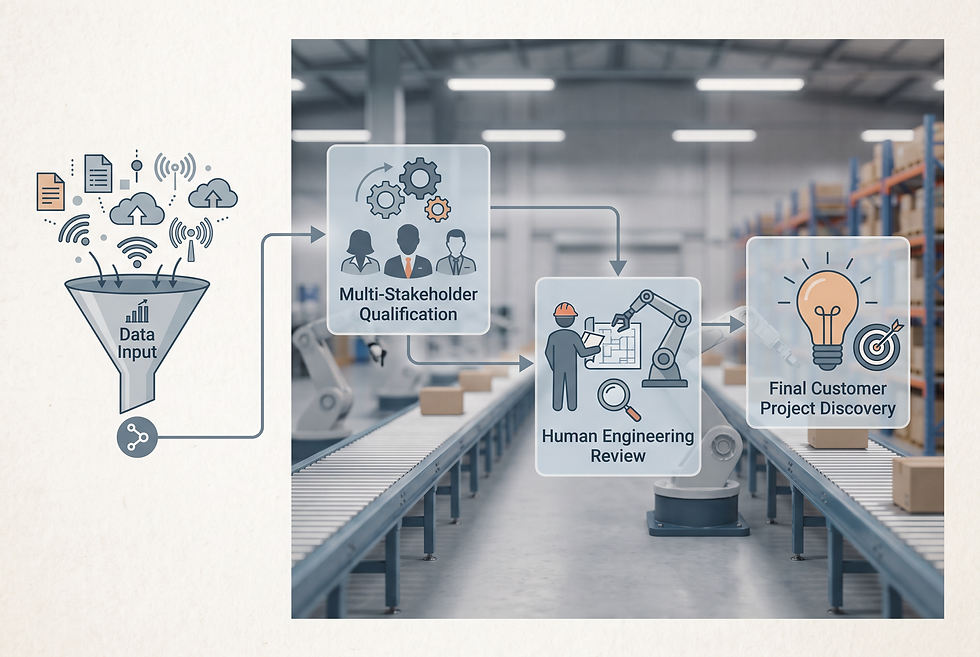
The modernized pipeline operates through five tightly integrated stages, balancing automated signal processing with human engineering expertise to create early deal leverage.
1. External Signal Capture and Target Ingestion
The system continuously aggregates external data points, including industrial real estate lease transaction feeds, local commercial planning board filings, and enterprise logistics job postings. These inputs are cross-referenced with ideal customer profile (ICP) parameters, such as facility footprint (>100,000 sq. ft.), SKU volume, and industry vertical (e.g., cold storage, pharmaceutical distribution, automotive spare parts).
2. Automated Intelligence Enrichment and Committee Mapping
Once an expansion or operational bottleneck signal is validated, the workflow maps the complete buying matrix at the operating entity. It identifies the operational executive, the facility engineering lead, and regional logistics leadership, eliminating single-threaded outbound blind spots.
3. Role-Specific Outreach and Value Architecture
The outreach engine creates targeted, value-driven touchpoints tailored to each stakeholder's functional focus. The VP of Logistics receives industry-specific benchmark reports illustrating payback models on dynamic pallet buffering, while the Lead Systems Engineer receives technical interface diagrams and PLC integration whitepapers.
4. Interactive Facility Feasibility and Direct Human Handoff
When a prospect engages with a technical feasibility assessment or responds to an inquiry regarding a facility expansion, the system captures throughput requirements and pallet capacity constraints. The opportunity is qualified and routed instantly to the dedicated Regional Sales Director and Application Engineering Lead with an executive briefing summary.
5. Solution Co-Design Prior to Tender Drafting
The human sales engineering team hosts exploratory site discovery sessions and facility simulation discussions. By assisting the prospect in defining system requirements—such as aisle clearances, sorting rates, and software interfaces—the vendor embeds its design principles directly into the eventual procurement specification.
Workflow Dimension | Legacy Reactive Bidding | Modernized Warehouse Automation Lead Generation Strategy |
Entry Point in Buying Cycle | After formal RFQ release (Late Stage) | Facility planning, lease signing, or brownfield retrofitting (Early Stage) |
Trigger Identification | Inbound portal forms, public tenders | Real estate permits, logistics job signals, supply chain contract wins |
Stakeholder Coverage | Single-threaded communication with purchasing agent | Multi-threaded engagement across Operations, Engineering, and C-Suite |
Technical Engagement | Generic product catalog distribution | Customized layout feasibility briefs, throughput modeling, and ROI calculators |
Win Rate Influence | Low pricing power, high vendor competition | High influence over tender design and technical specifications |
Typical Sales Cycle | 12–18 months in formal vendor bake-off | 6–9 months collaborative engineering dialogue prior to tender |
Evidence and Results: Measurable Operational Impact
Industrial automation providers and supply chain consulting firms documenting the transition from reactive tendering to proactive pipeline development report distinct operational shifts:

Early Influence on Technical Specifications: According to a 2024 industrial supply chain commercial report by an international logistics advisory firm, automation vendors that engage prospects during initial engineering design phases achieve a 3.4x higher win rate compared to vendors entering at the formal RFQ stage.
Sales Cycle Velocity: Official industry benchmark data compiled by supply chain research organizations indicates that early pre-qualification of engineering constraints reduces the proposal-to-contract phase by an average of 35% by eliminating post-tender redesign loops.
Account Expansion and Pipeline Predictability: System integrators applying systematic buying committee outreach across tier-1 3PL networks report a 40% increase in multi-site rollout opportunities versus one-off facility bids.
What Other Companies Can Learn: Replicable Strategic Principles
Industrial equipment manufacturers, robotics startups, and intralogistics system integrators can adopt four foundational principles from this operating model:
1. Treat Physical and Operational Milestones as Buying Triggers
Do not rely on software downloads or general newsletter subscriptions to gauge buyer readiness. In capital equipment sales, genuine intent is signaled by real-world operational changes: new warehouse leases, facility footprint expansions, SKU proliferation, and contract logistics wins. Build monitoring workflows around physical infrastructure indicators.
2. De-Risk the Buying Committee Simultaneously
Capital equipment decisions fail when one faction of the committee is ignored. If operations leaders love your throughput rate but IT engineers fear maintenance complexity or security compliance, deals stall. Craft dedicated technical assets, security overviews, and financial payback models for each specific stakeholder persona.
3. Offer Diagnostic Utility Instead of Hardware Pitches
High-value buyers reject generic sales pitches. Instead of asking for discovery meetings to pitch your AMR or ASRS specifications, provide self-guided calculation frameworks, warehouse layout optimization guides, or labor cost vulnerability assessments that deliver immediate analytical value.
4. Maintain Clear Boundaries Between Automation and Engineering Judgement
Automation workflows should handle pipeline monitoring, data enrichment, multi-stakeholder messaging orchestration, and lead triaging. However, detailed spatial design, mechanical configuration, and contract negotiations must remain in the hands of seasoned Application Engineers and Commercial Directors.
What This Could Look Like for Intralogistics and Robotics Manufacturers
Consider an industrial manufacturer producing pallet shuttle systems, AMR fleets, or automated packaging cells:
For an AMR Manufacturer: Rather than cold calling general warehouse managers, the business targets 3PL providers that have recently secured multi-year fulfillment contracts for consumer packaged goods (CPG). The sales engine coordinates communications with the Regional Operations Director regarding picking efficiency while sharing integration compatibility guides with the Controls Engineering Lead.
For an ASRS System Integrator: The company tracks planning applications for high-bay cold storage distribution facilities across target geographic regions. Before architectural designs are finalized, the integrator contacts the VP of Supply Chain with clear architectural space-utilization studies, demonstrating how high-density automated buffering cuts building footprint costs by 40%.
For a Packaging Machinery OEM: Outreach targets industrial food and beverage processors facing documented labor constraints, offering automated end-of-line palletizing assessments directly to Plant General Managers.
Deploying an AI Worker: AI Equipment Sales Rep
To operationalize this model without inflating administrative overhead, intralogistics enterprises can implement a specialized digital role tailored for industrial business development.
Role Profile: AI Equipment Sales Rep
Primary Daily Tasks: Monitors industrial real estate expansion registries, parses public permit data for distribution hub builds, identifies decision-makers across engineering and supply chain functions, and executes contextualized, multi-role introductory outreach campaigns.
Primary Work Channels: Corporate Email, LinkedIn Professional Networks, and CRM System Synchronization (HubSpot, Salesforce).
Authority Boundary: Automatically identifies accounts, enriches buying committee profiles, and conducts educational outreach. It is strictly prohibited from quoting custom engineering pricing, negotiating contract terms, or finalizing project delivery schedules without human Application Engineer authorization.
First Value Event: Successfully identifying a brownfield warehouse expansion project 6 months prior to tender, engaging both the Operations Director and Lead Facilities Engineer with custom throughput models, and scheduling a qualified discovery call with the Regional Sales Director.
Daily Report Output: A morning summary delivered to the Commercial Director detailing new facility permits tracked, active multi-threaded conversations across target 3PL accounts, qualified discovery calls booked for the engineering team, and follow-up alerts for pending capital proposals.
FAQ
Why is proactive lead generation more effective than bidding on public warehouse automation RFQs?
Bidding on public RFQs often places vendors in price-driven competitions where system specifications have already been influenced by competing incumbents. A proactive warehouse automation lead generation strategy engages buyers during initial facility planning, allowing vendors to help define engineering criteria, build executive trust, and secure preferred status before formal procurement begins.
What early signals indicate a company is ready to invest in warehouse automation?
Key upstream signals include commercial industrial real estate lease agreements, municipal facility expansion permits, corporate executive hiring in logistics engineering, multi-year 3PL contract awards, and public announcements regarding omnichannel retail distribution expansion.
How should intralogistics sales teams handle multi-stakeholder buying committees?
Sales teams should multi-thread their approach by delivering role-tailored value propositions. Provide COOs and Supply Chain VPs with TCO and payback models, supply Operations Directors with throughput and peak-season reliability data, and deliver controls compatibility, safety standards, and software API documentation to Facilities and Automation Engineers.
How does an AI Equipment Sales Rep support complex intralogistics sales cycles?
An AI Equipment Sales Rep continuously monitors market expansion signals, identifies all relevant members of the buying committee, and initiates role-specific technical dialogues. Once a prospect demonstrates interest in throughput calculations or facility feasibility, the AI worker routes the qualified opportunity directly to human application engineers.
Scale Your Intralogistics Pipeline Before the Tender Opens
Discover how deploying an AI Equipment Sales Rep helps automation OEMs and system integrators uncover capital warehouse projects months before the RFQ.


Comments