
Water Treatment Equipment Quote: Key Engineering Data Buyers Must Provide

Executive Summary: Procuring custom industrial water systems frequently stalls during technical intake due to ambiguous requirements. When engineering teams receive incomplete specifications, proposal turnaround stretches from days to weeks, inflating overhead and distorting capital budgets. Standardizing baseline technical inputs—such as influent chemistry, flow dynamics, physical footprint, and discharge standards—enables capital equipment OEMs to deliver an accurate water treatment equipment quote in a fraction of standard proposal cycles while eliminating costly engineering revisions.
Company Snapshot: The Industrial Water Equipment Sector
Industrial water treatment equipment manufacturers operate in a high-consequence, project-driven engineering sector. These original equipment manufacturers (OEMs) and engineering, procurement, and construction (EPC) integrators design, fabricate, and commission heavy-duty separation, filtration, and chemical dosing systems.
Primary Product Portfolio: Membrane bioreactors (MBR), industrial reverse osmosis (RO) skids, dissolved air flotation (DAF) units, ion-exchange systems, and zero liquid discharge (ZLD) crystallizers.
Core Client Base: Food and beverage manufacturing facilities, chemical refineries, semiconductor fabrication plants, municipal utilities, power generation stations, and pharmaceutical production sites.
Commercial Model: Engineered-to-order (ETO) and configured-to-order (CTO) project sales with contract values spanning tens of thousands to multimillion-dollar installations.
Why This Analysis Matters: In the capital equipment sector, pricing cannot be pulled from a standard catalog price sheet. Every system must be custom-sized to fluid chemistry and local regulatory mandates. Examining how leading industrial water OEMs manage technical discovery reveals how structured data intake transforms commercial velocity and margin retention.
What Industrial Water OEMs Sell: Complex Engineered Solutions
Industrial water treatment solutions are not off-the-shelf commodities; they are integrated mechanical, electrical, and chemical processing plants packaged into modular or site-built configurations. An industrial buyer does not simply order a pump or a tank. Instead, they procure an operating outcome: converting raw, contaminated influent water into process-grade water or meeting statutory environmental discharge limits.
Procurement in this domain involves multi-stakeholder consensus across plant operations, environmental health and safety (EHS) managers, facility engineers, and procurement directors. The operational environment dictates the metallurgy, membrane chemistry, sensor suites, and safety interlocks required on the equipment skid. Consequently, the commercial proposal is fundamentally an engineering document containing preliminary mass balances, piping and instrumentation diagrams (P&ID), electrical single-line assumptions, and lifecycle chemical consumption models.
When a buyer initiates a request for quotation (RFQ), the application engineering team must perform complex process calculations before a credible cost estimate can be established. If baseline operating assumptions are omitted from the initial RFQ, the sales cycle enters a protracted discovery loop that drains OEM engineering capacity and delays capital expenditure approvals.
The Business Problem: RFQ Friction and Specification Gaps
In capital equipment sales, the traditional quotation intake model suffers from significant informational friction. Industrial water suppliers routinely receive unstructured RFQs containing high-level statements such as "We need a 50 gpm RO system to treat well water" or "Please quote a DAF skid for food processing wastewater."
This lack of initial technical fidelity creates three structural operational bottlenecks:
The Application Engineering Rework Loop: Application engineers spend billable hours playing technical detective—issuing clarification emails, chasing laboratory water assays, and requesting missing plant utility data before preliminary sizing can begin.
Margin Erosion from Over-Engineering or Under-Sizing: Incomplete data forces OEM proposal engineers to make conservative sizing assumptions (such as over-specifying high-alloy stainless steels or over-sizing pump horsepower). This practice either artificially inflates the quoted price, causing the OEM to lose the bid, or leads to under-designed skids that fail performance acceptance tests during factory commissioning.
Protracted Response Latency: According to industry sales cycle benchmarks, unstructured water treatment RFQs require an average of 14 to 21 business days to produce a formal commercial proposal. In competitive bidding scenarios, delayed quotation delivery directly correlates with reduced capture rates, as early-responding vendors set the technical baseline against which all competitors are evaluated.
What Changed: Standardizing Technical Intake Protocols
Leading process equipment OEMs and industrial engineering teams have replaced informal email-based bidding with structured technical discovery protocols. Rather than accepting open-ended narrative requests, industrial suppliers deploy standardized parameter matrices that categorize required operating variables into non-negotiable engineering fields.
By establishing unambiguous data requirements at the point of commercial intake, engineering teams can instantly map raw customer specifications to validated product platforms, baseline mass balances, and bill-of-materials (BOM) cost modules. This shift enables technical sales teams to separate high-intent, technically feasible projects from exploratory inquiries, ensuring application engineering resources are deployed only on qualified, viable proposals.
The 10 Critical Data Parameters for an Accurate Water Treatment Equipment Quote
To eliminate pricing ambiguity and accelerate project delivery, industrial buyers must supply comprehensive data across ten mechanical, chemical, and operational categories.
1. Volumetric Flow Rate Dynamics
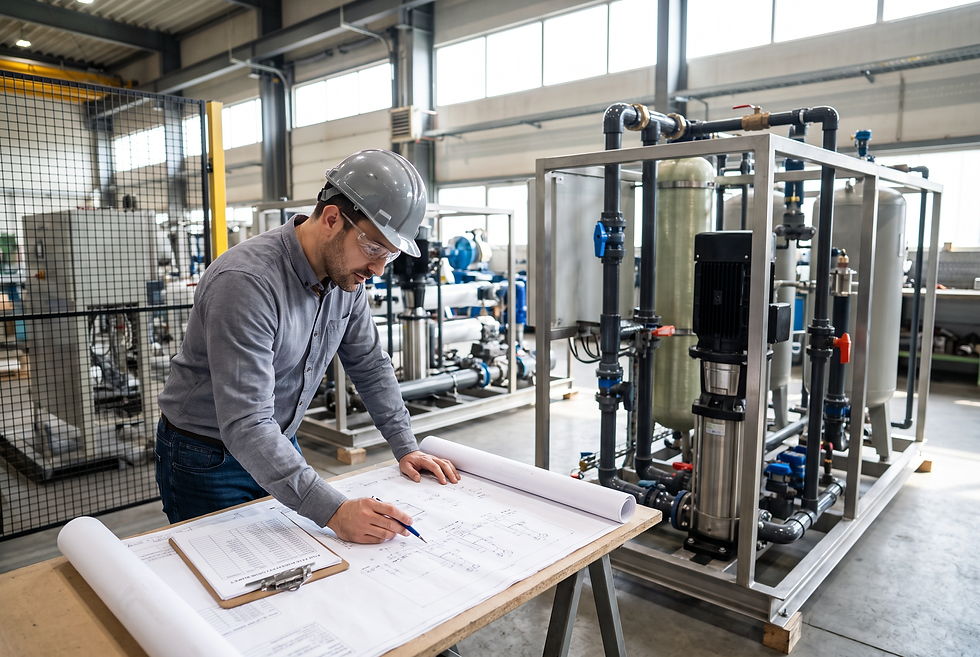
Process equipment cannot be sized without precise flow parameters. Buyers must state continuous average flow rate, peak hourly flow rate, daily operational volume, and design turndown ratios. Stating batch discharge volumes versus continuous steady-state flow dictates whether the system requires upstream equalization storage or direct inline processing.
2. Complete Influent Water Quality Profile
A comprehensive laboratory water analysis is vital. Required parameters include Total Dissolved Solids (TDS), Total Suspended Solids (TSS), Biochemical Oxygen Demand (BOD), Chemical Oxygen Demand (COD), pH ranges, turbidity, conductivity, hardness, and specific ionic concentrations such as chlorides, sulfates, silica, iron, and heavy metals.
3. Target Effluent Quality and Performance Objectives
Suppliers require exact numerical benchmarks for treated water. Whether the effluent must meet USP-grade pharmaceutical water conductivity, boiler feedwater ASTM standards, cooling tower makeup criteria, or municipal National Pollutant Discharge Elimination System (NPDES) discharge limits, exact target thresholds determine the sequence of membrane, thermal, or biological stages.
4. Operating Pressure and Hydraulic Profiles
Suppliers must know available raw water feed pressure, allowable system pressure drops across the treatment skid, and required discharge delivery pressure. Incorrect hydraulic assumptions result in mismatched feed pump selection and inadequate membrane flux rates.
5. Temperature and Environmental Operating Ranges
Fluids behave differently at varying temperatures; viscosity, biological kinetics, and membrane flux vary with thermal shifts. Buyers should provide minimum, average, and maximum fluid temperatures, as well as ambient site climate conditions (indoor climate-controlled versus outdoor freeze-prone or coastal marine installations).
6. Chemical Load and Specific Contaminants of Concern
Trace constituents can damage sensitive treatment components. Buyers must declare the presence of free chlorine, hydrogen sulfide, dissolved hydrocarbons, emulsified oils, aggressive surfactants, bio-fouling organisms, or emerging contaminants like PFAS/PFOS that dictate specialized metallurgy, chemical pre-treatment, or carbon polishing.
7. Physical Footprint and Structural Layout Constraints
Skid dimensions, floor load-bearing capacity, ceiling clearance, doorway access dimensions, and seismic zone ratings determine physical mechanical design. Supplying dimensional boundaries avoids structural redesigns during final drafting stages.
8. Controls, Automation, and Telemetry Architecture
Industrial facilities maintain strict operational technology (OT) standards. Buyers must define required programmable logic controller (PLC) brands (such as Allen-Bradley, Siemens, or Schneider Electric), human-machine interface (HMI) screens, SCADA integration protocols (Modbus, Profinet, Ethernet/IP), and remote diagnostic requirements.
9. Regulatory Compliance and Industry Certifications
Engineering fabrication must adhere to regional and industry codes. Requirements such as ASME Section VIII pressure vessel certification, UL 508A panel compliance, 3-A Sanitary Standards for food/dairy, ATEX/Class 1 Division 2 explosion-proofing, or NSF/ANSI 61 water safety certification must be stated upfront.
10. Project Execution Timeline and Commercial Milestones
Suppliers require realistic dates for drawing submittals, long-lead component procurement, factory acceptance testing (FAT), site delivery, commissioning, and final validation. Explicit timelines ensure manufacturing slot reservations align with plant turnaround windows.
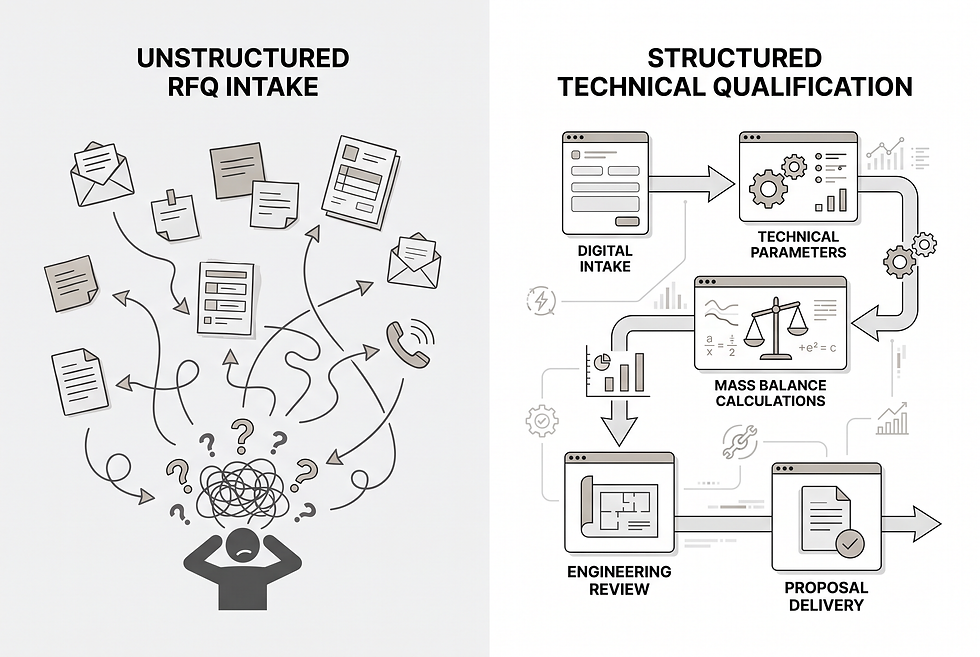
Workflow Comparison: Unstructured vs. Structured RFQ Execution
The table below contrasts the operational path of an unstructured quotation process against a structured, parameter-verified intake model.
Process Step | Legacy Unstructured Intake | Structured Parameter Verification Model |
1. Initial Inquiry Intake | Narrative email with generic capacity estimates | Complete 10-parameter technical intake form & water lab assay |
2. Completeness Review | Incomplete data passed to application engineering | Rule-based validation checks parameter boundary limits |
3. Clarification Cycle | 3–5 manual email loops across 10 business days | Single targeted technical alignment call if edge cases exist |
4. Process Sizing | Engineers manually calculate sizing on guessed assumptions | Rapid configuration matching verified fluid chemistry to modular skids |
5. Costing & BOM | Padded commercial pricing to hedge unknown chemical risks | Precise cost estimation based on verified metallurgy and components |
6. Proposal Turnaround | 14 to 25 business days | 3 to 5 business days |
7. Change Orders | High rate of post-award revisions and scope change orders | Minimal design variance between proposal and detailed design |
How the Modern Technical Qualification Workflow Actually Works
Implementing high-efficiency engineering quotation processes requires a disciplined multi-stage operational workflow connecting sales frontlines with process engineering:
Step 1: Raw Parameter Ingestion. Technical data sheets, laboratory water quality assays, and plant utility drawings are gathered through standardized intake channels or document extraction tools.
Step 2: Automated Completeness Screening. Technical criteria check the submission against physical feasibility boundaries (such as balancing cation-anion water chemistry or verifying that specified membrane flux matches temperature minimums).
Step 3: Commercial Triage and Routing. Inquiries that provide complete data are immediately routed to dedicated application engineering desks based on vertical application (e.g., ultrapure water vs. heavy wastewater).
Step 4: Rigorous Process Modeling. Application engineers run projection software (such as reverse osmosis system modeling or hydraulic head calculation tools) using confirmed empirical water chemistry.
Step 5: Bill of Materials Synthesis. Sizing models populate mechanical components, structural frame skids, electrical panels, and pipe schedules directly into an ERP/CPQ system for precise material costing.
Step 6: Human Peer and Legal Review. Senior process engineers and commercial directors review scope-of-supply limits, battery limits, warranty exclusions, and performance liability clauses.
Step 7: Structured Proposal Generation and Feedback. A complete engineering proposal is generated—including process flow diagrams (PFDs), utility consumption schedules, and firm commercial terms—establishing an auditable baseline for downstream project execution.
Operational Evidence and Practical Business Results
According to operational benchmarks from industrial manufacturing case studies and capital equipment sales research, implementing rigorous front-end technical qualification yields quantifiable improvements across quotation throughput and bid conversion:
Quotation Latency Reductions: Capital equipment OEMs transitioning from ad-hoc email scoping to mandatory parameter validation matrices report reducing quotation generation cycles from an industry average of 18 days down to under 5 business days.
Elimination of Post-Award Scope Creep: Engineering consulting studies indicate that over 60% of post-sale margin slippage in water skid manufacturing stems from unanticipated water chemistry fluctuations not identified during the quotation phase. Comprehensive parameter discovery at the RFQ stage eliminates unbudgeted metallurgy upgrades during fabrication.
Engineering Resource Optimization: Industrial application engineering teams using structured intake capture up to 35% more productive design capacity by eliminating manual discovery follow-ups and unviable speculative proposals.
What Other Capital Equipment Companies Can Learn
Industrial equipment manufacturers across mechanical, thermal, and fluid handling sectors can apply four core principles from this operational methodology:
Treat the RFQ as an Engineering Contract: Never initiate costly engineering calculations on narrative descriptions. Mandate verified boundary conditions before allocating high-cost technical resources.
Establish Rigid Application Envelopes: Define the exact operating boundaries where standard modular skids apply versus when fully custom engineering is required, avoiding over-customization on routine applications.
De-couple Discovery from Manual Sales Time: Standardize data collection tools and technical specification checklists so buyers can assemble required parameters internally before engaging the sales engineering team.
Quantify Operational Constraints Early: Space limitations, power availability, and regulatory certifications are structural hurdles; capturing them upfront prevents major mid-project redesigns.
What This Workflow Looks Like for Industrial OEMs
For industrial manufacturers producing complex machinery—such as industrial pump skids, heat exchangers, compressed air systems, or wastewater treatment hardware—deploying structured technical intake modernizes global commercial operations.
In a global commercial deployment, international leads arrive 24/7 across multiple time zones and technical languages. Rather than allowing foreign inquiries to wait days for a domestic technical sales engineer to begin discovery, an automated technical sales workflow captures the international buyer's operating environment immediately. It standardizes units of measurement, cross-references local electrical voltages (e.g., 380V 50Hz vs. 480V 60Hz), validates chemical metrics, and delivers a fully qualified engineering intake summary directly to the engineering team's desk at the start of the next business day.
YTT AI Worker Mapping: Streamlining Technical Sales Discovery
To bridge the gap between initial customer interest and rigorous engineering intake, industrial equipment manufacturers deploy dedicated AI-driven workflows.
AI Worker Title: AI Project Sales Rep
Main Daily Tasks: Ingests incoming multi-format RFQ emails, laboratory water assays, and technical tender documents; verifies that all 10 core engineering parameters (flow rate, water chemistry, footprint, PLC standards, etc.) are present; identifies missing or conflicting data points; engages the buyer in real-time technical clarification dialogue; and packages fully qualified discovery files for human process engineers.
Primary Work Channels: Corporate RFQ portals, inbound sales email infrastructure, and supplier digital bid rooms.
Authority Boundary: Operates exclusively within approved technical parameter ranges and discovery boundaries; does not negotiate final contract pricing, modify liability terms, or issue binding engineering guarantees without human application engineering review and commercial director sign-off.
First Value Event: Successfully extracting and validating all 10 critical engineering parameters from an unstructured customer RFQ and laboratory PDF, generating an engineering-ready project scoping dossier within 15 minutes of inquiry arrival.
Daily Report Output: A morning summary table highlighting all incoming RFQ submissions, categorized by technical completeness score, required process technology (e.g., RO, DAF, MBR), identified chemical risks, and prioritized next actions for the engineering proposal team.
FAQ
Why is a raw water laboratory analysis mandatory for an accurate quote?
Raw water chemistry dictates the entire process design. Membrane selection, pre-treatment chemical dosing, anti-scalant requirements, and metallurgy specifications depend entirely on ionic concentrations, biological load, and suspended solids. Quoting without a verified water assay leads to significant over-engineering or premature system failure.
How do peak flow rate variations impact water treatment skid pricing?
Water treatment equipment must be sized to handle maximum hydraulic flux. If a plant experiences peak hourly surges that exceed average daily rates, the OEM must design either a larger continuous processing system or integrate equalization storage, directly influencing equipment sizing, footprint, and capital cost.
What happens if plant footprint and clearance constraints are omitted from the RFQ?
Omitting physical space, doorway clearance, or ceiling height limitations often results in standard skid layouts that cannot physically fit into the mechanical room or pass through facility entryways, leading to expensive field modifications, pipe rerouting, or structural skid redesigns after delivery.
Can an equipment supplier provide a budgetary estimate with partial data?
Suppliers can provide high-level budgetary rough order of magnitude (ROM) estimates with partial information, but these quotes typically carry wide cost ranges (+/- 30%) and explicit exclusions. A firm, binding commercial quote requires all 10 core engineering parameters to ensure performance liability.
Automate Your Technical RFQ Qualification Workflow
Eliminate discovery friction and help your engineering sales teams turn complex technical specifications into accurate, quote-ready project dossiers in minutes. Request a guided workflow demo with YTT AI today.


Comments