

What Kind of Sales Data Can AI Remember? | YTTAI

AI sales memory can store and recall structured CRM records (deals, emails, and purchase histories) alongside unstructured data (technical RFQ specifications, buyer sentiment, and past meeting transcripts). By integrating with CRM platforms, AI agents maintain persistent context across long sales cycles to ensure highly personalized, accurate multi-touch follow-ups.
What Is AI Sales Memory and How Does It Work?
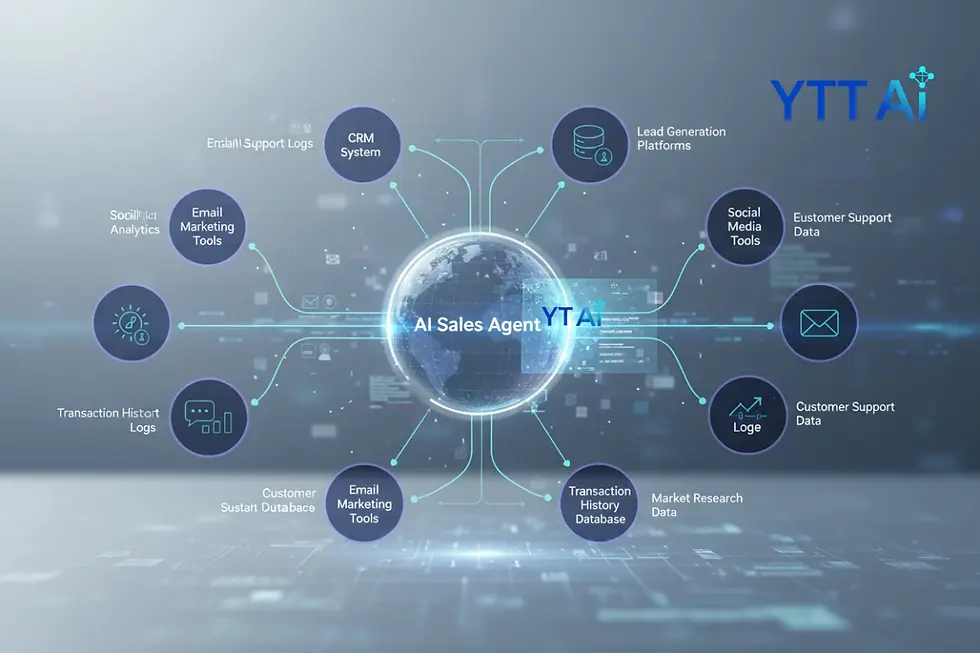
AI sales memory refers to an intelligent agent's capacity to retain, retrieve, and synthesize customer context across multiple touchpoints and channels. Unlike traditional static databases, AI sales memory is dynamic, contextual, and continuous.
To understand how AI processes sales data, it is helpful to look at the underlying technology. Modern AI sales agents use Retrieval-Augmented Generation (RAG) and vector databases to convert conversations, emails, and PDF proposals into mathematical vector embeddings. When a buyer reaches out months after an initial inquiry, the AI agent performs semantic search, instantly retrieving past context to draft a highly tailored response.
Structured vs. Unstructured: The Core Data Types AI Sales Agents Can Remember
When evaluating what systems to implement, B2B sales leaders often ask: What kind of sales data can AI remember? The answer spans two main categories of information:
1. Structured CRM and Transactional Data
Contact & Firmographics: Buyer titles, company size, geographic market, and language preferences.
Pipeline Metrics: Current deal stages, historical purchase frequencies, and average order values.
Interaction Logs: The exact date, time, and channel (Email, WhatsApp, or Web Chat) of the last communication.
2. Unstructured Conversational and Technical Context
Technical Specifications: Custom CAD requirements, voltage requirements (such as 25kV equipment specs), or material limitations (e.g., specialized steel grades for mold manufacturing).
Buyer Objections & Pain Points: Specific fears voiced by the prospect, such as concerns over lead times, shipping reliability, or pricing transparency.
Semantic Sentiment: Mood shifts over a multi-month email exchange, identifying whether the buyer is showing increased urgency or hesitation.

How AI Memory Solves the Long-Cycle Follow-Up Challenge for B2B Exporters
In B2B exporting—especially across industries like industrial machinery, custom mold making, and electronic components—sales cycles typically span 3 to 12 months. Human sales representatives often struggle to maintain consistency over these long periods. When reps manage hundreds of leads, technical details get lost, and crucial follow-ups slip through the cracks.
With persistent memory, an AI sales agent automatically retains all B2B sales automation data. It remembers that a buyer from Germany inquired about a specific industrial pump capacity in January, allowing it to follow up in April with precise inventory updates or customized technical data sheets. This level of personalization significantly reduces lead friction and prevents competitor poaching.
Traditional CRM vs. AI-Powered CRM Memory: A Comparative Analysis
To maximize team efficiency, establishing an AI sales agent CRM integration is essential. The table below illustrates the stark differences between managing sales data through traditional CRMs versus utilizing an AI-powered memory layer:
Feature Capability | Traditional CRM Systems | AI-Powered CRM Memory Layer |
|---|---|---|
:--- | :--- | :--- |
Data Entry | Manual logging by reps (prone to human error and omission) | Automatic capturing of emails, chats, and RFQs in real-time |
Contextual Retrieval | Keyword searches only; lacks understanding of synonyms | Semantic understanding; connects pricing concerns to budget negotiation |
Actionable Synthesis | Stores data passively; requires human analysis | Actively drafts contextual follow-ups based on historical context |
Cross-Channel Stitching | Siloed records across email, WhatsApp, and Zoom logs | Unifies all touchpoints into a singular, persistent buyer memory |
Step-by-Step: How to Implement Persistent AI Memory in Your Sales Workflow
Deploying AI memory within your enterprise requires a structured approach to ensure high-quality data outputs:
Map Core CRM Fields: Connect your AI agent directly to systems like HubSpot or Salesforce to establish your foundation for AI sales agent CRM integration.
Ingest Legacy Technical Knowledge: Feed your technical documentation, product catalogs, and shipping FAQs into the AI's knowledge base.
Define Communication Guardrails: Specify which pricing structures are final and which require manual human sign-off before a quote is sent.
Activate Multi-Channel Listening: Allow the AI agent to monitor incoming inquiries across all company channels, updating the memory database continuously.
Security, Privacy, and Human Oversight: Setting Boundaries for AI Memory
While AI memory is highly capable, keeping sensitive commercial data safe is paramount. B2B exporters must implement strict data governance:
Data Encryption: Ensure that both structured and unstructured data are encrypted at rest and in transit.
Role-Based Access Control (RBAC): Restrict who can view or modify the memories stored by the AI agent.
Human-in-the-Loop (HITL): Critical actions—such as sending final pricing sheets or custom RFQ approvals—must be routed to a human sales manager for validation.
Measuring the Impact of AI Memory: Key KPIs for B2B Sales Teams
Tracking the ROI of your AI systems ensures operational alignment. Key metrics to monitor include:
Response Time Reduction: Shrunk from hours to seconds for complex, technical inquiries.
Lead Reactivation Rate: The percentage of sleeping or cold leads successfully re-engaged using contextual history.
RFQ Accuracy: Reductions in quote revisions or configuration errors during order placement.

Frequently Asked Questions About AI Sales Memory
Implementing AI memory can raise practical integration and data safety questions for enterprise sales operations. Below, we address some of the most common questions on how modern sales teams configure these systems.
FAQ
How does AI sales memory integrate with my existing CRM?
Modern AI agents achieve integration via REST APIs, allowing real-time bidirectional syncing with platforms like HubSpot and Salesforce. This ensures that any update in the CRM instantly refreshes the AI's active context.
Can the AI process and remember unstructured hand-drawn sketches or complex custom RFQs?
Yes, multi-modal AI models can parse custom technical drawings, PDFs, and hand-drawn specifications, extracting quantitative requirements and mapping them to past product memory.
Does AI sales memory store credit card or sensitive personal data?
No. Enterprise-grade AI sales memory uses robust data anonymization filters to automatically redact PII (Personally Identifiable Information) and financial data before storing any records in vector databases.


Comments