
Why Great Strategy Fails: The Missing “Execution Engine” Most Companies Don’t Have

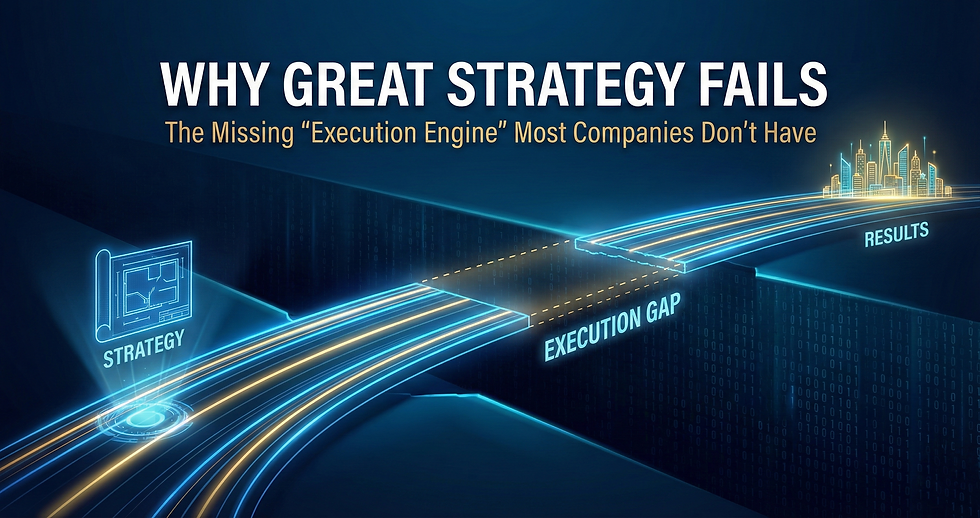
A Second-Rate Strategy with First-Rate Execution Beats the Opposite—Every Time
There’s a famous line in management:“A second-rate strategy executed flawlessly beats a first-rate strategy executed poorly.”
Most owners don’t disagree. What they struggle with is what happens after the annual strategy meeting—when the room cools down and reality kicks in.
If this feels familiar, you’re not alone:
The annual strategy workshop is inspiring… but weeks later, the plan disappears into silence.
You invest in R&D and marketing, but the impact can’t be measured—ROI becomes a black box.
Cross-functional projects turn into blame games, and the CEO becomes the “senior assistant,” firefighting everywhere.
These aren’t isolated issues. They are symptoms of what we call a company’s chronic execution disease.
Today we’re sharing a practical solution: a digital “war-room engine” for execution—the YTT AI Task Acceleration System.
What Is the YTT AI Task Acceleration System?
The YTT AI Task Acceleration System is a company’s digital execution engine and command center.
It is not another “process recording” tool.
Instead, it is built on YTT Profit Management methodology developed by profit-management expert Professor Shi Yongxiang, and delivered as an integrated “Diagnosis + Platform + Coaching” implementation system.
Here’s the key difference:
AI functions as your “super sensors”—connecting across systems, pulling real operational data, and eliminating blind spots.
External experts act as the “hard push”—breaking through internal politics and ensuring the mechanisms truly take root inside the organization.
In short:it’s a closed-loop engine designed to turn strategic intent into business results.

The Closed-Loop Logic: How Strategy Becomes Real Outcomes
To eliminate “strategy-to-nothing,” the system enforces a rigorous execution logic:
1) A Four-Step Closed-Loop Execution Cycle
Every task runs through:
Goal Decomposition → break strategic intent into measurable deliverables
Accountability Binding → assign owner, authority, resources, and responsibility
Process Tracking → monitor progress on a clear timeline with standards
Closed-Loop Verification → validate outcomes with evidence and results
This prevents high-level directives from staying vague—and turns them into actions with standards and a clock.
2) A Three-Layer Task Architecture
Execution must cover every level of management, not just “big projects.”
The system manages three types of work:
Strategic Tasks (profit growth initiatives, major transformations)
Improvement Tasks (cost reduction, efficiency gains, capability building)
Daily Tasks (routine operations with measurable outputs)
This design connects macro business goals with micro role-level responsibilities—closing the coordination gaps where execution often dies.
3) “Full-Volume Inspection” Supervision
Traditional management relies heavily on manual reporting—often delayed, selective, and filtered.
YTT introduces a “full-volume inspection” mode by using AI agents to pull data across:
Finance data
OA / workflow systems
Business systems (sales, production, delivery, service, etc.)
Leadership gains transparent, near real-time visibility—not based on storytelling, but based on signals from the work itself.

Treating the “Chronic Execution Disease” at Its Root
1) Reducing External Business Anxiety
Strategy that “lands in the bank.”No more slogans. Every strategy item is tied to tasks, milestones, and evidence.
ROI made visible.Cost reduction, efficiency projects, R&D, marketing—what works and what doesn’t becomes measurable. Money gets spent clearly, not emotionally.
Merit-based incentives driven by real outcomes.People’s rewards can link logically to market-validated results—not just “who looks busy.”
2) Fixing Internal Management Dysfunction
Prevent work from “vanishing halfway.”R&D and marketing often involve elastic, long-cycle work. Without tight tracking, projects disappear midstream. This system forces continuity.
Put leaders back in the right role.The boss stops being the universal problem-solver. Project owners carry real responsibility. Cross-department “passing the buck” becomes harder to hide.
Why YTT: Lightweight Deployment, Heavyweight Supervision
We offer a model that’s practical for real companies:
Someone to “play the bad guy”
Internal transformation often fails because relationships and politics soften enforcement.External experts bring a neutral, disciplined push—using rigid mechanisms and “close-range supervision” to break through resistance.
No “paper strategy” consulting
This is not training-only. It’s year-round implementation coaching.Consultants enter the field, identify bottlenecks on the spot, and push execution until results show up in operations.
A management tool, not a recording tool
Most software helps you register things after they happen.
YTT helps you:
design tasks before execution
supervise during execution
verify after execution with evidence
And it can connect with your existing ERP/OA/DingTalk systems to close the data loop.
The End Game: An Organization That Evolves Automatically
When execution becomes a system, companies change in predictable ways:
Mechanized execution: progress no longer depends on “someone watching someone.” Transparency drives movement.
Habitual results: employees develop a behavioral norm—everyone has tasks, and tasks are judged by outcomes.
Self-evolving organization: through coaching and repeated practice, internal management talent grows—teams learn to identify improvement points and upgrade themselves.
FAQ
Q1: Won’t employees feel task reporting is extra burden?
Actually, the opposite.AI data capture plus standardized templates reduce communication overhead and useless meetings. When tasks become clearer, people spend more time doing work—and less time negotiating.
Q2: Doesn’t stricter management make top talent leave?
High-execution environments are where strong performers thrive.This system makes real contributions visible, and prevents “coasters” from hiding. A fair, transparent merit system is one of the best ways to retain key talent.
Q3: We already have ERP/DingTalk/OA. Do we still need this?
Yes—because those systems are mostly recording tools.YTT is a management tool focused on pre-design and in-process supervision, and it integrates with existing systems to close the loop.
Q4: What if our processes aren’t mature yet?
That’s exactly when this works best.Execution bottlenecks will expose missing procedures and unclear job responsibilities—forcing the organization to move from experience-based management to mechanism-based management.


Comments