
AI Business Development Rep for Contract Manufacturing: From Target OEMs to RFQs

An AI business development rep for contract manufacturing acts as an autonomous front-of-funnel team member. It continuously tracks original equipment manufacturer (OEM) supply chain disruptions, maps mechanical engineering and procurement hierarchies, conducts account research, and coordinates outbound discovery. Its primary business objective is delivering qualified engineering-ready Requests for Quotation (RFQs) directly to your technical sales estimators.
The Structural Bottleneck in Contract Manufacturing Pipeline Development
Contract manufacturers and custom component suppliers face an increasingly complex selling cycle. According to the Gartner 2023 B2B Buying Report, enterprise purchasing groups now involve between six and ten decision-makers, each armed with disparate technical and commercial priorities. In contract machining, injection molding, electronics manufacturing services (EMS), and sheet metal fabrication, standard lead generation often falls short.
Traditional outbound methods rely on generic contact scrapers and mass email blasts that fail to resonate with design engineers, commodity managers, and sourcing directors. OEM engineering teams ignore generic sales pitches because custom fabrication requires strict alignment on tolerances, manufacturing certifications (such as ISO 13485, AS9100, or IATF 16949), equipment envelope capacities, and production volume flexibility. When human business development representatives spend up to 70% of their working hours manually digging through corporate directories, supplier portals, and disconnected procurement signals, outbound pipeline momentum stalls.
To build a predictable OEM pipeline, industrial suppliers are shifting from fragmented lead lists to structured, autonomous execution. Treating automated prospecting as a dedicated digital hire rather than a generic software dashboard enables consistent outreach tailored to discrete manufacturing requirements.
How an AI Business Development Rep for Contract Manufacturing Operates Daily
Unlike traditional sales automation tools that merely schedule template sequences, an autonomous representative executes a multifaceted daily workflow across corporate research, contact verification, and tailored technical communication.
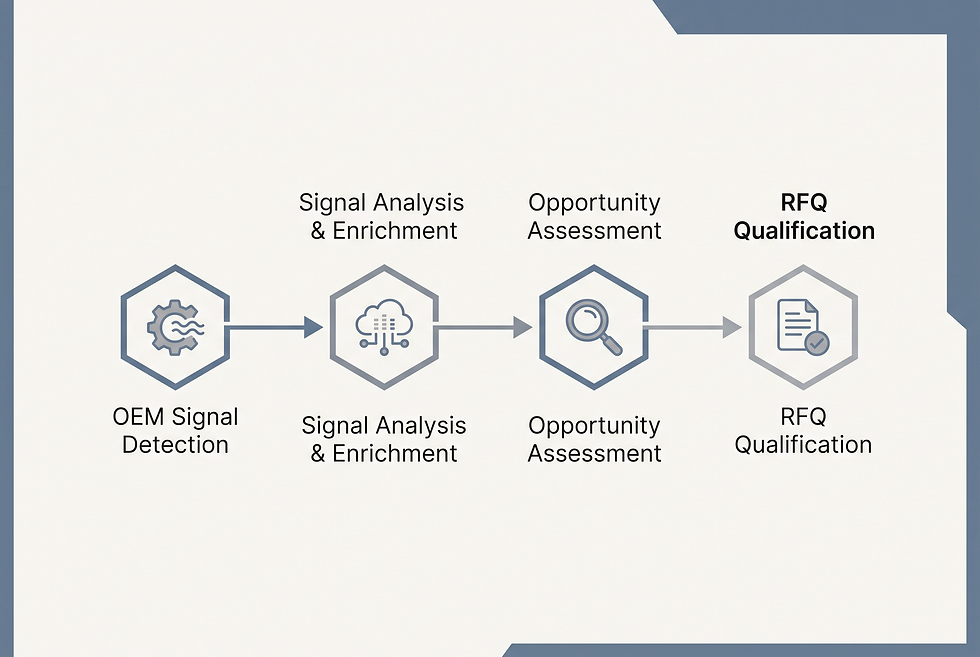
1. Signal Identification and OEM Account Research
Every business day begins with systematic market sensing. The digital representative monitors capital expenditure filings, new product introductions (NPI), reshoring notices, factory expansion permits, and public supply chain bottlenecks across target OEM accounts. If a medical device OEM announces an accelerated surgical robotics platform, the system flags the account, maps its current supplier footprint, and analyzes required manufacturing processes.
2. Stakeholder Mapping and Technical Persona Alignment
Contract manufacturing sales require engaging both commercial buyers and technical gatekeepers. The autonomous representative identifies:
Design & Mechanical Engineers: Focuses on manufacturability (DFM), alloy availability, precision tolerances, and rapid prototype turnarounds.
Commodity & Sourcing Managers: Emphasizes unit economics, landed cost stability, dual-sourcing risk mitigation, and lead-time guarantees.
VP of Supply Chain / Operations: Highlights supplier resilience, continuous quality audits, and tier-1 vendor compliance.
3. Primary Work Channels and Personalized Outbound
The primary operating channel for an automated BDR is corporate email alongside enterprise social platforms (such as LinkedIn). Outbound messages reference actual OEM design challenges, drawing on verified case studies of similar production runs rather than empty marketing claims.
Workflow Matrix: AI BDR Execution vs. Human Engineering Authority
Autonomy requires strict operational governance. The digital representative uncovers opportunities and qualifies intent, but technical review, pricing commitments, and contract terms remain with your internal engineering and commercial teams.
Operational Stage | Autonomous AI BDR Responsibility | Human Sales & Estimating Authority |
Account Discovery | Identifies OEM expansion signals, evaluates fit against machinery limits, verifies certifications. | Confirms target niche priorities and strategic factory capacity targets. |
Stakeholder Outreach | Conducts multi-touch, multi-persona research and sends tailored initial conversations. | Steps in immediately when a prospect requests an in-person audit or custom technical consultation. |
Opportunity Qualification | Clarifies material grades, annual usage volumes (EAU), tolerance bands, and target delivery dates. | Validates whether the opportunity meets shop-floor margin thresholds and machine availability. |
RFQ Handling & Scoping | Ingests drawing packages (CAD/STEP/PDF), logs project metadata, and confirms file completeness. | Conducts formal DFM review, generates cost estimates, and applies commercial margins. |
Commercial Terms & Pricing | Gathers benchmark expectations; drafts standard non-disclosure agreements (NDAs) for review. | Signs NDAs, establishes binding price quotes, defines payment milestones, and signs supply contracts. |
The Milestone to First Value: Converting Account Intelligence into Qualified RFQs
For contract manufacturing leaders, the core metric for any business development hire is time-to-first-value. An autonomous representative reaches this milestone not by calculating vanity metrics like email open rates, but by delivering a verified OEM buyer → RFQ handoff.
According to Salesforce's State of Sales (6th Edition, 2024), high-performing B2B sales teams spend over 40% more time on strategic customer interactions by automating preliminary research and administrative pipeline handoffs. When an autonomous representative coordinates technical non-disclosure agreements and collects 2D/3D technical drawings, your human sales engineers spend their time where it matters most: delivering accurate, winning bids.
Daily Reporting, Governance, and Human Approval Boundaries
Transparency is essential when integrating autonomous agents into enterprise sales operations. Industrial suppliers require direct visibility into daily outputs and risk boundaries.

The Daily Operational Briefing
At the close of each business day, the digital representative compiles an executive summary for the Sales Director. This report outlines:
New OEM Accounts Activated: Target tier-1 and tier-2 enterprises engaged.
Conversations in Progress: Engineering queries received, broken down by process (e.g., 5-axis milling, precision stamping, cleanroom molding).
RFQ Packages Collected: Complete technical packets staged for human quotation review.
Exceptions & Approvals Required: Custom NDA clauses, non-standard material inquiries, or unverified regulatory requests requiring executive authorization.
Strict Authority Boundaries
Autonomous agents must never make binding technical commitments. If an OEM buyer asks, "Can you hold ±0.0002 inches on Inconel 718 at 50,000 units annually?" the representative does not guess. It acknowledges the inquiry, confirms file receipt, and routes the exact tolerance specification directly to the chief applications engineer.
Deploying Autonomous Business Development with YTTAI
Implementing autonomous outbound operations should not require months of custom software development or complex engineering overhead. Purpose-built platforms allow contract manufacturers to deploy specialized digital workers configured specifically for discrete manufacturing and industrial sales.
With YTTAI, contract manufacturers can configure an autonomous digital representative equipped with deep understanding of industrial capabilities, machining envelopes, and supply chain personas. By aligning automated market sensing with rigorous human-in-the-loop governance, your commercial team maintains full control over pricing, quality assurances, and customer relationships while driving a predictable volume of qualified industrial RFQs.
To see how digital development representatives transform outbound pipeline predictability for precision component fabricators, explore a tailored guided growth strategy designed for your specific production capabilities.
Conclusion
Contract manufacturing growth depends on consistent, structured access to high-value OEM projects. By deploying an autonomous business development representative to monitor market shifts, map purchasing teams, and gather comprehensive RFQ packages, industrial manufacturers can scale their outbound pipeline while keeping engineering and estimating teams focused on profitable production.
FAQ
How does an AI BDR handle technical CAD files and NDA requirements?
The AI representative coordinates mutual NDA exchanges using standard company templates and provides secure upload links for CAD, STEP, or PDF drawing packages. Once files are received, it notifies your engineering and estimating team for technical review without attempting to interpret proprietary design files independently.
Will an AI business development rep send unauthorized pricing or quotes?
No. Strict authority boundaries prevent the AI from quoting prices, offering commercial discounts, or committing to delivery schedules. Its role is strictly limited to identifying OEM accounts, establishing contact, qualifying production scope, and gathering RFQ details for human estimating teams.
How long does it take for an autonomous representative to deliver its first RFQ?
Most contract manufacturing implementations see target OEM discovery within the first week, followed by active stakeholder dialogues and initial qualified RFQ submissions within two to four weeks, depending on the target industry's purchasing cycle.
Can the AI representative identify both design engineers and purchasing managers?
Yes. The AI maps the entire procurement committee across design engineering, commodity management, and supply chain leadership, tailoring messaging so technical gatekeepers see manufacturability benefits while commercial buyers see cost and supply stability.
Scale Your Contract Manufacturing RFQ Pipeline
Deploy an autonomous business development representative trained for discrete manufacturing. Capture active OEM demand and deliver qualified RFQs directly to your estimating team.


Comments