
AI Business Intelligence in Manufacturing: B2B Growth Guide

In the highly competitive world of global B2B trade, traditional reporting systems are no longer sufficient to drive sustainable growth. B2B exporters, industrial machinery suppliers, and precision manufacturers face highly complex customer journeys that span multiple time zones, involve numerous decision-makers, and require extensive technical communications.
AI business intelligence in manufacturing helps B2B exporters and industrial manufacturers accelerate overseas growth, eliminate customer context loss, and optimize the complete pipeline from lead generation to sales conversion. By bridging the gap between raw backend operational data and front-end international sales operations, artificial intelligence is reshaping how manufacturers identify opportunities, forecast demand, and scale overseas.
What Is AI Business Intelligence in Manufacturing?
Traditional business intelligence (BI) systems in industrial sectors are retrospective. They summarize what happened last month or last quarter—such as shipping volumes, production output, or total sales revenue. While this information is valuable, it lacks the predictive capability and operational agility required to capture fast-moving global trade opportunities.
AI business intelligence manufacturing represents a paradigm shift. Rather than looking backward, it acts as a proactive, predictive engine. It integrates legacy systems (like ERP and CRM software) with real-time communications (such as emails, WhatsApp messages, and website inquiries) to provide actionable insights.
With natural language processing (NLP) and machine learning models, AI BI understands the actual context of customer communications. For instance, when a buyer from Germany asks about the compatibility of a specific 25kV electrical component under high-temperature conditions, the AI system does not just log a ticket. It automatically retrieves technical context from historical engineering records, checks current inventory and raw material lead times, and recommends the optimal pricing strategy and response timeline to the sales representative.
Key B2B Growth Challenges Solved by AI in Manufacturing
Industrial manufacturers operate under unique constraints. Unlike transactional retail or simple B2B SaaS models, manufacturing sales involve highly technical products, massive order values, and long decision-making timelines. Some of the most persistent roadblocks include:
Inconsistent Sales Follow-up: Many manufacturing companies struggle with delayed RFQ (Request for Quote) responses. This delay often results in buyers seeking alternative suppliers who respond more quickly.
Customer Context Loss: When accounts are managed across personal emails, messaging apps, and phone calls, vital project specifications and historical agreements are frequently lost. This loss is especially common when sales representatives change roles.
Complex Pricing and Custom Configurations: Calculating quotes for customized molds, specialized machinery, or precision-machined parts requires cross-referencing material costs, production capacity, and historical discount margins.
Dormant Lead Neglect: Sales teams naturally focus on the most active pipeline deals, leaving hundreds of warm, historical inquiries to go cold in the database without structured follow-up.
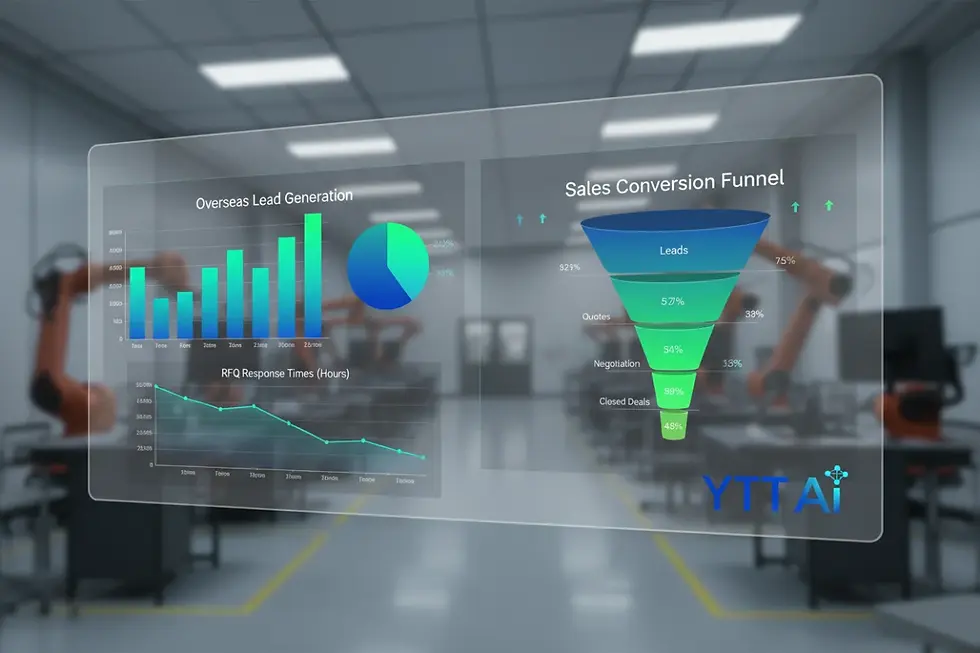
How AI Transforms Raw CRM Data with Manufacturing Sales Analytics
Many manufacturers have invested heavily in cloud-based CRM software, yet their sales teams still struggle to identify which leads are truly ready to buy. This is where advanced manufacturing sales analytics comes into play.
Traditional CRM systems treat all leads similarly, relying on basic criteria like company size or industry. AI-driven analytics, however, dynamically evaluates fit, intent, and urgency by analyzing behavioral signals across all communication channels. It tracks how quickly a prospect reviews technical documentation, how many stakeholders from the prospect's company are involved in email threads, and whether their inquiries align with high-margin product categories.
Furthermore, by integrating industrial sales forecasting AI, manufacturing leaders can align their sales pipelines directly with factory floors. If predictive models indicate a surge in demand for custom precision components in Europe over the next two quarters, the purchasing department can lock in raw material prices early, and the production team can optimize scheduling to avoid bottlenecks. This synchronization of sales intelligence and operational capacity prevents both costly overproduction and disappointing delivery delays.
Driving Global Pipelines with B2B Export Intelligence Software
For international exporters, managing global buyers across multiple regions introduces significant complexity. Language barriers, time-zone differences, and varied compliance standards can easily lead to lost opportunities.
Deploying specialized B2B export intelligence software acts as a 24/7 global operations hub. Instead of waiting for local offices to open, AI systems can automatically ingest, translate, and prioritize international RFQs in real time.
Through tools like Sales Master from YTT AI, companies utilize a feature called Sales Memory. Sales Memory preserves the entire interaction history of an account across all channels. If an exporter of solar equipment or agricultural machinery has been negotiating with a distributor in South America for nine months, the AI ensures that any sales agent stepping in has immediate access to past quote iterations, technical design adjustments, and shipping discussions. This seamless transfer of knowledge maintains momentum and fosters deep trust with buyers.

Strategic Visibility: The Digital CEO Manufacturing Dashboard
To drive sustainable overseas expansion, executive leaders need clear visibility into their operations. Many founders and CEOs find themselves frustrated by fragmented spreadsheets and conflicting data points from different regional offices.
A unified digital CEO manufacturing dashboard solves this problem by consolidating disparate data streams into a single, intuitive control center. Instead of wading through hundreds of raw CRM logs, a CEO can instantly view critical, high-level business health indicators:
Inquiry-to-Quote Conversion Velocity: How quickly are technical sales teams turning raw web inquiries into verified, priced RFQs?
Global Demand Heatmaps: Which regions and product lines are seeing the highest volume of qualified intent signals?
Pipeline Leakage Points: Where are high-value opportunities stalling during the long B2B negotiation cycle?
Dormant Lead Re-engagement Rates: How many past customers have been successfully re-activated through automated, personalized follow-up campaigns?
Equipped with these real-time insights, executive leadership can transition from reactive troubleshooting to proactive, strategic resource allocation.
Step-by-Step Implementation of Manufacturing Business Intelligence
Transitioning to an AI-powered business intelligence model does not require replacing your entire existing IT infrastructure. A phased approach ensures minimal disruption and rapid time-to-value:
Phase 1: Consolidate Communication Silos
Begin by connecting your primary communication channels—such as corporate emails, messaging accounts, and website contact forms—with your core CRM database. This centralization ensures that all inbound buyer signals are captured in one place, creating a foundation of clean data for AI models to analyze.
Phase 2: Define and Train on Sales Context
Configure the AI engine with your company’s unique product catalogs, engineering specifications, historical pricing parameters, and ideal customer profiles (ICPs). This specialized knowledge ensures that the AI’s recommendations are highly context-aware and specific to your industrial niche.
Phase 3: Automate Lead Qualification and Intent Scoring
Activate automated workflows to score incoming inquiries based on fit, technical complexity, and buying intent. High-priority, high-intent leads should be routed directly to senior sales engineers, while lower-intent inquiries are nurtured automatically through structured follow-up sequences.
Phase 4: Deploy Predictive Analytics and Executive Dashboards
Implement predictive forecasting models to align inventory planning with sales pipelines. Finally, roll out specialized dashboard interfaces for regional sales directors and executive leadership to track performance and scale growth.

Balancing AI Automation with Strategic Human Control
While AI business intelligence in manufacturing offers substantial efficiency gains, successful B2B selling still relies heavily on human relationships. Complex, high-value contracts are rarely finalized by machines alone; they require the empathy, negotiation skills, and strategic insight of experienced sales professionals.
Therefore, the most effective deployment model is a human-in-the-loop framework. The AI acts as an assistant—handling initial lead qualification, drafting technical responses, suggesting optimal follow-up schedules, and updating internal records. However, the final review, relationship management, and critical pricing decisions remain firmly under human control. This combination of automated efficiency and human expertise protects brand reputation, maintains high data security standards, and ensures that complex industrial sales are closed with a personal touch.
For B2B manufacturers and exporters seeking to scale their global footprint, the path to sustained growth lies in turning raw, fragmented data into clear, actionable intelligence. By integrating advanced analytics, automated sales workflows, and unified leadership dashboards, industrial companies can streamline their sales cycles, prevent lead leakage, and consistently outperform global competitors.
Are you ready to eliminate context loss, revitalize your dormant leads, and accelerate your international sales pipeline? Take the first step toward transforming your B2B sales operations and Request a Growth Diagnosis today.
FAQ
What is the primary difference between traditional BI and AI business intelligence in manufacturing?
Traditional business intelligence is retrospective, offering static reports on past metrics like shipment volumes or historical sales. In contrast, AI business intelligence is predictive and actionable. It integrates real-time communications with ERP and CRM data to forecast pipeline trends, qualify incoming RFQs, and recommend immediate next steps for sales teams.
Can B2B export intelligence software help manage leads across multiple time zones?
Yes. B2B export intelligence software operates 24/7, meaning it can immediately ingest, translate, and pre-qualify incoming overseas inquiries even when your local team is offline. This rapid response prevents international buyers from looking elsewhere and ensures that export managers start their day with a prioritized list of high-intent leads.
How does industrial sales forecasting AI benefit the manufacturing supply chain?
By analyzing real-time pipeline data and historical purchasing patterns, industrial sales forecasting AI predicts future product demand. This allows procurement and production teams to optimize raw material purchases and factory scheduling, avoiding both inventory shortages and costly overproduction.


Comments