
AI CRM for Manufacturing Sales: Streamline Global Export Workflows

For global B2B manufacturers, a traditional customer relationship management (CRM) system often behaves like an expensive, passive database. Sales representatives spend hours manually inputting data, updating deal stages, and copying technical emails, yet these legacy systems do little to actually drive conversions. As a result, critical technical specifications are lost across fragmented chat threads, quote follow-ups are neglected, and high-value RFQs (Requests for Quote) stall.
To break this cycle, modern exporters are transitioning from stagnant data repositories to proactive co-pilots. Deploying an AI CRM for manufacturing sales transforms how global industrial firms capture leads, manage intricate technical parameters, and nurture overseas clients. By transforming historical communications into an active "Sales Memory," these intelligent platforms bridge the gap between engineering complexity and rapid global buying cycles.
The Growing Pains of Traditional CRMs in Manufacturing Export Sales
Unlike fast-moving B2B SaaS or retail, industrial manufacturing sales are characterized by long sales cycles, high transaction values, multiple stakeholders, and highly customized technical requirements. Legacy CRMs simply cannot handle these dynamics, leading to severe operational bottlenecks:
Context Loss During Turnover: A typical export deal involves months of back-and-forth across email, WhatsApp, and Zoom, along with multiple versions of CAD drawings. If a sales rep leaves or a new project manager takes over, critical technical context is lost, forcing the buyer to repeat specifications.
Delayed RFQ Response Times: Custom orders—such as injection molds, precision machined parts, or electrical distribution setups—require complex feasibility reviews. Sales reps often wait days for engineering teams to provide quotes, allowing faster global competitors to capture the deal.
Inconsistent Lead Nurturing: Because sales teams naturally focus on immediate, hot orders, mid-funnel leads or quiet overseas accounts are frequently neglected. This inconsistent cadence allows dozens of prospective buyers to slip away quietly.
Multilingual Communication Barriers: Negotiating exact tolerances and certifications (such as CE, ISO, or ASME) in a second language can lead to misaligned expectations and costly production errors.

What Is an AI CRM for Manufacturing Sales and How Does It Work?
An AI CRM for manufacturing sales is not just a standard CRM with generic template plugins. It is an agentic, context-aware system designed specifically for the complexities of industrial commerce. It continuously captures unstructured communications, learns your product capabilities, and drafts complex technical content.
Instead of relying on manual data entry, an AI sales agent for manufacturers monitors incoming channels—such as website contact forms, direct emails, and global messaging apps. It automatically parses incoming technical parameters, cross-references them with past transaction records, and alerts the sales team with a recommended path forward.
By operating as both an automated sales assistant and a technical SDR, the system evaluates buyer intent, grades fit against your ideal customer profiles, and drafts precise email replies. This allows human sales teams to focus purely on strategic negotiation rather than administrative data logging.
Key Capabilities of an Intelligent B2B Sales Memory Stack
For global exporters, context is the foundation of trust. To prevent relationship decay, a modern B2B CRM software for exporters must leverage a unified "Sales Memory" stack that logs and structures every buyer interaction automatically.
Omnichannel Integration: Sales Memory automatically pulls data from email threads, WhatsApp Web logs, video meeting transcripts, and ERP records, consolidating them into a single chronological timeline for each account.
Deep Product & Capability Context: The system stores your exact manufacturing parameters, including material restrictions (such as grade 316 stainless steel vs. 304), machine tolerances, and surface finishes. When a client inquires about a specific capability, the CRM cross-references this database to verify feasibility instantly.
Strategic Intent Profiling: Before a sales rep drafts a proposal, the AI analyzes the buyer's organization, geography, and custom import-export data. It flags whether the prospect is a large-scale distributor, an OEM procurement manager, or a low-value price-shopper, enabling optimal sales prioritization.
Automating Complex Technical RFQs and Follow-Up Workflows
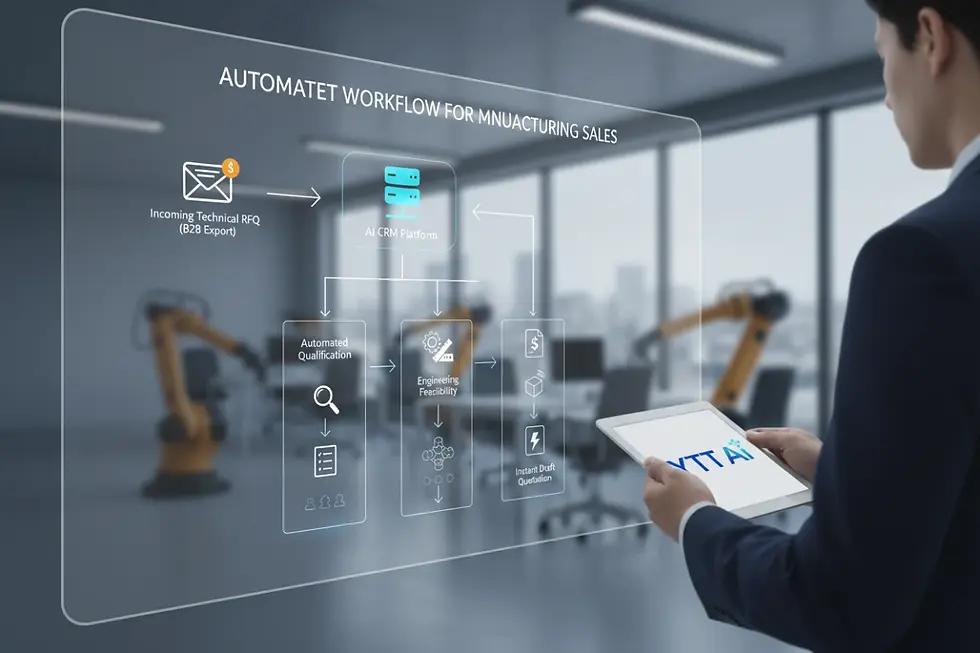
B2B sales automation must go beyond generic auto-responders. By implementing tailored sales automation for manufacturing, companies can compress their quotation timeline from weeks to minutes while maintaining extreme technical precision.
Step 1: Intelligent Lead Qualification & Feasibility Triage
When an overseas inquiry lands, the AI CRM reads the unstructured message to identify key requirements (e.g., specific materials, tolerances, and compliance standards). If key technical parameters are missing, the system automatically drafts a clarification request, saving days of back-and-forth.
Step 2: Instant Technical Proposal Drafting
Rather than starting a quote from scratch or waiting for engineering reviews, the salesperson is presented with an automated draft. This response synthesizes your technical capabilities, estimates pricing based on historical data of similar projects, and formats the output into a professional proposal.
Step 3: Contextual AI Sales Follow-Up Sequences
Most industrial orders are won through persistent, high-value nurturing. If an exporter receives a quote and goes cold, the platform initiates a targeted AI sales follow-up sequence. Instead of generic check-ins, the system generates contextual messages based on the buyer's unique timeline:
Follow-Up 1 (Day 3): Offers a technical drawing review or clarifies custom packaging options.
Follow-Up 2 (Day 7): Provides a production scheduling update, demonstrating how early commitment secures a faster delivery slot.
Follow-Up 3 (Day 14): Shares a localized case study of a similar engineering challenge solved for a buyer in their region.
Human-in-the-Loop: Balancing AI Efficiency with Human Trust
In high-value industrial sales—where order values regularly range from tens of thousands to millions of dollars—trust and absolute technical accuracy are paramount. Purely autonomous communication is too risky for custom manufacturing deals. Therefore, a modern AI CRM must utilize a "Human-in-the-Loop" (HITL) model.
In this framework, the AI operates as an intelligent co-pilot. It manages the heavy lifting of data capture, account research, and initial drafting, but it never communicates with the buyer directly. Every draft quotation, technical specification, and follow-up email is presented to a human sales representative first. The rep can quickly review, edit, and inject personal, relationship-building elements before hitting send. This setup guarantees error-free communication while maximizing speed.
AI CRM vs. Legacy CRM: A Direct Comparison for Industrial Exporters
Operational Dimension | Legacy B2B CRM | Modern AI CRM (YTTAI Sales Master) |
|---|---|---|
:--- | :--- | :--- |
Data Management | Manual data entry, leading to incomplete pipelines. | Automatic ingestion from email, WhatsApp, and files. |
Technical RFQ Handling | Manual engineering checks; delayed quotes. | Instant feasibility checks and automated drafts. |
Context Retention | Fragmented spreadsheets; lost when staff leaves. | Centralized Sales Memory of all buyer interactions. |
Follow-Up Nurturing | Relies on manual tasks; easily overlooked. | Proactive, multi-stage, highly personalized follow-ups. |
Multilingual Support | Basic machine translation; risk of technical errors. | Deep, industry-specific technical translation in real-time. |

A 90-Day Deployment Roadmap for Manufacturing AI Workflows
Integrating an AI CRM into your export operations does not require disrupting your existing systems. A structured 90-day phased approach ensures rapid onboarding and team adoption.
Phase 1 (Days 1–30) — Data Integration & Memory Setup: Connect active communication channels (emails, inquiry forms, messaging apps) to the CRM. Upload product catalogs, equipment capacities, tolerance limits, and past successful quotes to build your local Sales Memory database.
Phase 2 (Days 31–60) — Workflow Configuration & Training: Configure the AI agent to align with your key product lines. Set up the Human-in-the-Loop approval dashboard and establish multi-stage follow-up triggers for open opportunities.
Phase 3 (Days 61–90) — Analytics & Optimization: Track critical metrics like average RFQ response times and lead-to-quote conversion rates. Fine-tune the AI’s output based on actual user feedback.
Maximize Your Global Pipeline with YTT AI Sales Master
Deploying an AI CRM for manufacturing sales allows exporters to eliminate administrative overhead, accelerate quotation cycles, and capture deals that would otherwise be lost to poor follow-up. By pairing comprehensive Sales Memory with intelligent automation, your sales team can effortlessly handle complex, high-volume overseas inquiries without losing their personal touch.
At YTTAI, we specialize in helping global manufacturers and exporters build robust, high-converting pipelines. Our Sales Master platform acts as a 24/7 sales brain, integrating seamlessly into your daily operations to power your global expansion.
Ready to stop losing high-value B2B inquiries to slow responses and context loss? Request a Growth Diagnosis today to pinpoint your team's friction points and unlock your true export growth potential.
FAQ
What makes an AI CRM different from a standard B2B CRM?
A standard CRM acts as a passive database where sales reps must manually log data and move deals. An AI CRM is a proactive co-pilot that automatically ingests unstructured communication (emails, chats, CAD files), builds an active 'Sales Memory', analyzes buyer intent, and drafts technical responses and contextual follow-up sequences for human approval.
How does an AI CRM handle highly complex, custom manufacturing RFQs?
The system utilizes its Sales Memory stack, which is populated with your product catalogs, technical parameters (tolerances, materials), and previous transaction records. When a new RFQ is received, the AI extracts the requirements, assesses feasibility based on your uploaded parameters, and drafts an initial technical response or quote template for your engineering and sales teams to verify.
Will the AI CRM communicate with my B2B buyers directly?
No. In high-value B2B manufacturing and export sales, maintaining trust and technical precision is critical. We utilize a 'Human-in-the-Loop' model. The AI CRM does the heavy lifting of researching, compiling context, and drafting the follow-up, but your human sales representatives always review, adjust, and approve the message before it is sent to the client.
How long does it take to deploy an AI CRM workflow for exporters?
A standard, phased rollout takes approximately 90 days. Phase 1 (Days 1-30) focuses on connecting communication channels and building your technical database. Phase 2 (Days 31-60) configures agentic workflows and launches automated follow-up drafts. Phase 3 (Days 61-90) optimizes conversion rates and refines the AI's accuracy.


Comments