

How B2B Manufacturers Can Use AI to Qualify RFQs Without Losing Human Control

B2B manufacturers can scale their RFQ-to-quotation pipeline by deploying an AI sales agent for manufacturers to automate inquiry data extraction, conduct instant buyer background research, and score incoming leads. By integrating intelligent RFQ automation software, companies pre-qualify technical inquiries while leaving high-stakes decisions like final pricing, custom technical configurations, and contract sign-off securely under human supervision.
Why is the traditional RFQ-to-quotation process failing B2B manufacturers?
Traditional B2B manufacturing pipelines struggle with raw volume, slow response times, and incomplete technical data. According to industry feedback, a significant percentage of incoming RFQs lack essential technical specifications, requiring hours of manual back-and-forth communication.
Sales engineers waste valuable time manual-triage sorting low-intent tire-kickers from high-value enterprise accounts. This friction directly impacts the manufacturer's bottom line.
Operational Pain Point | Traditional Process | AI-Assisted Process (YTTAI Sales Master) |
|---|---|---|
:--- | :--- | :--- |
Initial Response Time | 24 to 72 hours (leads turn cold) | Under 15 minutes for research & initial draft |
Data Completeness | Manual back-and-forth emails | Auto-triage, extracting technical specs & gaps |
Lead Prioritization | First-come, first-served or gut feeling | Data-driven grading based on Fit, Intent, & Urgency |
Staff Allocation | Highly paid engineers sorting spam | Engineers focused purely on custom technical approvals |

How does an AI sales agent for manufacturers extract and qualify technical inquiries?
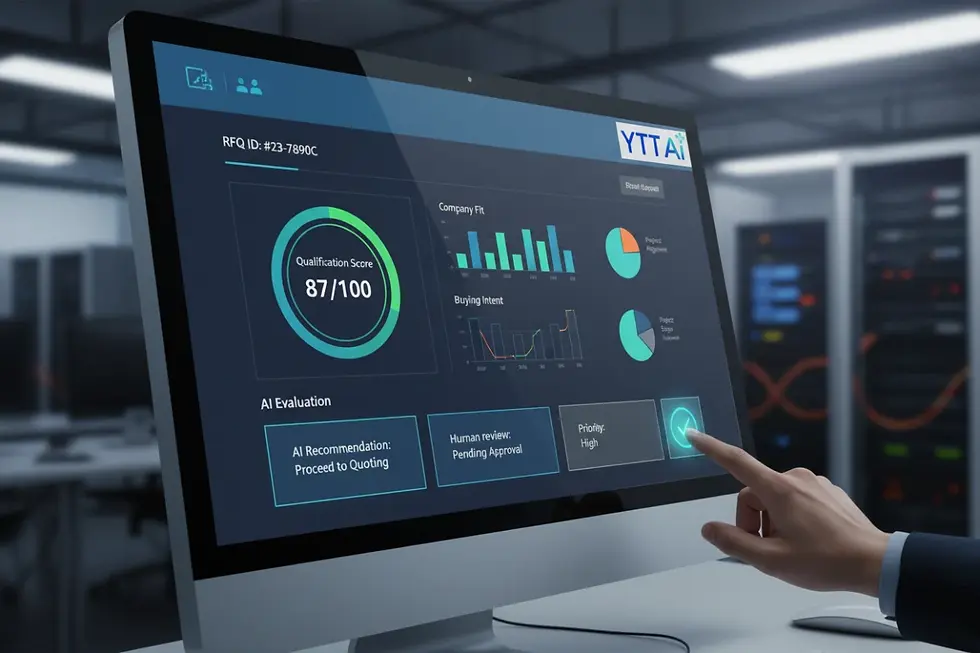
An AI sales agent for manufacturers serves as a 24/7 digital gatekeeper for inbound channels (including email, contact forms, and WhatsApp). The qualification workflow operates through three core layers:
Multilingual Parsing: The AI extracts critical procurement parameters—such as material specifications, quantity requirements, delivery terms, and drawings—from incoming text and attachments, regardless of language.
Instant Background Enrichment: The AI instantly cross-references the sender's business domain against commercial databases, LinkedIn, and public registries to pull corporate profiles, estimated revenues, and historical transaction contexts.
Intent Detection: By evaluating context clues (such as specific project timelines, CAD file attachments, and precise part numbers), the AI separates genuine buyers from competitors seeking price intelligence.
This immediate automated enrichment enables precise AI lead qualification for B2B, ensuring that your sales team addresses high-intent accounts first.
How can manufacturers maintain human-in-the-loop (HITL) control over pricing and technical approvals?
Automation does not mean letting an AI run wild with your pricing strategies. To protect margins and technical accuracy, B2B manufacturers must enforce a strict Human-in-the-Loop (HITL) architecture.
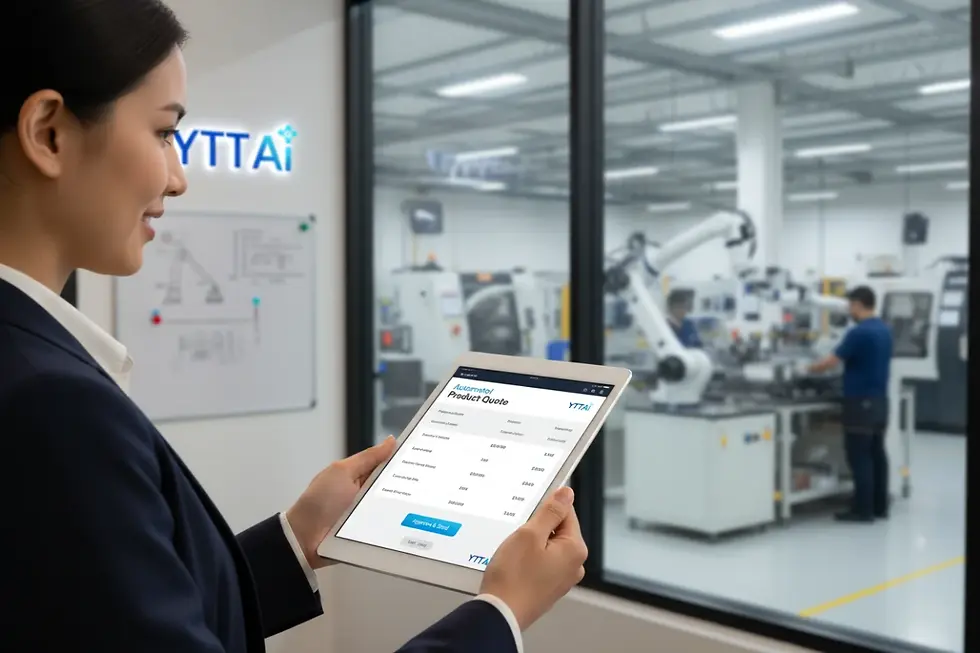
Within this framework, the AI functions as a high-speed assistant, not the final decision-maker. For example, when integrating with configure price quote software, the workflow remains highly structured:
AI Role (Preparation): The AI scans inventory, historical quote histories, and cost frameworks to draft the initial pricing proposal and technical response template.
Human Role (Authorization): The human sales manager receives a structured notification containing the AI's draft, the source buyer data, and a validation checklist.
Final Action: The manager reviews, adjusts the parameters, and clicks "Send" within the CRM. No pricing ever leaves the company without human authorization.
This hybrid model guarantees that the enterprise maintains absolute control over complex quotes while slash quoting latency by up to 80%.
What is the step-by-step workflow for implementing AI-driven RFQ management?
Implementing AI into your sales process is the ultimate driver for B2B conversion optimization. Here is how to roll out a secure, high-impact workflow:
Step 1: Centralize Inbound Inquiries
Connect all communication endpoints—including global email inboxes, website inquiry portals, and messaging apps—to your centralized AI-driven CRM or ERP pipeline.
Step 2: Establish the Qualification Rule Book
Define your ideal customer profile (ICP) parameters. Instruct the AI on what constitutes a "High Fit" lead (e.g., target industry, location, buying volume) versus a "Low Fit" lead, enabling automatic categorization and routing.
Step 3: Integrate Your Product Knowledge Base
Feed the AI with past successful quotations, product catalogs, FAQs, and engineering guidelines. This contextual training allows the AI to recognize technical terms and recognize missing technical parameters in the buyer's RFQ.
Step 4: Configure the Human Review Interface
Build an approval dashboard within your CRM. Here, drafted quotes and customer dossiers are compiled for human review before final dispatch. This guarantees a seamless transition from automated analysis to human relationship building.
Are you ready to streamline your incoming RFQ pipeline, eliminate repetitive administrative work, and ensure your engineers focus only on high-value quotes? Apply for an RFQ and Inquiry Conversion Audit to learn how YTTAI Sales Master supports client identification, data organization, quotation tasks, and follow-up.
FAQ
Can AI handle highly customized engineering drawings or non-standard technical specifications?
Yes. While the AI may not perform complex mechanical simulations, it can parse CAD filenames, extract geometric metadata, and detect if critical technical specs are missing. It then prompts the buyer to supply the missing files before escalating the RFQ to your engineering team.
How does RFQ automation software prevent AI hallucinations in price calculations?
By decoupling the AI from direct mathematical calculations. The AI extracts the unstructured data (e.g., '10,000 units of custom steel shafts') and inputs those clean parameters into a structured configure price quote software engine. This engine calculates prices based on your exact business rules, ensuring math is handled by reliable algorithms, not generative models.
What is the average ROI of deploying an AI agent for manufacturing sales?
Most manufacturers see an immediate 60% to 80% reduction in response times. By getting back to high-quality buyers first, companies see a 15% to 25% lift in conversion rates while freeing up expensive sales engineers from doing basic manual data entry.


Comments