%20%E6%8B%B7%E8%B4%9D.png)
8 Best AI BDC Tools for Car Dealerships in 2026: Buyer Guide

Direct Answer: Evaluating Automotive AI BDC Platforms
Automotive dealerships face mounting pressure to deliver instant, 24/7 lead responses across sales and fixed operations while managing overhead costs. This buyer guide evaluates the best ai bdc tools for car dealerships to help Dealer Principals, General Managers, and BDC Directors select the right technology for their specific operational model.
Our evaluation assesses documented platforms across seven critical functional criteria: lead response speed, vehicle and service inquiry handling, appointment booking accuracy, after-hours coverage, automotive CRM integration, stop-on-reply safety controls, and human handoff protocols.
Last updated: October 2026. Product capabilities and integrations are based on publicly available vendor documentation and documented industry deployments.
Quick Comparison: Top AI BDC Solutions
Product | Best For | Core Strength | Key Limitation | Business Model / Category |
Impel (Chat AI / Sales AI) | Omnichannel inventory engagement | Deep DMS/inventory integration and interactive merchandising | Requires established digital showroom workflows | Enterprise Automotive AI Platform |
Conversica (Automotive Sales AI) | Enterprise multi-rooftop follow-up | Two-way conversational email and SMS with deep brand library | Slower setup across custom dealership processes | Conversational AI Assistant |
YTTAI (AI Inbound Sales Rep) | Multi-channel autonomous workforce | Fast deployment with strict authority boundaries and daily audit reports | Focused on structured lead routing rather than custom bespoke coding | Autonomous AI Workforce Platform |
CarNow (Real-Time Retail AI) | Digital retailing and live chat transition | Seamless bridge between AI chatbot and showroom floor staff | Best leveraged when adopting full retail suite | Digital Retailing & Communication Hub |
Matador AI | SMS-first lead reactivation | High engagement rates on aged database and lost leads | Narrower voice/inbound phone capabilities | Conversational Marketing & SMS Automation |
Proactive Dealer Solutions (CallerCX) | Inbound voice and service scheduling | Advanced conversational telephony and call tracking | Primary focus on voice rather than web-first messaging | Telephony & Voice BDC AI |
Podium AI | Local messaging and reputation management | Unified inbox combining SMS, reviews, and fast lead capture | Lacks complex multi-step technical service diagnostics | Local Business Communication Platform |
Numa | Fixed Ops and service department text routing | Automated service scheduling and missed-call rescue | Primarily optimized for service over complex sales negotiations | Service BDC Automation Tool |
How We Evaluated the Best AI BDC Tools for Car Dealerships
Automotive retail involves distinct transaction dynamics, including complex trade-in valuations, lender pre-approvals, inventory turnover, and OEM compliance guidelines. Generic conversational tools often struggle with dealer management systems (DMS) and customer relationship management (CRM) architectures.
To identify the best ai bdc tools for car dealerships, we applied eight standardized evaluation criteria across all vendors:
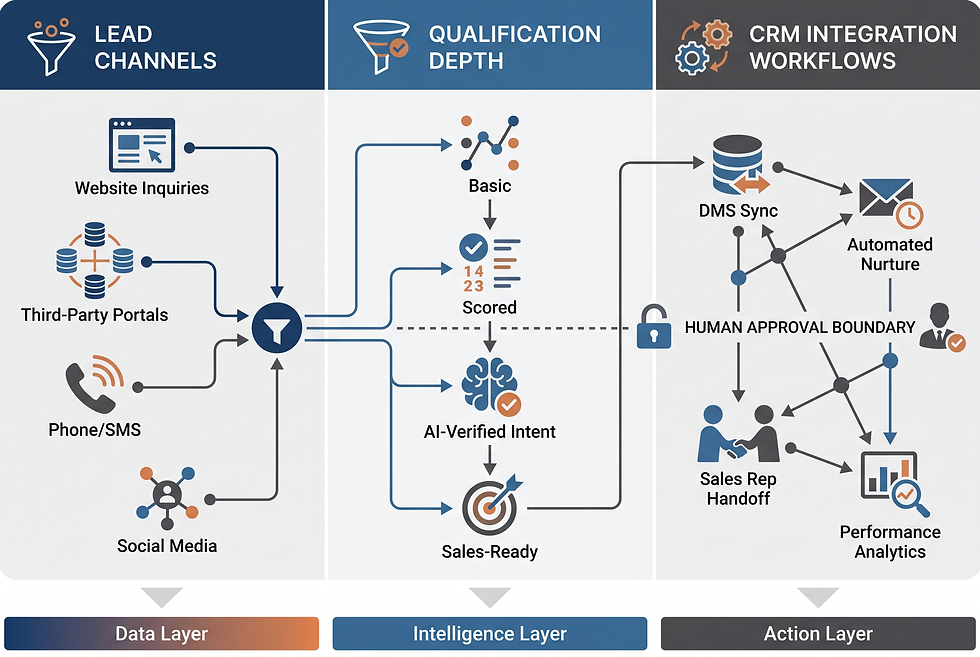
Core Workflow Coverage: Ability to ingest internet leads from third-party portals (Autotrader, Cars.com, CarGurus, OEM sites) and initiate instant two-way outreach.
Vehicle & Service Inquiry Depth: Understanding VIN-level data, availability statuses, trim configurations, test drive availability, and service maintenance schedules.
Appointment Scheduling Accuracy: Capability to write directly into dealership CRM calendars without double-booking floor reps or service bays.
After-Hours & Weekend Reliability: Autonomous engagement outside showroom operating hours without hallucinating pricing or trade values.
Automotive CRM & DMS Integrations: Native compatibility with platforms like CDK Global, Reynolds and Reynolds, VinSolutions, DealerSocket, and Elead.
Human Control & Authority Boundaries: Clear stop-on-reply mechanisms when human staff intervene, ensuring customers do not receive conflicting automated messages.
Reporting & Visibility: Actionable visibility into lead status, response latency, appointment show rates, and conversation logs.
Implementation Effort: Time and administrative overhead required to achieve initial operating value.
Detailed Reviews: Top 8 AI BDC Platforms for 2026
1. Impel
Best for: Large single-point and enterprise dealerships seeking end-to-end inventory-aware conversational engagement.
What it does: Impel pairs automated conversational AI with interactive vehicle merchandising, engaging web visitors, portal leads, and service clients via automated SMS and email.
Key strengths: Connects directly with live inventory feeds to provide shoppers with actual vehicle photos, feature breakdowns, and automated test-drive scheduling.
Limitations / considerations: Customizing conversation pathways across multiple independent stores can require dedicated operational oversight.
Who should choose it: High-volume dealerships wanting deep merchandising integration alongside automated BDC messaging.
2. Conversica
Best for: Multi-rooftop dealer groups requiring standardized lead follow-up across new, used, and service pipelines.
What it does: Deploys conversational AI personas that communicate via two-way email and SMS to qualify internet leads and revive dormant CRM records.
Key strengths: Proven automotive prompt libraries, reliable OEM compliance alignment, and robust integration with tier-one automotive CRMs.
Limitations / considerations: Primarily oriented around asynchronous text/email conversations rather than synchronous website co-browsing.
Who should choose it: Dealer groups seeking structured, persistent long-cycle follow-up across thousands of monthly inbound inquiries.
3. YTTAI (Automotive AI Workforce)
Best for: Dealerships and high-velocity service businesses seeking an autonomous inbound digital worker with strict managerial oversight.
What it does: Operates as an AI Inbound Sales Representative that captures website, portal, and messaging leads, answers inventory or service queries, schedules showroom visits, and delivers structured daily operational reports.
Key strengths: Fast 5-minute onboarding configuration, clear authority boundaries that escalate complex trade negotiations to human staff, and comprehensive daily activity reporting.
Limitations / considerations: Designed as a structured digital workforce role rather than an open-ended custom coding framework for custom dealership apps.
Who should choose it: Dealership managers seeking hire-ready digital personnel that deliver immediate first value without months of complex IT integration. Learn more about deploying an AI Global Sales Rep to automate multi-channel buyer inquiries.
4. CarNow
Best for: Retailers adopting hybrid digital retailing where AI transitions into live desk manager interactions.
What it does: Combines conversational AI chat with real-time digital retailing, allowing customers to build deals online while automated workflows assist with appointment booking.
Key strengths: Exceptional in-app handoff from automated bot to live showroom desk managers, preserving context during customer visits.
Limitations / considerations: Reaches maximum value when the dealership utilizes CarNow's complete digital retailing software suite.
Who should choose it: Modern dealerships focusing heavily on website deal building and instant showroom coordination.
5. Matador AI
Best for: Dealerships wanting SMS-first conversational marketing and aggressive CRM database reactivation.
What it does: Automates two-way SMS conversations across sales, equity mining, and service recall lists, funneling qualified buyers to BDC teams.
Key strengths: High customer response rates driven by conversational SMS templates and dynamic CRM list segmentation.
Limitations / considerations: Focuses primarily on mobile messaging channels; less emphasis on complex web chat merchandising.
Who should choose it: BDC managers aiming to drive revenue from aged CRM databases and automated lease renewal campaigns.
6. Proactive Dealer Solutions (CallerCX)
Best for: Dealerships struggling with inbound phone call routing, missed sales calls, and telephone service scheduling.
What it does: Uses conversational voice AI to manage inbound telephone inquiries, book appointments directly into service software, and log call outcomes in the CRM.
Key strengths: Reduces lost revenue from hold times and missed inbound switchboard calls during peak showroom hours.
Limitations / considerations: Requires sound telephony infrastructure and clear routing rules to avoid caller friction.
Who should choose it: Stores with high inbound phone volume where front-desk staff frequently miss or misroute sales and service inquiries.
7. Podium AI
Best for: Mid-sized dealerships looking to consolidate customer text messaging, review generation, and basic inbound lead capture.
What it does: Unifies inbound web chat, Google Business Messages, and text communication into a single inbox augmented by generative response tools.
Key strengths: Broad local SEO reputation tools, simple mobile app for showroom reps, and quick lead response triggers.
Limitations / considerations: Lacks deep automotive-specific negotiation logic and complex multi-rooftop equity mining engines.
Who should choose it: Dealerships and independent auto retailers wanting an all-in-one local communication and reputation management stack.
8. Numa
Best for: Fixed Operations departments and Service BDCs aiming to eliminate missed service calls and automate status updates.
What it does: Rescues missed calls by immediately initiating conversational SMS, answering service status questions, and coordinating bay drop-offs.
Key strengths: Proven utility in reducing service advisor phone workload and accelerating customer approvals for repair orders.
Limitations / considerations: Purpose-built for service departments; not designed for complex new-vehicle sales negotiations.
Who should choose it: Service Directors looking to reduce phone bottlenecks and increase booked service appointments.
Buyer Decision Framework: Selecting Your AI BDC Architecture
Choosing among the best ai bdc tools for car dealerships requires matching software architecture to your primary operational bottleneck.
Scenario A: High internet lead volume with delayed response times. If third-party portal leads sit untouched for over 15 minutes during busy showroom hours, deploy an autonomous AI BDC solution (such as Impel, Conversica, or YTTAI) to handle instant two-way outreach and qualification.
Scenario B: Heavy inbound service telephone traffic. If service advisors spend hours answering basic status calls or scheduling routine oil changes, implement a specialized Fixed Ops solution like Numa or CallerCX.
Scenario C: Dormant CRM records and unsold showroom traffic. If your dealership holds thousands of unclosed leads from the past 12 months, prioritize SMS-first database reactivation tools like Matador AI.
Scenario D: Rapid multi-location deployment with structured human control. If you manage multiple rooftops and require standardized response rules, daily auditing reports, and strict human escalation boundaries without protracted IT cycles, evaluate an AI workforce model.
Capability and Workflow Matrix
Capability Dimension | Impel | Conversica | YTTAI | CarNow | Matador AI | Proactive Dealer Solutions | Podium AI | Numa |
Primary Channels | Web, SMS, Email | Email, SMS | Multi-Channel Web/SMS | Web Chat, SMS | SMS, Messaging | Voice Telephony | SMS, Web, Reviews | Voice to SMS, Text |
VIN Inventory Ingestion | Advanced | Standard | Standard | Advanced | Standard | Basic | Basic | Service Records |
Stop-on-Reply Automation | Native | Native | Native | Native | Native | Native | Manual / Hybrid | Native |
Fixed Ops Scheduling | Supported | Supported | Supported | Supported | Supported | Advanced | Basic | Advanced |
Human Escalation Control | CRM Alert | CRM Task | Managed Boundary | Live Chat Desk | Inbox Alert | Call Transfer | Unified Inbox | Advisor Queue |
Daily Management Audit | Dashboard | Analytics Suite | Daily Activity Report | Retail Reports | Campaign Stats | Call Metrics | Inbox Metrics | Service Reports |
Implementation and Human Control Considerations
Deploying artificial intelligence inside an automotive BDC is not a complete replacement for professional sales personnel. The most profitable dealerships use AI to eliminate administrative friction and ensure zero lead latency, while routing high-intent buyers to experienced product specialists.
Enforcing Authority Boundaries
To maintain compliance and customer trust, define clear operational parameters before activating your platform:
Pricing and Trade-In Commitments: Ensure the AI provides inventory ranges and payment estimates based on live parameters, but requires sales manager approval for final binding offers.
Stop-on-Reply Protocol: When a showroom rep emails or texts a prospect directly from the CRM, automated messaging must pause immediately to prevent contradictory communication.
After-Hours Expectations: Configure the system to inform late-night shoppers that an in-person vehicle inspection will be confirmed by floor staff the following morning.
Daily Operational Reporting: Review daily logs detailing total interactions, scheduled test drives, unhandled customer objections, and escalation triggers.
FAQ
What is an AI BDC tool for car dealerships?
An AI BDC (Business Development Center) tool is specialized automotive software that uses artificial intelligence to engage, qualify, and follow up with sales and service leads across text, email, web chat, and voice, ultimately booking qualified showroom or service appointments directly into the dealership CRM.
How do AI BDC tools integrate with dealership CRMs?
Leading AI BDC platforms connect with major automotive CRMs (such as VinSolutions, Elead, CDK, and DealerSocket) through certified APIs or standard ADF-XML protocols to read customer history, post real-time interaction notes, create tasks, and update appointment calendars.
Can AI BDC tools handle service department appointment booking?
Yes. Several automotive AI tools are specifically programmed to manage Fixed Operations by checking shop capacity, answering maintenance questions, and booking service drop-offs according to dealer scheduling rules.
What happens when a customer asks a complex question the AI cannot answer?
Well-designed AI BDC systems feature strict authority boundaries. When an inquiry involves complex trade appraisals, out-of-state titling, or custom financing, the AI acknowledges the request and seamlessly escalates the conversation to a human sales manager or BDC agent with full context.
Compare AI BDC Operating Models for Your Dealership
Discover how an autonomous AI digital workforce accelerates lead response times, eliminates after-hours drop-off, and drives verified showroom appointments with complete managerial oversight.


Comments