
What Buying Signals Show a Manufacturer Is Ready to Invest in Robotics?

Executive Summary: Capital equipment sales rarely start with an inbound form. Industrial machinery and automation providers are shifting from speculative cold calls to operational signal tracking. By monitoring plant triggers such as line retooling, persistent labor shortages, ergonomic injury logs, and controls engineer recruitment, commercial teams identify when factories prepare to modernize. This signal-driven model allows suppliers to begin technical conversations before public tenders appear, protecting profit margins and shortening sales cycles.
Company Snapshot: Navigating Capital Machinery Sales
In the industrial machinery and automation sector, commercial success depends on identifying capital expenditure readiness before competitors enter formal procurement. Industrial robotics original equipment manufacturers (OEMs), turnkey systems integrators, and precision machinery builders operate in high-value, long-cycle environments where single robotic cell deployments average $150,000 to over $1,500,000.
These suppliers sell directly to automotive tier-1 suppliers, consumer packaged goods (CPG) packaging plants, electronics contract manufacturers, metal fabrication facilities, and regional warehousing hubs. Unlike software subscriptions with low switching costs, procuring articulated robotic arms, autonomous mobile robots (AMRs), or automated palletizing cells requires board-level capital budgeting, plant engineering validation, footprint recalculation, and cross-functional safety compliance.
Historically, equipment sales teams relied on static trade show leads, outdated directory lists, and generic geographic door-to-door visits. However, data from global industrial studies indicates that manufacturers evaluate production changes internally for 6 to 14 months before issuing an official request for quotation (RFQ). By the time an industrial plant posts an open public tender, technical specifications are often already written around a competitor’s proprietary architecture. Suppliers seeking sustainable pipeline growth must systematically uncover whether a factory has operational intent to invest in robotics.
What Industrial Automation Suppliers Sell and How Plants Buy
To map accurate buying signals, sales leaders must understand the operational lifecycle of robotics procurement. Industrial robotics suppliers do not merely sell mechanical hardware; they deliver engineered risk reduction and throughput certainty.
Industrial customers purchase automation across three distinct categories:
Standard Robotic Workcells: Pre-engineered cells for standardized applications such as CNC machine tending, repetitive spot welding, laser cutting loading, or case palletizing.
Custom Turnkey Automation Lines: Bespoke assembly systems integrating vision inspection, multi-axis articulate arms, part feeding, and custom programmable logic controllers (PLCs).
Intralogistics and Material Transport: Autonomous mobile robots (AMRs) and automated guided vehicles (AGVs) designed to replace manual forklift transport across brownfield warehouses.
Manufacturing plants do not procure automation for novelty. They purchase when production pain outstrips the capital expense, downtime risk, and organizational friction of introducing robotic cells. Commercial engineering leaders must recognize that buying intent is rooted in specific physical bottlenecks across the production floor.
The Business Problem: The Inbound Timing Trap
Industrial equipment sales representatives face significant pipeline friction. The primary challenge is not machine reliability; it is poor timing and invisible customer readiness.
First, industrial buyers exhibit long silence periods. A factory manager experiencing secondary packaging bottlenecks may spend nine months evaluating ergonomic injury logs and temporary labor overtime before speaking to an external vendor. If sales teams wait for a website form fill, they enter the sales cycle at the price-comparison phase rather than the solution-design phase.
Second, indiscriminate outbound outreach fails in B2B manufacturing. Plant managers and operations directors receive dozens of generic sales emails weekly. Cold messaging offering general automation rarely resonates with a plant director focused on immediate shift scheduling, component scrap rates, and upcoming audits.
Third, mismatched engineering capacity wastes valuable technical resources. Application engineers spend days preparing complex cycle-time simulations and layouts for prospects who lack the floor space, electrical infrastructure, or capital authorization to proceed. Without concrete operational buying signals, robotics companies waste sales capacity on unqualified inquiries while missing active factory expansions in their key territories.
What Changed: Transitioning to Operational Signal Detection
High-performing automation enterprises have redesigned their commercial discovery processes. Instead of tracking generic digital interactions, they monitor physical, organizational, and regulatory operational signals.
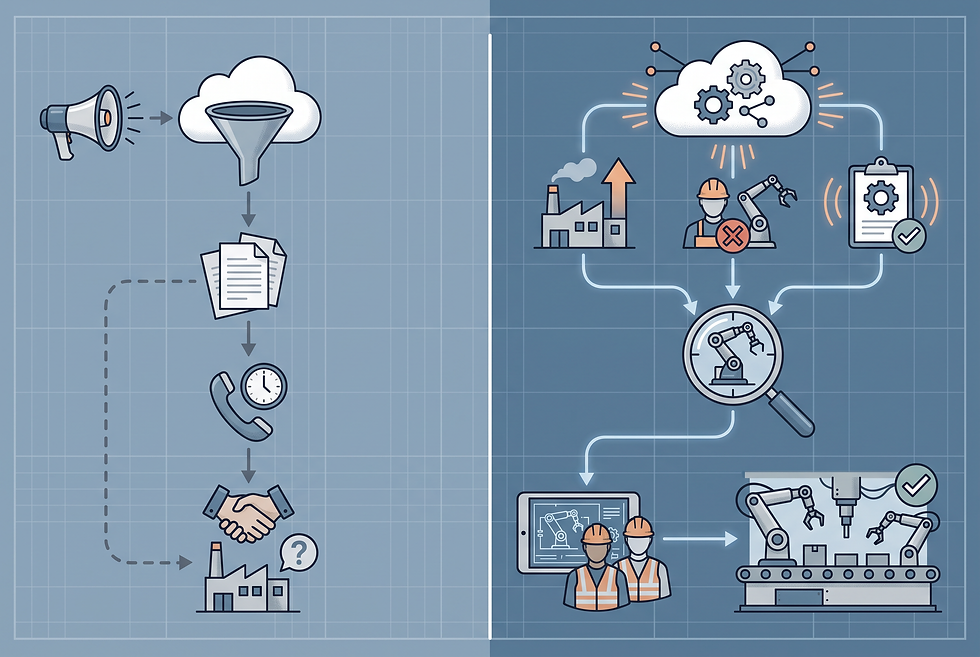
When a factory prepares to modernize production, operational ripples appear across public, technical, and supply chain channels long before capital allocations are formalized. Tracking these signals allows automation business development teams to tailor discussions around specific engineering challenges, positioning the vendor as a solution partner rather than a transactional hardware vendor.
Commercial teams categorize these critical operational buying signals into eight primary triggers:
New Product Line Announcements & Retooling: When a manufacturer wins a major OEM contract or announces a new vehicle, medical device, or packaged SKU variant, their existing dedicated tooling becomes obsolete. Flexible robotic cells provide the modularity needed to handle multi-SKU changeovers without long manual retooling.
Chronic Labor Deficits and Shift Shortages: Manufacturing facilities operating two shifts that cannot hire for a third shift face immediate throughput caps. Persistent postings for manual machine operators, deburring technicians, or manual packers indicate severe labor constraints that robotics directly solve.
OSHA Citations and Ergonomic Incidents: Public safety incident logs, ergonomics claims, and high workers' compensation premiums around manual heavy lifting create urgent compliance mandates to automate hazardous workstations.
Facility Expansion and Plant Relocations: Construction permits, industrial real estate zoning filings, and groundbreakings for plant expansions provide an ideal window for automation, as designing robotic layouts for greenfield floors is significantly cheaper than retrofitting brownfield lines.
Rapid SKU Proliferation: Expanding from 10 SKUs to 100 SKUs introduces severe packaging and sorting bottlenecks. Fixed automation jams under dynamic variation, making vision-guided collaborative or articulate robots essential.
End-of-Line Packaging Bottlenecks: Upstream CNC machines or automated injection molders operating at 95% capacity while finished goods pile up at manual packing stations indicate an acute need for robotic palletizers.
Automation and Controls Talent Hiring: When a company recruits PLC programmers, controls engineers, or automation project managers without having active equipment orders, they are building internal capacity to manage incoming robotic integration.
Quality Scrap Surges and Strict Customer Traceability: Demands from retail or automotive clients for 100% vision verification, sub-millimeter placement tolerances, or cleanroom compliance force plants to eliminate human assembly variability.
How the Signal-Based Sales Workflow Actually Works
The most effective industrial equipment sales workflows turn raw public and private operational data into timely engineering conversations through a structured, multi-step mechanism.
Step 1: Multi-Source Operational Data Ingestion
The commercial intelligence engine monitors public and semi-public data feeds across target territories. Inputs include local economic development board announcements, industrial construction permits, corporate CapEx quarterly reports, plant-level safety records, and technical job board postings (e.g., searches for "Fanuc programmer" or "Allen-Bradley PLC technician").
Step 2: Signal Synthesis and Plant Profiling
The system cross-references the ingested signal against ideal operational profiles. For example, if a tier-2 stamping facility posts five job openings for manual press loaders while simultaneously securing a multi-year automotive supply contract, the system registers a combined "Capacity Surge + Operator Deficit" trigger.
Step 3: Machine Compatibility Pre-Qualification
Before sales engagement, the workflow verifies basic engineering fit. It cross-checks facility floor area, industry classification, estimated power availability, and typical batch sizes against the supplier’s specific robotic reach, payload capacities, and integration requirements.
Step 4: Human Technical Validation
The commercial lead or application sales engineer reviews the generated account brief. The trigger report highlights the exact reason the account was flagged: "Midwest Plastics Plant #2 added 40,000 sq ft warehouse expansion and posted 6 job listings for end-of-line material handlers over the past 45 days."
Step 5: High-Relevance Application-Led Engagement
Outreach avoids generic sales collateral. Instead, the regional sales manager contacts the Director of Operations or Plant Manager with a targeted engineering asset—such as a cycle-time calculation model for high-mix palletizing or an ergonomics compliance layout study.
Step 6: Customer Site Assessment and Feasibility Audit
The qualified customer, recognizing that the supplier understands their current operational bottleneck, agrees to a plant walkthrough or shares 3D CAD step files of their current work area for simulation.
Step 7: Feedback Loop and Signal Calibration
Win/loss data and field discovery findings are fed back into the signal detection model. If certain job titles or permit types yield low conversion rates in specific sectors, the qualification scoring rules are refined automatically.
Operational Framework: Traditional Sales vs. Signal-Based Robotics Prospecting
Process Dimension | Traditional Outbound Prospecting | Reactive Inbound / Tender Bidding | Signal-Based Operational Selling |
Trigger Point | Arbitrary territory calendar or trade show list | Public RFP or formal quotation request | Verified operational disruption (hiring, expansion, safety citation) |
Engagement Timing | Random intervals; misaligned with CapEx budgets | Late; specs already set by competing vendors | Early; during internal problem definition and budgeting |
Initial Message | Generic product pitch and line card brochures | Price bid and compliance matrix submission | Application-specific bottleneck analysis and cycle-time benchmarks |
Primary Contact | General Purchasing Agent or Info inbox | Procurement Officer / Sourcing Manager | Plant Manager, VP of Operations, or Lead Automation Engineer |
Sales Cycle | 9 to 18 months with low close rates | 4 to 8 months with intense margin pressure | 4 to 7 months with sole-source integration positioning |
Win Rate Profile | Low (<10%) due to lack of operational urgency | Moderate (15–25%) in multi-vendor bidding wars | High (35–50%) due to early technical consultation |

Evidence and Results: Benchmarking Signal-Driven Qualification
Manufacturers and automation suppliers shifting to trigger-based qualification demonstrate measurable commercial efficiency improvements across verifiable operational metrics.
According to published industrial sales effectiveness benchmarks from the Association for Advancing Automation (A3) and independent industrial marketing research:
Pre-RFP Engagement: Early engagement during the problem-definition phase yields significant margin retention. In industrial machinery deployments, suppliers involved before final specification release achieve up to 40% higher gross margins compared to commoditized public tender bids.
Shorter Sales Cycles: Vendor deployment studies in capital machinery show that identifying accounts with active operational triggers—such as recent facility expansion or active PLC programmer recruitment—reduces the initial discovery-to-proposal timeline by an average of 30 to 45 days.
Application Engineering Efficiency: Equipment suppliers applying rigorous operational pre-qualification report a 50% decrease in discarded 3D layout simulations, freeing senior automation engineers to focus on active, fully financed projects.
These performance differences stem from entering the conversation when the client's internal cost of inaction is at its peak.
What Other Companies Can Learn: Core Principles of Operational Prospecting
Adopting an intent-driven sales model requires equipment executives to reconsider how they position engineering knowledge and commercial timing. Four fundamental principles guide this transformation:
Treat Customer Production Bottlenecks as Primary Pipeline Triggers: Static company size and revenue metrics are insufficient indicators of capital purchasing readiness. A $30M manufacturer facing severe labor turnover is far more likely to buy a robotic cell than a $200M enterprise with established, fully automated lines.
Align Outbound Messaging with Plant Economics: Discard generic feature sheets. Industrial leaders respond to metrics: cycle-time improvements, scrap-rate reduction, changeover speed, labor redeployment, and payback period under two years.
Engage Cross-Functional Plant Stakeholders Early: Robotics purchases involve multiple stakeholders. While the VP of Finance approves capital outlay, the Plant Safety Director, Controls Engineering Manager, and Maintenance Supervisor influence the final equipment selection.
Build Systematic Data Surveillance over Account Territories: Relying on sales reps to manually browse news for territory developments creates pipeline blind spots. Automated monitoring ensures timely operational intelligence across thousands of regional plants.
Identifying When Plants Are Ready to Invest in Robotics
Consider an industrial automation integrator specializing in robotic machine tending and automated palletizing cells across regional manufacturing clusters.
Under a traditional workflow, the commercial team purchases a database of 2,500 regional metal fabrication and food packaging plants. Representatives make cold phone calls and send generic emails asking if the company requires automation. Response rates remain below 1.5%, and the few interested leads often lack floor space or capital approvals.
When applying a signal-driven operational model, the company configures an automated discovery workflow targeting specific operational events:
Trigger Identified: A commercial bakery facility in the territory files a permit for a 25,000 sq ft cold-storage addition and posts listings for eight manual packaging associates and a Controls Specialist.
Automated Profiling: The workflow identifies the facility as a tier-1 regional supplier operating multi-shift packaging lines with high ergonomic turnover risks.
Engineering Outreach: The commercial system provides the sales team with a targeted briefing. The rep sends a direct, tailored inquiry to the Plant Operations Director sharing a case study on automated washdown-ready palletizing in confined footprint spaces.
Commercial Outcome: The plant director, currently planning line layouts for the addition, invites the integrator for a site feasibility audit before issuing an open RFP.
YTT AI Worker Mapping: AI Global Sales Rep
To institutionalize this intent-monitoring and early qualification framework without overburdening technical engineering staff, industrial machinery enterprises can deploy a dedicated digital role: the AI Global Sales Rep.
Role Specification: AI Global Sales Rep
Industry: Industrial Automation & Robotics
Job-to-be-Done: Continuous operational intent signal tracking, territory account intelligence synthesis, and highly contextual technical pre-qualification.
Primary Work Channels: Corporate CRM, B2B email workflows, technical professional networks, and structured industrial intelligence databases.
Authority Boundary: The AI Global Sales Rep autonomously tracks public intent data, monitors account triggers, scores plant fit, drafts tailored outreach, and flags high-priority operational opportunities. The system cannot issue final commercial price quotes, sign distributor agreements, or finalize engineering layouts without explicit sign-off from the Human Sales Director or Lead Application Engineer.
First Value Event: Successful automated identification of a regional factory expansion or labor shortage signal, mapped to a verified decision-maker, resulting in a scheduled site feasibility walkthrough within the first 30 days of deployment.
Daily Report Deliverable: Every morning at 07:30, the commercial director receives a prioritized Territory Operational Brief listing newly flagged production triggers, updated qualification scores for active pipeline accounts, suggested outreach angles, and notifications of engaged buyers requesting engineering discovery meetings.
FAQ
What is the most reliable operational signal that a plant is ready to invest in robotics?
The most reliable operational signal is persistent hiring challenges for repetitive, heavy-labor roles combined with facility capacity expansion or new product line tooling. When a factory faces production bottlenecks while struggling with operator turnover, the return on investment for automation becomes an immediate board priority.
Why is traditional cold calling ineffective for industrial automation equipment?
Traditional cold calling is ineffective because capital equipment purchases depend on precise operational timing and plant infrastructure readiness. Plant managers ignore generic pitches unless they are actively experiencing acute throughput limits, safety citations, or new contract retooling requirements.
How early should robotics suppliers engage prospective manufacturing clients?
Suppliers should engage prospects during the internal problem-definition and budgeting phase, typically 6 to 12 months before an official RFP is drafted. Engaging early allows automation vendors to assist with site feasibility assessments and cell specifications, significantly increasing win rates and margin retention.
What role does internal controls and automation hiring play as a buying signal?
When a manufacturing plant recruits controls engineers, PLC programmers, or maintenance automation technicians, it indicates that management is building internal engineering capabilities to commission, operate, and maintain incoming robotic equipment.
Build a Signal-Based Robotics Sales Workflow
Transform your industrial equipment pipeline from reactive bidding into proactive, trigger-driven commercial engagement. Explore our guided growth framework to detect factory operational signals and scale your engineering sales outreach at https://www.ytt-ai.com/


Comments