

Digital CEO AI: Elevating B2B Sales Decision Intelligence for Global Exporters

In the highly competitive landscape of global B2B trade, executive leaders often find themselves flying blind. While marketing teams monitor web traffic, sales representatives manage complex client communications, and operations teams schedule production, enterprise leadership struggles to access a single, unvarnished source of truth. This disconnect is where Digital CEO AI steps in—an advanced decision-intelligence technology designed to integrate fragmented sales, marketing, and operational data into real-time, actionable strategic insights.
By unifying data pipelines across multi-channel global campaigns, trackable pipeline activities, and enterprise resources, Digital CEO AI empowers manufacturing and export executives to make rapid, data-driven decisions. Rather than relying on lagging retrospective reports or suffering from customer context loss during long sales cycles, modern enterprise leaders can leverage true automated intelligence to drive predictable overseas growth.
What Is Digital CEO AI and How Does It Work?
At its core, Digital CEO AI is not just another analytics engine; it is a comprehensive cognitive layer that sits atop your existing B2B technology stack. While standard business intelligence tools require analysts to write manual queries and build static charts, this AI-driven architecture dynamically ingests unstructured data from emails, messaging applications, CRM platforms, and ERP systems to construct a live operational model of the enterprise.
YTTAI has engineered the Digital CEO framework to solve the unique operational challenges faced by exporters and industrial manufacturers. By integrating seamlessly with tools like Sales Master and Marketing Master, the AI continuously processes multi-lingual customer inquiries, technical specifications, and delivery variables. It identifies patterns that humans might miss, such as a sudden drop in communication velocity with a high-value account or emerging demand trends in specific geographical markets. This capability provides executives with immediate clarity, enabling proactive interventions before opportunities slip away.
Why Traditional Executive Reporting Fails B2B Exporters
Traditional executive reporting is fundamentally broken for manufacturers and exporters dealing with complex global sales processes. A typical industrial exporter handles high-value contracts with long cycles, involving multiple stakeholders from purchasing agents to lead technical engineers. In these scenarios, traditional reporting tools fail for three primary reasons:
Data Fragmentation and Context Loss: Crucial communication is scattered across individual sales reps' emails, local messaging apps, and custom quotation sheets. When a customer relationship changes hands or a sales cycle stretches over several months, historical context is lost.
Lagging Indicators: Standard dashboards tell you what happened last month or last quarter. They do not warn you that a critical RFQ (Request for Quote) has stalled at the technical evaluation phase today.
Lack of Actionable Directives: Static reports show metrics but fail to provide the logical path to resolve issues, leaving managers with the burden of digging through systems to find out why a metric has declined.
By contrast, incorporating dedicated sales decision intelligence transforms raw pipeline data into guided logical actions. It highlights precise bottlenecks in the sales process—such as delayed follow-up times on specialized quotes—allowing leadership to deploy resources effectively.

Core Capabilities: How Digital CEO AI Transforms B2B Sales Operations
To achieve operational excellence, modern global enterprises require specialized capabilities that bridge the gap between back-office manufacturing schedules and front-end marketing touchpoints. Digital CEO AI achieves this through several key pillars:
Advanced B2B Sales Analytics AI
Unlike transactional retail systems, B2B sales involve subjective relationships and technical negotiations. The B2B sales analytics AI engine embedded within YTTAI platforms evaluates the qualitative aspects of client interaction. It analyzes the sentiment of incoming emails, measures customer intent signals, and assesses whether a prospect's urgency levels match historical patterns of successful deals. This prevents sales teams from wasting valuable engineering hours on low-probability inquiries.
Structured RevOps Automation for Manufacturers
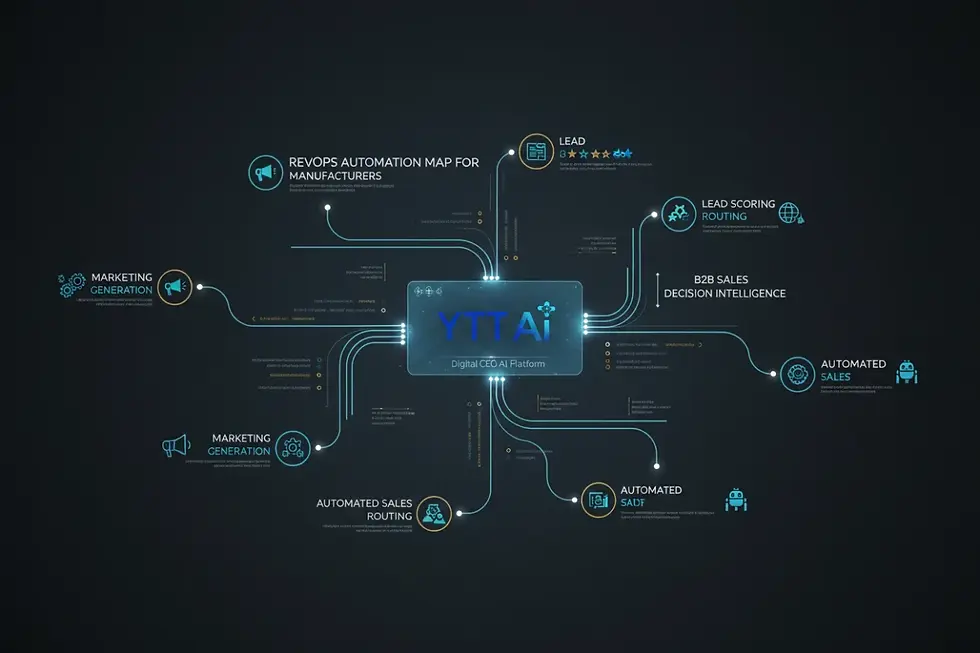
Operating in global markets requires seamless coordination across departments. Implementing RevOps automation for manufacturers ensures that from the moment an overseas inquiry is registered via Marketing Master, it is automatically qualified, enriched with background corporate intelligence, and routed to the most appropriate technical sales representative. If a quote is delayed due to complex customization requirements, the AI alerts the revenue operations lead, preventing bottlenecks in the quotation lifecycle.
Enterprise Sales Memory Preservation
One of the most valuable assets of a manufacturer is its historical sales context. YTTAI’s Sales Memory framework preserves every historical interaction, technical clarification, and pricing logic ever utilized. Digital CEO AI accesses this repository to draft context-aware follow-ups, suggest alternative product configurations, and ensure that the departure of an individual sales rep does not result in the loss of critical institutional knowledge.
AI vs. Human Leadership: Defining the Operational Boundaries
While the concept of a Digital CEO AI sounds highly autonomous, its purpose is to augment human intelligence rather than replace executive authority. The operational boundaries between machine capability and human leadership must be clearly defined:
The AI's Responsibility: Automating heavy-lifting data aggregation, running real-time predictive models on pipeline health, highlighting anomalies in communication, tracking competitor shifts, and standardizing sales decision intelligence protocols across global offices.
The Executive's Responsibility: Strategic relationship building, final approval on highly customized high-margin pricing models, establishing corporate ethics, steering long-term capital investments, and validating AI-recommended operational adjustments.
This division of labor ensures that while the system handles the micro-efficiencies of pipeline progression and data alignment, human executives can focus entirely on relationship governance and high-stakes negotiation.
A Comprehensive KPI Scorecard for B2B Executive Decision-Making
To manage a global sales organization, leaders need a clear dashboard. Digital CEO AI powers a highly sophisticated, real-time AI executive dashboard B2B interface that displays critical operational health metrics:
Metric Category | Specific KPI | What It Tracks | Strategic Impact |
|---|---|---|---|
:--- | :--- | :--- | :--- |
Pipeline Health | Pipeline Velocity | The speed at which an RFQ moves from inquiry to closed-won deal. | Predicts future revenue and manufacturing capacity requirements. |
Engagement Quality | Context Loss Score | Percentage of unlogged customer interactions across email and chat. | Reduces risk of account churn and enhances institutional memory. |
Response Efficiency | First-Touch & Follow-up Lag | Average time taken to reply to complex technical questions. | High response speed directly correlates with higher B2B win rates. |
RevOps Alignment | Resource Allocation Efficiency | Time spent by engineers on qualifying non-ideal prospects. | Maximizes the ROI of expensive technical and operations teams. |
By reviewing these metrics on a continuous basis, manufacturing leaders can shift from reactive management to predictive planning.
Step-by-Step Roadmap: Implementing Digital CEO AI in 90 Days
Deploying advanced decision-intelligence technology does not require a multi-year IT overhaul. A structured, phased approach ensures minimal operational disruption while delivering immediate value:
Phase 1: Days 1 to 30 – Data Consolidation & Connection
During the first month, the core focus is integrating your primary communication channels and legacy CRM data with YTTAI systems. The Digital CEO AI begins mapping historical communication logs to establish a robust baseline of your enterprise's Sales Memory.
Phase 2: Days 31 to 60 – Automation Alignment & Training
In this stage, customized RevOps automation workflows are configured. We map the technical rules specific to your industry—whether you manufacture high-precision electrical systems, custom mold components, or industrial machinery. The AI begins training on your product catalogs, technical sheets, and historical pricing models to provide accurate sales decision intelligence.
Phase 3: Days 61 to 90 – Executive Dashboard & Optimization
By the final month, the executive dashboard goes live. Leadership teams are trained to interpret predictive alerts, manage global pipelines, and implement AI-assisted sales follow-up strategies. The system begins autonomously identifying dormant leads, helping sales teams systematically reactivate idle accounts without manual work.

Unlocking Global Growth with Structured Intelligence
Ultimately, scaling a global B2B manufacturing or export business is an exercise in managing complexity. Trying to supervise multiple overseas sales offices, varied language requirements, and complex technical procurement cycles via basic spreadsheets is no longer viable. True competitive advantage belongs to enterprises that operationalize their data, converting raw communication histories into a cohesive engine for growth.
By leveraging YTTAI's comprehensive suite—combining overseas brand marketing, automated inquiry management, and executive-level analytics—founders and directors can finally gain complete oversight of their global sales pipelines. Ensure your organization never loses another deal due to context gaps, delayed follow-ups, or siloed operational data.
To discover how your business can transform its operational visibility and streamline its global revenue pipeline, Request a Digital CEO decision-intelligence assessment with the YTTAI advisory team today.
FAQ
How does Digital CEO AI differ from a traditional CRM system?
Traditional CRMs rely entirely on manual data entry by sales representatives and only show historical records. Digital CEO AI automatically captures unstructured interaction data (emails, chats, inquiries), preserves comprehensive Sales Memory, and uses predictive sales decision intelligence to guide executives on future strategic actions.
Can Digital CEO AI handle highly technical product inquiries for manufacturers?
Yes. Digital CEO AI, integrated with YTTAI's Sales Master, parses technical specifications, technical drawings, and historical RFQ data. It helps technical sales teams quickly reference previous solutions and draft precise, context-rich responses, reducing engineering bottlenecks.
What is the role of Sales Memory in preventing customer context loss?
B2B manufacturing deals often take months and involve multiple negotiators. Sales Memory stores every email, meeting detail, and technical update in a unified system. Even if a sales representative leaves the company, the replacement rep or executive has instant access to the entire relationship history, eliminating context gaps.
Is the system secure for sensitive enterprise and client data?
Absolutely. YTTAI prioritizes enterprise-grade security protocols. All incoming data streams, historical communication databases, and analytical tools operate within secure, encrypted environments to ensure intellectual property and client communications remain strictly protected.


Comments