
FANUC Robotics Training Sales Enablement Case Study: De-Risking Automation

Executive Summary
Industrial automation purchases carry high capital expenditure risk and steep operational learning curves. FANUC addressed this adoption friction by turning education, simulation, and application engineering into the primary engines of its commercial funnel. By providing prospective and existing buyers with structured FANUC Academy curricula, hands-on application testing, and virtual cell simulation before contract execution, the company systematically de-risked industrial robotics adoption. For automation leaders, this operating framework demonstrates that technical enablement is not post-sales overhead, but the single most effective lever for shortening complex B2B sales cycles.
Company Snapshot: Industrial Automation at Scale
FANUC Corporation (Fuji Automatic Numerical Control), founded in 1956 and headquartered at the base of Mount Fuji in Oshino, Yamanashi Prefecture, Japan, is one of the world's premier manufacturers of computer numerical control (CNC) systems, industrial robots, and factory automation machinery (Robomachines including ROBODRILL, ROBOSHOT, and ROBOCUT).
Operating across global manufacturing hubs in the Americas, Europe, and Asia, FANUC serves diverse end markets ranging from automotive OEMs and Tier-1 suppliers to electronics, aerospace, pharmaceuticals, consumer packaged goods, and general precision engineering. The enterprise operates on a high-margin hardware, software, and lifecycle service business model, distinguished by its "Service First" philosophy—a commitment to provide lifetime parts and maintenance support for any FANUC product for as long as the customer operates it.
Analyzing FANUC provides critical commercial insight because the enterprise competes in a high-ticket, mission-critical capital goods sector where customer hesitation is driven not by price alone, but by technical uncertainty, programming complexity, and fear of factory downtime.
What the Company Sells: The Dynamics of Complex Robotics Procurement
FANUC does not simply sell standalone articulated robot arms or CNC controllers; it delivers high-precision, programmable automation subsystems that must integrate flawlessly into brownfield manufacturing environments or high-throughput greenfield assembly lines.
In industrial manufacturing, purchasing a robotic workcell involves significant operational disruption. A typical deployment entails:
Payload and reach calculation based on specific workpiece geometries.
Cycle time and repeatability verification under strict production tolerances.
End-of-arm tooling (EOAT) engineering, safety fencing, and vision system integration.
Fieldbus communication with programmable logic controllers (PLCs) and factory execution systems (MES).
Workforce readiness to operate, teach, program, and recover the robotic cell during fault conditions.
Because most end-user manufacturers—especially small-to-midsize enterprises (SMEs)—lack internal robotics engineering divisions, procurement decisions stall when internal plant managers question whether their line technicians can handle robot recovery or maintenance. Furthermore, FANUC routes a substantial volume of its market volume through Authorized System Integrators (ASIs) and machine tool distributors. Consequently, the company's commercial velocity depends entirely on enabling both the end buyer and the intermediary integrator to scope, configure, and validate applications with zero ambiguity.
The Business Problem: High-Risk Capital Sales and the Adoption Barrier
Historically, the bottleneck in scaling industrial automation has not been component manufacturing capacity, but the technical barrier to adoption at the plant level. Industrial manufacturers faced three acute friction points throughout the buying cycle:
The Operational Skill Gap
Plant managers frequently rejected automation proposals due to a perceived lack of internal programming expertise. If an automotive component supplier or metal fabricator could not hire experienced robotics engineers, purchasing a six-axis articulated robot created unacceptable operational risk.
Extended Feasibility Scoping
Traditional request-for-quotation (RFQ) cycles required weeks of manual engineering consultations. Integrators and direct sales teams had to physically evaluate part blueprints, calculate theoretical throughput, and conduct physical trials on factory floor testbeds before delivering a binding quote.
Channel Enablement Friction
Distributors and regional systems integrators often lacked uniform technical mastery across FANUC’s expansive catalog of over 100 robot models. When channel partners could not quickly diagnose application feasibility, end prospects postponed capital budget allocations or defaulted to lower-capability legacy machinery.
What Changed: Institutionalizing Technical Sales Enablement and Application Support
To dismantle these structural hurdles, FANUC transformed its go-to-market strategy from transactional hardware sales into an integrated technical enablement architecture. The framework rests on four operational pillars:
FANUC Academy and CERT Programs: Establishing standardized global training facilities that train tens of thousands of customer technicians, operators, and vocational students annually on official controller interfaces and safety standards.
ROBOGUIDE Digital Twin Simulation: Deploying proprietary, offline 3D simulation software that allows sales engineers, integrators, and prospective clients to model exact kinematics, calculate true cycle times, and detect spatial collisions before committing capital.
Application Engineering Centers: Maintaining regional proof-of-concept testing facilities where customer-supplied workpieces are tested with specialized vision (iRVision), force sensing, and handling tools under production conditions.
Certified System Integrator Network Protocols: Providing channel partners with structured engineering repositories, standardized cell architecture templates, and automated sizing tools to rapidly build validated customer proposals.
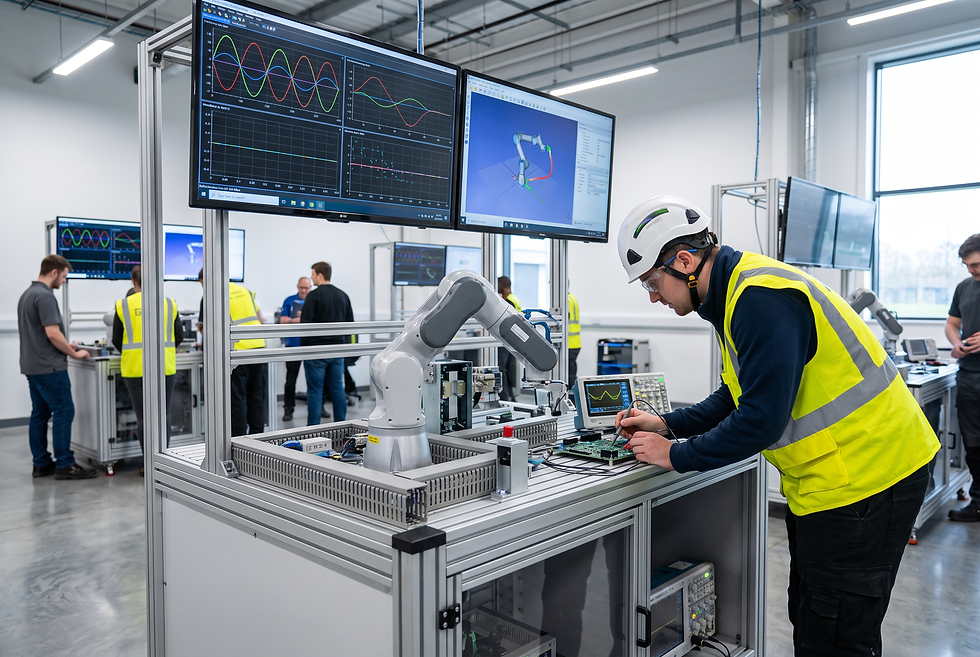
By embedding technical education and application validation directly into pre-sales discussions, FANUC turned risk mitigation into its primary value proposition.
How the Workflow Actually Works: The End-to-End Enablement Mechanism
To understand the operational mechanics of this model, consider the structured process through which an industrial automation opportunity moves from initial customer application inquiry to verified operational deployment:
Step 1: Application Parameter Intake and Specification
The engagement begins when the prospective customer or system integrator inputs core application parameters: part weight, cycle time target, operating envelope, surface finish constraints, and upstream/downstream material handling protocols. This data establishes the engineering boundary conditions.
Step 2: Virtual Kinematic Modeling and Digital Twin Validation
Instead of issuing a generic speculative quote, the technical sales team builds a high-fidelity digital twin in ROBOGUIDE. The software models the exact robot arm kinematics, payload inertia, trajectory, and virtual cell layout. The system outputs precise cycle time estimates, identifies potential reach interferences, and verifies duty cycle limits.
Step 3: Physical Proof-of-Concept Testing in Application Centers
For complex material handling, robotic deburring, or vision-guided bin picking, the prospect ships raw sample parts to a regional FANUC Application Engineering Center. Engineers set up real-world test rigs utilizing integrated iRVision cameras and force sensors to prove repeatability under variable lighting and part-presentation conditions.
Step 4: Collaborative Engineering Feasibility Review
The resulting simulation videos, cycle time reports, and physical trial data are packaged into a comprehensive feasibility packet. The customer’s plant engineers, safety coordinators, and financial decision-makers review verified performance data rather than theoretical sales claims.
Step 5: Pre-Delivery Workforce Enablement
Prior to physical machinery delivery, the customer's maintenance technicians and line supervisors complete structured training at the local FANUC Academy or via certified online modules. Operators learn controller navigation, coordinate jogging, fault clearing, and routine preventative servicing.
Step 6: Streamlined Commissioning and Continuous Support Loop
When the physical robotic cell arrives on the factory floor, the customer’s internal team already understands the operating logic. Commissioning time drops drastically, production ramps up on schedule, and lifetime diagnostic data feeds back into the regional technical service organization.
Comparative Analysis: Traditional Machinery Sales vs. Enablement-Led Sales
Process Stage | Traditional Machinery Sales Model | Enablement-Led Technical Model (FANUC Approach) | Operational Impact on Buyer |
Initial Qualification | Generic catalog review and speculative sales estimates | Rigorous application parameter intake and reach/payload validation | Eliminates undersizing or oversizing machinery costs |
Feasibility Verification | Static CAD drawings and high-level theoretical throughput claims | 3D dynamic simulation in ROBOGUIDE with kinematic collision detection | Verifies cycle times and factory layout fit before purchase |
Application Risk Testing | Limited off-site testing; risk shifted to customer during commissioning | Physical trial runs with actual workpieces in dedicated application labs | Guarantees vision and sensor reliability under shop-floor conditions |
Workforce Readiness | Ad-hoc documentation provided post-installation | Structured operator and technician training prior to equipment arrival | Prevents installation delays and post-commissioning operational downtime |
Channel Integration | Integrators left to solve custom engineering hurdles independently | Standardized cell architectures, shared simulation tools, and certified training | Shortens partner quotation cycles and improves proposal win rates |
Sales Cycle Duration | 9 to 18 months due to lingering technical and financial uncertainties | Compressed evaluation cycles backed by definitive empirical proof | Lowers internal sign-off friction across procurement and engineering |
Evidence and Results: Documented Commercial and Operational Impact
The effectiveness of technical sales enablement and structured training in industrial automation is corroborated by official corporate reports and verifiable robotics industry benchmarks:
Cumulative Production Leadership: According to official company disclosures, FANUC surpassed 1,000,000 cumulative industrial robots produced and installed globally—maintaining its position as one of the world's highest-volume robotics manufacturers.
Workforce Development Scale: FANUC America’s Certified Education Training (CERT) program has integrated robotics curricula into more than 1,500 high schools, community colleges, and universities across North America, training thousands of certified operators annually to populate the talent pipeline for FANUC-equipped factories.
Lifetime Support Execution: As reported in official corporate governance and annual integrated reports, FANUC maintains a network of over 270 service locations in more than 100 countries, executing on its core commercial pledge of lifetime product maintenance.
Industry Context: The International Federation of Robotics (IFR) consistently highlights that availability of skilled personnel, ease of programming, and validated application testing are the primary determinants for SME automation adoption worldwide.
Strategic Takeaways: FANUC Robotics Training Sales Enablement Case Study
For executives leading industrial machinery, robotics, hardware-software integration, or complex B2B manufacturing firms, examining this fanuc robotics training sales enablement case study provides four actionable methodologies:
1. Shift Application Engineering from Post-Sales to Pre-Sales
When selling high-complexity products, engineering resources should not be reserved solely for warranty support or post-delivery troubleshooting. Deploying technical qualification and digital modeling early in the commercial funnel eliminates buyer anxiety and weeds out unfeasible applications before costly sales resources are misallocated.
2. Treat Customer Training as a Revenue Driver, Not Cost Center
If your product requires specialized operational skill, lack of buyer expertise is your biggest competitor. By offering certified, structured training programs, you lower the barrier to adoption, create long-term brand loyalty among line engineers, and turn machine operators into internal champions for future capital upgrades.
3. Arm Channel Partners with Standardized Verification Assets
Distributors and systems integrators will always gravitate toward the supplier that is easiest to quote and specify. Providing channel partners with simulation software, component sizing configurators, and standardized feasibility templates amplifies your commercial reach without ballooning direct sales headcount.
4. Provide Empirical Feasibility Proofs Before Contract Signing
Eliminate sales ambiguity by replacing speculative promises with empirical test data. When a prospective client sees their exact physical workpiece processed within target cycle times in a simulated or physical test environment, internal capital expenditure approvals accelerate.
What This Could Look Like for Industrial Automation & Machinery Manufacturers
For a mid-market industrial machinery manufacturer—such as a custom packaging equipment builder, CNC tooling supplier, or water treatment equipment vendor—applying this operating logic transforms daily commercial execution.
Instead of relying on field sales reps to exchange dozens of unstructured emails clarifying motor voltages, fluid viscosities, or footprint constraints, the organization implements an automated technical qualification pipeline. Inbound technical inquiries are immediately matched against standardized product sizing databases, preliminary dimensional layouts are generated automatically, and direct sales engineers receive pre-qualified, mathematically verified project dossiers ready for final commercial negotiation.
YTT AI Worker Mapping: Scaling Technical Sales Enablement
For industrial automation, robotics, and machinery manufacturers seeking to institutionalize pre-sales application qualification and channel enablement, YTT AI provides specialized, role-focused digital workers.
Worker Job Title
AI Technical Sales Rep
Main Daily Tasks
Ingesting complex technical RFQs, mechanical specification sheets, CAD metadata, and environmental operating requirements from prospective buyers and channel distributors.
Evaluating application boundary conditions (e.g., payload capacity, power requirements, throughput tolerances, chemical compatibility) against official engineering catalog parameters.
Generating structured preliminary application briefs, complete with component recommendations, dimensional boundary warnings, and accessory checklists for human engineering review.
Answering technical product configuration inquiries 24/7 across distributor and customer portals with reference-backed documentation.
Primary Work Channel
Inbound website technical portals, central sales engineering inboxes, distributor partner extranets, and CRM integration pipelines.
Authority Boundary
The AI Technical Sales Rep autonomously conducts technical qualification, product matching, and feasibility documentation generation. It does not issue binding legal warranties, grant unauthorized commercial discounts, or bypass senior sales engineering sign-off on custom engineered-to-order projects.
First Value Event
Within 10 minutes of a prospective buyer submitting raw application parameters, the AI Technical Sales Rep parses the requirements, verifies compatibility against the manufacturer's technical catalog, and outputs a complete, professional Feasibility Sizing Brief ready for sales engineer approval.
Daily Report Result
A daily executive digest delivered to the VP of Sales and Engineering Director detailing: total technical RFQs processed, breakdown of matched product lines, flagged application constraints, distributor responsiveness metrics, and high-probability deals ready for commercial closing.
FAQ
Why is customer training considered a sales enablement tool in industrial robotics?
Customer training directly removes the operational skill barrier that causes manufacturing executives to delay automation investments. When plant technicians and maintenance teams gain hands-on training prior to installation, procurement risk drops, commissioning cycles shorten, and the total cost of ownership becomes predictable.
How does digital twin simulation software like ROBOGUIDE de-risk the robotics buying process?
Digital twin simulation enables sales engineers and buyers to validate exact kinematics, cycle times, payload limits, and physical reach envelopes in a virtual 3D environment before capital expenditure is committed, eliminating costly engineering errors and on-site cell collisions.
How do application engineering centers help robotics manufacturers convert complex RFQs?
Application engineering centers provide physical proof-of-concept testing using the customer's actual workpieces, tooling, and vision sensors. Delivering empirical trial reports proves process repeatability and cycle time feasibility under real-world factory conditions.
How can mid-sized automation manufacturers replicate this enablement model without large physical training campuses?
Mid-sized manufacturers can replicate this framework by standardizing technical sizing tools, creating modular digital training portals for channel partners, automating pre-sales parameter qualification, and utilizing virtual simulation software to provide clear feasibility proofs early in the sales cycle.
Scale Your Technical Sales and Application Engineering Velocity
Discover how deploying an AI Technical Sales Rep can automate application qualification, assist distributor networks, and compress high-ticket industrial sales cycles. Meet an AI Technical Sales Rep at https://www.ytt-ai.com/ today.


Comments