
Festo Engineering Tools Digital Sales: B2B Technical Enablement Case Study

In industrial automation and complex component manufacturing, engineering sizing and product selection represent the primary bottleneck in the commercial pipeline. This analysis of festo engineering tools digital sales demonstrates how codifying technical calculation models, dynamic physics simulation, and CAD generation transforms internal engineering expertise into an autonomous revenue engine for global B2B buyers.
According to research from Gartner (2024), B2B buyers spend only 17% of their total purchase evaluation journey meeting directly with potential suppliers, while allocating the vast majority of their time to independent research and digital self-service. For component manufacturers and automation providers, capturing early mindshare requires moving specialized sizing logic out of manual engineering backlogs and placing it directly into the customer's design environment.
The Engineering Bottleneck in Complex B2B Component Sales
Traditional technical sales workflows in industrial equipment and discrete automation rely on Application Engineers (AEs) to handle routine specification requests. When a design engineer at an Original Equipment Manufacturer (OEM) specifies an electric drive axis, pneumatic cylinder, or modular valve terminal, they historically submit dimensional parameters via static forms or direct email inquiries.
This manual operating model introduces three structural friction points across the commercial pipeline:
Protracted Qualification Cycles: Sizing calculations, thermal limit verifications, and duty-cycle modeling typically require 24 to 72 hours of turnaround time from internal engineering departments.
Excessive Engineering Overhead on Standard SKUs: Highly compensated application engineers spend disproportionate billable hours recalculating basic load, stroke, and air-consumption parameters rather than architecting complex, high-margin enterprise solutions.
Disconnected Design-to-Order Hand-offs: When engineering calculations reside in disconnected spreadsheets, generating accurate bills of materials (BOMs), native 2D/3D CAD models, and commercial quotes requires manual re-entry across CRM and ERP platforms, creating margin errors and quoting delays.
Architecting Festo Engineering Tools Digital Sales for Global Buyers
Festo, a global supplier in industrial automation technology and technical education, structured its commercial model around empowering mechanical and electrical design engineers to configure, calculate, and order components autonomously. Rather than treating sizing calculators as ancillary marketing widgets, Festo integrated these utilities into its global commercial infrastructure.
1. Parametric Sizing and Dynamic Simulation
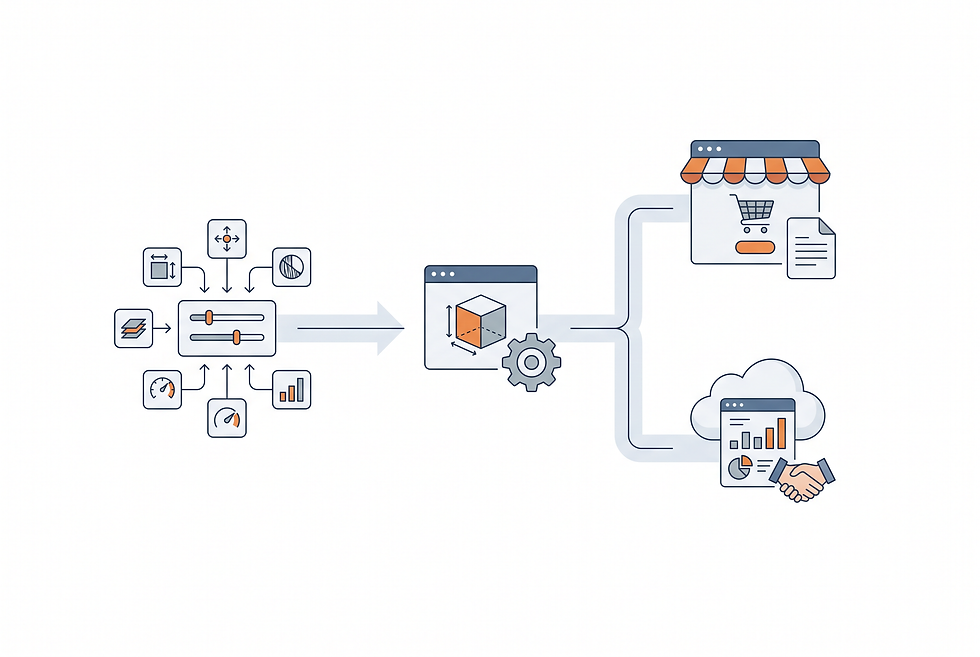
Festo digital utilities—such as the Electric Motion Sizing tool and pneumatic calculation modules—allow external machine builders to enter physical operating parameters directly. By specifying mass, stroke distance, positioning time, cycle frequency, and ambient temperatures, the calculation engine runs dynamic load simulations. It automatically recommends balanced motor, drive, and mechanical actuator combinations while highlighting thermal thresholds and mechanical utilization limits before any formal RFQ is issued.
2. Automated CAD and Circuit Macro Delivery
Once an assembly is sized, the platform immediately generates native 3D CAD files compatible with major mechanical CAD software alongside standardized electrical EPLAN schematics. Eliminating the manual CAD request step embeds Festo components directly into the customer's digital machine blueprint during the earliest conceptual engineering phase, creating high switching costs for competing hardware vendors.
3. The Didactic Ecosystem as Long-Term Commercial Enablement
Beyond online calculators, Festo Didactic bridges technical education and industrial procurement. By supplying industrial training rigs, digital learning platforms, and mechatronic curricula to vocational schools, universities, and industrial training institutes worldwide, engineering students develop familiarity with Festo design logic years before making enterprise component procurement decisions.
Digital Sizing vs. Traditional Technical Sales Workflow
The following comparison table outlines the operational and commercial differences between conventional technical hand-offs and an integrated digital sizing approach.
Operational Dimension | Traditional Technical Sales Workflow | Festo-Style Digital Sizing & Configuration |
Initial Dimensioning | Manual calculation by internal Application Engineer (24–72 hours) | Instant real-time simulation via browser-based physics engine (< 5 minutes) |
CAD Asset Access | Email request or static catalog download requiring manual redrawing | Dynamic native CAD & EPLAN generation tailored to exact configured stroke/options |
BOM Generation | Manual assembly code creation prone to transcription error | Automated, validated single-part-number or multi-item BOM generation |
Sales Team Involvement | Administrative sizing, parameter gathering, and data entry | High-touch consultation on system architecture, negotiations, and delivery terms |
Buyer Friction | High barrier to compare alternative design iterations | Low friction; engineers can rapidly test multiple speed/payload scenarios |
Data Capture | Static contact forms with minimal context on project urgency | Rich telemetry capturing payload, cycle speeds, and CAD download intent |
Strategic Implementation Framework for Manufacturing Leaders
Industrial equipment, fluid power, and mechatronics manufacturers seeking to replicate this technical enablement model should execute across four staged implementation phases:
Phase 1: Knowledge Codification and Rule Standardization
Identify the exact mathematical equations, mechanical safety margins, thermal boundaries, and part compatibility tables used by internal technical specialists. Convert isolated design rules into standardized algorithmic calculation engines and accessible API services.
Phase 2: Self-Service Workflow and CAD Automation
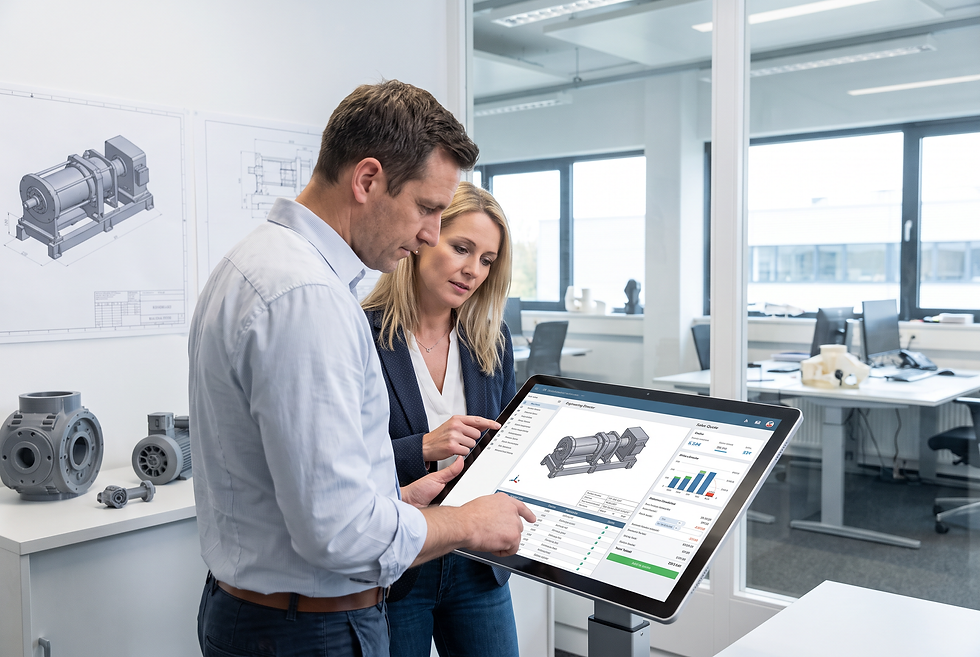
Deploy responsive customer interfaces that guide design engineers through mandatory boundary conditions while abstracting catalog complexity. Ensure software outputs generate native 2D/3D CAD models, detailed specification datasheets, and exact ordering codes immediately without mandatory sales contact gates.
Phase 3: Connecting Digital Engineering to Commercial Workflows
Bridge sizing tool outputs directly into CRM and ERP systems. When an engineer downloads a native CAD model or saves a system calculation, commercial teams receive high-intent behavioral telemetry indicating active machine development and specific product preferences.
Phase 4: Establishing Human Approval Boundaries for AI and Automation
While automated sizing and documentation delivery operate continuously, commercial governance requires defined human checkpoints. Automated platforms must never issue unverified custom pricing, contractual discount tiers, non-standard delivery commitments, or safety-critical engineering warranties without formal verification by authorized sales managers and application engineers.
Extending Technical Sales Enablement with Intelligent Agent Architectures
While web-based engineering tools handle structured parameter inputs effectively, modern industrial buyers frequently present unstructured requirements: extensive RFQ specifications, mixed operating constraints, and multi-vendor replacement inquiries. Integrating dynamic knowledge retrieval with structured calculation tools bridges the gap between static configurators and consultative technical discussions.
This is where YTTAI Sales Master supports industrial manufacturers. By indexing proprietary product documentation, engineering manuals, and sizing rules into specialized B2B agent workflows, enterprises can assist technical buyers across multi-channel digital touchpoints in real time.
Rather than forcing engineers to navigate disconnected sizing tools, autonomous commercial systems can interpret unstructured machine parameters from an RFQ, trigger the appropriate calculation models, and generate verified technical options for commercial review. Industrial commercial leaders can explore these capabilities firsthand through a guided growth demo to observe how automated qualification enhances technical sales efficiency while maintaining rigorous human oversight.
FAQ
What are Festo engineering tools in industrial digital sales?
Festo engineering tools are digital sizing, simulation, and configuration applications that allow industrial design engineers to calculate component specifications, simulate operational loads, and generate CAD models directly online during machine development.
How do self-service sizing tools accelerate the B2B sales cycle?
Self-service sizing tools reduce quote and design lead times from days to minutes, allowing prospective buyers to validate feasibility independently while freeing internal sales engineers to focus on high-value system engineering and commercial closing.
Where should human approval remain when automating technical sales enablement?
Human engineering and sales teams must retain approval authority over customized pricing, volume discount tiers, contractual terms, non-standard engineering guarantees, and final safety-critical system designs.
Scale Your Technical Sales Enablement Workflows
Discover how intelligent technical qualification and automated product knowledge tools empower global industrial buyers while keeping your sales engineering team focused on high-margin opportunities.


Comments