
How AI Helps Manufacturers Test a New Export Market Before Hiring Local Teams

Manufacturers can test a new export market by deploying AI-driven workflows to conduct account discovery, monitor local buyer intent signals, map regional distributors, and run structured initial outreach. This approach validates commercial demand, pricing sensitivity, and channel willingness in 30 to 60 days before companies commit fixed overhead to overseas legal entities or full-time local sales hires.
The Cost and Risk of Premature Headcount in Foreign Markets
Expanding into overseas territories has traditionally forced industrial leaders into an expensive dilemma. Setting up an overseas legal subsidiary, hiring local business development directors, and retaining specialized regional recruiters frequently requires upwards of $200,000 to $350,000 in upfront commitments per country before the first purchase order is signed.
According to Gartner research on global B2B expansion strategies (2024), over 60% of regional direct-sales hires in newly entered geographic territories fail to meet quota within the first 18 months, primarily due to unverified product-market fit and misaligned distribution channels rather than poor sales execution.
When industrial equipment, robotics, or automation manufacturers expand prematurely, they encounter three core structural liabilities:
High Sunk Costs: Significant fixed compensation, benefits, compliance overhead, and local office leases before validating demand.
Fragmented Territory Insight: Reliance on the anecdotal feedback of a single local hire rather than systematic, data-driven territory mapping.
Prolonged Feedback Loops: It often takes 6 to 9 months to discover that regional certification requirements, buyer procurement cycles, or distributor margin expectations do not match the domestic model.
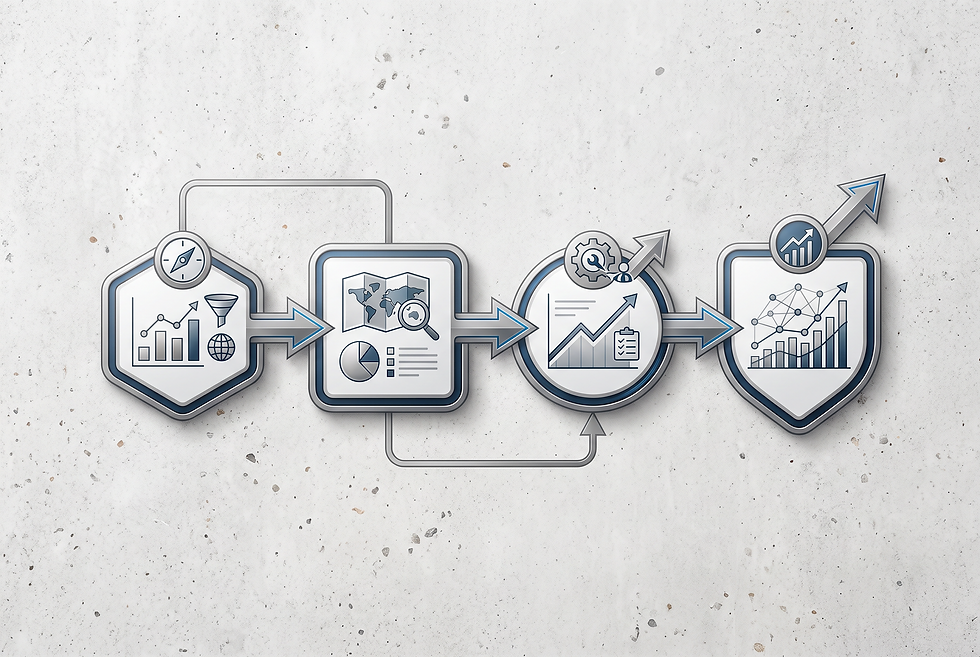
A 4-Stage Framework to Test a New Export Market with AI
Modern digital workflows allow commercial directors to systematically test a new export market through structured data collection and automated engagement, moving from broad territory analysis to high-conviction pipeline validation.
1. Systematic Account Discovery and Buyer Research
Instead of buying static regional contact databases, AI systems continuously scan target regional registries, trade directories, import-export customs manifests, and localized commercial registries. Machine learning models categorize potential B2B accounts by production capacity, existing machinery fleets, and verified technical compliance criteria.
2. Demand Signals and Buyer Intent Monitoring
AI engines track macro and micro signals indicating procurement activity, such as plant expansion permits, capital expenditure announcements, tender publications, and localized hiring for specific engineering roles. This filters thousands of nominal target accounts down to high-probability commercial buyers actively seeking efficiency upgrades.
3. Strategic Distributor and System Integrator Mapping
For industrial machinery and automation components, direct-to-end-user sales are rarely the fastest route. AI tools evaluate regional distribution networks, analyzing which channel partners already stock complementary, non-competing product lines and have the field-service bandwidth to represent a new manufacturing brand.
4. Multilingual Structured Outreach and Demand Testing
Automated systems execute personalized, localized outreach in native languages to test value propositions, target pricing thresholds, and technical compatibility. Real-time reply analysis classifies responses into technical inquiries, commercial objections, or requests for quotation (RFQs).
Comparing Traditional Export Entry with AI-Led Territory Validation
The following evaluation matrix demonstrates the operational differences between conventional direct market entry and modern AI-driven market validation.
Operational Dimension | Traditional Market Expansion | AI-Driven Territory Validation |
Time to First Market Signal | 6 to 12 months (recruiting, onboarding) | 3 to 6 weeks (data scanning, initial outreach) |
Upfront Financial Commitment | $200,000 – $400,000+ per territory | Fraction of operational platform software costs |
Account Coverage Breadth | Limited to single rep capacity (~50 accounts/mo) | Complete regional TAM scanning (1,000+ accounts) |
Feedback Objective Reliability | Subjective, rep-reported qualitative notes | Structured quantitative response and objection data |
Channel Partner Visibility | Reliant on personal industry contacts | Comprehensive multi-tier distributor mapping |
Sunk Cost if Market Incompatible | High severance, entity closure, and legal costs | Zero severance or legal entity termination costs |
Defining the Human Approval Boundary in Automated International Sales
While intelligent software can aggregate market signals and initiate early-stage dialogue, industrial sales cycles require strict operational governance. Manufacturers must establish clear boundaries between automated data tasks and executive human discretion.
McKinsey & Company analysis on B2B commercial operations (2023) highlights that hybrid commercial models—combining automated intelligence with high-touch technical sales engineers—yield up to 50% faster deal velocity while preventing margin erosion.
Manufacturers should enforce the following human intervention gates:

Commercial Pricing and Tiered Discounts: Automated workflows must never quote final commercial terms or non-standard discounts without authorization from the Commercial Director.
Technical Feasibility and Custom Engineering: When prospects submit detailed RFQ specifications, application engineers must review CAD drawings, voltage requirements, and material tolerances directly.
Contractual and Legal Commitments: Territory exclusivity agreements, distributor contracts, and warranty obligations require formal legal and executive sign-off.
How Modern AI Workforce Systems Accelerate Cross-Border Execution
Once industrial leaders establish the decision framework, implementing an autonomous AI Sales Representative enables continuous, autonomous market testing across multiple time zones and languages.
Platforms such as YTTAI function as specialized digital team members that integrate account discovery, localized buyer research, distributor profiling, and structured initial engagement into a single pipeline. By operating continuously, these systems uncover real commercial interest, qualify inbound RFQs, and present verified opportunities directly to your headquarters team.
Rather than making speculative investments in overseas headcount, industrial enterprises leverage digital workforce solutions to build data-backed conviction before signing distributor agreements or establishing local regional hubs.
Strategic Checklist for Commercial Directors
Before authorizing capital allocation for regional overseas offices, executive teams should complete this structured validation checklist:
TAM Verification: Identify and categorize at least 300 to 500 qualified target manufacturing plants or end-users in the specific geographic region.
Channel Mapping: Identify top 20 active regional distributors, documenting their current brand portfolios and field-service coverage.
Value Proposition Resonance: Achieve a baseline benchmark of qualified technical responses from localized initial outreach campaigns.
Regulatory and Certification Audit: Clarify all mandatory regional import tariffs, safety certifications (e.g., CE, UL, UKCA), and documentation standards.
Human Resource Trigger Point: Commit to local on-the-ground hires only after pipeline revenue visibility covers at least 2x the annual fully loaded cost of local personnel.
FAQ
How long does it take to test a new export market using AI workflows?
Most industrial manufacturers can map the addressable market, identify regional distributors, and gather initial qualified buyer feedback within 30 to 60 days, compared to 6 to 12 months using traditional hiring methods.
Does AI replace the need for local distributors or sales agents entirely?
No. AI is designed to validate market demand, locate the most qualified distributors, and generate initial end-user interest before companies make permanent investments. Once sustained demand is confirmed, local distributors and technical field engineers remain vital for local servicing, installation, and relationship management.
How does automated outreach handle language and technical nuances in specialized industries?
Modern B2B AI systems are configured with deep industry-specific glossaries, localized terminology, and native grammar models. They focus on precise technical capabilities and compliance standards rather than generic marketing language, ensuring credibility with regional engineering and procurement buyers.
What metrics determine whether a foreign market is worth entering with local staff?
Key validation metrics include the volume of addressable tier-1 accounts, response rates from qualified distributors willing to carry the product line, technical compatibility confirmation from initial RFQs, and a pipeline of qualified opportunities that supports local operational costs.
Validate Your Next Global Market with Autonomous Sales Intelligence
Deploy an AI-powered global sales representative to map distributors, engage target accounts, and validate commercial demand in target overseas markets before committing local headcount.


Comments