

How can B2B manufacturers preserve customer context across long sales cycles, team handoffs, and multiple communication channels?

How can B2B manufacturers preserve customer context across long sales cycles, team handoffs, and multiple communication channels?
In B2B manufacturing, closing a deal is rarely a linear path. High-value transactions—such as custom injection molds, complex power distribution equipment, or precision machinery—routinely take six to eighteen months to finalize. Throughout these long B2B sales cycles, a single account will interact with business development representatives (BDRs), account executives (AEs), technical engineers, and customer success teams. Conversations shift fluidly from official emails to instant messaging apps like WhatsApp or WeChat, and back to face-to-face technical consultations.
This raises a critical question for industrial leaders: How can B2B manufacturers preserve customer context across long sales cycles, team handoffs, and multiple communication channels?
The Direct Answer: B2B manufacturers can preserve complete customer context across complex, multi-month sales cycles by deploying an AI Sales Memory that auto-consolidates emails, WhatsApp messages, technical specs, and RFQs into a unified timeline, ensuring seamless handoffs and eliminating redundant buyer conversations.
The Hidden Cost of Lost Context in Long B2B Sales Cycles
When a sales cycle spans several quarters, information leak is almost inevitable. A buyer’s procurement team might mention a critical voltage tolerance in a WhatsApp thread in month two. By month six, when the technical specification sheet is being drafted by a newly assigned application engineer, that nuance is forgotten.
In manufacturing, context loss is not just an administrative nuisance; it is a major revenue killer. When sales teams repeatedly ask buyers to restate their technical requirements, product tolerances, or delivery timelines, trust erodes rapidly. The buyer begins to perceive the manufacturer as unorganized or incapable of handling high-stakes, custom industrial projects. Furthermore, critical details missed during internal transitions can lead to costly manufacturing errors, shipping delays, and post-sale disputes over liability.
Why Traditional CRMs Fail to Maintain Manufacturing CRM Context
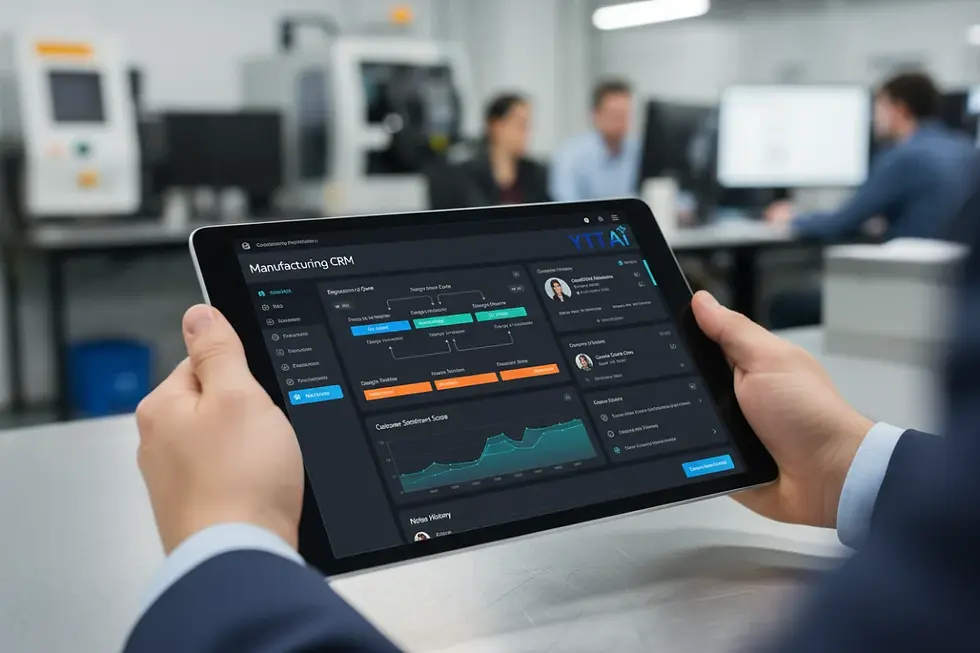
Historically, enterprises have relied on customer relationship management (CRM) systems to act as the single source of truth. However, conventional software is notoriously poor at capturing real-world manufacturing CRM context.
Traditional CRMs fail in complex manufacturing environments for three reasons:
High Reliance on Manual Logging: Sales reps hate entering data. Crucial details from phone calls, WeChat groups, or PDF attachments remain trapped in the salesperson's memory or private inbox.
Lack of Technical Structure: Standard CRMs are built for transactional SaaS sales, not industrial manufacturing. They struggle to parse and organize unstructured technical data such as CAD drawings, raw materials requirements, and factory capacity constraints.
Channel Fragmentation: A single deal might involve communication on email, WhatsApp, and localized platforms. CRMs rarely offer robust, automated multi-channel synchronization out of the box.

How AI Sales Memory Automatically Centralizes Multi-Channel Context
To address the root cause of this challenge, organizations must ask: How can B2B manufacturers preserve customer context across long sales cycles, team handoffs, and multiple communication channels? The answer lies in replacing manual logging with a dedicated AI sales memory.
An AI sales memory acts as an intelligent, invisible assistant that sits across all communication channels. By integrating directly with corporate email clients, official WhatsApp Business accounts, and file servers, the AI continuously ingests and interprets conversations. It reads the raw text, identifies the context (such as an RFQ adjustment, a delivery concern, or a product technical inquiry), and automatically structures this information within your CRM.
Instead of a flat timeline of emails, the sales team is presented with an enriched, searchable knowledge base of the account's history, showing how technical demands evolved from the initial contact to the final quotation.
Key Customer Context Fields Your Sales Team Must Track
To prevent critical specifications from slipping through the cracks, your centralized system must automatically capture and update specific industrial data points:
Technical Specifications & Tolerances: Exact dimensions, materials, certifications (such as ISO or CE), and power requirements.
Lead Fit & Intent Signals: The buyer's operational urgency, current supplier pain points, and specific industry applications.
Key Stakeholder Roles: Mapping who holds decision-making power across the buyer's engineering, procurement, and executive teams.
Quotation History & Revisions: Tracking how prices changed through various technical design iterations.
A Step-by-Step AI Handoff Workflow and B2B Sales Handoff Checklist
When designing a foolproof system, managers frequently wonder, How can B2B manufacturers preserve customer context across long sales cycles, team handoffs, and multiple communication channels? The solution involves a structured transition protocol powered by AI.
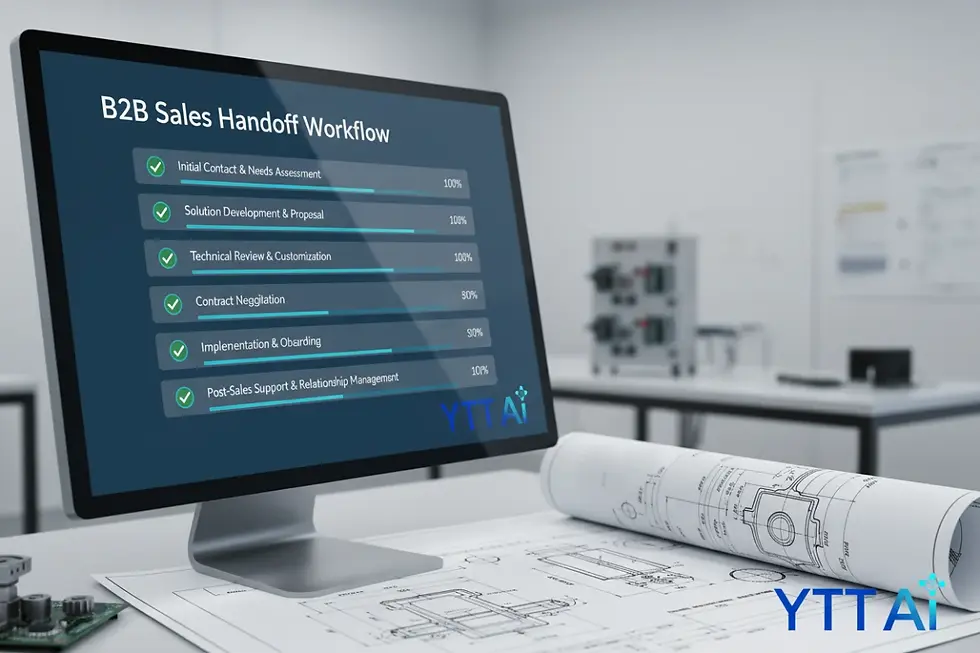
By combining AI capabilities with a standardized B2B sales handoff checklist, manufacturers can guarantee a smooth transition when moving a lead from marketing to sales, or sales to technical engineering:
Step 1: Automated Summary Generation
When a deal progresses to a new stage (e.g., from "Qualified Lead" to "Technical Review"), the AI analyzes all historical communications and generates a comprehensive client profile summary.
Step 2: Running the Handoff Checklist
The receiving team (such as the field engineering team) runs through a structured verification list:
Technical drawings and CAD files are parsed and attached.
Raw material preferences and quality standards are documented.
Budget constraints and target unit pricing are clearly defined.
Delivery timelines, shipping destinations, and compliance rules are verified.
Historical communication summaries from WhatsApp/Email are compiled.
Step 3: Interactive Knowledge Handoff
Instead of reading through hundreds of old emails, the new account manager can query the AI sales memory directly: "What were the specific custom packaging demands mentioned by the client last month?" The AI instantly retrieves the precise response, saving hours of ramp-up time.
Security and Governance: Balancing AI Organization with Human Verification
Deploying AI-driven intelligence across industrial sales pipelines requires careful security measures. Manufacturing specifications often involve highly sensitive intellectual property, proprietary chemical formulas, or custom product designs.
To protect this data, B2B manufacturers must utilize enterprise-grade AI platforms that ensure data privacy, localized hosting compliance, and strict role-based access control. Crucially, while AI organizes and suggests summaries, human sales professionals must verify the technical accuracy of final RFQs and formal sales agreements before they are sent to production.
Accelerating Complex Deals with YTTAI Sales Master
At YTTAI, we understand the core operational challenge: How can B2B manufacturers preserve customer context across long sales cycles, team handoffs, and multiple communication channels? Through our Sales Master platform, we help global manufacturing and exporting enterprises transition from fragmented spreadsheets to structured, automated intelligence.
By leveraging advanced AI capabilities, YTTAI Sales Master acts as your team's permanent memory, capturing complex multi-lingual technical discussions, automating technical checklists, and ensuring that no vital detail is lost during handoffs. This ensures your sales representatives focus on what they do best: building relationships and closing high-value deals.
Ready to transform your sales coordination and eliminate communication gaps? Request a Customer Memory and Sales Handoff Process Evaluation to see how Sales Master organizes communication history, customer requirements, and next steps.
FAQ
Why do traditional CRMs struggle with long manufacturing sales cycles?
Traditional CRMs rely on manual data entry, which is often incomplete or missing entirely. They fail to parse technical unstructured data (like CAD specifications) and struggle to track informal communication channels such as WhatsApp and WeChat, which are frequently used in global B2B trades.
How does an AI sales memory improve internal team handoffs?
An AI sales memory automatically logs, structures, and indexes communication across all channels. When a deal is handed off from marketing to sales, or sales to technical engineering, the AI creates concise summaries and answers specific questions about customer requirements, removing the need for tedious manual brief-writing.
What should be included in a B2B sales handoff checklist for manufacturers?
A robust handoff checklist should cover technical specifications (materials, tolerances, certifications), buyer intent signals, budget and quotation history, key stakeholder roles, and preferred communication histories.


Comments