
Accelerating Global Growth: Why Your Business Needs a Multilingual AI Sales Agent

For global B2B manufacturers and exporters, international expansion presents a massive revenue opportunity. However, scaling across borders introduces critical operational bottlenecks: handling complex RFQs across multiple time zones, translating highly technical specifications without losing accuracy, and maintaining prompt communication. According to buyer discussions on platforms like Reddit, long delays in quote responses and a lack of precise product support from overseas suppliers are among the top frustrations for engineering and procurement professionals.
A multilingual AI sales agent is an intelligent system that automatically qualifies international leads, drafts technical responses, and follows up in native languages. Integrating with CRMs and product databases, it helps B2B exporters eliminate cross-border timezone delays, maintain 24/7 responsiveness, and scale global sales pipelines without adding headcount. For modern exporters seeking to stay competitive, deploying a multilingual AI sales agent is no longer an optional tech upgrade—it is a strategic necessity.
The Core Challenges of Global B2B Sales: Why Traditional Translation Falls Short
Expanding into global markets requires more than just translating your product brochure into French, Spanish, or German. B2B purchasing decisions, especially in industries like electrical equipment, precision machining, and industrial molds, involve highly specialized vocabularies and strict safety standards. When an overseas contractor submits an urgent RFQ, they expect more than a generic reply; they need fast, accurate technical validation.
Traditional approaches to localization and sales communication fall short in three major ways:
The Timezone Barrier: A lead submitted by a buyer in Chicago arrives during the middle of the night for an exporter based in Asia. By the time a local sales representative logs in the next morning, over 12 hours have passed. In modern B2B purchasing, the first qualified supplier to respond often wins the deal.
Static Translation Errors: Standard machine translation tools fail when interpreting technical drawings, specific alloy grades, or 25kV electrical distribution configurations. A small mistranslation in custom-engineered specifications can lead to costly errors, supply chain delays, and damaged buyer trust.
Inefficient Multi-Channel Follow-Ups: Manually managing cross-border B2B lead response across email, WhatsApp, and web forms is labor-intensive. Leads are frequently dropped or neglected after the initial reply, leaving valuable pipeline value on the table.
To bridge these operational gaps, forward-thinking manufacturers are moving away from manual translation and shifting toward automated, context-aware systems.
What Is a Multilingual AI Sales Agent and How Does It Work?
Unlike traditional chatbots that rely on pre-programmed, rigid logic trees, a multilingual AI sales agent uses advanced large language models (LLMs) paired with specialized retrieval systems. Acting as a dedicated AI sales agent for exporters, this technology reads incoming inquiries, references your company's proprietary product database, and responds with human-level accuracy in the prospect's native language.
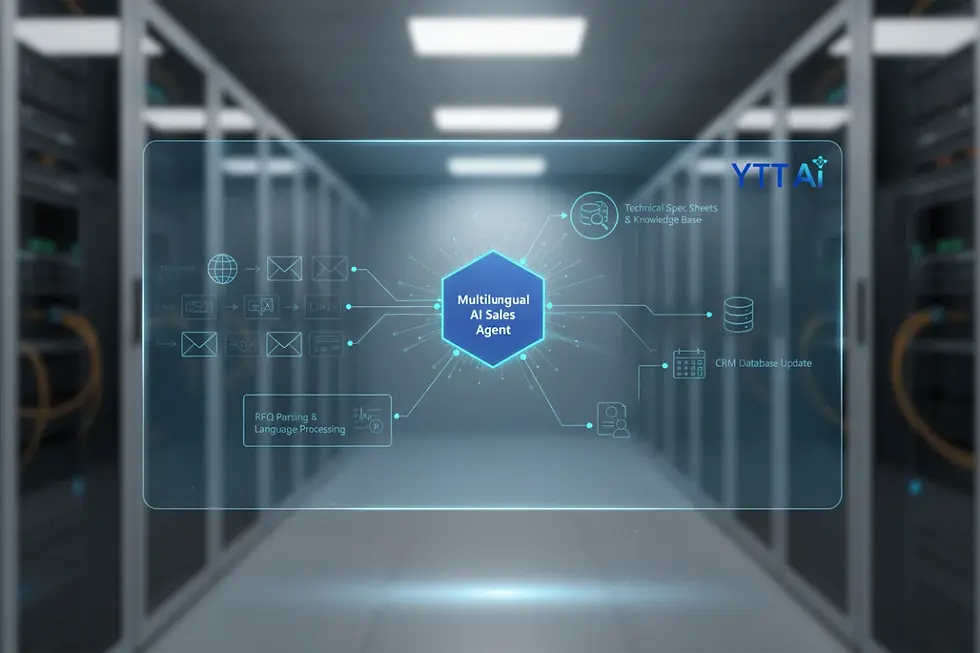
At the core of a multilingual AI sales agent lies a deep, semantic understanding of your business catalog. The workflow operates through three clear layers:
Input Parsing and Intent Detection: The agent identifies the prospect's language, evaluates the intent (e.g., general inquiry, request for quote, order status update), and extracts critical parameters such as product quantities, dimensions, and delivery timelines.
Context Retrieval and Formulation: Instead of relying on general internet knowledge, the agent queries your internal knowledge base—including PDF datasheets, CAD file summaries, pricing configurations, and historical quotation rules. This step guarantees that the generated response is accurate and industry-compliant.
Global CRM Automation & Channel Integration: The agent drafts a tailored response in the buyer's language and automatically updates the prospect's profile within your CRM platform. This seamless global CRM automation ensures that every interaction is logged, tracked, and ready for human review.
Key Capabilities: How AI Handles Complex Global RFQs and Technical Inquiries
Global B2B procurement is highly detail-oriented. Procurement officers do not just buy products; they buy engineering solutions. When choosing a multilingual sales automation platform, exporters must ensure the agent can go beyond basic greetings to manage complex sales tasks.
1. Parsing Complex Engineering Specifications
If an electrical contractor requests a custom switchgear setup, the AI agent can read technical attachments, cross-reference design codes, and verify whether your manufacturing facility has the capability to produce the item. This speeds up the technical vetting stage, transforming a process that typically takes days into a matter of minutes.
2. Intelligent Pricing Explanations and RFQ Handling
Buyers frequently complain about the lack of transparent pricing for large industrial systems. While final prices often require human sign-off, a multilingual AI sales agent can automatically draft detailed budget estimates. It explains the core cost drivers (such as raw material choices or custom finishing steps) in the buyer's native tongue, establishing trust early in the sales process.
3. Automated Lead Qualification and Intent Scoring
Not every inbound inquiry is a high-value opportunity. By analyzing fit, intent, and urgency, the agent screens low-quality or irrelevant requests. It prioritizes high-intent RFQs, ensuring your human sales reps spend their premium hours on the most promising deals.
Human-in-the-Loop: Establishing Safe Boundaries and Approval Workflows
In high-value B2B industries, trust and accountability are paramount. Deploying an autonomous agent does not mean handing over your pricing and client relationships to an unsupervised algorithm. Instead, a successful integration relies on a robust "human-in-the-loop" framework.

This hybrid operational model ensures perfect safety and control:
Draft Mode Guardrails: For high-stakes quotations or complex technical specifications, the AI agent operates strictly in draft mode. It analyzes the incoming inquiry, fetches the accurate data, and writes the response. However, the reply remains as a draft in your CRM. The account manager receives a notification, reviews the draft, makes any necessary adjustments, and clicks send.
Pre-Approved Confidence Scores: Organizations can set automated rules based on confidence metrics. For standard catalog questions or simple inventory checks, the agent can reply autonomously. For custom engineering or high-value pricing negotiations, the agent automatically flags a human representative for manual approval.
Continuous Learning Loops: As human sales representatives refine and edit the agent's drafts, the system continuously learns. This feedback loop improves future drafting accuracy, helping the AI align closely with your brand's unique voice and technical requirements.
Step-by-Step Guide to Implementing a Multilingual AI Agent in Your Sales Stack
Deploying a multilingual AI sales agent in your organization is a structured process that can be completed in five practical stages:
Step 1: Centralize Your Technical Knowledge Assets
Compile your product catalogs, technical manuals, past successful RFQ answers, and localized pricing matrices into a clean, digital format. This repository acts as the single source of truth for your agent.
Step 2: Connect Communication Channels
Link the agent to your primary customer touchpoints, including inbound email addresses (such as sales@yourcompany.com), web contact forms, and instant messaging accounts like WhatsApp or WeChat.
Step 3: Integrate with Global CRM Systems
Sync the agent with your central CRM (e.g., HubSpot or Salesforce). This ensures that customer history, interaction records, and deal stages are updated automatically, keeping your sales team fully aligned.
Step 4: Configure Qualification and Language Parameters
Set up clear business rules. Define what constitutes a "qualified lead" based on company size, region, or product focus. Specify which target languages require full automation and which ones require draft-and-approval workflows.
Step 5: Test, Refine, and Launch
Run the agent on a batch of historical customer inquiries. Compare its drafted responses against your team's actual historical replies. Once accuracy and tone are fully validated, transition the system to live, real-time operations.
Success Metrics: Key Performance Indicators (KPIs) for Global AI Sales Agents
Measuring the ROI of your multilingual sales automation setup is critical to ongoing optimization. Exporters should closely track the following KPIs:
Metric Category | Key Performance Indicator (KPI) | Business Impact | Target Benchmark |
|---|---|---|---|
:--- | :--- | :--- | :--- |
Response Speed | Lead Response Time (LRT) | Drastically reduces drop-off rates by engaging buyers while search intent is peak. | < 15 minutes globally |
Efficiency | Automated Qualification Rate | Frees up human sales reps from answering repetitive, low-value catalog questions. | > 70% of inbound leads |
Quality | Technical Drafting Accuracy | Minimizes misunderstandings and ensures compliance with client-specified technical standards. | > 95% accuracy score |
Pipeline | Lead-to-Opportunity Conversion | Boosts revenue by keeping international prospects warm through consistent, personalized follow-ups. | 15% - 25% increase |

By tracking these operational metrics, sales leaders can easily identify bottlenecks, refine technical prompts, and measure the direct contribution of AI agent technology to global revenue growth.
Traditional SDRs vs. Multilingual AI Agents: A Comparison Matrix
To understand how modern tools reshape the global sales floor, let us compare a traditional, human-only Sales Development Representative (SDR) team against a hybrid model powered by a multilingual AI sales agent.
Operational Feature | Traditional Human SDR Team | Multilingual AI Sales Agent |
|---|---|---|
:--- | :--- | :--- |
Timezone Coverage | Restricted to local business hours unless operating expensive, rotating night shifts. | 24/7/365 active coverage with zero downtime or shift overhead. |
Language Capabilities | Usually limited to 1-2 native languages per rep; scaling requires hiring expensive regional talent. | Instantly speaks, reads, and writes in over 30+ international languages. |
Technical Accuracy | Requires weeks of intensive training; highly susceptible to human error on complex spec sheets. | Instant access to your entire digital technical library, ensuring error-free data retrieval. |
Scaling Cost | Linear costs; adding more sales pipeline requires hiring more full-time staff. | Scalable marginal costs; handles surges in seasonal lead volumes with zero extra headcount. |
CRM Record Keeping | Prone to manual error, incomplete data entry, or delayed status updates. | Executes real-time global CRM automation, logging every interaction instantly. |
Rather than replacing human workers, a multilingual AI sales agent functions as an elite digital assistant. It absorbs repetitive, manual tasks, allowing your premium human sales specialists to focus on building deep customer relationships and finalizing high-value contracts.
Conclusion: Unlock 24/7 Global Pipeline Growth with YTTAI
In the fast-moving world of global B2B exports, responsiveness and technical precision are the ultimate competitive advantages. Exporters who continue to rely on slow, manual translations risk losing high-value contracts to faster competitors. By leveraging a multilingual AI sales agent, your organization can break down timezone barriers, deliver flawless technical proposals, and maintain a highly active, automated global pipeline.
YTTAI specializes in delivering tailored growth solutions, digital workflows, and advanced agentic integrations for international manufacturers and B2B exporters. Ready to transform your cross-border sales process and boost your conversion rates?
Request a multilingual sales workflow plan today and discover how our advanced Sales Master solution can elevate your global revenue.
FAQ
What is a multilingual AI sales agent?
A multilingual AI sales agent is an automated, intelligent software system that uses large language models and proprietary company knowledge to qualify international leads, draft technical sales replies, and follow up in multiple languages. It operates 24/7 and integrates directly with B2B CRMs.
How does an AI sales agent handle highly technical B2B product specifications?
The agent connects to your technical knowledge base (including manuals, spec sheets, and pricing tables). When a technical RFQ is received, the AI retrieves precise data from these source documents to formulate accurate answers, avoiding the hallucinations common in generic AI models.
Will a multilingual AI sales agent replace our human sales team?
No. The AI agent acts as a digital assistant that handles timezone coverage, repetitive inquiries, and initial translations. This frees up human sales professionals to focus on high-touch relationship building, complex negotiations, and closing deals.
Is it safe to let an AI talk to our high-value B2B buyers?
Yes, through a "human-in-the-loop" approval workflow. You can configure the agent to operate in "draft mode" for high-value negotiations or complex pricing, ensuring a human sales representative reviews and approves every message before it is sent to the customer.


Comments