
Protolabs Automated Quoting Case Study: Cutting RFQ Friction

Executive Summary: Protolabs transformed custom part procurement by turning design analysis into an automated software workflow. By pairing computational geometry with instant design for manufacturability (DFM) feedback, the company compressed quoting turnarounds from days to minutes. This operational model reduced sales overhead, captured technical buyers upstream, and created a scalable benchmark for B2B industrial manufacturers.
Company Snapshot: Pioneer of Digital Manufacturing
Protolabs (NYSE: PRLB) operates as a technology-enabled digital manufacturing service provider headquartered in Maple Plain, Minnesota. Founded in 1999 by Larry Lukis, the organization was built on a straightforward premise: replacing the manual, human-intensive process of quoting and tooling design for injection molding with proprietary automation software. Over two decades, the company broadened its manufacturing capabilities to include CNC machining, sheet metal fabrication, and industrial 3D printing.
Unlike traditional machine shops or localized contract manufacturers that operate as decentralized job shops, Protolabs runs a vertically integrated digital model. The business serves product developers, design engineers, procurement specialists, and enterprise supply chain teams across aerospace, medical devices, automotive, consumer electronics, and industrial equipment sectors. Its commercial engine functions on high-mix, low-to-mid-volume production, rapid prototyping, and bridge manufacturing.
Understanding the operational mechanics of Protolabs is essential for B2B leadership. It demonstrates how eliminating quote friction directly alters customer acquisition velocity, conversion rates, and gross margin retention in technical industries.
What the Company Sells: High-Mix Custom Manufacturing
Custom physical components cannot be ordered like standardized off-the-shelf catalog items. Every manufactured part is unique, requiring custom toolpaths, specific raw material stock, and precise tolerance validations. In a standard manufacturing engagement, a prospective buyer sends a 3D CAD model along with technical 2D drawings to several machine shops or injection molders.
Before a supplier can issue a firm price, an application engineer or quoting estimator must manually review the geometry. The engineer checks draft angles, wall thicknesses, undercuts, hole depths, machine tool clearances, and material stress requirements. This manual estimation process requires significant engineering hours. If a design contains manufacturing flaws, days of back-and-forth email correspondence follow before an updated CAD file can be priced.
Protolabs sells custom manufactured prototypes and production-grade parts, but its core commercial advantage lies in selling speed, predictable lead times, and engineering certainty. The customer interaction begins not with an exploratory sales pitch, but with an automated digital upload interface.
The Business Problem: The High Friction of Traditional RFQ Cycles
In standard contract manufacturing, Request for Quote (RFQ) processes suffer from four core operational bottlenecks that slow commercial growth:
Severe Quoting Latency: Traditional custom quoting takes between 48 hours and two weeks. During this window, engineering teams pause development, or more commonly, source parts from whichever competing vendor responds first.
High Engineering Cost per Dead Quote: Traditional machine shops spend between 15% and 30% of their skilled engineering capacity reviewing CAD files for quotes that never convert into paying purchase orders.
Design-Related Iteration Delays: When design issues (such as zero draft on an injection mold or unmachinable deep pockets) are discovered manually days after submission, customer frustration spikes, extending procurement cycles.
Asymmetrical Follow-up Gaps: Because technical sales reps are overloaded with manual quote generation, they lack time to actively follow up on high-value qualified opportunities, resulting in low pipeline conversion.
For custom manufacturers, the cost of processing non-converting RFQs acts as a perpetual drag on operating margins and limits top-line pipeline expansion.
What Changed: Digital DFM and Algorithmic Quoting
Protolabs addressed this structural challenge by engineering software that automates the analytical steps an estimation engineer performs manually. Instead of assigning human estimators to calculate tool paths and material volumes, the company developed proprietary computational geometry engines.
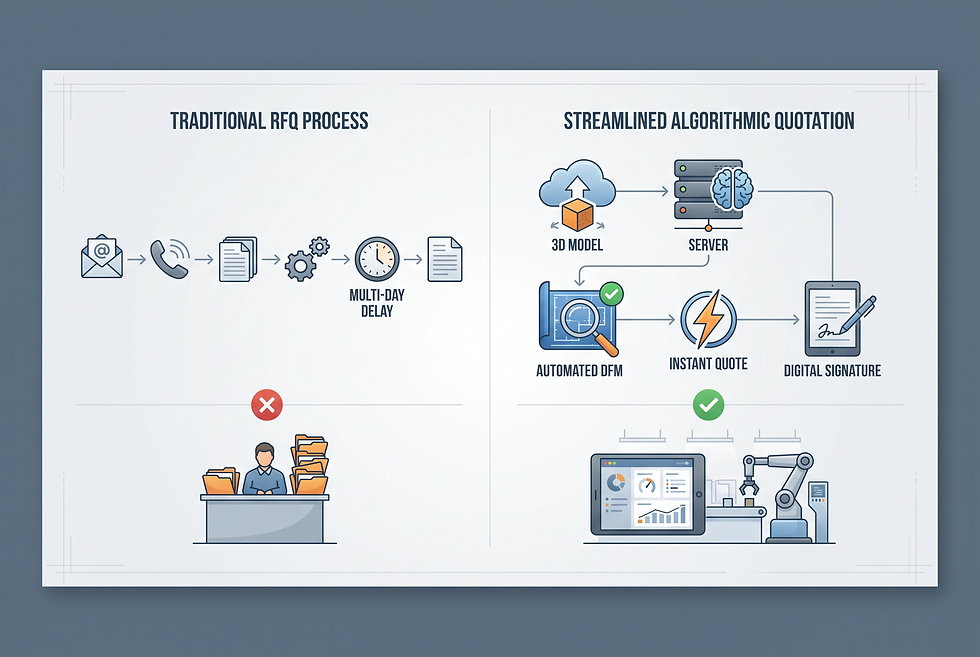
When a customer uploads a 3D CAD model, the software automatically parses the geometry. It evaluates parametric features against production constraints for CNC mills, lathes, 3D printers, or injection molding presses. Within minutes to a few hours, the platform generates an interactive quotation containing full pricing, volume break tiers, and detailed visual Design for Manufacturability (DFM) feedback.
Critical to this transformation is the distinction between mere automation and guided self-service. The system does not merely produce a static number; it visually highlights specific geometry on the user’s 3D model that presents manufacturing risks—such as thin walls, sharp internal corners, or sink marks—and suggests concrete design modifications before the order is placed.
How the Workflow Actually Works: The End-to-End Operating Engine
The Protolabs quoting engine operates through an integrated, seven-step loop combining algorithmic processing, selective human verification, and rapid manufacturing execution:
Data Intake and Ingestion: The prospect uploads a native 3D CAD file (e.g., STEP, IGES, SolidWorks) to the web portal, selecting desired material families, finish requirements, and target production quantities.
Algorithmic Geometry Parsing: The proprietary software analyzes the volumetric and topological data. It calculates machining time, raw stock bounding boxes, tool deflection risks, surface area finishing requirements, and cooling times for molds.
Automated DFM Generation: The system builds a 3D interactive heat map. Green zones indicate full compliance; yellow zones flag potential manufacturing anomalies; red zones denote non-machinable or non-moldable geometry.
Instant Dynamic Pricing Computation: Pricing algorithms determine production cost based on calculated machine run-time, material usage, tooling wear, and selected delivery schedules (ranging from same-day dispatch to standard turnaround).
Selective Human Engineering Review: If the geometric algorithm detects edge cases or non-standard tolerance requests, the digital system routes the ticket to internal application engineers for targeted review, ensuring complex edge cases receive manual validation.
Customer Action and Real-Time Iteration: The buyer views the interactive quote, adjusts quantities or lead times dynamically to evaluate price sensitivity, modifies CAD files if necessary based on DFM cues, and submits the purchase order digitally.
Automated Production File Generation: Once purchased, the system converts the validated CAD data into machine tool paths, work instructions, and procurement triggers without requiring manual CAM reprogramming.
Evidence and Results: Quantifiable Operational Gains
To objectively evaluate this operational model in our protolabs automated quoting case study, we examine published corporate reports, regulatory filings, and verified technical documentation.
According to Protolabs public annual reports and official company operational disclosures, the automated quote-to-production engine delivers measurable advantages across the enterprise:
Quote Generation Speed: Over 80% of standard CAD uploads receive comprehensive, interactive DFM feedback and firm pricing in less than an hour, with many simple parts priced in under 10 minutes.
Engineering Throughput: By automating standard design reviews, application engineers can support thousands of distinct customer parts per month, focusing exclusively on complex geometric consultation and high-volume accounts.
Customer Velocity: The company manufactures millions of custom parts annually for tens of thousands of unique product developers, maintaining multi-day delivery averages that traditional machine tooling workflows cannot match.
Financial Resilience: Protolabs has maintained strong gross margins historically characteristic of software and technology-enabled services rather than conventional contract machine shops.
Operational Dimension | Traditional Custom Machining Shop | Protolabs Automated Quoting Model |
RFQ Response Time | 2 to 7 Business Days | Under 1 Hour (Often Minutes) |
DFM Feedback Delivery | Manual redlines via PDF / Email | Interactive 3D visual analysis on web UI |
Engineering Quoting Cost | High (15-30% of engineering bandwidth) | Algorithmic / Minimal human touch |
Pricing Transparency | Single static price point | Multi-quantity dynamic curve with lead-time options |
Order-to-CAM Transition | Manual NC toolpath programming | Direct programmatic translation to machine code |
What Other Companies Can Learn: Core Business Principles
Industrial equipment manufacturers, specialized suppliers, and B2B engineering firms do not need to build custom computational geometry engines from scratch to apply the commercial lessons of this case study. B2B leaders can adopt three core strategic principles:
1. Shift Technical Validation from Post-Sale to Pre-Sale
Traditional organizations treat technical engineering as a cost center deployed only after a sales contract is secured. By democratizing engineering insights during the quoting stage, you remove buyer risk and build immediate technical trust before competitors have even opened the RFQ email.
2. Eliminate Dead-Time Latency in Commercial Communication
B2B buyers in industrial and technical sectors prioritize speed and clarity over high-pressure relationship selling. Compressing response latency from days to minutes dramatically boosts win rates because buyers typically progress down the path of least resistance.
3. Protect Skilled Human Engineers for High-Leverage Tasks
Senior application engineers should not spend their working days transcribing dimensions, calculating standard linear cutting feet, or formatting quote spreadsheets. Routine technical qualification and data normalization must be automated, freeing human experts to handle custom problem solving and enterprise account development.
What This Workflow Looks Like Across B2B Sectors
The principles of algorithmic intake, automated technical qualification, and structured sales handoffs apply across diverse industrial and technical verticals:
For Precision CNC and Sheet Metal Suppliers: An automated intake system validates incoming drawings, extracts CAD boundary dimensions, checks stock availability, and drafts complete quotation proposals before sales representatives conduct final pricing reviews.
For Industrial Robotics and Automation Integrators: Inbound requests detailing payload, reach, cycle time, and electrical requirements are automatically structured into preliminary application feasibility briefs before engineering discovery calls.
For Packaging and Water Treatment Equipment Manufacturers: Customer capacity inputs and facility constraint parameters are instantly cross-referenced against standard modular product matrices, generating custom engineering specification sheets automatically.
Operationalizing the Process: The AI Business Development Rep
For precision manufacturing suppliers, industrial equipment builders, and export-driven manufacturers seeking to replicate this responsive operating model, the first logical operational deployment is an AI Business Development Rep.
An AI Business Development Rep acts as an always-on technical intake coordinator across primary sales channels, executing the initial stages of qualification, technical data structuring, and quoting follow-up.
Core Job Responsibilities
Multichannel Technical Intake: Ingests inbound RFQ emails, web forms, and uploaded attachments (including drawings, RFQ sheets, and technical briefs).
Parameter Extraction & Normalization: Automatically extracts critical project specifications—including tolerances, material grades, surface finishes, annual usage volumes (EAU), and delivery dates.
Preliminary Feasibility Checks: Compares customer technical requirements against internal shop floor capabilities, machine envelope limits, and capacity rules.
Quote Pipeline Follow-Up: Proactively contacts prospects via email or WhatsApp following quote distribution, answering technical logistics questions and flagging revisions.
Authority Boundaries & Control Mechanisms
Authorized: Generates draft quotations within pre-approved pricing tables; requests missing drawings or CAD files from the customer; schedules engineering review meetings; updates CRM deal status.
Escalation Triggers: Unusually tight tolerances (e.g., aerospace sub-micron requirements), exotic materials outside standard stock, custom legal terms, or enterprise RFQs exceeding target dollar thresholds are automatically routed to the Head of Engineering or Commercial Director.
First Value Event and Reporting
First Value Milestone: The AI Business Development Rep receives an unformatted email RFQ with three technical drawings, extracts all dimensional parameters, verifies shop envelope feasibility, populates the ERP quote draft, and generates a ready-to-review quote proposal within 10 minutes of arrival.
Daily Executive Report Output: Delivers an end-of-day digest summarizing new RFQs received, technical qualification pass/fail rates, average customer response latency, active quote follow-ups completed, and stalled deals requiring executive intervention.
By systematically stripping friction from the technical quoting journey, industrial businesses transform their commercial pipeline from a manual choke point into a repeatable growth engine.
FAQ
What is the primary commercial benefit highlighted in this Protolabs automated quoting case study?
The core commercial benefit is the drastic reduction of RFQ latency from days to minutes. By automating CAD analysis and design for manufacturability (DFM) feedback, Protolabs captures buyer intent early, minimizes non-productive engineering hours on non-converting quotes, and secures higher conversion rates.
How does automated DFM feedback assist B2B manufacturing buyers?
Automated DFM feedback analyzes 3D CAD models instantly and visually highlights geometric risks such as thin walls, deep pockets, or inadequate draft angles. This allows engineers to modify designs immediately before manufacturing begins, preventing costly delays and production defects.
Can mid-sized custom manufacturers implement automated quoting without massive R&D budgets?
Yes. Mid-sized industrial suppliers can deploy specialized AI workers, such as an AI Business Development Rep, to automate RFQ data ingestion, technical parameter extraction, feasibility scoring, and quote follow-ups without building proprietary CAD engines from scratch.
What role do human engineers play when quoting workflows are automated?
Human application engineers shift from repetitive manual quote estimation to high-value technical consultation. They focus on complex geometric edge cases, high-value enterprise accounts, custom manufacturing problem-solving, and direct client engineering support.
Eliminate RFQ Friction in Your Manufacturing Pipeline
Deploy an AI Business Development Rep to extract technical RFQ parameters, qualify production feasibility, and follow up on quotes within minutes. Meet an AI Business Development Rep at https://www.ytt-ai.com/ to modernize your commercial sales operations.


Comments