
Best Quote Follow-Up Software for B2B Manufacturers: Recover Lost RFQs with AI

For global B2B manufacturers and exporters, the period immediately following the submission of a Request for Quote (RFQ) is where high-value deals go to die. Sales teams dedicate hours—sometimes days—to coordinating with engineering, validating technical specifications, and calculating margins. Yet, after the quote is sent, an eerie silence often settles in.
Research reveals that over 70% of B2B quotes receive no structured follow-up, leaving millions in potential revenue on the table. In global trade, where buyers navigate complex supply chains, wait times, and fluctuating costs, failing to engage post-quote is a fatal sales mistake. To solve this, leading industrial enterprises are turning to specialized software solutions.
Direct Answer: The best quote follow-up software for B2B manufacturers and exporters combines automated tracking with AI-driven, context-aware email sequencing that integrates directly with ERP and CRM systems. Key capabilities include automated technical specification validation, custom margin pricing rules, multi-channel (email/WhatsApp) follow-ups, and seamless human-in-the-loop handoff for high-value negotiations.
The Cost of Silence: Why Post-Quote Friction Stalls B2B Deals
In B2B purchasing, especially within industrial sectors like electrical distribution, machinery, and precision machining, buyers face immense pressure to secure reliable, cost-effective suppliers. Qualitative evidence from industry forums like Reddit highlights that procurement professionals frequently struggle with long wait times, incomplete technical specifications, and a total lack of transparency in budgeting.
When a seller sends over a quote and then fails to follow up, the buyer often interprets this silence as a lack of interest or poor operational capability. The friction that stalls these deals typically stems from three major pain points:
The "Black Box" of Custom Configurations: Buyers seeking specialized equipment, such as customized power distribution cabinets or complex mold designs, are often left in the dark about how their technical requirements affected the final price.
Long Internal Approvals: Large industrial purchases require multiple internal sign-offs on the buyer's side. Without consistent, helpful follow-up from the seller, the project loses momentum.
Resource-Constrained Sales Teams: Export sales managers are often too busy chasing new incoming inquiries to systematically follow up on the hundreds of quotes already sent out.

Using manual follow-up methods like spreadsheets or standard email templates fails to solve these issues. Modern operations require a dedicated system designed specifically for the complexities of industrial sales pipelines.
What Is Quote Follow-Up Software and How Does It Empower Exporters?
Dedicated quote follow-up software is not merely a tool for sending automated emails. For international exporters, it serves as an intelligent bridge between raw customer data and active deal progression. Unlike generic CRMs, these systems are deeply integrated with technical sales contexts.
By leveraging sales automation for manufacturers, global sales groups can monitor when a buyer opens a quote, which sections they spend the most time reviewing (such as delivery terms or warranty policies), and how frequently they share the document internally. This behavioral data provides sales teams with the perfect timing to trigger an outreach.
Furthermore, for exporters handling multilingual buyers across multiple time zones, these systems work around the clock. If a buyer in Europe opens a quote at 9:00 AM Central European Time, the system can instantly deploy a personalized follow-up in their local language, long before the sales team in Asia or North America has even started their workday.
Essential Capabilities: What Matters Most for Complex Manufacturing Quotes
When evaluating B2B quote management tools, generic solutions designed for SaaS or retail fall short. Industrial manufacturers operate under highly specific constraints. To ensure success, your selection should prioritize the following core capabilities:
Multi-Channel Communication (Email & WhatsApp)
B2B buyers do not live solely in their inboxes. In regions like Latin America, Europe, and Southeast Asia, WhatsApp is a primary channel for business communication. A robust system must support automated multi-channel sequences, sending formal technical documents via email while maintaining quick, conversational touchpoints on mobile messaging apps.
Integrated RFQ Automation Software
The follow-up process starts the moment the RFQ enters the system. High-performing software includes RFQ automation software features that parse technical drawings, extract bills of materials (BOM), and automatically cross-reference them with historical pricing structures to help sales teams generate and follow up on quotes in record time.
Contextual AI Sales Follow-Up
Generic automated templates look robotic and get ignored. Modern AI sales follow-up modules analyze the original buyer inquiry, the specific technical specs quoted, and any prior communication. They generate hyper-personalized follow-up sequences that read as if they were drafted by a senior technical engineer, significantly increasing reply rates.
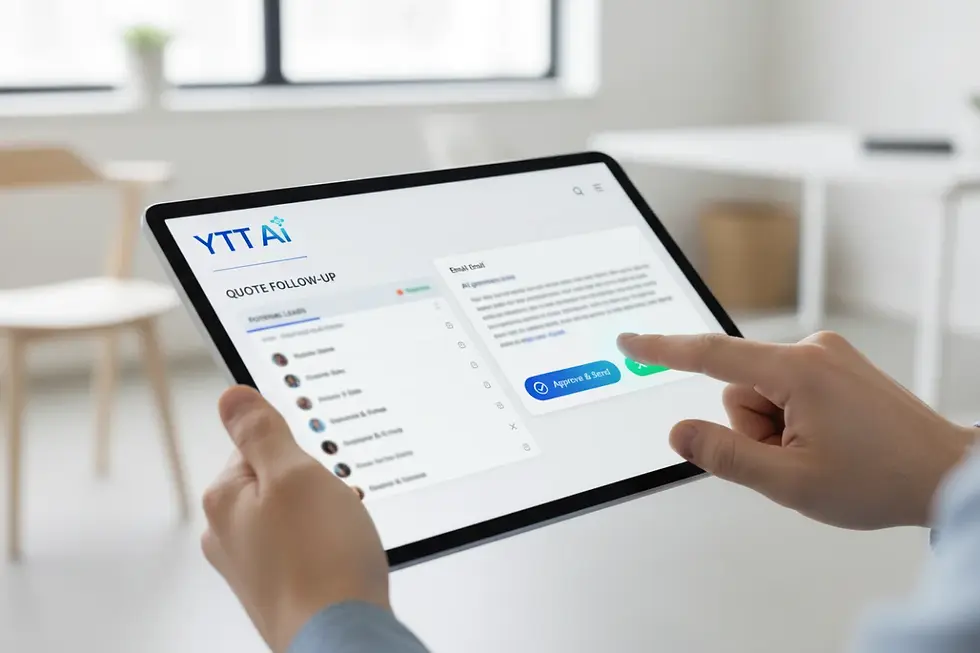
The AI-Human Hybrid: Designing Approval Workflows for High-Value RFQs
One of the most common fears among manufacturing executives is that fully automated workflows might accidentally send incorrect prices or inappropriate messages to strategic accounts. To prevent this, leading platforms implement a "Human-in-the-Loop" (HITL) model.
For standard catalog items or low-value spare parts, the quote follow-up software can operate on complete autopilot, moving the buyer through the pipeline automatically. However, for high-value capital equipment (such as power generation turbines or industrial boilers), the AI acts as an assistant rather than the sole driver.
In this hybrid model, the AI draft is queued for review inside the sales team's workspace. The system alerts the account manager: "AI has prepared a follow-up email for the 25kV switchgear quote sent 3 days ago. Click here to approve or modify." This combines the massive scale of automation with the precision, authority, and relationship-building skills of experienced human sales engineers.
Step-by-Step Guide to Deploying Quote Follow-Up Software
Implementing a new sales tool doesn't have to disrupt your current operations. By following a structured deployment roadmap, B2B manufacturers can begin recovering lost pipeline revenue in less than 30 days.
Connect Your Core Databases: Integrate the software with your existing ERP (to track inventory and raw material costs) and your CRM (to synchronize customer contact records).
Map the Buying Journey: Define the typical touchpoints for your quotes. For example, set up an automatic trigger for a follow-up 48 hours after a quote is sent, followed by a technical value-add document 5 days later if no response is received.
Train Your AI on Product Context: Upload your product catalogs, technical manuals, and historical successful quotes into the system. This builds a specialized "sales memory" that the AI uses to draft accurate, context-rich emails.
Define Human Approval Gates: Establish clear thresholds. For instance, any deal valued over $50,000 must require manual sales rep approval before any automated follow-up is dispatched.

Quote Recovery Scorecard: Core KPIs for Sales Operations
To ensure your investment delivers a clear return, sales operations leaders must track specific performance indicators. A successful deployment should directly improve the following metrics on your corporate dashboard:
KPI Metric | Definition / Purpose | Target Benchmark |
|---|---|---|
:--- | :--- | :--- |
First-Response Time | The speed at which a sales rep or system responds to an initial RFQ with a confirmed quote. | Under 4 hours |
Quote Open-to-Reply Rate | The percentage of buyers who actively reply to a follow-up sequence after opening a quote. | > 35% |
Dormant Lead Activation Rate | The ratio of silent, uncommunicative leads that are re-engaged and brought back into active negotiations. | 15% to 25% |
Quote-to-Order Conversion Rate | The ultimate metric: the percentage of sent quotes that successfully turn into signed purchase orders. | > 20% improvement |
By monitoring these metrics, manufacturing executives can pinpoint exactly where friction occurs in their sales funnel and continuously refine their AI-driven sequences to maximize revenue capture.
Frequently Asked Questions About Quote Follow-Up Automation
How does quote follow-up software differ from a standard CRM?
A standard CRM acts as a database for customer records, but it often relies on manual inputs from busy sales reps to log tasks and send emails. Quote follow-up software is actively proactive—it monitors document engagement, automatically executes personalized, multi-channel outreach sequences, and uses AI to write highly contextual, technical follow-up messages without adding manual admin work.
Can AI handle highly technical, customized industrial product quotes?
Yes, when configured correctly. Modern AI engines do not rely on generic public databases. Instead, they are trained on your company's specific technical documentation, brochures, historical quotes, and product rules. This ensures that any automated copy remains highly accurate and technically sound.
Is it safe to automate follow-ups for international export clients?
Absolutely. In fact, it is often more effective than manual outreach. The software can automatically detect the buyer's local time zone and language, ensuring that polite, professional, and grammatically perfect emails or WhatsApp messages arrive precisely when the buyer is active at their desk.
Drive Revenue from Every Quote with YTTAI
Stop letting valuable RFQs fade into silence. With YTTAI’s Sales Master, global manufacturers and exporters can seamlessly automate their entire follow-up process, ensuring no high-value opportunity is left behind. Our intelligent agent workflows keep your buyers engaged, clarify technical details, and hand off warm leads to your sales reps at the perfect moment. To find out how much hidden pipeline revenue you can unlock, Request a dormant lead recovery assessment today and partner with YTTAI to supercharge your global sales growth.
FAQ
How does quote follow-up software differ from a standard CRM?
A standard CRM acts as a database for customer records, but it often relies on manual inputs from busy sales reps to log tasks and send emails. Quote follow-up software is actively proactive—it monitors document engagement, automatically executes personalized, multi-channel outreach sequences, and uses AI to write highly contextual, technical follow-up messages without adding manual admin work.
Can AI handle highly technical, customized industrial product quotes?
Yes, when configured correctly. Modern AI engines do not rely on generic public databases. Instead, they are trained on your company's specific technical documentation, brochures, historical quotes, and product rules. This ensures that any automated copy remains highly accurate and technically sound.
Is it safe to automate follow-ups for international export clients?
Absolutely. In fact, it is often more effective than manual outreach. The software can automatically detect the buyer's local time zone and language, ensuring that polite, professional, and grammatically perfect emails or WhatsApp messages arrive precisely when the buyer is active at their desk.


Comments